
Category Archives: Science

It’s very difficult to tell what’s going on at the centre of our galaxy, what with interstellar dust blocking the view of conventional telescopes. In other bands of light however, such as radio, it’s a pretty lively place. To wit:

The featured picture shows the inaugural image of the MeerKAT array of 64 radio dishes just completed in South Africa. Spanning four times the angular size of the Moon (2 degrees), the image is impressively vast, deep, and detailed. Many known sources are shown in clear detail, including many with a prefix of Sgr, since the Galactic Center is in the direction of the constellation Sagittarius. In our Galaxy’s Center lies Sgr A, found here just to the right of the image center, which houses the Milky Way’s central supermassive black hole. Other sources in the image are not as well understood, including the Arc, just to the left of Sgr A, and numerous filamentary threads. Goals for MeerKAT include searching for radio emission from neutral hydrogen emitted in a much younger universe and brief but distant radio flashes.
(Image: MeerKATSARAO)

apod

Behold NGC 1566 – also known as ‘The Spanish Dancer Spiral Galaxy’. To wit:

An island universe containing billions of stars and situated about 40 million light-years away toward the constellation of the Dolphinfish (Dorado), NGC 1566 presents a gorgeous face-on view. Classified as a grand design spiral, NGC 1566’s shows two prominent and graceful spiral arms that are traced by bright blue star clusters and dark cosmic dust lanes. Numerous Hubble Space Telescope images of NGC 1566 have been taken to study star formationsupernovas, and the spiral’s unusually active centre. Some of these images, stored online in the Hubble Legacy Archive, were freely downloaded, combined, and digitally processed by an industrious amateur to create the featured image. NGC 1566’s flaring centre makes the spiral one of the closest and brightest Seyfert galaxies, likely housing a central supermassive black hole wreaking havoc on surrounding stars and gas.

Full sized image here.

(ImageNASAESAHubbleLeo Shatz)

apod

Alas, now getting shorter again.

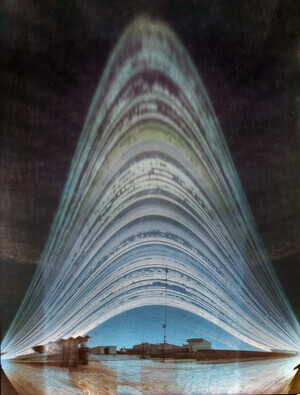
A composite image of the time between the Winter and (nearly) Summer Solstice (December 21, 2018 to June 16, 2019) all compressed into a single point of view. To wit:

 Dubbed a solargraph, the unconventional picture was recorded with a tall, tube-shaped pinhole camera using a piece of photographic paper. Fixed to a single spot at Casarano, Italy for the entire exposure, the simple camera continuously records the Sun’s daily path as a glowing trail burned into the photosensitive paper. Breaks and gaps in the trails are caused by cloud cover. At the end of the exposure, the paper was scanned to create the digital image. Of course, starting in December the Sun trails peak lower in the sky, near the northern hemisphere’s winter solstice. The trails climb higheras the days grow longer and the June 21st summer solstice approaches.

(Image: Gianluca Belgrado)

apod

Behold M83 (no, not the French electronica project): a beautiful spiral galaxy, 12 million lights years away on the southeastern tip of the constellation of Hydra (no, not the Marvel Universe terrorist organisation). In fact, Messier 83 –  its full title – has many names. To wit:

Prominent spiral arms traced by dark dust lanes and blue star clusters lend this galaxy its popular name, The Southern Pinwheel. But reddish star forming regions that dot the sweeping arms highlighted in this sparkling colour composite also suggest another nickname, The Thousand-Ruby Galaxy. About 40,000 light-years across, M83 is a member of a group of galaxies that includes active galaxy Centaurus A. In fact, the core of M83 itself is bright at x-ray energies, showing a high concentration of neutron stars and black holes left from an intense burst of star formation. This sharp composite colour image also features spiky foreground Milky Way stars and distant background galaxies. The image data was taken from the Subaru Telescope, the European Southern Observatory’s Wide Field Imager camera, and the Hubble Legacy Archive.

(Image: Subaru Telescope (NAOJ), Hubble Space TelescopeEuropean Southern Observatory, Robert Gendler)

apod

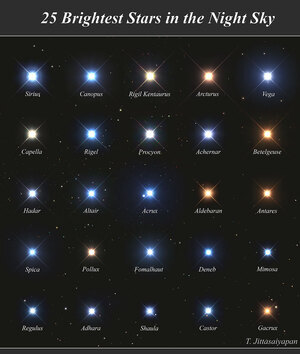
You’ve seen ‘em. Now you can name ‘em. To wit:

Many world cultures have their own names for thebrightest stars, and it is culturally and historically important to remember them. In the interest of clear global communication, however, the International Astronomical Union (IAU) has begun to designate standardized star names. Featured above in true color are the 25 brightest stars in the night sky, currently as seen by humans, coupled with their IAU-recognized names. Some star names have interesting meanings, including Sirius (“the scorcher” in Latin), Vega (“falling” in Arabic), and Antares (“rival to Mars” in Greek). It’s also likely that other of these bright star names are not familiar to you, even though familiar Polaris is too dim to make this list.

(ImageTragoolchitr Jittasaiyapan)

apod

A close-up of the weathered craters of Acidalia Planitia taken by the Mars Reconnaissance Orbiter’s HiRISE camera. But wait, isn’t that a key location in the Andy Weir (and Ridley Scott) yarn ‘The Martian’? Why, yes, it is. To wit:

The novel chronicles the adventures of Mark Watney, an astronaut stranded at the fictional Mars mission Ares 3 landing site corresponding to the coordinates of this cropped HiRISE frame. For scale Watney’s 6-meter-diametre habitat at the site would be about 1/10th the diameter of the large crater. Of course, the Ares 3 landing coordinates are only about 800 kilometers north of the (real life) Carl Sagan Memorial Station, the 1997 Pathfinder landing site.

(Image: HiRISEMROLPL (U. Arizona)NASA)

apod

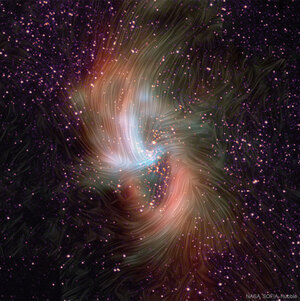
An image of the magnetic field at the centre of the Milky Way taken using a specialised HAWC+ camera by NASA’s 747 mounted observatory SOFIA. To wit:

HAWC+ maps magnetism by observing polarized infrared light emitted by elongated dust grains rotating in alignment with the local magnetic field.

Now at our Milky Way’s center is a supermassive black hole with a hobby of absorbing gas from stars it has recently destroyed. Our galaxy’s black hole, though, is relatively quiet compared to the absorption rate of the central black holes in active galaxies.

The featured image gives a clue as to why — a surrounding magnetic field may either channel gas into the black hole — which lights up its exterior, or forces gas into an accretion-disk holding pattern, causing it to be less active — at least temporarily.

Inspection of the featured image — appearing perhaps like a surreal mashup of impasto art and gravitational astrophysics — brings out this telling clue by detailing the magnetic field in and around a dusty ring surrounding Sagittarius A*, the black hole in our Milky Way’s center.

(Image: NASASOFIAHubble)

apod

Breathing, walking, being interested in things, experiencing fear: all unconscious and automatic things, and therefore – strictly speaking – not you, sez exurb1a. To wit:

Consciousness is a bit like poop. It’s a mysterious internal process, and if you talk about it at parties you’ll stop getting invited to parties.

Fair enough.

Previously: You Will Never Do Anything Remarkable (Probably)