





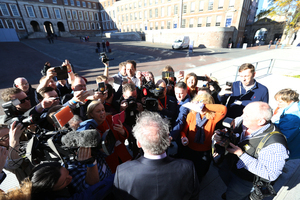
From top: President Michael D Higgins speaks on his re-election victory on Saturday at Dublin Castle in front of Taoiseach Leo Varadkar (right) and Presidential candidate, Peter Casey (far left); Bryan Wall
Across Europe the rise of movements of the Right has been especially noticeable in recent years. What binds them together, in spite of the geographic distances between them, is a worldview based on a number of recurrent themes.
Distress at the apparent loss of national identity, anguish for the loss of religious belief and institutions, fear or dislike of modernity and the resulting atomisation of society due to the prevalence of technology and neo-liberalism, and an overriding contempt for what they view as a form of coddling liberalism which pervades the industrialised world.
For those on the Far Right, this list of grievances is not sacrosanct but it is nonetheless a basis upon which their actions rest.
Economic conditions for the last decade have proven to be fertile ground for the rise of movements which give a voice to people with these beliefs. Their rise in the polls should come as no surprise yet, like the election victory of Donald Trump, it often does.
How do we explain this surprise?
Firstly, the source of much of the surprise comes from the mainstream media. Content to ignore the proliferation of right-wing movements, the Left often comes in for much vilification and degradation on the part of pundits in the media.
Reading any of the most popular British publications for the last two years would leave one with the impression that Jeremy Corbyn is the next Adolf Hitler and Karl Marx rolled into one. Such an obvious contradiction is not enough to deter his most vociferous enemies in the press.
All the while the rate of hate crimes has risen. Insinuating that Jeremy Corbyn and actual anti-Semites are cut from the same cloth undermines the whole notion of social justice, does damage to legitimate movements of the Left, and only emboldens those on the Right who relish in the muddied waters of confused ideologies.
This latter aspect allows them to brand themselves as “alt-right”; an alternative to, and sometimes ironic undermining, of mainstream institutions such as political offices and the media itself. A label like this allows them to market themselves as an “alternative” to the mainstream, as opposed to using the more appropriate term of fascist.
Others, such as the Alternative für Deutschland (AfD) have no such concerns when it comes to their marketing policies.
Most recently, for example, they called on students in German schools to report their teachers for political bias using an online tool that the AfD designed. The bias in question would be “bias against our party”, according to an AfD spokesperson.
Since their creation, the AfD have campaigned on the basis of fighting against immigration, the supposed Islamisation of Germany, alongside restoring German cultural values, amongst other things. Given their policies one would hope that they would not be successful.
But they are just that. In the federal elections in 2017 they won 97 seats which in turn made them the third largest party in the German parliament.
What explains the success of the AfD, and others like them, is they have tapped in to the concerns of many people who feel they have been ignored by the mainstream. It is also explained by the support of people who feel alienated from the Left, or at least what passes as the Left in some quarters.
These concerns, enumerated above, are not always based on the idea of a form of racial supremacy or an authoritarian takeover of society. On occasion, as is the case here, some of their concerns warrant attention if we take them at face value.
Alienation from the Left and social justice movements more generally, is one element in particular on which we should focus our attention. I
n the American case, not every single person who voted for Donald Trump is a racist, gun-toting, misogynist. In the German case, the same applies.
What has made movements of the Right more prolific in recent years has been the previous ten years of economic austerity and hardship in Europe. In America, these hardships have lasted for decades.
And a movement of the Left more concerned with gender-neutral bathrooms and racial diversity in a corrupt political system than with economic realities, lived in and experienced daily by millions, has been a blind spot used by the Right to its advantage.
Social justice without economic justice is meaningless and this has been noticed by the Right who promise both.
Anger at mainstream politics and politicians has been utilised by elements of the Right at the expense of the Left. In Ireland it has often been noted that a Far Right movement has never taken off. There are no easy explanations for why this is the case.
One possible reason has been the dominance of parties of the Right and Centre-Right in Ireland for most of its history which have offered a pressure valve release of sorts. In this sense, a movement of the Far Right has been forestalled given the traditional social conservatism of the two major political parties here.
Nonetheless, there is a sizeable contingent of the population who are apparently unhappy with the current state of Irish society who are finding an outlet in elements of the Right that are not associated with mainstream politics.
When Sam Harris, Douglas Murray, and Jordan Peterson gave a lecture in Dublin in July of this year, they spoke in front of a crowd of thousands.
Mr Harris is a well-known defender of U.S. foreign policy and is a staunch defender of Israel. He is also known for his defence of racial profiling along with his general writings on Islam and the supposed threat it poses to the West.
Mr Murray is a neoconservative and criticises Islam along the same lines as Harris, arguing that Islam poses a threat to Europe in particular and therefore immigration must be stopped.
Mr Peterson, for his part, is beholden to the idea that a postmodern Marxist ideology has infiltrated universities and politics. From here it undermines all that was good about society in the past where it also insists that truth no longer matters.
All three speak the language of the Far Right; lamenting the destruction of aspects of modern society they consider important, a dislike of modern politics and culture, a wish to return to the golden days of the past, the Marxist infiltration of our institutions.
At one stage Peterson had planned to launch a website which listed university departments and courses which were “indoctrinated” by postmodern Marxist views. The plan was eventually scrapped — for reasons other than Peterson’s complete misunderstanding of both Marxism and postmodernism — but it bears a striking similarity to the AfD’s current initiative.
The appearance of these three men here and the fact that it was so well attended should be a wake-up call for many of us.
Despite the liberal facade that now covers the country, there is a sizeable portion of people who are unhappy with the current functioning and structure of society. Spokespeople for the Right are capitalising on this.
What will follow not long afterwards is a political movement of the Right that likewise capitalises on the real discontent that is felt and experienced and utilises the same inroads made by the Petersons of the world. Peter Casey’s result in our own presidential elections over the weekend is a symptom of this.
Yes, his comments about Travellers were contemptible and some of the many people who voted for him likely did so because of these comments.
But many are just as likely to have voted for him given the lack of coherent candidates, the clear bias shown against Gemma O’Doherty in her attempts to gain a nomination for the elections, and the very real and serious questions that were raised, and still need to be answered, surrounding the expenses of the incumbent Michael D. Higgins while in office.
Many on the Left in Ireland were in lockstep with Fianna Fáil and Fine Gael in their support for Higgins and his re-election. An alignment such as this should have given them pause for thought.
And now that Casey has placed second in the election, their own lack of comprehension of how this was possible is demonstrable of an even more serious problem.
They simply do not understand why people are unhappy, angry, and how the Left’s lack of self-awareness feeds into this.
Support for Higgins by Leftist parties and the hypocrisy this entails should be self-evident. It is apparently not. People voting for Casey as a result of this is currently too much for them to decipher.
This result, then, should be a warning that unless moral consistency is shown alongside an understanding of why people are deeply unhappy with modern society, the Right will continue to win at the expense of equality, justice and those on the Left who dedicate themselves to the pursuit of both.
What we will end up with if this continues is an Irish version of the AfD. With no coherent or consistent response to them or their supporters, their victory is assured and the Left will continue to fail to understand some very basic truths through either incompetence or unwillingness.
Bryan Wall is an independent journalist based in Cork. His column appears here every Monday. Read more of his work here

















 </a