Members of the Citizens Assembly vote on the Eighth Amendment in April

Yesterday.

In The Times Ireland edition.

Ellen Coyne wrote about how a woman, referred to as Niamh, wanted an abortion in Ireland 16 years ago but was warned by a counsellor she might go to jail if she did so.

She was told this by a counsellor working for Life pregnancy counselling service in Cork city.

Ms Coyne explained how Life changed its name to Anew in 2015 and how it receives annual funding from the HSE.

From Ms Coyne’s report:

“I sat down and [the counsellor] said, ‘well you do know now, your baby has a heartbeat’. And, ‘you can’t even think about an abortion, that would be murder’. And she said, ‘I understand you’ve talked to loads of people, and one of those people now could go to the gardaí and tell them that you’ve had an abortion. And if they find out, you’ll spend years in prison’,” Niamh said.

She was so scared of being arrested and not being able to get a job that she continued the pregnancy. “I was forced into it. It was horrible.”

Life changed its name to Anew in 2015. Like Cura, it receives annual funding from the HSE crisis pregnancy programme. Niamh said that there was Southern Health Board literature on the tables and walls. Both Anew and Cura are anti-abortion, but do not clearly advertise their ethos. Cura also receives funding from the Catholic Church.

“I remember going to them and thinking they were funded by the HSE so they must be legit,” Niamh said. “Now I can see it clearly, I am so, so angry about it.”

…Niamh’s story was featured as part of the citizens’ assembly review of abortion laws this year. She said she was conscious that there were anti-abortion extremists who argue that if the counsellor had not deceived her, she would not have her eldest son.

“But I’m lucky, because I love my son,” she said. “There are other women out there that do not love their children. Some women look at a child that they didn’t want, and that’s not OK.

“And it’s also not OK for a child to grow up in a relationship where they are not wanted. That harms society. It’s just about indentured servitude at the end of the day, creating this class system of vulnerable people having children early.”

…Niamh’s son is 16 years old and understands what happened to his mother when she was pregnant with him. “He has said that he understands my decisions. He also feels very angry. It makes him panic thinking that that could happen to him and his girlfriend or friend even now,” she said. “And I am very angry. Nothing has changed. It’s the same shit over and over again.”

Crisis pregnancy counsellor told Irish student abortion would lead to years in jail (The Times Ireland edition, Ellen Coyne)

Rollingnews

History is being forgotten.

David Wall writes:

As the Irish education system is revamped and modernised an issue that slipped below the radar was the relegation of History to being an option subject.

Students will no longer have to learn about The Age of Exploration (slavery and empire) The Reformation (religious intolerance) Victorian child labour (the creation of workers’ rights) or World War II (the dangers of a democratically elected demagogue who builds a platform built on intolerance and hate…)

At junior cert we learn about Celts right up to modern-day Europe and Ireland. We are given a grounding, thin as it may be, in how the world has become what it is. We develop a sense of self and begin to question why things are as they are.

The junior cert might not allow for depth of study but it grants us with an understanding of who and what we are. It provides us with opportunities to question and challenge the structures of the world, it allows us to form our own identity and it provides the capacity to realise that marching under the swastika possibly isn’t the best way to present an argument.

Students are armed with the skills of considering fact vs fiction. They focus what propaganda is and how to question sources. They are introduced to the skills necessary to combat lies and hate and develop the capacity to think for themselves.

They no longer have to do this.

The protests and counter-protests in America have served to scratch at the thin skin of social inclusivity within America. If the images from recent weeks of young white men with neatly parted hair illuminated by flaming torches were in black and white we could have safely assumed they were of rallies and marches in 1930s Germany.

They weren’t. This is America; Land of the Brave and Home of the Free, 2017.The anger and hate contorting the faces of these young men beneath the swastika encapsulates a damaged society. That the violence and hate is so closely linked to events in living memory is frightening.

A rudimentary Junior Cert education tells us what dangers to expect.

A combination of historical amnesia, willful ignorance and blatant hate has bloomed within American society in recent weeks. This is not an earth-shattering revelation, accepted, but it is a moment of truth.

The speed with which history repeats itself is terrifying. We are teetering on an abyss as the ground fragments beneath our scrabbling feet. Whether this is overly dramatic or not, the sentiment is clear: the study and understanding of our history is not an option.

David Wall is a freelance writer

Pic: Amazon


Is RTE New delhi website design platforms alarge enough to offer you the knowledge and expertise we’ve gained servicing the Corporate and website design australia Government sectors, yet small enough to care. .

Conor McGregor (left) and Floyd Mayweather

Some reckon McGregor’s next fight
Will be this year’s unique sporting sight
But the pubs down in Oz
Won’t show it because
Drunken Irish may ruin the night.

John Moynes

Pics: PA

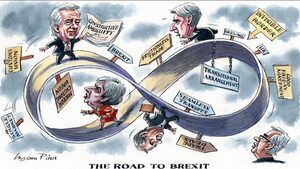
From top: Ingram Pitt’s Brexit view in the Financial Times: Derek Mooney


According to its Brexit position papers issued last week, the British Government is absolutely determined to avoid a hard Brexit and is hell bent on making sure that there will be no changes to how the border between the two parts of this island operates.

If only it were true.

It isn’t. As many others have already pointed out, you have barely to scratch the surface of the British government’s argument to quickly realise that its glistening yet imprecise language masks a dark and base core.

Last week’s papers were not about the massive machinery of the British government and civil service setting out its key positions on crucial realities arising from Brexit, but rather they were a crude and infantile political attempt to prepare a platform from where current British Ministers can accuse the EU27 of imposing borders and costs when the inevitable hard Brexit happens.

The former Tory Chancellor, George Osbourne called it right a few months back in a tweet when he predicted that the EU/UK Article 50 negotiations will end in failure in 2019 and that the UK will crash out of the EU with no deal and end up a transitional arrangement that resembles Norway’s.

The UK position papers were not about negotiations or ambitions. They were, almost literally, about positioning.

They were about the current crop of UK Tory Ministers positioning themselves for a hard Brexit – a hard Brexit that will impose a hard border across this island – and then being able to wring their hands afterwards, claiming that this wasn’t what they wanted, and that it is all the fault of the faceless, unelected, bloated bureaucrats in Brussels, aided and abetted by ungrateful Irish politicians

They know that the negotiations are on a collision course. The best deal for Britain is not the best deal for the Tory party. And so, the Tory party’s interests are about to trump the countries, helped along by the fact that the British Labour party is even more paralysed by its divisions on Europe than the Tories.

That is why the UK position papers on the Customs Union and Northern Ireland contradict each other.

It is why they want to confuse and upset the Article 50 negotiations timeline by dragging decisions on Northern Ireland out from the first phase of talks and dragging it into the customs and trade talks, thereby frustrating both.

There was nothing to welcome in last week’s position papers and diplomatic niceties should not prevent us from saying his openly and candidly.

Brexit in any shape or form will cost us, but a hard Brexit will hurt us economically and potentially cause political turmoil by undermining much of the progress made since the Good Friday Agreement; with its dismantling of the border structures and military architecture.

It took decades for us to convince the British that there were no security or military solutions to the political problems associated with partition.

It was a slow and painstaking process that involved the building up of strong personal relationships, most notably between Albert Reynolds and John Major and followed by Bertie Ahern and Tony Blair.

Now Mrs May, and her ministers, are set to turn back the clock for Northern Ireland and this entire island, and all for reasons of Tory party unity.

This time around instead of talking about security solutions they talk about technological solutions – solutions to a problem that had all but disappeared but which their blind intransigence is determined to make reappear.

As I have said here for well over a year: Brexit changes everything on this island – and I do mean everything, not just economics.

Up to now, most of the Irish political talk has been on mitigating the economic damage and cost of Brexit and seeking the opportunities it offers – all that has been fine, if not a little understated at times, but the impact of Brexit goes beyond the economic.

The relationships between these two islands and between the two parts of this island are also about to change: economically, socially and politically… especially politically.

The hard Brexit that Gove, Johnson, Fox, Davis and Hammond are forging is about to make all-island approaches here the only viable ones.

The Brexit vote in the North has changed everything. Despite the consent principles contained within the Good Friday Agreement, the constitutional position of the people of the North, in this case as fully represented EU citizens, is about to change contrary to how a majority voted.

As the SDLP leader Colum Eastwood stated almost exactly one year ago:

“Northern nationalists are once more a restless people. The constitutional accommodation which we voted for by referendum in 1998 has been violated, not by a vote of the people of Northern Ireland, but rather by a vote of others in the UK 18 years later.

The blanket of that constitutional comfort has been abruptly removed. In particular, undermining our connection with the South achieved via common EU membership is not something which can be tolerated.”

It is regrettable that Irish politicians down here – of all hues – have not focussed sufficiently on this theme over the past year. While their attention to some of the finer detail is commendable, that cannot be allowed to come at the price of missing this bigger issue.

Derek Mooney is a communications and public affairs consultant. He previously served as a Ministerial Adviser to the Fianna Fáil-led government 2004 – 2010. Follow Derek on Twitter: @dsmooney

Illustration: Ingram Pitt (FT)

Broadsheet.ie