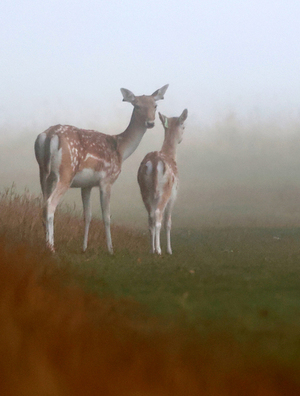
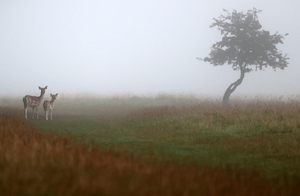
Oh.
This afternoon.
Sundrive Road, Kimmage, Dublin 12.
Langeroo, to you.
FIGHT!
Pics by KN



Oh.
This afternoon.
Sundrive Road, Kimmage, Dublin 12.
Langeroo, to you.
FIGHT!
Pics by KN

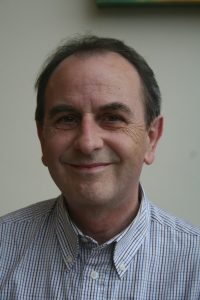
From top: Former Taoiseach John Bruton; Eamonn Kelly
The week that was
Just when Fine Gael had cleared the no-confidence vote in Simon Coveney, John Bruton, demonstrating how long a week can be in politics, burst from retirement to pick a fight with President Higgins.
It all came down to a word, as so many things often do. The word in this case was “partition”, used in such a way as to suggest that its inclusion in the invitation sent to the president of a republic opposed from day one to partition, wasn’t entirely innocent.
Later, after the President’s response to that word and to his being misaddressed by the DUP leader, Jeffrey Donaldson, and after social media let loose with its own words like “snub” and “boycott”, and after John Bruton hauled the hefty “unconstitutional” to the party, realising too late that it was the wrong word, with constitutional experts popping up to correct him; and after an Irish Times columnist took the President to task for failing to practice patience on the road to peace, and after the President assured everyone there was no snub intended to the Queen, no boycott intended, no insult intended towards the churches organising the event; after all this it emerged that the President was simply annoyed with the DUP.
He was annoyed at the inclusion of the word “partition” in the official title of the event. And he was annoyed at Jeffery Donaldson for affecting to “forget” his official title, President of Ireland.
Those who said the President should attend the event were coming from a place of “diplomacy”, another word. Diplomacy is when you resolve to meet the other side halfway.
But sitting dangerously next to “diplomacy” is the word “appeasement”.
Elastic Diplomacy
Appeasement arises when the other side, to test the elasticity of your diplomacy, steal a little bit more than what was agreed upon. If the bit extra is ignored, for the sake of diplomacy, you enter the hazardous would of appeasement, which is the political equivalent of interpersonal bullying.
The problem with appeasement is deciding where to draw the line. Before you sell out Czechoslovakia, or after?
The President mulled over the poorly worded invitation and its accompanying forgetfulness concerning his official title, for close on six months, no doubt aware of the diplomatic implications of declining the invitation, before finally deciding it was time to draw a line.
As President Higgins noted, the actual border, strictly speaking, didn’t come into effect until 1925, whereas the commemoration was concerned with the centenary of the establishment of the Northern State in 1921. Whoever had decided to include the word “partition” in the official title of the event had apparently reached a bit, as they say.
Though a spokesperson for one of the churches involved in organizing the event claimed that the inclusion of the word “partition” in the title of the event was intended to appeal to nationalists, to ensure that the event would have something in it for all persuasions.
Yes, it must be clear to everyone by now that nationalists just love that word. Like honey to bears.
Practical Joke
The President’s later remarks suggest that he regarded the inclusion of the word “partition” as a deliberate political choice, a kind of word trap. But President Higgins is the wrong person to be attempting to trap with a cleverly placed and politically motivated word trap. Language is his specialty.
If he had attended, for the sake of diplomacy, as suggested by John Bruton and others, his attendance would have had the effect of compromising the integrity of the presidential office and would have set off more emotive words elsewhere.
The inclusion of that one emotive word in the official title of the event may even have been a kind of prank, a practical joke of sorts. One that betrayed not only a disrespect for the President of Ireland, but also a disrespect for the learning and intelligence of Michael D. Higgins.
The irony of this is that this cheap shot has had the effect really of undermining the dignity of the commemoration of the founding of the Northern Irish State, by using that commemoration as an excuse to deliver a not very subtle dig at Southern institutions.
Back to Reality
In the same paper where Jennifer O’Connell was happily scolding the President for his diplomatic “failure”, Fintan O’Toole wrote an interesting article on our relationship with the questions pertaining to a united Ireland and the use of the Irish language, wondering were these aspirations just a form of “virtue signalling”.
While a majority of people are in favour of the Irish language, hardly anyone bothers to speak it. O’Toole then wonders might the same apply to the idea of a United Ireland? A situation where a majority are in favour, in theory, but who may find the reality not much to their liking.
His conclusion is that we haven’t had an honest discussion among ourselves about the North, and that a majority of people seem to have sentimental attachments to what are essentially abstract romantic notions of a united Ireland, without really examining the reality.
For instance, once you introduce the idea of taxes to fund such an entity, to keep the North in the style to which it’s accustomed under empire, (you might have to buy them a nuclear submarine), not to mention the possibility of an FFG DUP coalition government, and a giant bonfire in your backyard every 12th of July, with an effigy of yourself on top, the actuality of a united Ireland immediately looks a little less attractive.
Eamonn Kelly is a Galway-based freelance Writer and Playwright. His weekly round-up appears here every Monday.
Previously: Eamonn Kelly on Broadsheet
Earlier: Derek Mooney; Three More Reasons Why The President Is Right

 1
1


Saturday.
Dublin city centre
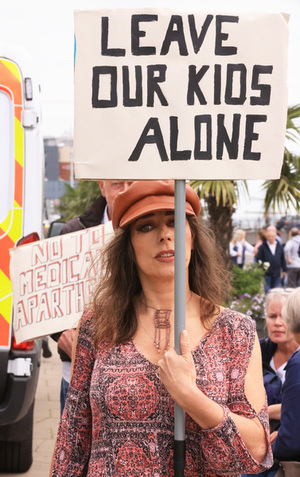
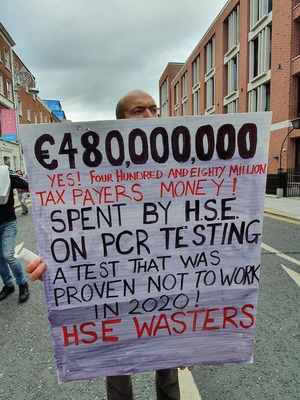
Scenes from the Dublin World Freedom Day Rally against covid measures. Protesters marched from the Custom House to the GPO, visiting the Grand Lodge of Ireland Freemasons’ Hall (pic 5) in Molesworth Street and O’Connell Bridge, along the way.
Eamonn Farrell/RollingNews and KN
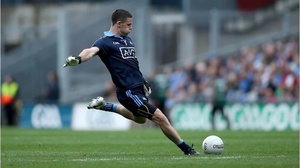
Dublin GAA football goalkeeper and captain Stephen Cluxton
This morning.
Shay Connolly writes:
It’s 10 years today since Stephen Cluxton nailed that score. Who would have thought what was to come? A Decade of Ring a Ring a Rosies! Certainly not I. Sixteen years waiting for it, there were times I was sure that I’d never see another one before I headed for the Planet’s departure lounge.
My son asked me, as an innocent 12 year old, tears streaming down his face after we were beaten in the replay to Kerry in 2001, if he ever would see Dublin win an All Ireland (he had no real memory of the 1995 win). Ah of course you will, I said consoling him, the same way you would tell your children about Santa Claus.
My other kids were on the list for Prozac at the time also, such was the depression that overhung our household that day. At least myself and Caroline had seen Santa Clause come down the chimney on a good few occasions but you desperately wanted your kids to share those same type of emotions.
It would be 10 long years before Cluxton’s point sailed into the blue Dublin skies to bring back that emotion as utter unadulterated delirium wrapped itself around the people of Dublin. Once the drought was over, glorious salt tasting rainfall poured and poured on to our cobbled streets to heal our previous wounds. And we drank and swallowed gaily from its overflow.
As a City, with all its problems, its divisiveness, its different classes, its hussle and bustle of separation, we now gelled into one mass identity band. As success followed success it was us and them now as the country threw spears and arrows from all directions in an attempt to penetrate our gallant band. Some of the most intelligent people in the Country suggested lunar type solutions to strengthen their assault but no matter how hard they puffed and puffed they just could not blow our Dublin House down.
Our band carried themselves around the country like Paragons of Society, displaying all the humility of our ancient Celtic Warriors of old as we stepped out of the Celtic Tiger era and all its greed.
No matter how bad life was going we always had our Dubs to fall back on. A time to bury all the stresses into the waste bin of our brains and bask in the glorious football in front of our eyes. And when the battle was over we drank ourselves merry in song and dance, all the time enflaming the true ethos of our ancient Irish culture. Business people all over the country vied for our wallets and Kerry nearly had another Civil War when Tralee and Killarney gnawed at each other for our pockets.
Other counties laid out the blue carpet for us and as soon as our pockets were emptied reverted to type in disliking us again. However not all did so and cross county relations were forged through all the spears and arrows with the Tyrone Brigade standing out from the rest.
The final curtain came down four weeks ago. The cast looked somewhat tired and forlorn. We know not what the future does hold. What we do know is that it was an unforgettable journey, where the most romantic of novelists would find it hard to write the script.
Children who witnessed it will go on to tell their children and the journey wil be retold in pubs and clubs over and over again for many years to come. For this capital city, a city whose streets and laneways can tell of its many historical scenes, its tragedies and melancholies, its bravery and glory, the reign of this glorious Dublin Football team will now be added to its long and winding saga of memories.
Take a bow, brave sons of Baile Atha Cliath.. We may never see your likes again.
Shay Connolly is a writer/songwriter, a Ringsend resident and a former Dublin Minor Hurler.
Pic: RTÉ

‘Áille ar Airgead’ on TG4.
A documentary following the lives of two women; one born in Ireland, who became the face of America’s ten-dollar gold coin and the other, born in the USA, graced the first banknote of a newly independent Ireland.
Deirdre Ní Choistín writes:
Lady Lavery (top) was born in Chicago of wealthy Irish parentage. Her maiden name was Hazel Martin. She was chosen by her husband, Irish artist John Lavery, to be the face of ‘Caitlín Ní Uallacháin’ representing Ireland when he was commissioned to design the new punt banknotes for the Irish Free State.
Mary Cunningham was Irish, she had emigrated to America from An Charraig in the Donegal Gaeltacht. She was selected by the famous sculptor Augustus Saint Gaudens to become the face of ‘Liberty’ dressed in Native American headgear on the most controversial gold coin ever minted in America. Augustus Saint Gaudens was also Irish, he was born in Dublin in 1848, the son of a French shoemaker, Bernard Paul Ernest Saint-Gaudens, and Mary McGuinness, from Co. Longford. They emigrated to America when he was six months old.
Áille ar Airgead on TG4 on Wednesday, September 29 at 9.30pm.
This morning.
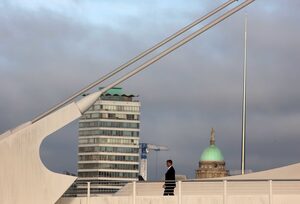
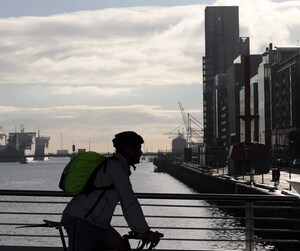
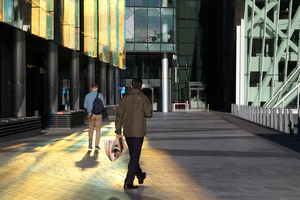
Dublin city centre as offices are allowed to reopen after Covid 19 restrictions.
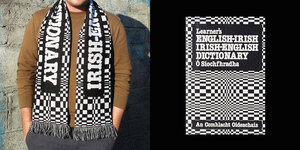
Designer Richard Collier writes:
I’ve designed a scarf, The Dictionary Scarf inspired by the Learner’s English-Irish Dictionary, first published in 1958, it’s equal parts Irish nostalgia and anxiety-inducing cold sweats.
The scarf is now available for pre-order via my website (below). Zero hours of painful translations are necessary. Pre-order ends on October 4.
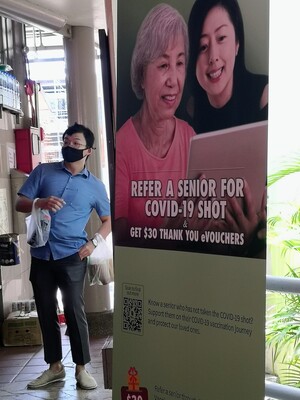
Um.
Singapore.
Good times.
Thanks Jody O’Dea




 </a
</a