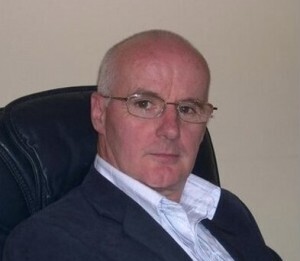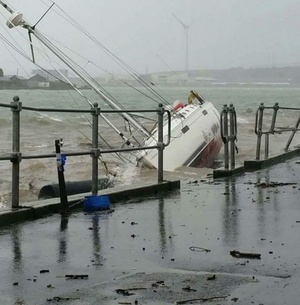

From top: Flooding at Cobh harbour, county Cork; Anthony Sheridan
RTÉ presenter Kathryn Thomas, sitting in for Ray D’Arcy on RTÉ Radio One, was bubbling with optimism as she introduced author Oisin McGann to talk about his new book – A Short, Hopeful Guide to Climate Change.
While documentaries on climate change are great they can, at times, be a bit overwhelming Thomas told listeners, so she was delighted with the publication of a book with the word ‘hopeful’ in it.
The author, who wrote the book on request from Little Island Books and Friends of the Earth, was equally optimistic about the future, saying:
“People have been working on this [saving the environment] for a very long time, the progress that built our civilisation is still going and it’s taking us away from fossil fuels.”
Thomas enthusiastically agreed:
“Greta Thunberg. and all the rallies that have been happening around the world are great but it’s sometimes forgotten that a lot of the environmental work has been done as far back as the 80s.”
McGann added:
“This is the first time as a species we’ve decided to take on something that is a planet wide problem and do something about it. Things are happening, Shell lost a big court case, Bord Na Mona have stopped mining peat.”
Yes, Thomas agreed and Ireland has passed its first climate bill.
I shouldn’t have, but, I couldn’t help laughing out loud at this example of hope for the future.
Thomas concluded the interview on an optimistic note:
“There’s lots to be hopeful about and as David Attenborough said, we have a decade to change and while that doesn’t sound like a long time, there is momentum and we’ve got to be hopeful.”
I really, really despair when I listen to such discussions. Neither McGann nor Thomas are aware that it is they who pose the greatest danger because they promote hope as a solution when fear is the only emotion that gives humans any chance of survival.
When humans are filled with hope they sit back and do little or nothing. When they’re filled with fear they take immediate action.
This is because over millions of years, the human brain, of necessity, evolved into a strictly short-term acting entity. This makes sense when we consider that for almost all of history, humans only had to deal with short-term problems, principally concerning food, shelter and protection.
Humans can imagine into the long-term but cannot act in the present to resolve problems that may arise in the far future. It is only when a problem becomes short-term, when humans are faced with immediate danger that they respond effectively.
In other words – fear is the psychological spark that triggers immediate action when faced with catastrophe.
The book is aimed at teenagers, the generation that will bear the brunt of what’s coming. They need to be told the truth so that they feel the fear which in turn may trigger the action necessary to save themselves.
Here’s just one example:
In the latest David Attenborough documentary [Breaking boundaries: The science of our planet] we are told that the Greenland ice sheet cannot be saved. The ice sheet is losing 10,000 cubic metres per second.
Before this astonishing figure was complete, my mind was guessing the timescale – per month, no, perhaps per week or even per day…no, I thought it couldn’t be that bad.
So….just to repeat: It’s losing 10,000 cubic metres – per second.
Its unstoppable destruction will result in a 7 metre rise in sea levels. This is not an IF, it’s going to happen, very soon.
I live in Cobh, in Cork harbour. The 7 metre rise will destroy the town front. The deep water quay, railway station, heritage centre, Victorian promenade and all the homes and business along the town will be submerged – forever.
But Cobh raises steeply from the sea so the higher areas will survive, for the time being anyway. Cork city will not be so lucky. The city is built on a swamp, it suffers regular flooding particularly when tide and wind are in sync.
Very soon, this will no longer be a problem after the sea engulfs the city – forever.
This 7 metre rise will, of course, be catastrophic for all coastal cities and towns in Ireland and around the world, there is no way to stop it.
False hope is as dangerous as ignoring or denying what’s about to happen. The instilling of global fear is the only rational strategy if we’re to avoid the complete collapse of civilisation.
Anthony Sheridan is a freelance journalist and blogs at Back Garden Philosophy
RollingNews
Pic: Jimmy Stafford