
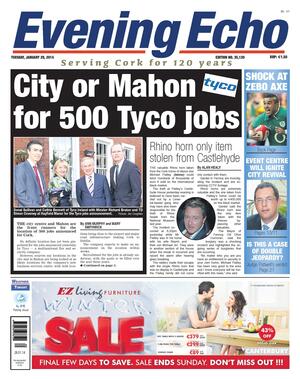
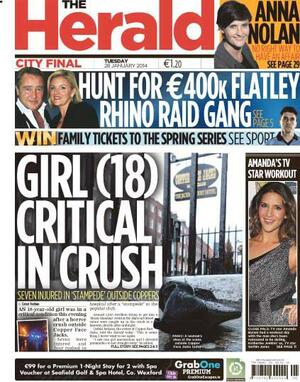
Via Eveningecho.ie and Independent_ie



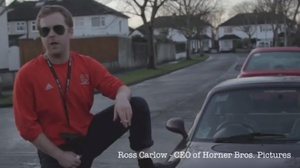
‘Irish Stories: Making of an adult movie’.
A LightSwitchHat sketch from Ronan Grace, Trevor Browne and Andrea Farrell. The trio behind that Netflix sketch.
SFW.

A flash I’m going to pretend I didn’t just see: “AIB SAID TO CONSIDER REINTRODUCING EXECUTIVE INCENTIVE PLAN.”
— Megan Murphy (@meganmurp) January 28, 2014
They’d only emigrate otherwise.
AIB seeks way around executive pay cap – report (Irish Times)
Sam Boal/Photocall Ireland


Photographer Christopher Morris’s shots of the NY subway 33 years ago – the grimy, crime-ridden, tag-covered face of what, until a crackdown by the NYPD and Mayor Rudy Giuliani’s ‘zero tolerance’ policy in the late 90s, was one of America’s most dangerous cities.
(Top pic: An original chalk drawing by the late artist Keith Haring. Bottom pic; two vigilante ‘Guardian Angels’ )
We share with you a graffiti found in a Roman street near the #Vatican / Les compartimos este graffiti que vimos hoy pic.twitter.com/In76sMJE4v
— VaticanCommunication (@PCCS_VA) January 28, 2014
No. It’s SuperFran.
You’d miss Benedict all the same.

From 1986, for Marathon bars.
A penny wise ‘vox pop commercial’ conducted at ‘Gaiety corner’ at the top of Grafton Street and Merrion Row,South King Street, Dublin. The confectionery was of course needlessly rebranded four years later.
Recognise anyone, anyone?
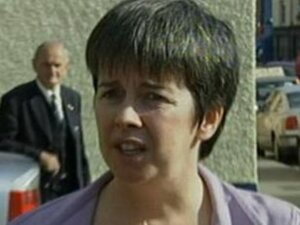
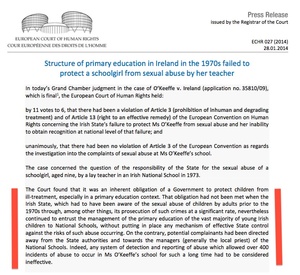
[Louise O’Keefe, top, and the press release about her victory from the European Court of Human Rights this morning]
Ms O’Keeffe took legal action against the Department of Education, arguing that the State had failed to put in place appropriate protection measures to prevent and stop systematic sexual abuse at her school.
However, the High Court dismissed her claim that the State was liable.
The Supreme Court subsequently upheld that ruling, finding that while the State funded the education system, the management role of the Catholic Church was such that the State could not be held vicariously liable for the criminal acts of the teacher.
The European Court of Human Rights was Ms O’Keeffe’s final legal opportunity to have the Irish State held liable for the sexual abuse she suffered.
European Court of Human Rights finds State liable for sexual abuse (RTE)
What’s it all about?
Legal Coffee Drinker writes:
This case and its finding that Ireland breached the provisions of the European Convention on Human Rights raises interesting implications given the terms of the European Convention on Human Rights Act 2003.
In particular Section 3 which provides that every organ of the State shall perform its functions in a manner compatible with the State’s obligations under the European Convention on Human Rights and that a person who has suffered injury, loss or damage as a result of a contravention of this obligation may, if no other remedy is available, institute proceedings to recover damages from the State, provided that same are instituted within one year of the breach.
Although the strict time limit may limit the application of this section in respect of sexual abuse which has taken place more than a year ago, the possible liability of the State under Section 3 in respect of acts of abuse going forward, is likely to have very significant repercussions.
However we will have to await the judgment to see the extent to which the finding as to the State’s liability was based on the particular facts of Ms O’Keefe’s case and the serious and blatant nature of the abuse to which the State appears to have turned a blind eye.
As regards past acts of sexual abuse it’s also worth noting that a court hearing an application under Section 3 has the power to extend the time limit backwards where this is regarded as required in the interest of justice
.
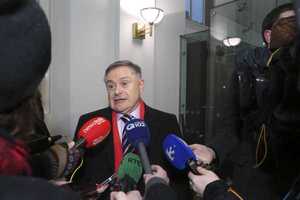
[Minister Brendan Howlin on his way into a cabinet meeting at government buiildings this morning]
Brendan Howlin has joined calls for Martin Callinan to be spared any further scrutiny for the Pubic Accounts Committee to stop its current line of investigation into the penalty points controversy.
Brendan Howlin: “I sought last year or the year before that in fact, for the people to give further powers to the Oireachtas so that we could have inquiries, so that people could be called and give evidence and so those committees could come to conclusions, now the people didn’t accept my recommendations in that and I think part of the fears that arose during that debate was that people would politicise the process and I think that we have to prove to the people we can conduct inquiries as an Oireachtas in a fair and impartial way, that we don’t parse and analyse or give our personal opinions on evidence on a daily basis…”
Unidentified reporter: “Does that give you any concern about a banking inquiry dealing with these members and showing a capacity to maybe overstep the mark on occasion?”
Howlin: “Well we’ve set out in clear legislation now that there… what must be in place before we can have a full inquiry of the type that now will be embarked upon to see what happened leading up to our economic collapse and I think there’ll have to be a very clear understanding that that’s a process not an event that people can march out daily and give their opinions on, it has to be a thorough, impartial, fair analysis of fact and everybody has to be given fair weight and due time to present their case before conclusions are arrived at or opinions are voiced by individual members.”
Howlin ‘concerned’ over conduct of PAC (RTE)
Earlier: Lock Step
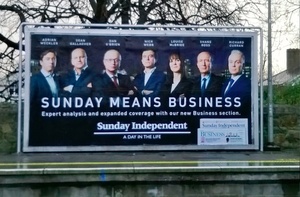
Oh.
Ger writes:
[Sydney Parade Dart station this morning] “Do you think their readership is 1/7th female?”
FIGHT!
