
Amen brother!! #digitalmarketing #WebSummit pic.twitter.com/vy1BjQNfvV
— Judy Hopkins (@judyhops) October 30, 2013
Ben Jones of AKQA releases his inner thoughts at the Web Summit.



Amen brother!! #digitalmarketing #WebSummit pic.twitter.com/vy1BjQNfvV
— Judy Hopkins (@judyhops) October 30, 2013
Ben Jones of AKQA releases his inner thoughts at the Web Summit.
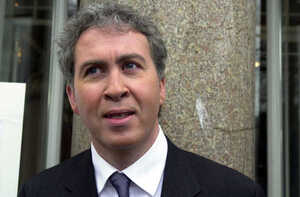 (Judge Colm Mac Eochaidh)
In August 2012, the Refugee Appeals Tribunal turned down an application for refugee status from an Iranian asylum seeker, now aged 36.
The man arrived in Ireland in June 2007, telling the Irish authorities that he is gay. He told them he and was afraid of being persecuted in Iran because of his sexuality.
He said he fled Iran after a male neighbour raped him. He explained the background to the incident involved the neighbour, whose father was a colonel in the Iranian police, inviting the 36-year-old to watch a gay pornographic DVD before blackmailing him into having sex.
The neighbour told the 36-year-old that he would tell his father that he supplied the neighbour with the DVD if he wouldn’t engage in the act.
The 36-year-old claimed the neighbour’s father appeared and attacked him in the midst of the rape. In a letter written by the man’s mother and submitted to the Tribunal it is alleged that the neighbour’s father took a picture or video of the incident on his phone.
The letter also states that the neighbour’s father showed these pictures to the applicant’s mother. The 36-year-old claims he fled to his aunt’s house following the incident and was then smuggled out of Iran concealed in his uncle’s friend’s car and later a truck.
The man received a negative recommendation at first instance from the Office of the Refugee Applications Commissioner (ORAC) in October 2007 but the man appealed this to the Refugee Appeals Tribunal, which upheld the negative recommendation.
He then challenged this decision of the Tribunal and was granted leave to apply for judicial review. But a re-hearing of this appeal lead to the Tribunal again upholding the recommendation of the ORAC.
But In July of this year, Judge Colm Mac Eochaidh, quashed this decision and, in September, outlined his reasons for doing so.
Lawyers for the Iranian man levied a series of complaints against the Tribunal member who decided to uphold the negative recommendation. But the main complaint was that a Tribunal member concluded the man was not gay.
However, Judge Mac Eochaidh found that the manner in which the Tribunal assessed the credibility of the man’s sexuality rendered its decision unlawful.
In his findings, Judge Mac Eochaidh wrote:
“The Tribunal Member believes that the applicant was inconsistent in his evidence and that an answer to a question in his s. 11 interview undermined certain other responses given. The Tribunal Member states that: “the appellant’s contention to the Tribunal that he was an unwilling participant [in the alleged rape incident] and resisted advances made by his neighbour was undermined by his admission later to the Tribunal that he found the same man attractive and had, as a result, made suggestive overtures to him in the past, which he had given as the reason as to why that neighbour may have known that the appellant was allegedly gay. This was in response to the presenting officer putting his response to question 63 of the s. 11 interview to him”. It is noted that at question 63 in his s. 11 interview the applicant was asked: “Did other people know you were gay?” To this the applicant replied: “I kept myself to myself, I didn’t let other people know, I didn’t know what gay meant.” The court finds it difficult to comprehend how the applicant’s claim to be an unwilling participant in the incident could be undermined by his admission that he had found his neighbour attractive. Further, it does not follow that the applicant’s behaviour towards his neighbour prior to the incident contradicted a statement by the applicant in his s. 11 interview that he did not make it known publicly that he was a homosexual. In my view, the Tribunal Member’s contention in this regard flies in the face of commonsense contrary to the standard set by Henchy J. in State (Keegan) v. Stardust Victims’ Compensation Tribunal [1986] I.R. 642 and is illegal.”
Judge Mac Eochaidh also addressed a complaint about the manner in which the Tribunal member dealt with the evidence of a Mr O’Ceallaigh, formerly of Galway Gay Men’s Helpline.
He wrote:
“While it is true to say that the evidence of a witness is not necessarily determinative of an applicant’s claim, it must be properly assessed and taken into consideration. In this regard the Tribunal Member notes: “When the Tribunal asked the witness directly if he thought it was at all possible that the appellant may have been pretending to be gay, he stated that he was at a loss as to why anyone would pretend to be gay. It was pointed out to him that such a stratagem would not be at all unusual for the purposes of fabricating or bolstering a bogus asylum claim. This seemed to never have occurred to him previously. One must approach this witness’s opinion on the appellant’s sexuality with a degree of caution therefore.” However, on viewing the solicitor’s attendance note of the Tribunal hearing it appears that the above statement by the Tribunal Member is a mischaracterisation of the evidence of the witness. The attendance note records that when the witness was asked whether he thought the applicant was genuinely homosexual or trying to convince him, he sated: “[I] Have asked myself [the] same question a number of times. Yes I would know. I cannot think of [a] single instance I felt he was in any way trying to convince me he was gay. I have known a lot of people from Asia, School of Oriental and Africa Studies, known gay men from Central Asia. I am not unfamiliar with people from this culture. I’m absolutely convinced A. is not a straight man…This is clearly an obvious context where this could happen. I’ve been in hour after hour where he’s in severe emotional distress. I’ve put a lot of my time over [the] last five years supporting this guy. I wouldn’t be doing this if I thought he was a straight guy.” It would appear that by mischaracterising the evidence of the witness the Tribunal Member has erred in failing to fairly weigh the evidence and give it sufficient weight in the assessment of the applicant’s claim.“
Judge Mac Eochaidh has granted the man leave to seek judicial review and ordered the Tribunal to rehear his case.
Read Justice Mac Eochaidh’s decision in full here
Thanks Mark Malone
 Come into the parlour, JobBridger.
“The intern will gain practical experience in milking cows…”
Farm Labourer, Roscrea Job Club (Facebook)
Thanks Gillian Middleton

http://www.youtube.com/watch?v=SzMoN0L0hc4&feature=youtu.be
Alcohoot at At the Dublin Web Summit hoo ha this morning.
Laura Gaynor writes:
Interviewing all the start-ups at The Summit. Here’s Alcohoot: The World’s First Smartphone Breathaliser. What do you reckon?
What if you go over your credit limit.
What THEN?
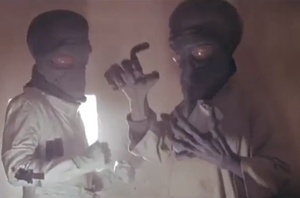
A 36 year-old compilation of previously unseen outtakes (some without sound) recently uncovered by an editor in Lucasfilm’s book division during archival research. Worth it, if just for Peter Cushing’s Goon Show impression.
 A preview of new work from Canvaz.
He writes:
These are commissions for IDA {Dublin] web-summit founders events taking place tonight. This series of paintings draws on Ireland’s rich culture of history and tradition. The format pays homage to the strong tradition of innovation & craftsmanship, in this instance the stained glass tradition. The pieces reference Ireland’s more recent history and hope for the future, with the elements reaching from darkness to light with a modern interpretation of the traditional Legend of the Children of Lir returning from exile to their homeland…

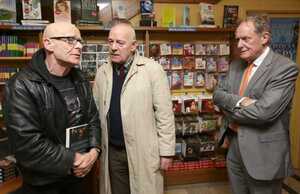


 The launch of Kitty Holland’s book ‘Savita – The Tragedy That Shook A Nation‘ at Dubray Books, Grafton Street, Dublin last night.
Kitty, the daughter of the late journalist Mary Holland and Eamonn McCann, broke the story of the death of Savita Halappanavar just over a year ago in the Irish Times.
From top: (l-r) Mary O’Rourke, Kitty Holland, Kitty’s daughter Rosie and Eamonn McCann; Eamonn McCann, Mannix Flynn and Vincent Browne; Mary O’Rourke and Vincent Browne; Eamonn McCann and Nell McCafferty and Kitty Holland.
(Laura Hutton/Photocall Ireland)
Meanwhile:
Andaneppa Yalagi, father of Savita Halappanavar, an Indian dentist who died in Ireland a year ago after being denied abortion, attributed credit to the media for the movement against the anti-abortion law that took place in Ireland and rest of the world.
He was speaking at a function to mark the first death anniversary of Savita Halappanavar, organized at the Prajapita Brahmakumaris’ Centre in Mahantesh Nagar . Andaneppa lauded Kitty Holland, a senior journalist with the Irish Times, who broke the news of Savita’s death.
He showed the book, ‘Savita – The Tragedy That Shook The Nation’, to the audience, written by Kitty Holland, which he received from the writer a week ago. He said the 300-page book has covered all major developments that took place after Savita’s death. “It highlights the complexities of the judiciary, church, parliament as well as the action and inaction by the citizens of Ireland,” he said.

 This morning at Stillorgan/Sandyford {Dublin] reservoirs
Peter Cogan writes:
I work in a building overlooking the three big resevoirs in Sandyford. The largest one seems full enough, but the two smaller ones seem to be at low levels. You can see the water mark indicating a recent reduction in volume. Have been trying to get info online about the standard or expected capacity but can’t find anything.
Anyone?
Earlier: Ballymore Useless

