

An oddly mesmeric video by Andreas Roedi of moving water trapped between the double glazed panes of a bus moving through Sassnitz in Germany.



An oddly mesmeric video by Andreas Roedi of moving water trapped between the double glazed panes of a bus moving through Sassnitz in Germany.
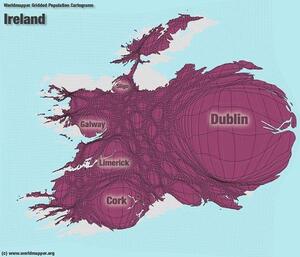
By @AmazingMaps
(H/T: Maigh Eo For Sam)
UPDATE: the politically charged All-Ireland version with bonus Belfast tumour and incipient Derry hernia (thanks Laszlo & Nitro)


More to follow.
Covers to broadsheet@broadsheet.ie
Thanks Patrick Conboy, Neil Henderson, Barry Duggan, Meliosa Fitzgibbon and Joe Donnelly.


(John Waters, top, and the heavily-regulated streets of Dun Laoghaire, above)
Thank God (yes, Him) almighty, he’s free at last.
Following an arduous spell in ‘chokey’, lax parking evader John Waters went on The Right Hook on Newstalk this evening to declare his innocence outrage and WAR on Dun Laoghaire/Rathdown council
.
George Hook: “I’m joined by my first ever jailbird, just released from prison, it’s John Waters, the legendary, iconic indeed, columnist with ‘The Irish Times’. How did you finish up in jail?”
John Waters: “Well, I spent a couple of hours in jail this afternoon, George, I was supposed to be in for a day, but they let me out after about two hours. It all goes back about three and a half years, to a parking ticket that I got in Dun Laoghaire, for being one minute over, well over the great period as well, which is apparently a technical point, which I don’t understand as well, anyway, so one minute over the grey period, and they issued me a ticket.
I ignored the ticket, it went to court, I was fined sixty euros and eighty five euros expenses. I told the judge there and then that I would not be paying it, because I believe there is a fundamental issue here about the right of people to inhabit and enjoy the public spaces and the parking regime in Dun Laoghaire is absolutely crucifying, not just to the spirit of the people in the town, but the actual traders in the town, there are now a hundred empty lots in between the shopping centre and the main street.”
Hook: “One has to say, before we get to your particular problem, it is held, by many, many people that Dun Laoghaire is being destroyed by the draconian regime of parking and that’s commonly…”
Waters: “…It’s a ghost town now George.”
Hook: “The Chief Executive of Dun Laoghaire Town Council, I’ve crossed swords with, many a time, in his previous appearance at Dublin City Council, and he certainly believes he is right. But not many people agree with him. But, nevertheless, this is a democracy, you broke the law, you were fined, and then you refused to pay it. So, jail for you!”
Waters: “It was a hundred and forty five euros, all in all, or one day in Wheatfield in lieu. So, that was May 1, March 2011, that was the hearing. I would say there was a bit of paper-work going through, which I ignored for a few months and then it dried up and I thought, maybe they’ve forgotten, maybe they haven’t, I don’t know. But then, about a year ago I arrive back and there was a warrant on my door-mat and the name of a Guard, with a card, saying; call him.
The warrant at that point was actually four months out of date. So, I contacted my solicitor, asking him to call the Guard and point this out to him. The Guard said, ‘Ah well, we’ll always get it re-issued, no problem!’. And March this year, they re-issued it, and they’ve been trying to get me ever since. Now, I haven’t been at home very much this year, I’ve been away quite a bit.”
Hook: “But you were a fugitive from justice at this point?”
Waters: “Yeah, I was, I was on the run, but anyway, we negotiated an end to the stand-off, clearly, they weren’t going to give up. So I said I was quite happy to go to jail. So I said I would arrive at Dun Laoghaire Garda Station 12 noon on Tuesday, that’s today, and serve my time. And I did so and I arrived.
Now, the bizarre thing was George, you can take this with a bit of grain of salt, in a way, but like, the negotiations between my solicitor seem to go on, and the Guard in question went on and it seemed that the Guard was a bit a wagon, a weapon, you know, but actually in person, he was a really nice guy.”
Hook: “He was only doing his job!”
Waters: “That’s true, but you know, we had a great old chat on the way down…”
Hook: “Now, hang on a minute, he then had to get into a state vehicle and drive you to Wheatfield Prison?”
Waters: “No, no, there were two Guards, there was him in the back with me and there was the driver, who drove at high speed out of Dun Laoghaire Garda Station, clipping the toes of some elderly women, who were protesting…”
Hook: “Ah come on now, come on.., they were protesting about your incarceration, the elderly women?”
Waters: “No, they were traders, they weren’t all elderly, there were about fifteen or twenty local traders who came out to protest, don’t forget Dun Laoghaire has been crucified…
Hook: “And were they protesting about your jailing? So, you had… ah come on now, you chatted them all up and said, listen now; I’m going to jail!”
Waters: “If you went out to Dun Laoghaire, you’d see along the main street there’s a big, one of the, one of the closed-down shops has a huge hoarding, with a picture of me and an article I wrote for The Mail on Sunday, The Irish Mail on Sunday, about the recent closure of Marks & Spencer in Dun Laoghaire and the effect it’s going to have on the town and the fact that it’s down to the policy of the Dun Laoghaire…”
Hook: “Correct, it’s outrageous!”
Waters: “It’s unbelievable!”
Hook: “It’s not the, it’s not the Council, it is the Chief Executive, who appears to..”
Waters: “Owen Keegan!”
Hook: “Yeah, Owen Keegan, who appears to have untrammeled powers.”
Waters: “He does yeah, he seems not to like cars, or car drivers. But the problem is, you see, I…this is, it’s one thing for me, I’ve been here 22 years in this area, in the Dun Laoghaire area and I go in maybe three or four days a week having my lunch there…I’ve only been caught three times, and I paid two tickets ‘cos maybe I was ten minutes over, this one, one minute. The guy, the traffic warden, I was told by a passer-by that the traffic warden actually saw my ticket, went down an alley-way, waited there for two or three minutes until the clock clicked past the point where my ticket was no longer valid!”.
Listen here
Pics: DublinObserver
 Dublin Docklands this evening.
Thanks Laura Mullett

SEE the Electric Picnic in THREE minutes through the eyes of camera-clad ‘reveller’ Barry Knight of CollegeTimes.ie.
Did YOU have a better time?
Earlier: Leaving No Trace
Thanks Spaghetti Hoop
IMO confirm 1 day national strike of NCHDs in Irish hospitals on Sept 25 next & 1 each wk from 30 Sept, in @ least one hospital in each region
— Nicola Cooke (@nicola_cooke) September 3, 2013
 Head of the Political Science department at Trinity College Dublin, Dr Michael Gallagher, above far left, has written a measured piece on the upcoming Seanad Referendum.
He writes:
“Opinion polls suggest that while in a straight choice between the status quo and abolition the latter would prevail, the idea of retain-and-reform is growing in appeal. Indeed, advocates of a No vote are at pains to emphasise that they do not want to preserve the Seanad as it is – a No vote, say Democracy Matters, ‘is the first step to a new Seanad’.
“The reformed Seanad, as outlined by Democracy Matters, would be a directly elected body: elected not just by the current Dáil electorate but also by those in Northern Ireland who are eligible for Irish citizenship, by all Irish passport holders abroad, and by graduates of all third-level institutions (it’s unclear whether this would include non-Irish citizens, given that Irish citizens would already have a vote under one of the other headings).”
“What powers should this reformed Seanad have? The Quinn–Zappone draft bill is relatively modest in its proposals, suggesting roles such as scrutinising draft EU regulations and directives as well as statutory instruments, as well as ‘the power to inquire into the need for new legislation in certain areas’. Whether voters would bother turning out in significant numbers to choose the candidates whom they regard as best equipped to scrutinise draft EU regulations is doubtful, though. Far more likely that those elected would be aspiring TDs and ministers who would, as Senators, do whatever they thought most likely to secure their election to the Dáil, and that might not involve spending much time on scrutiny of draft EU legislation.”
“Others go further and would like to see the Seanad given more or less the same powers as the Dáil. Vincent Browne (Irish Times, 17 July 2013) argues that the lack of accountability in the current system could be addressed by ‘giving the Seanad the same powers as the Dáil, except the power to elect and unelect a government’. And Democracy Matters, on the front page of its web site (3 September 2013), seems to see the reformed Seanad as being more powerful than the Dáil – indeed, the body to which the Dáil should in some way be answerable – stating that ‘A new and effective Seanad is critical to make the Dáil accountable to a body other than themselves’. It would also have significant legislative powers: ‘A reformed Seanad means new expertise and new legislation to underpin Ireland’s economic recovery’. The range of views on the composition and powers of any ‘reformed Seanad’ suggests that if the electorate votes No on 4 October, it would not be easy to reach swift agreement on what such a body should look like, and that in practice the current Seanad would be with us for some time.”
“Part of the motivation underpinning the idea of a directly-elected Seanad with pretty much all the powers of the Dáil no doubt comes from despair at the deficiencies in the Dáil’s ability to compel accountability from the government.
…
“Even so, the idea of a strong Seanad, elected at a different time and by a different electorate than the Dáil, is unlikely to be a remedy for anything except gridlock. When the two houses disagree, whose will should prevail – that of the Dáil, or of the reformed Seanad? Looking around Europe the only examples of genuinely strong second chambers are to be found in Belgium (a manifestation of federalism), Romania (close to a presidential system), and Italy. The power of the Italian Senate is one of the main reasons why left-wing governments rarely last their full term and why the Italian system of governance is regarded as one of the least effective in Europe. If the only measures that can get through parliament are ones that can command majority support from two different houses, elected at different times by different electorates, which appears to be the Democracy Matters preferred option, then only lowest common denominator measures have much chance of making it through.”
“The desire for a strong Seanad is an understandable, though surely mistaken, response to the reluctance of the government to move as far and as fast as it could in giving a more meaningful role to the Dáil – a role that, while not enabling the opposition of the day to thwart the elected government, would compel a higher degree of accountability and would enable meaningful input from government backbenchers and opposition TDs.”
Read in full here
Pic: TCD

The Pixies’ new four-track EP for your aural pleasure.
Pixies release brand new four-track EP and video – watch (NME)
The Pixies Motor On, Without Their Longtime Bassist (New York Times)
Pic: Consequence of Sound
