
-1

She could not or would not thaw.

Kidnapped Irish Princess ‘Melkork’ and her son Olaf with spouse/kidnapper Hoskuld in background.

She gave Hoskuld the silent treatment for three years.

He would look back on it as their happiest time together.

Sibling of Daedalus writes:

Just browsing through the Laxdæla saga when I came across the story of Melkorka, an Irish princess abducted as a slave (the exact word is ‘bondswoman’) by Icelandic raiders back in 910 or so.

In protest against her enslavement, she refused to utter a word, and her purchaser, Hoskuld the Viking, only discovered she was able to talk three years later when he overheard her chatting in Irish to their son (see pic above).

Melkorka getting her voice back proved a mixed blessing for Hoskuld; domestic tiffs between her and his primary wife became so frequent and heated that she had to be given her own farm at the other end of the island and, later married off to Thorbjorn the Feeble.

Melkorka’s son with Hoskuld, Olaf the Peacock, became one of Iceland’s premier heroes and never forgot his Irish origins, even making a visit to see his relatives back in the auld sod after he had grown up (some say Melkorka’s marriage to Thorbjorn was to assist him in obtaining funding for this trip).

Melkorka’s story (apart from the royal descent and the self-imposed silence) was not unusual.

With few of their own women prepared to make the trip to Iceland, its settlers had to look for home comforts closer by, and, even today, a very considerable portion of Icelanders (some say as high as fifty percent) are of Irish descent in the matrilineal line


Three years.

Pic via The Story of Iceland Folk (Heathengods)

protester

Rabble writes:

“Approximately 30 Campaign Against Home & Water Tax activists have occupied Revenue office on O’Connell St. Gardaí have arrived on scene. Activists have ‘locked-on'”

Rabble

GSCO1

GGsoc2

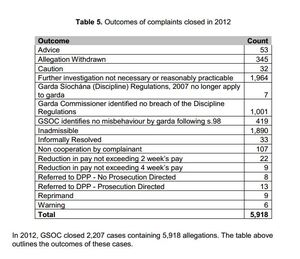
The Garda Síochána Ombudsman Commission released its annual report for 2012 this morning.

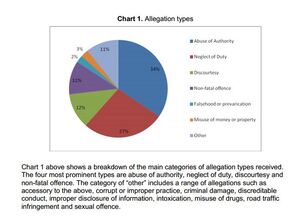
In 2012, GSOC received 2,089 complaints from members of the public which resulted in 5,449 allegations of misconduct by Gardaí. The outcome of these complaints can be deciphered in the table above.

The report also includes criticisms about the delays in disciplinary investigations and the manner in which Gardaí handles GSOC’s requests for information pertaining to the complaints.

“At any one time there are several hundred disciplinary investigations with Garda Síochána Investigating Officers. These matters normally lie at the less serious end of the disciplinary scale and we believe these should be completed quickly. There is an agreement that they will be dealt with within 12 weeks, however, this is rarely achieved. There were 567 investigations with the Garda Síochána at the close of 2012; 73% of these were over time. It is of great concern that 21 of these were over two years old. This situation must improve substantially.”

The Ombudsman Commission and the Garda Commissioner also agreed systems to cover information exchange in more sensitive cases; examples might include matters involving an informant or intelligence of a sensitive nature to establish a material fact. Sensible caveats were agreed at the time of signature. These types of requests do not occur frequently. However, timeframes have not been observed. In one matter GSOC waited 542 days for a request to be satisfied; in some cases requests have been refused; in some cases GSOC has been given only partial or controlled access to information or documents. None of these practices meet the standards agreed.”

“There have been times when requests that GSOC would view as routine, non-sensitive requests have been treated by the Garda Síochána as being of a different nature. On some occasions the Garda Síochána declined to operate the agreed protocol and sought to create conditionality around GSOC’s access to the information, withholding it if conditions were not satisfied. In GSOC’s view, unjustifiable caveats have been placed on a basic request. On some occasions we have been refused information and/or documents offered within a controlled access situation. This has led to a situation where GSOC, a State investigative body, undertaking important enquiries, has been obliged to justify why it needs certain items germane to its enquiries to the very body whose members’ behaviour is under investigation. As stated, undue justification, refusals, part disclosure, or part access, were never envisaged especially as in these cases the matters asked for are considered by GSOC to be non-contentious. We consider this situation unacceptable.”


View full document here

_224593_golden_virginia300

No more roll-ups?

No more ‘More’?

Taoiseach Enda Kenny received a delegation of senior tobacco industry figures in Government Buildings a fortnight ago, the first time any taoiseach has held formal talks with the industry. The industry figures also called on the Government to reject proposals in a draft EU tobacco directive to ban menthol and roll-your-own products. They also want the Government to reject measures in the draft directive on standardised and plain packaging.


Taoiseach conducts formal talks with tobacco industry (Arthur Beesley, Irish Times)

(Laura Hutton / Photocall ireland)

Broadsheet.ie