

This morning.
At Trinity College Dublin where Freshers’ Week is taking place.
Labour leader Brendan Howlin and Labour Senator Kevin Humphreys mingle with students.
FIGHT!
Thanks Sauvignon Blanc



This morning.
At Trinity College Dublin where Freshers’ Week is taking place.
Labour leader Brendan Howlin and Labour Senator Kevin Humphreys mingle with students.
FIGHT!
Thanks Sauvignon Blanc

Labour TD Alan Kelly and Labour leader Brendan Howlin
“I think Brendan needs to consider what is best for the Labour Party into the future.”
“I certainly believe from a leadership point of view, after two-and-a-half years, we haven’t been able to turn the ship around. We haven’t even looked like we’re turning the ship around.”
“We need a radical shake-up. We need to change the direction of the party. We need a different vision. We need far more energy.”
Yikes.
Comments made by Labour TD Alan Kelly during an interview with Fran Curry on Tipp FM this morning.
Labour needs ‘radical shake-up’: Kelly challenges Howlin’s leadership (Harry McGee, The Irish Times)
Previously: Must. Have. Power
Rollingnews
UPDATE:
Martina Fitzgerald, of RTE, reports:
Mr Howlin said he was disappointed that Mr Kelly would make any comments that would seem like the party is divided when they need to work together. He said there is a collective leadership.
He also said that all the parliamentary party, which is made up of seven TDs and six senators, bar Mr Kelly support his leadership.
Mr Howlin said the majority of the party’s 50 councillors support him.
Howlin ‘disappointed’ by Kelly’s call for significant change (RTE)

Alan Kelly during the General Election 2016 count in Thurles, Tipperary
Would somebody please give him some power, for pity’s sake.
Seven councillors have now called on leader Brendan Howlin to resign and make way for another leader.
Speaking to the Irish Examiner, a number of councillors have said Mr Kelly is what the party needs and restated the calls for Mr Howlin to make way….
Councillors call for Alan Kelly to become Labour leader (Irish Examiner)
Yesterday: Labour Can Work
Previously: ‘Power Is Like A Drug…It Suits Me‘

Labour leader Brendan Howlin
According to Brendan Halligan, pro-democratic centre-left and centre-right political parties should all merge to stand against anti-democratic populists, authoritarians and nativists.
Brendan is wrong, in his own terms.
Ireland’s mainstream political parties already co-operate, in formal coalitions, in local government and in the operation of the Dáil and Seanad. We can work together to defend democratic values and oppose extremism without any logical requirement to merge.
There are significant differences between Ireland’s centrist parties. In every government it has joined, Labour has protected wages, social protection and State industries to the best of its ability. And we have had to fight to do so against others in government.
A single Irish centrist party, dominated by the centre-right, would have given us a lower minimum wage, lower welfare payments, widespread privatisation and a weaker economic recovery as a result.
Labour has also uniquely championed marriage equality and women’s reproductive rights, long before other parties caught up with social change on these matters.
It matters to have multiple parties. As we can see in Westminster and elsewhere, backbenchers in one big party have a lot less influence than minority parties in coalition.
Brendan rightly points to the importance of institutions in cementing democratic gains.
But he overlooks the fact that proportional representation has been institutionalised in Ireland, and the most extreme examples of populism in the western world have occurred in countries operating under less proportional referendums and voting systems, such as the disproportional electoral system that gave Viktor Orbán’s Fidesz-KDNP party in Hungary two-thirds of the seats (67 per cent) with just under half of the votes (49 per cent).
As long as we maintain proportional representation, Ireland’s people are better served by having a choice of government coalitions, each of which offers real policy differences. If choice was reduced to a national centrist party versus extremists, this would weaken Irish democracy.
In such a scenario, it is inevitable that people would eventually grow disaffected with the centrist monolith and vote for change, even if that meant electing Ireland’s answer to Donald Trump, Viktor Orbán or Boris Johnson.
As long as there are multiple parties, there will be greater freedom of speech, greater diversity of policy ideas and stronger democracy as a result.
Brendan Howlin, TD
Leader of the Labour Party,
Leinster House,
Kildare Street,
Dublin 2.
Brendan Howlin: Why Halligan is wrong about merging parties (The Irish Times letters page)
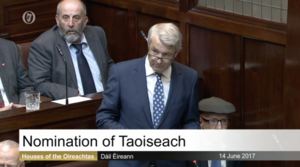
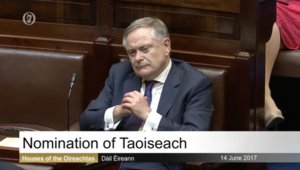
From top: Labour TD Brendan Howlin and Independent TD Michael Lowry
In the last few minutes.
Independent TD Michael Lowry responded to comments made earlier by Labour leader and TD Brendan Howlin in relation to Leo Varadkar securing Mr Lowry’s support for his nomination to the position of Taoiseach and the recent contact between the pair.
Mr Howlin said:
“I note today that you will be supported by Deputy [Michael] Lowry. I’m informed that you’ve spoken to Deputy Lowry on a couple of occasions in recent days and I read in this week’s Tipperary Star that Deputy Lowry has claimed that, in return for his support, he will have access to your office, as Taoiseach, to your officials and to your ministers. As Taoiseach, I hope you will put at end to such contact. You should not depend on his support.”
In his response, Mr Lowry said:
“Deputy Howlin, I consider your comments here today to be nasty and offensive. I have absolutely no doubt, and I’m in this house for 30 years, that your actions and your words were prompted by your deputy from Tipperary, Deputy Alan Kelly because they’d be very typical of his reaction to me in my county.
“When you attack me in such a manner, as you did today, you insult the people of Tipperary, the people who vote for me, as an elected representative from this House. And I remind you Deputy Howlin that, like every member of this House here today, I have a democratic mandate from the people of Tipperary who have voted for me consistently and put me as their representative in this House.
“I have enjoyed their confidence and their trust for over 30 years and I hope when the next election is called, they’ll re-endorse me as a member of this parliament for the constituency of Tipperary.”
“And, finally, I would say to you, Deputy Howlin, that I have exactly the same entitlements to access the system of Government as any other member of this House. My telephone conversations with Taoiseach-elect Varadkar were on the basis of the Programme for Government, for the policies which I was hoping that he would support.
“And on the basis of those two discussions that I had with him, I’m very happy to support him as Taoiseach and to continue to support this Government, particularly on budgetary matters because it’s not possible, as members of a parliament, to be clambering every other day for resources and monies to be spent on particular projects if you’re not prepared to stand up and to take the budgetary measures that are necessary to make sure there are funds available to implement the policies you seek.”
Watch Dail proceedings live here
Earlier: And Breathe…
UPDATE:

In addition.
Social Democrat TD Catherine Murphy also had something to say about Michael Lowry’s support for Leo Varadkar, saying she finds it difficult to be…
“…preached to about budget responsibility by someone who’s been in the courts and who’s been with Revenue in relation to his own tax affairs. It’s hardly the kind of ethical, you know, ethical behaviour that should exemplify the kind of rebuilding of this country.”
FIGHT!
Brendan Carr says some people at Holles Street board meeting told him they made the initial decision ‘under duress’ https://t.co/dkNOeAjGF2 pic.twitter.com/Jf7MlOrxkP
— RTÉ News (@rtenews) April 27, 2017


From top: Dublin’s Lord Mayor Brendan Carr on RTÉ’s Morning Ireland; Dublin City Councillor, with the Green Party, Clare Byrne; and a graphic from mediator Kieran Mulvey’s report on the agreement to the Minister for Health Simon Harris
This morning.
On RTÉ’s Morning Ireland.
The Lord Mayor of Dublin Brendan Carr, spoke to Cathal MacCoille, following last night’s meeting of the board of the National Maternity Hospital where a motion re-endorsing the agreement for it to move to the St Vincent’s site was passed.
Mr Carr was one of three members who opposed the motion.
During the interview, Mr Carr told Mr Mac Coille:
“A number of people stressed to me last night when that initial decision was made, they took it under duress. I thought, what I’m saying is last night, my opinion, right, I stress this is my opinion, the manner in which some members of the board were treated last night was done in a very bullying and intimidatory way. That’s my opinion.”
Following Morning Ireland, Labour party leader Brendan Howlin and two board members of the National Maternity Hospital, Sinn Féin councillor Micheal MacDonncha and Green party councillor Clare Byrne, both of whom were at last night’s meeting, spoke on Today with Seán O’Rourke.
During the segment, Ms Byrne said she understands the Religious Sisters of Charity “will have no representation on the governance” of the new hospital.
From the interview…
Clare Byrne: “In three years, as a board member, that’s the first time that I’ve sat at that table with the Lord Mayor. So, he was coming to a meeting discussing an issue that has been repeatedly discussed for a number of years. He didn’t attend any of the special meetings that were called. So, it was terse meeting, there’s no denying that. But, of course it was, I mean it’s an extremely important decision that’s being made. And, obviously, it’s important to consider the opinion of the public…”
Sean O’Rourke: “And…”
Byrne: “…which we made very clear over the last week also.”
O’Rourke: “What do you make of Peter Boylan, his reason, I think, for resigning. Just to quote from him, ‘I can’t remain a member of the board that is so blind to the consequences of his decision to transfer sole ownership of the hospital to the Religious Sisters of Charity and so deaf to the concerns of the public which it serves’. You’re all deaf. And blind.”
Byrne: “No, I certainly don’t think I’m deaf and blind to the concerns of the public. I’ve listened very carefully to, and I’ve had a number of people contact me over the last few days, in particular. And I do share their concerns. Absolutely. But look, the reality is, is that we need this hospital and this is the only site that was being offered. There has been little or no support from this government or the previous government, which Brendan [Howlin] you were a member of, to do anything to end the marriage between church and State. There’s been little support for the board for this move which is a crucial service that we need for the women of Ireland. I had my child in Holles Street last year, I received an impeccable level of care but how they do it, in those conditions, is nothing short of a miracle on a daily basis.”
[Can hear Ms Byrne’s baby in background]
O’Rourke: “And the baby is obviously thriving, we’re glad to hear. There’s no doubt about it.”
Byrne: “He is, he is. But the reality is, is that building is not fit for purpose. And they’re in situations where they’re literally shoving beds in between beds and you may have a woman who has just lost a child having to recover surrounded by women who are celebrating the birth of their children. To me, that’s not fair. I think it’s cruel. That needs to change. This move to Vincent’s will provide the level of maternity care that women of Ireland…”
Brendan Howlin: “Everyone is in agreement that we need a new hospital. I walked every inch of it with Dr Rhona Mahony. I went back and immediately spoke to [former minister for health] Dr James Reilly, we allocated the money to do it. Nobody is arguing that there shouldn’t be a new national maternity hospital. But we have to think generationally into the future. That it would be democratically controlled and…”
Byrne: “But Brendan with all due respect, you know that that land was owned by the Sisters of Charity when you walked the site back then, so why didn’t you do anything about it when you were in government?”
Howlin: “Because I would have insisted, had I been in government, that the control and ownership would be exactly the same as in Holles Street. That’s what I understood was going to happen.”
Byrne: “Well, my understanding from the board meeting back in November and, again, last night, is that the Sisters of Charity will have no representation on the governance or input into the clinical [inaudible]…”
Howlin: “But they will have four out of the nine members of the board…why would they want to, if they don’t have any influence, and would the sensible, sane and rational thing now to do would simply be to hand over the land, including getting compensation, getting…”
Byrne: “But that’s not a matter for the board to decide. That’s a matter for the minister to decide. The ownership…”
Howlin: “No, but the governors are the future of the hospital. Maintaining the ethos that you praised within Holles Street is a matter for the board to decide. And, you know, the notion that you’re going to have a legal agreement that [inaudible], that give you assurances, that all sounds well and good but let’s put it beyond doubt now, let’s have ownership..”
Talk over each other
Byrne: “Well, hopefully, when the minister signs off on the final memorandum of agreement, that will be put beyond doubt. And it’s up to him to ensure that that’s what happens now.”
O’Rourke: “I just want to…”
Byrne: “I’m satisfied from the current governance structure that the Sisters of Charity will have no input into clinical decisions made in that hospital…”
Howlin: “Why do they want to own it then?”
Bryne: “And of course I’m concerned about that for the women of Ireland. I want to see a repeal of the Eighth Amendment. I raised those concerns repeatedly during the meeting and I’m satisfied from the responses that I received from the negotiating team, and the legal team, that that will not be the case.”
Later
Howlin: “Kieran Mulvey was brought in and I’ve dealt with Kieran Mulvey for 20 years, to broker deals between parties in dispute. So the fact that there was a dispute between the Sisters of Charity and the National Maternity Hospital indicates that what was brokered was a settlement…”
O’Rourke: “And it was one side had ownership and the other side had control.”
Howlin: “Well, that’s the point. I don’t think it’s right that people should…”
O’Rourke: “And the minster has a veto…”
Howlin: “Well, I mean there’s going to be a board of nine, four of them are going to be appointed by the Sisters of Charity, four by the National Maternity Hospital and, if you like, the casting vote or the deciding vote is to be an eminent person, in the field of…”
Byrne: “[inaudible]…by St Vincent’s.”
Howlin: “I beg your pardon.”
Byrne: “Four will be appointed by St Vincent’s…
Howlin: “No, no, the St Vincent’s trust, which is the Sisters of Charity.”
Byrne: “Well, my understanding is…”
Howlin: “It’s the St Vincent’s trust who are the Sisters of Charity, is that not a fact?”
Byrne: “My understanding is that the Sisters of Charity will have no input into who’s elected onto the [inaudible]”
Howlin: “You’ve attended all the meetings, you’ve said to us that the…the St Vincent’s trust is the Sisters of Charity. And so they would nominate four, maybe you haven’t a full grasp of that. And maybe…”
O’Rourke: “Just to come back Micheal MacDonncha, do you want to enlighten us on that?”
Micheal MacDonncha: “Yes, I mean, that is, what Brendan Howlin is saying there is correct and let’s remember that, from day one here, the aim of the St Vincent’s Trust was complete control. Their original approach was that they wanted to subsume the National Maternity Hospital into Vincent’s and that was the starting point and, hence, there was deadlock and hence there was negotiations and that has been revealed by the Lord Mayor. It was stated at the meeting last night that members themselves that they were under duress to endorse the agreement back in November…there was duress in the sense that it was a Hobson’s choice. It was either this agreement or no hospital.”
Listen back in full here
Thanks Ian


From top: Brendan Howlin; from left Former Irish Water head of PR Elizabeth Arnett, Labour TD and former Minister for the Environment Alan Kelly and Pat Tierney, CEO of Irish Water in December 2014
It’s all free water under the bridge.
“We were under the cosh to build a huge utility like Irish Water. To get a national metering programme in place and charge for water in the space of three years, which we just should have said no to. I’m sorry we didn’t.
“Within Government, we certainly had that battle with Fine Gael. At a critical point, the decision we made was to stick with it as opposed to pulling down the Government at that stage.
“Because we were afraid of the consequences for our country if we pulled the Government down. But we paid too high a price for that and we should certainly have stood our ground in relation to Irish Water.
“This was one of the things we had to make progress on. Because they were signing off monthly on the paycheck for the nation, in order for us to pay pensions and pay the cost of wages and so on.
“Under normal circumstances, that should have been a ten year project. I certainly think it was handled badly.”
Brendan Howlin, Labour Party Leader in today’s Irish Mirror
Lest we forget…
Minister for Public Expenditure Brendan Howlin has said that there cannot be a situation where people decide to not pay their water bill.
It follows on from Environment Minister Alan Kelly’s comments on Monday night, in which he refused to rule out measures that could mean unpaid charges are recouped from peoples’ wages and social welfare payments.
Outside the Dáil fellow Labour politician, Minister Brendan Howlin told UTV Ireland
“There can’t be a situation where anyone of us decide not to pay our bills. If you come to a supermarket checkout and decide “Nah, I’m not paying the bill” and walk off – that’s just not the way the system works.”
Minister Howlin: People cannot decide to not pay water bill (UTV March 24, 2015)
Rollingnews

This afternoon.
Labour’s Brendan Howlin in the Dáil during the debate on the Apple tax ruling.
“There seems to be a belief that Ireland, a small nation, should carry the reputational hit for correcting what is an issue – and that we’ve all agreed is an issue – we’re told this is an investigation under state aid rules yet the lion’s share of the commentary seems to be the announcement of the commission’s position has been about taxation levels.
“The same sort of commentary we heard for many, many years about corporation tax policy in Ireland.”
“It’s a dishonest charge levelled against us and all it seeks is to do us harm. And those who would be complicit in it do Ireland harm and the prospect of continuing, to be the success we have in attracting investment into this country.”
“But it is the mud that sticks, the mud that is thrown often enough. The truth is that this State collects higher than average revenue from corporation taxes.
“It implements, at a national level, an effective tax rate higher than other countries with bigger systems of relief that don’t seem to be the focus of the commission’s overview. A point made I think, rather effectively, in the case of France, by Deputy [Michael] Martin.”
“As Dan O’Brien and other commentators have pointed out, there’s a growing trend in the European Commission rulings to find against smaller countries but ignoring potential breaches elsewhere. That should give every member of this house pause for thought before automatically rushing to agree with the commission.”
Right so.
Watch proceedings live here
Previously: The Apple Deal Explained
Minister Brendan Howlin didn’t seem to think mileage, expenses or attendance records were “private papers” pic.twitter.com/Z7FK4sFTjh
— Ken Foxe (@kenfoxe) August 10, 2016
A clip from a meeting of the Oireachtas Committee on Finance, Public Expenditure and Reform discussing the Inquiries, Privileges and Procedures Bill 2013
You may recall journalist Ken Foxe’s ongoing efforts to obtain the invoices and receipts submitted by 22 TDs and Senators.
He’s been denied access, and has been told the expenses are ‘private papers’.
At the weekend, Mr Foxe tweeted the video clip above and called into question the differences between what was said and the official Oireachtas transcript.
This is a transcript of what was said:
Sean Fleming: “…like we have no problem. Our fobs everyday, I think it’s in the paper, our attendance, from the, our electronic papers of everyday, we fob in here, and our mileage and our expenses. There’s a whole lot of records and [inaudible] that are published.”
Brendan Howlin: “That’s procedural. They’re not private papers. It’s up to the Oireachtas itself to determine private papers but I mean there will be communications that should be privileged. There are things that should not be determined to be private papers. The Oireachtas will set those rules.”
Meanwhile…

The official Oireachtas transcript, via Kildarestreet.com.
Anyone?
Previously: Crazy Like A Foxe

Minster for Public Expenditure and Reform Brendan Howlin
Minster for Public Expenditure and Reform Brendan Howlin spoke to Seán O’Rourke on RTÉ Radio One this morning in light of the Regulation of Lobbying Act, which comes into force today.
Mr Howlin said the purpose of the legislation is to allow the public see who is lobbying politicians and officials in relation to public policy.
He said there’s no need for the Act to cover politicians lobbying politicians, saying Freedom of Information requests and Dáil questioning are suffice. See Catherine Murphy for details.
Seán O’Rourke: “New rules governing lobbying come in to force today. These require the disclosure of contacts between lobbyists and the politicians and officials whom they seek to influence. The rules were developed by Minster for Public Expenditure and Reform Brendan Howlin who is with me in studio. Minister, thank you for coming in. This new legislation was promised and eventually delivered in the form of a bill now, it kicks off today. I think there’s a year of a ‘bedding in’ as it’s being put. What exactly do you hope it will achieve?”
Brendan Howlin: “Well Sean, I suppose it’s part of the suite of measures that we set out at the start of this government to make the whole business of public administration more transparent. The restoration of Freedom of Information, the ensuring that people who are lobbying Government and lobbying administration do it in a very open and transparent way – giving supports to whistleblowers. All these things have been put in place. Funnily enough, if you’d asked me four years ago when I set out, all the different important measures, I would have thought that regulation of lobbyists would have been probably the easiest one and in many ways it’s become the most difficult because it’s a balancing act. Because lobbying is a good thing. In an open democracy, citizens have the right to contact local representatives or national representatives to have their view indicated but I think there was certainly a backdrop of real unease about the peddling of influence. You know whether it was the euphemism of the Galway Tent where some people had extraordinary access and we need to have a regime…”
O’Rourke: “But sure the Galway Tent happened in broad daylight you could say. It’s surely what was going on where people couldn’t be seen fraternising or…”
Howlin: “Yes, I know. There was the Galway Tent and golf outings and all the rest but under this regime, that now will kick in from today, those conversations will have to be registered. You might know that Mr Y is talking to Minister X or special advisor Y or senior public administrator Q in a particular location but you don’t know what he’s saying, now you will. If they make a lobbying procedure under the act, if they’re talking about public policy and trying to influence public policy, they will be obliged to put that out in a public register, who they contacted about what and when.”
O’Rourke: “How far down the food chain does the responsibility lie in terms of say ministers and officials with whom contact has to be registered?”
Howlin: “Well, in the initial iteration of it, obviously, you know, this is going to be a work in progress. It’s not a fixed entity from the start because we’re going to have to broaden this over time. But right now it involves all politicians, either any TD, any Senator, any member of the European Parliament, any Minister of State, any Minister, any advisor to a Minister. It also encompasses secretaries genera of departments, assistant secretaries, generals and directors of departments. I put up my own contact list last night on my own website. And at local government level, chief executive officers and directors of service. It is my intention, as I informed the Dáil, to broaden that net so it will involve, for example, within the next 12 months, principal officers and so on. And then, you know, this is an interesting part of the debate we had. There are people who actually have influence that might not be actually senior. For example, should we include the private secretary to a minister who might actually have a lot of influence without having a particular...”
O’Rourke: “Well certainly where the appointments are concerned, he or she would.”
Howlin: “Well there you are. So. You know, we need to have a bedding in process. The Standards in Public Office are going to commission, are going to administer this whole system, we’ve looked at international best practice. There are only 7 countries as I understand now, within the European Union, that have legislated in this area and we are seeking to be best in class if you like.”
O’Rourke: “So if somebody approaches you, looking for a particular action to be taken that has to be registered. What about for instance, you yourself? As a local deputy for the county or constituency of Wexford, let’s just say you wanted a new operating theatre in Wexford General Hospital or some new facility, would that have to be registered by you or by the person you’re making your representations to. And it would be perfectly legitimate that you would do that.”
Howlin: “No, no I mean public representatives have to operate as public representatives and they’re entitled to the public administration and the public representative work, that’s what we’re elected to do, no more than local authority members would be entitled to do that. It is people who are…”
O’Rourke: “But surely that is central to the whole, you know, fear or at least suspicion that there’s a lot of pork barrel stuff going on with ministers using their own influence with colleagues. Surely that should have to be registered.”
Howlin: “No, I mean, it is understood that every local representative would obviously represent. I mean that’s the definition of local representative. What we’re talking about here is people who are trying to shape public policy externally, who are not elected people. But who are doing it for their own commercial gain. Obviously..”
O’Rourke: “But I mean charities are covered by this. There’s no commercial gain there, I’m just wondering why it shouldn’t apply to public representatives seeking to use their influence. Just tell us about it.”
Howlin: “But, but public representatives…”
O’Rourke: “I mean, for instance, there was a big controversy and your own former colleague who is the junior minister Roisin Shortall in the Department of Health. She took serious issue with the location of primary health centres, as set out by her former colleague James Reily. Now again, should a light not be shone in there about who was lobbying him for the location of these, in terms of constituencies.”
Howlin: “But there would be. That’s the very point.”
O’Rourke: “Not if, for instance, you or Phil Hogan were doing the lobbying.”
Howlin: “No, no, well I mean obviously, the notion that a public representative would receive a lobbying from somebody who wanted to have a health centre on his property, that would be registered. But the notion that the Minister for Health, or the Minister for the Environment would make a discernment, within his elected responsibility about where a housing scheme goes or where, that’s, he’s elected to do. And he’s accountable to the Dail and accountable to his own electorate for doing that. Sure that’s what public administration is about.”
O’Rourke: “Yes, but I’m just wondering, should we not know more about how these decisions are taken.”
Howlin: “But you have FOI, you have Dáil questioning, you have all these matters. I mean it almost goes to absurdity then when our public representatives debarred from….”
O’Rourke: “Nobody is suggesting, and I wouldn’t for a minute suggest that a public representative would be debarred from making representations. But I’m just wondering why they should be excluded from the terms of this legislation when they are the ones doing the lobbying as opposed to the ones being lobbied.”
Howlin: “But patently, you’re talking about ministers. Ministers are the lobbied, they’re not the lobbyists. The dialogue of cabinet is I suppose a lobbying, because I get lobbied every time I walk down the corridor by ministers looking for money. You don’t have to look beyond today’s papers to see that. Is that lobbying? Of course it is, of a kind. But that’s what they’re there to do. To be advocates for health or advocates for education or advocates for their own area of responsibility. That’s how public administration works.”
Listen back in full here
Lobbyists must record details of contacts with public officials (Irish Times)
Previously: Redactulous
Do You Want Your Old Lobby Washed Down?
Sam Boal/Rollingnews.ie