
Tag Archives: Dan on Thursday

From top: Minister of Communications, Climate Action & Environment Richard Bruton addresses a  ‘town hall’ meeting last week in UCC to promote the government’s Climate Action Plan; Dan Boyle

I wasn’t going to go but decided to anyway. It was billed as a ‘town hall’ meeting but was anything but.

An opportunity for the government to present its green credentials, to sell their plan.

And it was going well, at first. Richard Bruton and Simon Coveney are people I get on well with. I admire their political skills. They were even sounding plausible until the inconsistencies they were juggling began to be exposed.

The first glaring error was the attempt to stage manage the meeting from the offset. Attendance at the meeting was by invitation. Many who should have been invited weren’t, some by oversight, others for the sake of having a quieter night.

Most of those from the environmental sector were kept in the dark about the event happening, where it was going to happen, or what the purpose if it was.

The local media were told to leave once the set piece speeches were made.

On the stage with the Ministers were representatives of State agencies. There to amplify the government’s supposed wonderfulness, but never to critique it.

There to placate us were representatives of the Environmental Protection Agency, the Sustainable Energy Authority of Ireland, and because someone thought the organisation had some climate emergency credibility – Teagasc!

Within the hall were environmental activists who, long before this, should have been involved in this process since its inception.

All this before an argument was made. When asked how the government could be arguing for a National Development Plan, dripping with new roads projects, each one of which will add enormously to the country’s carbon load, could be compatible with a climate action plan, I was told it just could.

Direct denial was one thing. Making claims that weren’t and couldn’t be true another. We were told that the NDP prioritises public transport over new roads by a factor of two to one. It doesn’t.

The most depressing part of the evening was that more than half of the questions were from farmers engaging in special pleading, that they were already doing all they could be doing on climate change.

Repeated by these pleaders was the hoary, supposed fact that in Ireland we produce beef in a far more sustainable way than elsewhere in the World. As if that mattered in any way at all.

The comparison isn’t about the different methods or effects in raising cattle. It’s about the extent that greenhouses gases are being created by too many cattle being bred, wherever such cattle are being bred.

The fact that these questions were being asked in the way they were being asked, highlights the major difficulty Fine Gael faces when it comes to being seen as credible in relation to the climate emergency.

Since coming into government in 2011, Fine Gael has overseen an expontential increase in Irish emissions. Fuelled by policies that are antithetical to reducing carbon risk.

Having failed to achieved credibility to date, it’s hard to see how Fine Gael can do so now, especially when to do so would mean to challenge the core of its political support.

That I can’t see happening.

Dan Boyle is a former Green Party TD and Senator and serves as a Green Party councillor on Cork City Council. His column appears here every Thursday. Follow Dan on Twitter: @sendboyle

Pic: merrionstreet

From top: Minister for Communications, Climate Action and Environment Richard Bruton (centre), Taoiseach Leo Varadkar (left) and Minister for Finance Paschal Donoho (right) at TU Dublin Grangegorman, to launch the government’s Action Plan to Tackle Climate Breakdown last week; Dan Boyle

A government which has overseen year on year increases in this country’s carbon levels since 2011, wants to be taken seriously as a Climate Emergency champions. Excuse me while I shoot a cynical glance in its direction.

We need a coming together of political actors to work to meet the challenge of the Climate Emergency.

While this plan represents the best attempt yet from a government still too wed to the concept of a market economy that can, and it believes will, solve all society’s ills; it continues to show, negatively, a government that either doesn’t or doesn’t want to get it.

There are certainly targets in this plan, which if reached, would make for very impressive achievements. The problem is that this government have never shown any previous inclination to move in this direction, often and continuing to frustate necessary actions from happening.

The plan is short of, and deliberately vague, on the details required to achieve these targets.

Some areas of necessary policy areas, such as dealing with the agricultural sector, are totally avoided in this report.

Agriculture is responsible for a huge proportion of Ireland’s carbon emissions. To produce a plan of this nature without any proposal to reduce the size of the national herd, is politically pandering of the worst kind.

Sins of omissions are one thing, muddled thinking another. This government’s thinking on transport in this plan seems particularly muddled.

The bias on transport spending still weighs far too heavily towards new roads projects. It is the ultimate irony that mainstream political thinking in Ireland clings to the belief that capital/infrastructural spending that is concrete reliant, and thus carbon emission increasing, represents the only hope for continued economic prosperity.

The National Development Plan, is as much a political manifesto as it is an economic strategy

Replacing an environmental bad with another environmental bad hardly represents progress.

The ‘debate’ about electric cars typifies this.

If every fossil fuel car gets replaced with an electric model, such a change will do nothing to tackle traffic gridlock. The electricity required to charge a replacement fleet of cars, will still to some extent into the immediate near future, require the burning of fossil fuels . to generate that electricity.

The issue isn’t really car type. It isn’t even car ownership. The real issue is that of car usage. What has probably been the most personally liberating invention of the twentieth century, has become the noose that chokes the life out of our towns and cities.

Any government that is serious about tackling the climate emergency would need to be investing massively and immediately in public transport.

Especially outside of the Dublin region. There is little in this plan that has given any indication of that.

The aftermath of publishing this plan has seen Fine Gael and Fianna Fáil revert to type, in squabbling over which road project the other would be prepared to jettison in order to appear more Green.

The implication being that cancelling any road project would be an act of political madness. Only when new road projects become the exception rather than the headline of transport plans, will it be seen that the Climate Emergency is being taken seriously.

We will still need to spend money on roads, but the emphasis should be almost entirely on repairing the existing road network.

The mania that has seen more and road projects being developed, has also led to existing roads being repaired less frequently while often to a poorer standard.

To change minds this government first needs to change its mindset.

Dan Boyle is a former Green Party TD and Senator and serves as a Green Party councillor on Cork City Council. His column appears here every Thursday. Follow Dan on Twitter: @sendboyle

Rollingnews

From left: Dan Boyle, Grace O’Sullivan MEP and Green Part Leader Eamon Ryan

I would be lying if I said I saw it coming. I was confident there would be an upward trajectory in the number of votes we would win, and with that the prospect of gaining some additional seats.

The mood at the doors was relaxed and friendly. Negative responses were more about indifference than anger.

As a party we had approached these elections with a better sense of strategic purpose and organisational focus. With each election we distance ourselves further from the enthusiastic amateurism that use to characterise Green election campaigns.

The mood music was helpful. The concentration on the words of the now totemic figures of Greta Thunberg and David Attenborough, were being communicated to more people through a less sneering media.

The results astounded us as much as anyone.

More than 200,000 Green votes were won across the island of Ireland in the European elections. 11.4% of the Euro vote in the Republic, nearly 50% higher than the previous Green peak of 7.9% from 1994.

Two MEPs elected and almost a clean sweep of three, after the phenomenal campaign of Saoirse McHugh.

The average vote of Green local election candidates was in double digit percentages. The final tally of local election seats more than quadrupled the previously held number of seats the party held.

This, in turn, was over 30 more local authority seats than the previous peak achieved (18 seats in 2004). The biggest increase in seats of any Irish political party, almost by a factor of two, in 2019.

Was it a wave? Was it a ripple? Was it a rip tide? Whatever force of current it was, it represented the greatest Green political advance in the 37 year of the party in Ireland.

There have been other Green breakthroughs but never of this scale. We need to celebrate the victory while being wary of the expectation it has created.

We should take credit for the better organisation and stronger effort. We should also give a nod towards more favourable media coverage.

If we are totally honest with ourselves, we need to admit that there is also a touch of political favour of the day about the recent election.

The challenge for The Greens is to consolidate these advances. We are now being set up to fail, communists to those on the right; sellouts to those on the left.

We need to work even harder now to justify the renewed trust that has been placed in us.

Part of this consolidation should be to recognise that the right/left axis is no longer relevant to modern democratic policies.

The real cleavage is between progressives and reactionaries. Reactionaries exist as much on the traditional left as they do on the traditional right.

The political tides will continue to ebb and flow, but they will do so on a shifting platform of ideas and policies, rather than set, ingrained traditional political philosophies.

The present is Green. The future may not be. It won’t be if we continue to practice politics as usual.

The problems we face as a planet are so huge that we need to work with whoever, however, to achieve the desired results.

The Greens being different can make a difference. But only if we can make it different. This time.

Dan Boyle is a former Green Party TD and Senator and serves as a Green Party councillor on Cork City Council. His column appears here every Thursday. Follow Dan on Twitter: @sendboyle

Pic: CorkGreens

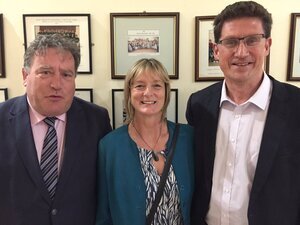
New Cork Green Party councillors, from left: Lorna Bogue, Dan Boyle, Collete Finn and Oliver Moran

You mean Councillor Dan?

Newly-elected Green Party Cork City Council representative Dan Boyle’s column will not appear today.

Dan is busy at the Ireland South re-count in the European Elections where The Green Party’s Grace O’Sullivan is in contention for a seat.

Or maybe he doesn’t need us anymore?

And this is his subtle ‘green wave’ goodbye?

Only time will tell.

It’s a waiting game.

Previously: How Green Was My Tally

Top: Local Election candidate Dan Boyle (second left) canvassing in Douglas, Cork this week with Green Party colleagues.

Tomorrow is a day I’ve been working towards for the past six months. It is my fifteenth election.

While I’m experiencing the usual feelings of uncertainity, married with a somewhat obsessive need to do more, this is an election campaign that seems different.

Reactions on the doors have been more friendly. Angry responses have been fewer, and more about disillusionment with politics in general.

I’ve known what it is like to win. I’ve known what it’s like to lose, when I hoped I could win. For the most part I have contested elections as part of a wider and longer process.

I have tried to show that the values and ideas I hold, values and ideas I hold with others, could have a better application; a better way of doing things; achieving better results.

I have chosen to do so from a less traditional, less prominent place.

Politics has been a huge part of my life, but it has not been my life itself. It has dominated, affected me too personally too often, but there are more important aspects of my life involving my family, in particular, that I hold more dearly.

As precarious as politics can be, there are easier ways to navigate its often choppy waters. Who we choose to associate with, how we choose to act and what we choose to say, are the main detriments of political ‘success’.

Conventional wisdom is that you should choose to associate with those who have, or are near power. Once associated you should keep your head down. Do nothing that will rock the boat. Say or do nothing that hinders career prospects.

Not my choices, because of which my political journey has been more rollercoaster-like than it otherwise might have been.

I don’t regret any of it, even if there many things I wish I had approached differently.

What sustains me with these interests? What encourages to keep going?

Watching my colleague Saoirse McHugh perform so brilliantly in an European Elections television debate onTuesday night, has helped crystalise those questions for me.

I also have a daughter named Saoirse. They are both around the same age, half that of my own. I am reassured that the path I have followed will be travelled by others, certainly more assuredly.

I have seen myself as a pragmatist in politics. I have been involved in compromise in attempts to achieve incremental change. These are important political tools but they are, and should remain, secondary tools.

Passion should be the prime motivator in politics. Saoirse McHugh is showing that in spades. Her performance has bolstered my confidence and has hardened my resolve.

At a time when the very idea of a future for our planet is being compromised, never has this passion been so needed.

An increase in public concern surrounding our climate emergency may see more Green representatives being elected.

Hopefully so. However, even if raised expectations cannot be met, the Greens as a political party will have benefited enormously from this election campaign.

The performance of Saoirse McHugh is helping the party renew its soul. Collectively we will face future challenges more convinced we are pursuing the right approach. Our confidence re-established that we can succeed.

I’m more than happy to stand behind a new generation of torchbearers. Their energy giving more of us renewed energy. Their passion helping us to remember the commitment that sometimes we have misplaced.

I am honoured to continue to be a part of this process. I would be privileged to serve in whatever way the public decides.

Dan Boyle is a former Green Party TD and Senator and is standing in the Local Elections for the party in Cork tomorrow. His column appears here every Thursday. Follow Dan on Twitter: @sendboyle

Top pic via Dan

Wednesday: ‘Go On Dancing With The Stars If You Want The Attention’

From top: Washington Street, Cork as it would appear under plans for a Luas-style rail system contained in the Cork Transport Strategy; Dan Boyle

So we are to have a Cork Luas (CLUAS), or maybe not. Another launch of a big spending plan spread out over a significant time span, by a government that seems intent to be the cast of the latest remake of ‘Brewster’s Billions’.

Another spin-dominated presentation that is as much about business as usual, than it is about any Brave New World of transportation.

The reasons to be cynical? This plan, despite its PR gloss, is made from the same template of all previous plans that have preceded it.

The biggest tranche of spending will continue to go to the construction of new roads, with payments front-loaded ahead of any public transport options.

The shining bauble of a CLUAS system is presented with a number of caveats. Much will depend, we are told, on whether hoped for demographic changes occur, and in whether other public transport (bus) initiatives will have taken up the slack by then.

When is then? 2031 apparently, the date it projected to begin a CLUAS system. To be finished for operation by 2040.

Twelve years from now, the twelve years that we need to change tack to avoid climate change becoming irreversible. Twelve years when we should be prioritising public transport over roads only initiatives. Après le déluge CLUAS.

As with most spin presentations the main emphasis has been out on the headline figures. €3.5 billion is to be spent over a twenty year period on this plan. This averages out at €175 million each year, a not insignificant sum.

Except that spending won’t be averaged on an annual basis. There will be very little upfront expenditure with this plan, as has been the case with all previous plans.

Early expenditure will go on scoping exercises. These will rarely be in house with consultants being brought in to reinforce the already held biases of the National Transport Authority.

Future expenditure, the longer implementation gets delayed, will see more of the anticipated budget being eaten up by construction cost inflation. Either that, or the costs get layered on. Much like we are experiencing with the National Children’s Hospital.

The belief is that new road announcements are what pleases the punters. The truth is rather different. Most voters would prefer the proper maintenance of the existing road network, especially pavements.

There is a notorious double standard in transport planning. Asphalt carpets designed largely for single user vehicles, which operate under capacity for decades after construction, are created under a build it and they will come philosophy.

Public transport infrastructure always seems to be assessed on justifying its use on existing, not future, population load.

The basis of infrastructure spending should be to provide now to create development, not to respond later, and inappropriately, try to meet uncatered for needs.

Public transport initiatives should now become the overwhelming focus of transport planning. Such projects should be prioritised for soonest possible implementation.

Brian Nolan, as Myles na gCopaleen, once wrote that the Irish roads programme was to build a series of parallel roads, with the construction equipment being left in situ, in the yet to be completed lane.

That was satire. Current transport planning thinking, and how it been historically informed, is much worst than that.

Dan Boyle is a former Green Party TD and Senator and is standing in the Local Elections for the party in Cork on May 24.  His column appears here every Thursday. Follow Dan on Twitter: @sendboyle

From top: Clean up started in February at Cork City Council-owned Ellis’s Yard site in Ballyvolane where 200,000 kgs of rubbish was illegally dumped; Dan Boyle

When I last had been a councillor, local government in Ireland had greater powers, that allowed councils to make more direct and more immediate impact in providing services.

Many councils had Direct Build Units that saw public housing being provided efficiently and in large numbers.

At the very least, Works Departments existed in each council, that were better resourced, allowing repairs to done more quickly, and vacant housing units to become more readily available.

A huge component of the work of local councils was in waste management. Each council had a fleet of Waste Disposal trucks, that would call to designated areas at a set time each week.

From the 1990s a new philosophy on public services began to develop. Imported from the UK, it was known as New Public Management.

At the heart of this thinking was the belief that local government was monolithic, making it inefficient. This gospel indicated, when it came to public services, the private sector could do things ‘better’.

Waste management was to be one of the first sacrificial lambs brought to the altar of New Public Management. Councils sold on their fleets, often at bargain prizes, to new private sector providers.

Soon a multiplicity of waste companies would be found on our streets. Each offering different methods of collection, collecting on different days of the week, charging different rates for the ‘service’ that was provided.

The myth that the private sector is more efficient, and thus better, has been badly exposed by how we have organised waste management since then.

I believe we should return to a simpler time, that when there was a single provider of waste collection in each local authority area.

While such a service could be provided again by local councils, it would be naive to assume they could do so immediately, given large scale capital acquisition costs, particularly at a time of other priorities.

I believe local authorities should contract out, over say a five to ten year period, waste collection to single providers.

Local councils could then become more effective regulators of the service in a way that would standardise how waste is collected, when the waste is collected, and what payment should be made for the service.

Government policy in recent years has been to oblige local councils go in exactly the opposite direction.

In an effort to make the excessive number of waste collection companies viable, local councils have passed a series of by-laws obliging householders to prove how they pay for disposing their waste.

This is being done under the smokescreen of dealing with the very real scourge of fly tipping. However, as with companies registering with REPAK is seen as somehow businesses ‘fulfilling’ their responsibilities on recycling, this is an exercise to driving all householders into becoming customers of the waste collection companies.

This is unnecessary. It is possible for most households to restrict the need to have a large scale waste collection service.

I take my recyclable and contaminated waste to a civic amenity site. My organic waste I put into a container where it breaks down in compost. After five years the container is only half full.

There is nothing particularly virtuous in this. As an individual I continue to produce too much waste. Like others I would like better incentives that recognise household efforts to reduce waste and to recycle.

The main focus of any waste collection system should be to encourage householders. It shouldn’t be to subsidise waste collection companies.

Dan Boyle is a former Green Party TD and Senator and is standing in the Local Elections for the party in Cork on May 24.  His column appears here every Thursday. Follow Dan on Twitter: @sendboyle

Pic via Cork City Council

From top:  Monica McNamara, author of ‘Come On In: A History of Cork Simon Community’; Dan Boyle

Twice in the past week I have met with homeless men in Cork’s city centre. In each case I was called over by name, my election posters acting as a calling card.

Both men were friendly, the weather being good helped in that regard. The few bob were asked for, but the conversations were wider than that with me asking if they were getting what they needed from the services available. They were, even if their expectations weren’t much.

That same week two younger men were found dead on Cork’s streets, each within a stone’s throw of the main homeless hostel in the city. Young anonymous lives ended.

It has been almost five years since the death of Jonathan Corrie near the gates of Leinster House. A name, a face and a story that accompanied a situation.

There have been at least four such deaths in Cork within the past two years. I can recall the death of a young woman who had been living in a tent, no further than fifty metres from a house where my daughter was living. And an older woman found in a doorway, again close to the Cork Simon hostel.

Now we have the deaths of these two young men. With these deaths, and their increasing frequency, grows the fear that we are being desensitised to what is happening right beside us.

Since 1971 Cork Simon Community has been the main agency responding to homelessness in Cork City. How it has done so has been excellently chronicled in a recent book written by Monica McNamara named ‘Come On In’.

The original Simon shelter on John Street was better than the street, but only marginally so. It took twenty five years for a far superior building to be made available at Andersons Quay.

Almost twenty five years later the scope of the services provided by Cork Simon has increased significantly. The two men I met now have access to showers and to laundry services. Food, simple in nature and modest in content, is also available

The lottery remains access to the shelter itself. The occupancy rate of the hostel is 110 per cent. If the mathematics of that seem impossible, the additional figures are reached by placing overflow mattresses on the floor of a common area, meaning many more people sleep there than the hostel was designed for.

And still more get turned away.

A number of months ago Cork Simon commissioned a report from University College Cork, the launch of which I was delighted to be associated. The report, which I’ve already highlighted here, outlines the extent emergency accommodation which shelters are meant to be, have become short term, or at least interim, accommodation they were never meant to be.

Much like this government’s approach to housing supply, there seems a studied incomprehension that increased resources of themselves are not enough.

Resources have to be both sufficient and targeted. Increased resources that fail to meet increased demand, only help to widen and deepen the nature of the problem.

Improved facilities remain tantilisingly unattainable to a growing number of homeless. Current policies only help to grow the number of homeless.

More homeless without shelter. More without services. More effectively given a death sentence from the courtroom of the smug.

Dan Boyle is a former Green Party TD and Senator and is standing in the Local Elections for the party in Cork on May 24.  His column appears here every Thursday. Follow Dan on Twitter: @sendboyle

Pic: Cork Simon Community


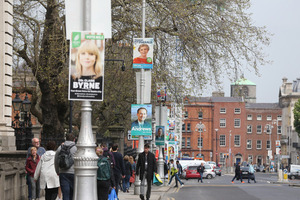
From top: Local and European election posters on Merrion Street, Dublin 2 yesterday; Dan Boyle

The posters are up. The phoney war is over. The new belligerents being the fight for space on the poles, and avoiding the ire of the no posters anywhere focus groups.

In The Greens we always had a somewhat ambivalent attitude towards posters. The preference would have been not to use them at all.

After some debate it was decided to use posters, but they had to be generic. Greens also strongly opposed the personalisation of Irish politics, seeing it as one of its biggest problems. In fact we were wrong about that. It actually is one of Irish politics greatest strengths.

John Gormley almost caused a schism in the party, with his insistence to use not only his name but also his picture on his election poster. The slogan on that poster was also quite striking:

“Other parties promise you the Moon and the stars; Only The Greens promise The Earth,”.

He came very close in that election to bringing Garrett FitzGerald’s political career to an ignominious end.

Postering was different then. Paper posters had to be pasted onto hardboard backing. Rain usually pealed the paper away. After torrential rain the hardboard itself would get soaked breaking away from cable ties and risking severe injury to whoever might unluckily be passing.

Plastic posters that could be printed upon were seen as a boon. Being easier to make, easier to put up, more likely to stay up, has led to a proliferation of posters. That has created a whole other set of problems.

For me, however they are made, posters an important part of the democratic process.

They are a relatively low cost means of marketing that help to level the playing field between independent and smaller party candidates, and candidates of traditional political parties.

That many candidates go over the top in their use is undoubted. The snowblind effect of pole after pole taken up by a single candidate provides no useful benefit to the democratic process. There has to be standardisation. There has to be regulation.

One current Cork City Council candidate has produced a three metre long poster. Thankfully the poster does not consist of a full length body shot. The amount of empty space on the poster would seem to indicate that not enough achievements exist to meet the candidate’s ambition.

I would be a fan of the European poster box used in many places on the continent to publicise public events. Build them and people will come. However such a culture shift is not going to occur before May 24. Nor can we bring in appropriate regulations to bring sanity to the system before then.

I think it is at least worth stimulating a debate on how such regulations might work. First limit the number of posters that can be used by each candidate. This election I’m using one hundred posters. I don’t understand how many more than that would be needed.

Secondly regulations could signify a minimum distance between posters of any candidates, or repetition of posters of a single candidate. Say one hundred and two hundred metres respectively.

Finally there should an onus on candidates and their campaigns, to identify where their posters have been placed. This would perform a protection for candidates from one of the nastier aspects of election campaigns.

Often posters get moved, by nefarious persons, to unknown locations, so litter fines get imposed on those unaware their posters had been removed.

Nasty business politics. Not that I want to be seen as a poster child for any of this.

Dan Boyle is a former Green Party TD and Senator.  His column appears here every Thursday. Follow Dan on Twitter: @sendboyle

Rollingnews

Update:


From top: Vernon Mount House in Cork was destroyed by fire on July 25, 2016; Dan Boyle

It is nothing like the same context, importance or cultural significance. As Notre Dame was burning I thought of the many of the abandoned husks we have in Ireland.

Stretching as far as back to Norman keeps, and more recently in history to the score of torched stately homes, ruins of buildings seem to have become an entrenched part of the Irish landscape.

In Cork we have a number of recent examples. The fires at Our Lady’s Hospital in 2017 and a year previously at Vernon Mount, have deprived the region of two buildings of significance each poised on either side of the city, defining its outer limits.

Both have since been left discarded. Those who should be thinking about what to do being frightened about the cost of restoration, or lacking any viable plan as to how the renovated buildings could be used.

I particularly pine for Vernon Mount, a huge part of the landscape of my growing up.

The extent of its deterioration, within a very short time span, has been very much a thing of pity. It has been reduced to little more than frontage. In reality it needs to rebuilt from scratch.

Many would argue what would be the point. Many would say that there are far more important uses for public money, especially at a time of housing crisis.

And yet I believe a case can be made. There is an onus to protect elements of architectural heritage from various eras of an area’s history. In Ireland we have been too quick, too often, to demolish rather than add to.

Cork’s Georgian architectural history has virtually disappeared. Restoring Vernon Mount would be a continuing exemplar of what Cork once looked like.

Even if this argument were to persuade there is a still a question as to what a restored building could be used for. Again, I believe it is only imagination that prevents an answer to this question. It could be a community facility, a cultural centre or an innovative social housing project.

Vernon Mount has a story to tell. Cork’s Hellfire Club, its most renowned resident the infamous Sir Henry Browne Hayes, abducted a wealthy heiress here to inveigle her into an illegal marriage as cunning plan to deal with his mounting debts.

Other voices will say let what was be, but I have been here before. One of the more disappointing campaigns I had been involved with, when previously a city councillor, was to argue an alternative use for the former Greenmount industrial school.

An austere, imposing building, it carried with it a tragic history. I had succeeded in persuading the Presentation Brothers (then managers of the school) to mark the names of young men who had died at the school having been sent there, but who had been buried in an unmarked grave.

The order subsequently sold the building to a private developer. What followed was an all too familiar story of loose security, encouraged anti social activity, and when that was not enough, the strategic removal of the roof. This was all part of a wearing down process to encourage a community’s disinterest under which potential would never defeat the folk memory of history.

Another lost building changes the history of nothing. The ruins of many past structures do little to enhance the landscape. What is sorely lacking is a policy on what we should do.

Some ruins need removing. Some buildings need restoring, repurposing. What we need are criteria that help us define why and how.

Top pic: Tara Higgins