
Tag Archives: Dan on Thursday

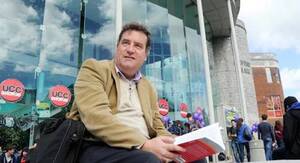
From top: Student accommodation hoarding in Thomas Street, Dublin; Dan Boyle

Last weekend I spent a night in on campus student accommodation at Dublin City University. It was basic but comfortable and near where I needed to be.

DCU management seem to work their asset well, an asset I now presume has since fully reverted to use as student accommodation.

I cite my experience because I believe this is something we need to have a conversation about.

Student housing is a land use issue, not a housing issue.

There is no formal policy in local development plans for student housing.

On average the cost per month of a room in a student housing complex is the same per month as a 2007 tracker mortgage for 90% of a 320k mortgage (for a room in shared apartment complex).

The argument that student housing frees up much needed housing stock is spurious and unsupported. Evidence exists that seems to show that the opposite seems to be the case.

Student housing built on serviced and well connected land in city centres displaces residential accommodation elsewhere.

Because of the rents attainable cash investors are now more inclined to buy houses in residential areas then gearing them for student, rather than residential, use.

This is turn is causing serious local planning issues with most of these conversions being carried out without proper applications for change of use

The supposed ‘freed up housing’ is often older stock that has been poorly maintained and is in need of major renovation. These levels of cost and investment put them well beyond the normal first time buyer.

The approach to student accommodation at each third level college differs wildly resulting in differing affects.

Colleges that build on campus and/or through outreach seek to best co-operate with nearby community, seem to achieve a better sense of cohesion.

Those that project off campus, with privately constructed and managed facilities, invite a distance in community response that can often encourage hostility from the existing community.

What then are the effects of Student housing? It is short term let accommodation in principle.

Anecdotally there is evidence that suggests that it dilutes and divides local communities into which they are placed.

In Cork, as I suspect in it is with other colleges, current proposals were originally mooted as apartment or residential development sites with a mixed use aspect.

There is no social and affordable housing aspect to any of the developments. In terms of adaptability the only likely alternative use for this housing are co-living centres or as hotels. They will never be suitable for housing families.

Student accommodation should no longer be given strategic planning exemptions, simply because they create more problems than they solve.

Where a more permissive approach can be taken is in developing residences on campus. Even with this no student residences should be developed on infrastructured land that is not adaptable for long term residential use.

There should be a social and affordable element to student housing.

These residences should be taxed accordingly for use as short term lets during summer months, and be required to have stand alone planning permission for that purpose.

The Dutch approach of matching students with older single occupiers, would carry far greater social benefits at a far lower cash outlay.

Instead we see a total overdevelopment of student accommodation far in excess of more needed other types of housing development.

This is being subsidy led. It is an area where developers see that profits can be quickly and easily got. Remove the subsidy and that will soon change.

Building activity, such as with student accommodation, does not a housing crisis solve. In truth it has helped make that crisis worse.

It is something of a tasteless irony that in catering for those whose minds we try to strengthen, we seem to be doing so in the most stupid way possible.

Dan Boyle is a former Green Party TD and Senator and serves as a Green Party councillor on Cork City Council. His column appears here every Thursday. Follow Dan on Twitter: @sendboyle

Top pic: Rollingnews


From top: Brazil President Jair Bolsonaro (left) greets President of Bolivia Evo Morales; Dan Boyle

I have been reading an interesting article on the wider implications of the Amazonian rainforest fires.

The article is unstinting in its portrayal of Brazilian President Bolansaro as an ignorant oaf dedicated to inflict as much environmental damage as possible, whilst encouraging others to do the same.

But Bolonsaro is far from being the only villain of the piece.

Dozens of rivers comprise the Amazon drainage basin. The furthest away of these reach as far as Bolivia.

There an equally demagogic President (Morales) is encouraging proportionately greater clearing of the rainforest.

Morales has been something of poster boy for progressive politics. His record since his first election has been spotted. He can point to some economic growth during his reign, but also a dimunition of democracy.

A new Constitution introduced in 2009 contains several clauses that speak in glowing terms of protecting natural resources and the environment. There doesn’t seem to be any real application of these warm words.

The same Constitution placed a restriction on the number of terms that can be served by a President. Morales wants to increase this to three terms from the current proscribed two term limit.

In fact it would be a fourth term for Morales, as he doesn’t count the term he served before a new Constitution was introduced.

Bolonsaro and Morales would be placed on different ends of the political spectrum. Although when it comes to demagoguery, however democratically legitimised, they are no different from each other.

The same can be said of the effects of their respective environmental policies. While Bolonsaro can be said to more honest in his contempt for the environment, the damage being caused in Bolivia is just as bad as that occurring in Brazil.

There should be no surprise in this. Environmental policies have never sat easily in being defined through the traditional right/left political axis.

Throughout the twentieth century smokestacks were just as highly thought of as economic status symbols in communist/socialist countries as they were in the most avidly capitalistic ones.

Political analysis dealt with mechanical change, then subsequently techological change, in the same way. Capital and Labour were the only inputs that were ever worthy of consideration.

Whatever economic system has been in place, particularly during the twentieth century, there has been a shared addiction to a carbon fix, resulting in a shared responsibility for the crisis the planet now finds itself in.

We need now to define the means of production differently and better. We need to collectively manage, preserve and protect the environmental inputs of air, water and soil.

This is what now we should define what we see as economic well being, and especially how we should be bringing about social fairness.

A similar Bolonsaro/Morales axis can be seen with the current holders of the highest office holders in the United States and the United Kingdom.

Trump, in that unique fantasy land he inhabits, declares himself an environmentalist, even though his every action is antithetical to bringing about a health environment.

Johnson speaks a better game, but he and his ilk are dedicated to a deregulated world that will drive environmental degradation ever more quickly.

The moral here is to judge political leaders only by what they do. A lesson that our Taoiseach and his government seem particularly slow to take on board.

Dan Boyle is a former Green Party TD and Senator and serves as a Green Party councillor on Cork City Council. His column appears here every Thursday. Follow Dan on Twitter: @sendboyle

Pic via YouTube

From top: Young climate change activists protest in Dublin city centre last May; Dan Boyle

I was sent a text this week from a young environmental activist. He wanted to let me know that he had read my book on The Green Party’s experience in government, ‘Without Power or Glory‘, and that he found it illuminating.

I thought it indicative of the many young activists now coming to the fore. For them it isn’t enough to respond to the emotional triggers that permeate the environmental debate. For them to be able to debate with passion it is necessary to become sufficiently informed.

This is so different from the prevailing practice of those two or three times their age. Those with a lazier intellectual disposition, content with static commentary often wrong in context or historical accuracy.

We are beginining to see a generation where the cliche of youth being wasted on the young, may no longer apply.

While we should encourage young people to live and enjoy life, with the fecklessness and recklessness that adolescence was created for, the emergence of a cohort of serious young people is no bad thing.

Of course no generation speaks in a single voice. The best we can hope for is that a preponderance of those, of this generation, match their concerns with ever probing challenges towards those whose failings have delivered such a threadbare legacy.

I identify strongly with these young people. I was first elected a councillor when I was twenty eight years of age. But that was a journey that had only started from my mid twenties.

I greatly enjoyed my rock and roll years that preceded my becoming a conscientious bore.

Where I have less patience is for those who not choose not only to act against type prematurely, but also choose to think old before their time; absorbing everything negative from the ancien régime.

Without having to resort to metaphor or analogy just think Young Fine Gael.

Maybe just maybe, with the very nature of leadership being redefined, we may finally have a generation that can get ahead without having to ape all that has been awful before them.

Especially encouraging to see is the number of young women coming to the fore as activist leaders. It has probably has something to do with the Greta Thunberg effect.

But only slightly. In Ireland a more likely effect, for young women at least, would have been the expectations raised by the Same Sex Marriage and the Abortion referendums. Together these events have helped politicise a generation.

They too will get it wrong. We can only hope that, in the Beckett sense, they will fail better.

It’s almost guaranteed that they can’t get to do any worse, and we can’t afford them to do otherwise.

If I’m truly honest I should point out to them that I am their natural enemy, or at least characteristic of it. Middle aged and male, deeply in fear of having our World about us changed, without us.

Prepared to strike out at those challenging our outdated certainties. Doing so in a far more childish manner than those whose early maturity frightens the hell out of us.

And proper order too. The smugness and arrogance of my generation needs to be set aside by those whose life choices and chances do not need to be further compromised by our failings.

I only hope they can do so efficiently but not so impetuously.

Dan Boyle is a former Green Party TD and Senator and serves as a Green Party councillor on Cork City Council. His column appears here every Thursday. Follow Dan on Twitter: @sendboyle

Rollingnews

From top: Grafton Street, Dublin last Christmas; Dan Boyle

Adam Smith and Karl Marx would have been agreement that wealth was the prism through which we should look at society.

Three hundred years of political economy have been based on variants of their musings on what wealth is, how it is created, and how it is distributed.

It can be argued that the relentless pursuit of wealth, regardless of consequences, has not as has been assumed, been the main determinant in our achieving happiness. Often it can be a huge impediment.

Much of this can be put down to how we define what wealth is. In our ‘developed’ societies we have sought to put a price on everything while denying ourselves the ability to realise the value of anything.

If we are to have a cultural war on anything it should be on how we define what is wealth, and how should it be applied.

Evolved societies should become more preoccupied with the idea of wellbeing. In Ireland we could greatly benefit if we were to follow emerging trends in this area.

As we were still analysing the votes and seats won in this year’s local and European elections, the New Zealand government led by Jacinda Arden was introducing what was being claimed as the World’s first Wellbeing Budget.

While in many ways the budget didn’t diverge too far from a conventional budget, it did prioritise two significant areas of additional public spending.

Spending on measures aimed at protecting and improving mental health was the first priority. The second area of additional spending on family and child welfare.

There is a canniness to this thinking. Under conventional measures of wealth, reactive spending in these areas are deemed to be adding to a nation’s wealth. Spending that seeks to lessen or prevent actions that lead to poor social impact, is currently seen as black hole expenditure. Yet which adds more to a community’s sense of happiness?

New Zealand is a country that has a similar population to that of Ireland. So has Denmark. The Danes are said to live through a philosophy they call Hygge, which they define as “a quality of cosiness and comfortable conviviality that engenders a feeling of contentment or well being”.

Outside of an overemphasis on alliteration, this is not a bad goal to strive for.

Since 2012 the United Nations has been publishing a World Index on Happiness. Through a number of criteria – social supports; life expectancy; freedom to make choices; charitable giving and perceptions of corruption – countries are ranked according to how proactive they are seen to be.

In the most recent report the top four countries were Nordic. Each is also a high tax and spend country. Ireland was listed as 14th in the index.

If we were so minded, and if the political will existed, Irish policies could be moulded in this way. They are being formulated and practiced in countries that are not too dissimilar to ours.

To achieve this we need to devote as much spending to social infrastructure as we do to traditional infrastructure. We have to invest more in people and less in tarmac and concrete.

In doing this we will begin to realise how hollow our obsession with economic growth is. How little of it has to with actual growth, improvement, evolution of who we are or the planet on which we live.

That what is presented as economic growth, is in fact a Kamikaze mission to denude our planet of irreplaceable resources over the shortest possible period of time, is unarguable.

Happy?

Dan Boyle is a former Green Party TD and Senator and serves as a Green Party councillor on Cork City Council. His column appears here every Thursday. Follow Dan on Twitter: @sendboyle

Rollingnews


From top: A Chicago police officer in the classroom of Dan Boyle’s primary school where a 14-year-old shot the principal dead and wounded three others on January 17, 1974; Dan Boyle

We lived on Southside of Chicago, which Jim Croce had described as the baddest part of town.

The reality wasn’t nearly that bad. My parents were hard working folk who gave their family a basic, but comfortable standard for living.

And yet my Mother had an intuition that it wasn’t the place where she wanted to bring up her children.

Our main playground was a nearby open, unguarded railway line. Our biggest thrill was catching onto garbage trucks to enjoy the ride.

Once some older ‘friends’ encouraged me to break into a neighbour’s house. Not to steal anything, just for a sense of devilment. I was eight years of age.

My Mother’s intuition saw us move to Ireland to live in our Grandmother’s house in the early seventies.

It didn’t take long for my Mother’s intuition to take hold.

Two years after our family had moved to Ireland, we learned that the principal of the primary school my siblings and I had attended, was shot dead by a fourteen year old former student. Three others were also injured.

I remembered him as a kindly man. The eight year old me saw his whiteness (his hair) as his being an elder, someone approaching the end of life. He was fifty two years of age.

Whatever he was he certainly didn’t deserve that.

I have visited Chicago on a number of occasions since then. I have made it my business to visit the old neighbourhood. Each subsequent visit has saddened me further.

My first school, a place of which I had nothing but happy memories of, had been turned into a high security compound.

This sadness has been deepened as I read media reports of the most recent US mass shootings at El Paso and Dayton.

Most depressing of these was the contribution of Fox News (Irish American) propagandist, Sean Hannity. In his, as ever, worthless contribution, he argues that an already fortified society should become more so:

“I’d like to see the perimeter of every school in America surrounded, secured by retired police … have one armed guard on every floor of every school, all over every mall, the perimeter and inside every hall of every mall.”

This is what is what the Land of the Free has become.

Hannity is someone I am happy to wilfully ignore. The problem is that he seems to have the ear of the President of the USA. Not only the ear, but also apparently the space between his ears.

He is but one of the Trump apologists who have moved on from the now tired thoughts and prayers approach, to the pseudo psychology that mass shootings (by white people) should be reduced to a mental health issue, informed solely by an access to and subsequent prolific use of violent video games.

One thing that it isn’t, nor can it be, is the availability or excessive use of guns. The National Rifle Association (NRA) with its generous contributions to, mainly, Republican members of Congress, has assured that it cannot be so.

I hope again to visit Chicago. The city I want to visit is one that has finally left its gun culture behind. For culture is really where Chicago should be, what it should be talked about.

A culture of food, of music, of comedy, of theatre, of visual arts. There is so much more to Chicago than the gun. There is so much of the US that should be similarly acknowledged.

The temptation is to encourage the use of guns against those whose verbal violence has worsened a more enlightened USA to emerge.

But that would be hypocritical and contradictory. We, and they, have to be better than that.

Dan Boyle is a former Green Party TD and Senator and serves as a Green Party councillor on Cork City Council. His column appears here every Thursday. Follow Dan on Twitter: @sendboyle

Pic via Chicago Tribune archive

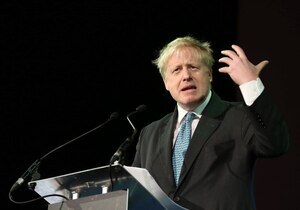
From top: British Prime Minister Boris Johnson; Dan Boyle

Boris Johnson seeks comparison with Winston Churchill. The better comparison would be with Alex Douglas-Home, the rather dull, unelected and ultimately unelectable, Prime Minister, defeated in the 1964 British General Election, mere months after Johnson himself was born.

Churchill was a product of Harrow and the military college at Sandhurst. Hume, like Johnson, was a scion of Eton and Oxford.

It isn’t difficult to see why Johnson wants to invite the Churchill comparison. He has even gone to the trouble of writing a biography of him.

Churchill undoubtedly is a British/English icon, but he was also a deeply flawed individual. Perhaps this is what Johnson identifies with.

Politically promiscuous, Churchill flitted between the Liberals and The Tories. Johnson’s chameleon-like behaviour saw him become a liberal Mayor of London, only later to embrace Brexitism as his preferred route to Downing Street.

Like Churchill, Johnson chose journalism as an entry portal for politics. Although the jingoism both wrote could hardly be described as journalism.

Johnson has practised a politics not based on values but on vanity. His strategic approach not calculated but more informed by fantasy.

Churchill, at least, seems to have had convictions. Even if they were often horribly applied.

If Brexit wasn’t a thing Johnson probably would have another context to define himself. His promise to lie before the bulldozers to prevent an additional runway being developed at Heathrow Airport, was an obvious attempt to add an green string to his bow.

Although in what has become typical Johnsonian logic, his proposal to avoid further environmental degradation at Heathrow was to suggest the building of an entirely new airport elsewhere.

His Kubla Khan garden bridge over the River Thames seems to have come from a similar place.

Subsquently abandoned by his successor as Mayor, this project encapsulates two defining features of his political career.

The first being a tendency to attach himself to the most immediate, most superficially popular cause. The second being an obvious lack of nous to succeed on those areas he has deliberately chosen not to understand.

The carefully cultivated persona of Boris would be considerably undermined if the the British and international media referred to him by his actual name – Alexander de Pfeffel Johnson.

If de Pfeffel was the media tagline instead of Boris, it would be a far more representative of the privilege and entitlement his barmy Brexit army have come to represent.

Stripped to his essence, at the heart of Alexander de Pfeffel Johnson is an emptiness, a hollowness, a shallowness. England deserves better. So do we.

Dan Boyle is a former Green Party TD and Senator and serves as a Green Party councillor on Cork City Council. His column appears here every Thursday. Follow Dan on Twitter: @sendboyle

Rollingnews


From top: Voting in the last General Election in 2016 at St Joseph’s National School, Navan Road, Dublin; Dan Boyle

One of the colourful phrases made by Brian Lenihan Senior, the perhaps unwitting wing man of the Haughey era, was his opposition to what he called ‘the futility of consistency’.

By his logic to be consistently consistent was to be closed to the need to be adaptable, to be flexible, to be pragmatic. To him, the essential tools of the modern politician.

To others it highlighted the vacuousness of his and his party’s philosophical approach to politics.

That of the catch all political party unencumbered with principles, free to move with prevailing winds, seeking the support of most whose collective opinion they sought to reflect, whilst seeking to cause the least offence (or alienation) to others.

Principle should be immutable. Almost. There has to be some room for Damascene conversion.

Strongly held, lifelong principles, shouldn’t be easily jettisonned. When they are it is for the holder of such principles to realise that they are wrongly held, that they may lack a sufficient basis in reality, or if ever applied they may result in unintended consequences.

Policies should always be adaptable. They are dependent on resources and conditions. They are prioritised against other policies. They have to be timetabled in terms of their implementation.

Prioritisation and implementation depends on negotiation. This occurs within political movements, about the political system, and should most importantly exist among the general public.

Strategy is the third part of this political Trinity. It is the means to the ends. The ends being implementing policies to widest possible degree in the quickest possible time.

This can be done through creating awareness, informing public debate, swelling a groundswell of concern leading to calls for action. This is more effectively done by campaigning organisations than it can be by political parties.

Those, individually and collectively, who seek and attain public office comprise themselves by doing so. In democratic societies it is necessary that they do.

In the two and half thousand years of modern democracy we have evolved far too slowly. We have yet to see one hundred years of universal sufferage, and that only in limited parts of the World.

Along with the right to choose, the right to be given an adequate choice should also exist. Again this is limited to far few places on the Planet.

Maintaining power, with the ability to make most decisions on 50% of the vote, remains a perverse Interpretation of what democracy should be about.

The more we weight majorities, and the greater use we make of such mechanisms, the more engagement with others has to be entered into. Surely the essence of democracy.

These are the principles that matter. What matters is the ability to engage the maximum number of people, making as many decisions as possible, in the most informed way, with the widest availability of choice, to the deepest degree of agreement.

By seeking to eliminate winner takes all democracy, we begin to question our hard core beliefs. We increase the need to co-operate with others, especially with those with whom we agree with least.

Politics that is more diverse is also more competitive. More competition on ideas places more threats upon the existence of traditional all things to all people political parties.

How does this lead on from Brian Lenihan Senior’s glib pronouncement? Let’s say he was half right but in the wrong way.

Dan Boyle is a former Green Party TD and Senator and serves as a Green Party councillor on Cork City Council. His column appears here every Thursday. Follow Dan on Twitter: @sendboyle

Rollingnews

Dan Boyle

I am sceptical about any Ism, religious or political. I don’t believe that there exists a collective system of belief, that somehow encapsulates an analysis of how we should behave in any given circumstance.

There is no cohesive collection of values, held by anyone, that can guarantee happiness.

At best, in the marketplace of ideas, Isms compete with each other. They test their most valued tenets through the lens of public engagement.

Success is sometimes a short term popularity. Real success is when tested ideas become established values, especially among the secular or the apolitical.

Where Isms are least successful is when they define themselves by what, or who, they are not.

Some Isms, those whose confidence seems to depend on it, exist by defining a mortal enemy, a polar opposite.

Where the defining energy of any movement is not about what you are but what you are not, not about what you are for but what you are against, any ability to persuade has already been lost.

The undermining of any movement occurs when negative traits dominate its thoughts and actions.

With religions the fault lines are when headline teachings, such as encouraging people to be kind and generous to each other, get sidelined by more obscure positions on dogma, such as proscribing sexual expression. Often hypocritically.

With political movements it occurs when popular policies get pursued less vigourlessly, because adherents over concentrate on strategy at the expense of implementation.

For sex with religion read prospective participation in government with politics.

Apparently it isn’t what you do, it’s who you decide to do it with.

Of such Augustinian philosophical contortions have many, invariably left wing, political movements foundered.

The price of losing the precious, ephemeral, quality of political purity matters more to some than having an ability to achieve change.

But purity may not be as pure as it is seems. What is displayed more often is a rigidity of opinion that reveals an incapacity to work with others.

Being rigid. Being prepared to preclude in advance those who need to be persuaded, hardly represents a strategy. Certainly not any effective one.

When urgency demands that the need to persuade be most immediate, refusal to engage is hardly principled. At best it is bloody minded. At worst it is horribly self indulgent.

Being holier than thou can sometimes be a successful political tactic. That doesn’t make it a valid one. Demonisation of others, can help achieve distinctiveness. But it is, ultimately, a hollow exercise in deceit.

Notoriety fades. Popularity mutates. Stand offishness creates it own sense of unfulfilled expectation.

Those who cheerlead from the sidelines tend to be the most faithless of suitors. When fickle enablers are gone, those who remain still need to be convinced.

That may be the only, actual, article of faith.

Dan Boyle is a former Green Party TD and Senator and serves as a Green Party councillor on Cork City Council. His column appears here every Thursday. Follow Dan on Twitter: @sendboyle

Pic: Denis Minihane

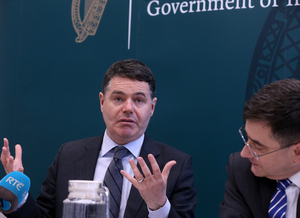
From top: Minister for Finance Paschal O’Donohue (left) and Department of Finance Chief Economist John McCarthy outlining the Stability Programme, which sets out revised macroeconomic and fiscal forecasts for the period 2019-2023; Dan Boyle

I’ve been mulling over a few figures. Ireland’s Gross Domestic Product has a value of around €300 billion. General government expenditure is little more than a quarter of our GDP. Total taxes collected are at a similar level, as we are balancing budgets.

Our general expenditure and overall taxation figures are the lowest among the OECD group of countries.

Much of our political debate centres around how money gets spent, often justifiably. Where we have a near absence of debate is on the efficacy or the efficiency of our taxation system.

Of course there are no shortage of all taxation is theft nuts. Nor those who see the proposal of any new measure as an assault on some exaggerated liberty.

What we have never properly have had is a debate on the advantages/disadvantages of high/low tax/spend policies.

For me public services are always better in high tax and spend countries. Conversely economic inequality is always worse in low tax/spend countries.

In Ireland we seem to want it both ways. We admire the sensibilities of the Nordic countries yet practice the fiscal aloofness of the US and the UK.

This is something we should be confronting before the start of the next (negative) economic cycle.

Not only are we on the wrong side of the tax and spend debate, we are to continuing not to learn the biggest lesson from 2008 the need to widen the tax base.

More than a decade on from then we remain over dependent on particular taxes that are hugely exposed in the event of an economic downturn.

We should have a larger basket of taxation measures. The more taxation measures that are in place, and the wider their application, the better the economy would be able to withstand any putative collapse.

Aside from what we tax and how we tax, is truly unasked question – from where do we tax?

Ireland’s city and county councils spend about €5billion every year. While this might sound an impressive amount of money, it really isn’t.

As proportion of our GDP our local government spending is miniscule, putting Ireland again at the unacceptable end of international comparisons.

When compared to national government spending (itself poor by international standards) our local government spending is especially lamentable.

Contrast Ireland with Denmark. There, by a factor of almost two to one, most public expenditure occurs (and taxation is collected) through local rather than national government.

Denmark is a country that is smaller in size but is comparable in population to Ireland. There is no reason that what is done there can also be done here.

So the questions we should be addressing are, firstly, can we as a country ever have the maturity to accept that we cannot have high quality public services with low levels of taxation?

Secondly, can we increase the spread of taxes, reducing reliance on particular taxes, to better protect public spending in the event of a downturn?

Finally when will we realise that taxes collected (and spent) locally gives us a bigger bang for our euro?

We obsess too much on headline rates rarely considering effective tax rates (which are rarely that effective).

Smarter taxes would be better taxes. Never the most popular thing to say. Never enough to convince those for whom tax will always be a four letter word.

Dan Boyle is a former Green Party TD and Senator and serves as a Green Party councillor on Cork City Council. His column appears here every Thursday. Follow Dan on Twitter: @sendboyle

Sam Boal/RollingNews


From top: Plans to demolish buildings in North Main Street, the medieval heart of Cork city, have caused outrage; Dan Boyle

I can’t say I didn’t know what I was getting into. I’m not lacking for things to do, or issues to respond to. A re-baptism of some heat, if not exactly fire.

My electoral area contains the island City Centre. At its core is the historic spine of the city. Joined on the northside by Shandon Street, led out on the southside by Barrack Street.

In between are North and South Main Street. Once the beating heart of a proud city, years of neglect have reduced the streets to a shabby shell.

North Main Street had carried a particular pre-eminence. The city faced northwards. The North Gate its imposing portal. Here stood Skiddy’s Castle. A seventeenth century stone carving of the City Coat of Arms, its only remnant.

Here is the birthplace of Terence McSwiney, the commemoration of whose death we are meant to be marking in 2020. The plaque identifying the house where he was born, is now semi obscured by a defunct neon sign.

Where North Main Street begins, and South Main Street ends, there are a number of Eighteenth century buildings. Each has had various stages of uses. One through embossed lettering on its frontage, continues to boast its once much loved status as Hosford’s Bakery.

Like much of North Main Street these buildings, and the streetscape they compose, have been listed in the National Inventory of Architectural Heritage.

However there has been no parallel listing of these buildings as protected structures in the Cork City Development Plan.

In December 2015 these four buildings were placed on Cork City’s Derelict Sites Register. Joining them was a large site further up North Main Street which housed a business known as the Munster Furniture Centre.

Unfortunately that business would soon become the victim of a curious fire that would raze its premises to the ground.

Also joining these properties on the register on that same day in December 2015, were two further buildings on Barrack Street. All these properties have/had the same beneficial owners.

Not a penny of the Derelict Sites Levy due to Cork City Council, for these properties, has been paid since.

Last week a partial collapse occurred in one of the buildings. The owners of the building, who prior to this had shown complete indifference towards maintaining them, moved with great alacrity to commission an engineer’s report suggesting demolition.

Soon a demolition company were on site. The expectation being that the City Council would pay for the demolition work, creating a newly cleared site that would be infinitely more commercially valuable.

The narrative being created of entrepreneurial souls who had taken a punt, at the wrong time, is utter bollocks.

Greed has been the only motivator throughout this saga. Negligence and contempt of the City we love, the only tools that have been operated by these sleeveens.

In a dramatic change of tack Cork City Council has been facing down these ingrates. By making it clear that no public money would be used to demolish these buildings, we may have crossed The Rubicon (or at least the North Channel of The Lee) in how we deal with dereliction in Cork.

Let’s be having more of it.

Dan Boyle is a former Green Party TD and Senator and serves as a Green Party councillor on Cork City Council. His column appears here every Thursday. Follow Dan on Twitter: @sendboyle

Pic: twitter

Previously: Get Medieval