Tag Archives: Denis Naughten

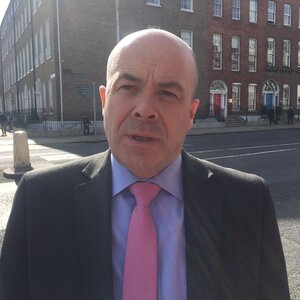
From top: Minister for Communications Denis Naughten and Fianna Fáil TD Timmy Dooley and Sinn Féin TD Brian Stanley

Earlier today.

In the Dáil.

Minister for Communications Denis Naughten was asked again about his contact with lobbyist for Independent News and Media Eoghan O’Neachtain in November 2016, in relation to INM’s proposed takeover of the regional newspaper group Celtic Media.

At the time, the minister told Mr O’Neachtain that he planned to refer the proposed takeover to the Broadcasting Authority of Ireland.

This discussion was then relayed to Denis O’Brien in an email of November 12, 2016.

This was two months before the minister’s plans were made public.

In addition, on December 6, 2016, Minister Naughten told Social Democrats TD Catherine Murphy and Sinn Féin TD Brian Stanley he had not yet decided if he was going to refer the proposed takeover to the BAI.

Minister Naughten never took a note of his mobile phone call with Mr Ó Neachtáin, he didn’t tell his officials and Mr Ó Neachtáin didn’t register the approach with the Lobbying Register.

Further to this…

In the Dáil this morning:

Brian Stanley: “Are there two types of meetings with your department? And two types of contacts? Both official and unofficial? And how many of these do occur?”

Denis Naughten: “We do comply with all of the standards and the legislation, as set out, as I’ve said. I’ve discussed this with my secretary general and he is reviewing the situation to consider if there are further changes. I, for one, won’t be taking any phone calls from lobbyists in the future, I can tell you that for nothing. But the reality is that we do comply with it, and as you know, if you look at the register I think, there are, I think 951 occasions in which my own name is mentioned in relation to various interest groups that have lobbied me since I was appointed minister. I think that’s an average of about 50 a month, covering a wide range – right from the environmental sector, right through to communications, energy, broadcasting media, right across the spectrum. So it is a very busy department, a very complex department – many aspects that are very technical and, as I said, I have discussed this with my secretary general.”

Timmy Dooley: “Look, if we could try and bring this thing to a conclusion, rather than having it, dragging it on, it doesn’t suit any of us. But I think we all have a responsibility to this House to try and get it tidied up. So, for me, there’s a couple of straight questions that you need to answer.

“And if you first accept that you provided confidential information, in other words, an insight into what you were, what you were ultimate intentions might be or your future intentions, and let’s not dance around the head of a pin and that, three weeks later, you came in here and misled the Dáil, albeit inadvertently, I would suspect, but nonetheless, you mislead the Dáil. There’s potential for all of us to do it. It’s just a matter of addressing it and getting beyond it. And that your actions amounted to wrongdoing.

“I don’t  bear you any ill will whatsoever. I have considerable sympathy for you, to be honest in this instance. The way you wandered into such a firestorm, but nonetheless minister, you’re responsible to the House. So there’s three things I think you need to do.

You need to accept that there was confidential information, because you did give insight into where you were, where you might ultimately go, you can put the caveat on it. The issue of misleading the Dáil and accepting it was wrongdoing.

“It doesn’t require you to resign, minister. Nobody has been really demanding that. But it requires you to be answerable to the House. And then I think, you know, this issue gets off your desk and gets off everybody’s desks.”

Naughten: “No, I did not give confidential information and I’m quite categoric in relation to that. The conversation that I had, and I sincerely regret that conversation, and I acknowledge that it was a political mistake to have that conversation and I’ve learned form my experience and I apologise for that. And I sincerely apologise for that.

“But I did not give confidential information, because I did not have any information available to me at that stage. The information that I had was the information that everyone else in this House had or was available on Google and yes, I do regret giving my opinion in relation to it at that point and the reality was that three weeks later, when I was here in the House, I had an active file in front of me at that stage, and it was a very different situation at that point.

“And I’ve been at pains to try and point out that. And I do sincerely regret it.”

Stanley: “Minister, just in relation to your reply. The problem arises that I asked you in October of 2016 about this and I asked you again on the 6th [of December] in a Priority Question here, in this seat, and you sitting over there in relation to what was your intentions regarding that merger and what you intended to do and you told me, and the transcript is there from that debate in the Dáil between you and I, that you had absolutely no idea, I remember you, I think you shook your head, as to what you were going to do with it. And you can say that in relation to, that you didn’t have the file in front of you at that point, that you hadn’t entered the process, and I know how that works, I’ve looked at all of that in detail.

“And I was following that very carefully at that time because we had huge concerns about that and I was raising it with you for months before that. But the problem, that’s where the problem arises.

“I accept the fact that you have apologised, what we wish to do now is to make sure that we tighten up all of this area…Would you agree that unofficial contacts with lobbyists, for ministers, has to stop?”

Naughten: “Look. Deputy Stanley, in my initial reply to you, to your supplementary, I said, look, I won’t be taking calls for lobbyists. I’ve said to you that I have discussed it with my secretary general and he will be reviewing the situation to see if there are other changes that, in procedures. But procedures are set out very clearly in relation to this and as I say, look, I have apologised for it. I do sincerely regret it. And look, I just want to get on, focus on the job and work that’s in front of me, the very demanding job, it’s a very demanding department and I know that all of you here want to do the same thing. And look, there’s nothing more that I can say in relation to this.”

Dooley: “I want to let you on with your job, I want to get on with mine. But I’m still at a loss as to understand, why you regret taking the call? Why you’ve apologised for taking the call? Why you’ve asserted that you’ll never take a call again – if you did nothing wrong in the first instance?

The facts remain, minister, that you fail to understand, by providing an insight into your thinking, a personal opinion, whatever it might be, that was confidential information. It’s the confidence of your own personal information that’s at play here – not access to some information in relation to your officials.

Because you had a hunch as to where this thing was going. And you gave that information to the lobbyist and he passed it on. Which is now the result, or is now forming part of evidence which the Director of Corporate Enforcement is using as part of his campaign to appoint investigators [into INM]. So it was confidential information, minister. That’s what you need to accept. That’s what you’ve identified as being regrettable for taking the call, that’s what you’ve apologised for. You need to start at the beginning and just accept that you provided confidential information, that it was wrong, it was on  a relatively low scale and it can be addressed within this House.

“Will you just please, just bring this to a conclusion, minister?”

Naughten:One, I did not give any confidential information. Two, I made it crystal clear that I would be guided by whatever advice that I got from my officials and the file shows clearly that’s exactly what I did. And the reason that I regret and apologise is this is the fourth day in a row, in this House, that we’ve been discussing this issue here regarding a 30-second conversation that I had giving an opinion that I sincerely regret giving and that’s why I’m apologising to this House and to the public out there. That his House has been preoccupied about this for four days in a row.”

Previously: ‘He Didn’t Do Any Favours For Denis O’Brien’

Naughten To See Here

Denis Denis

From top: Minister for Communications Denis Naughten; Taoiseach Leo Varadkar

This afternoon.

In the Dáil.

During Leaders’ Questions.

Fianna Fáil leader Micheál Martin again raised Minister for Communications Denis Naughten’s contact with lobbyist for Independent News and Media Eoghan O’Neachtain in November 2016, in relation to INM’s proposed takeover of the regional newspaper group Celtic Media.

At the time, the minister told Mr O’Neachtain that he planned to refer the proposed takeover to the Broadcasting Authority of Ireland.

This discussion was then relayed to Denis O’Brien in the aforementioned email of November 12, 2016.

This was reportedly two months before the minister’s plans were made public.

In addition, on December 6, 2016, Minister Naughten told Social Democrats TD Catherine Murphy he had not yet decided if he was going to refer the proposed takeover to the BAI.

Further to this.

This afternoon.

Mr Martin claimed the Dáil was mislead and said Minister Naughten should apologise to the Dáil, and correct the record of the House.

M Martin also added:

“His [Minister Naughten’s] officials in the department must have warned him in advance of this issue, given their experience in relation to the Moriarty Tribunal and the awarding of the State’s second mobile phone licence to Esat Digifone. We know that experience traumatised the officials considerably and obviously left a mark within the department.”

In his response, Mr Varadkar said:

“Minister Naughten didn’t do any favours for anyone. He didn’t do any favours for Independent News and Media. He didn’t do any favours for Denis O’Brien. In fact, his action was to delay the merger, delay the proposed merger between INM and Celtic Media by referring it to the Broadcasting Authority…”

Watch Dáil proceedings live here

Previously: Naughten To See Here

Denis Denis

This morning.

Minister for Communications Denis Naughten speaking to RTE One’s Martina Fitzgerald.

It follows a report in The Irish Times yesterday based on an affidavit sent to the High Court by the Office of the Director of Corporate Enforcement, in which it has asked the court to appoint inspectors to examine matters at Independent News and Media (INM).

The report stated, and Minister Naughten confirmed yesterday, that he spoke to Heneghan PR official Eoghan Ó Neachtain, who was representing INM at the time, on either November 10 or 11, 2016, about the proposed takeover of  the Celtic Media Group by INM to the Broadcasting Authority of Ireland.

Minister Naughten has told the Dail that he told Mr Ó Neachtain that he would likely send the matter to the BAI.

However, according to an email sent from Nigel Heneghan, founder of Heneghan PR, to Leslie Buckley, former chairman of INM, on November 12, 2016, Mr Heneghan wrote:

“The information, following Eoghan’s call with the minister which happened yesterday afternoon, is based on advice from his officials, he will pass it to the Broadcasting Commision [sic] of Ireland for review, because of the overall ownership of print and broadcast titled by DOB [Denis O’Brien].”

The decision to send the matter to the BAI wasn’t publicly known until January 2017.

In addition, he told Social Democrat TD Catherine Murphy in the Dáil, on December 6, 2016, that he hadn’t made a decision yet.

INM and the minister: who said what to whom and when? (The Irish Times)

RTE News/Martina Fitzgerald 


During Leaders’ Questions in the Dail this morning

This morning.

More details from the affidavit which the Director of Corporate Enforcement Ian Drennan has given to the High Court – in a bid to have inspectors investigate Independent News and Media (INM) – emerged.

Simon Carswell and Mark Paul, in The Irish Times, reported that on November 12, 2016, former INM chairman Leslie Buckley forwarded an email to INM’s largest shareholder Denis O’Brien which Mr Buckley had received from PR executive Nigel Heneghan.

The email from Mr Heneghan detailed a conversation the Minister for Communications Denis Naughten had with Eoghan O’Neachtain, director of public affairs at Nigel Heneghan’s PR firm the day before, November 11, 2016.

[Mr O’Neachtain took up the role at Heneghan PR in 2015 – after he served as Press Secretary to three Governments and Taoisigh]

The Irish Times has reported that Mr O’Neachtain’s conversation with Minister Naughten was about INM’s proposed takeover of the regional newspaper group, called Celtic Media Group and, in this conversation, the minister told Mr O’Neachtain that he planned to refer the proposed takeover to the Broadcasting Authority of Ireland.

This discussion was then relayed to Denis O’Brien in the aforementioned email of November 12, 2016.

This was reportedly two months before the minister’s plans were made public.

Further to this…

This morning.

During Leaders’ Questions…

Taoiseach Leo Varadkar was questioned about the matter.

Sinn Fein TD Mary Lou McDonald pointed out that the email sent to Mr O’Brien “stressed that the information contained within it should be treated with the strictest of confidence”.

Ms McDonald also said that the PR company didn’t log the engagement with the minister with the Lobbying Register.

As he responded, Mr Varadkar outlined the timeline of events, as he saw them – after he told the Dail that he is satisfied that Minister Naughten didn’t disclose any information which was confidential.

Mr Varadkar also said there appeared to be a misunderstanding about the process and that “it’s not a secret process“.

From his responses:

The minister informs me that it was the 4th of January 2017, and not November 2016. The information, as I said earlier, was not confidential. It is not unusual for PR companies and PR agents to use information that is not confidential or publicaly available and make out that somehow that it is confidential information.

“…I think deputy, almost anyone in Ireland can have access to a minister, it’s not that difficult to access politicians or ministers in Ireland, whether it’s through a constituency clinic or whether it’s simply by requesting a meeting or a phone call.”

“…In terms of timeline, I’m advised that the merge’s process went through the full rigour required of the Act and the guidelines after it was received by Minister Naughton on the 21st November, 2016.

The recommendation was made by officials on the 4th January 2017 – that the acquisition be referred to a phase two examination and that was approved by Minister Naughten on the 10th of January.”

Further to this…

A few weeks after this reported phonecall between Mr O’Neachtain and Minister Naughten on November 11, 2016, Social Democrats TD Catherine Murphy was told by Minister Naughten that he had not yet decided if he was going to refer the proposed takeover to the BAI (see above).

So.

It appears Minister Naughten told an INM representative but didn’t tell the Dail.

Deputy Murphy has said in a statement:

The entire matter really opens up questions, yet again, regarding the axis between powerful individuals and political decisions.“

Denis Naughten will give a statement to the Dail and take questions on foot of it at 3pm.

Meanwhile…

Readers may wish to recall that Nigel Heneghan was appointed to the Broadcasting Authority of Ireland in February 2015.

The position was not advertised.

At the time, the then Minister for Communications Alex White told The Sunday Times he wasn’t required to advertise the position as the compliance committee didn’t come under new rules for appointments to State boards.

In November 2016 – the same month that the alleged exchanges took place between INM representatives and the Minister for Communications Denis Naughten – Mark Tighe, in The Sunday Times, was reporting that Mr Heneghan had to excuse himself from discussions about several complaints it had dealt with because he was acting for two companies connected with Denis O’Brien.

Mr Tighe reported:

“Nigel Heneghan is a spokesman for Actavo, an O’Brien-owned construction services company formerly called Siteserv, and for Independent News & Media (INM), the newspaper publishing company in which O’Brien is the largest shareholder.

He declared conflicts of interests in relation to five cases before the BAI compliance committee, according to its 2015 annual report.”

“…Heneghan absented himself from cases involving complaints that dealt with water charges or Irish Water. Actavo was one of three firms contracted by Irish Water to install meters. It became a focus of protests after some people were temporarily jailed for physically stopping Actavo staff working on installations.

“Two of the cases in which Heneghan declared conflicts involved Newstalk, a national radio station owned by O’Brien’s Communicorp. The other three instances involved RTE Radio shows. Heneghan did not declare conflicts in relation to other Newstalk cases that did not involve water charges.”

O’Brien told of Minister’s plan to refer INM’s Celtic Media takeover (Simon Carswell, Mark Paul, The Irish Times)

BAI member in conflict due to O’Brien link (Mark Tighe, The Sunday Times, November 20, 2016)

Transcript: Kildare Street

Video: Mick Caul

screen-shot-2016-10-14-at-16-12-26

Minister for Communications Denis Naughten

Stephen Collins, in The Irish Times, reports:

The prospect of State funding for quality print journalism has been raised by Minister for Communications Denis Naughten.

Speaking to the Association of European Journalists in Dublin, the Minister said he would like to think that print journalism could draw down some of the money that goes to broadcasting at present.

…“The important thing is that there is content there that people can rely on,” he said.

The Minister said he would like the Oireachtas communications committee to look at the broad question of how quality journalism should be funded.

The public have respected institutions like our national newspapers. Like our national broadcasters, I think it is important that that trust remains there and I think it does need to be supported and that broader debate now needs to take place.

Thud.

Minister raises prospect of State funding for print media (The Irish Times)

Earlier: A Drop In The Ocean