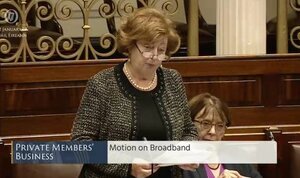
From top: light blue areas are where Eir has ‘committed’ to commercial rural deployment plans, amber areas are the target areas for the state Intervention of the National Broadband Plan and blue areas are where commercial operators are delivering or have indicated plans to deliver high speed broadband services; Catherine Murphy in the Dáil last night
Last night.
A Social Democrat motion calling for a “Government commitment that any National Broadband Plan roll-out will prioritise affordability for homes and businesses in rural Ireland” was debated in the Dáil.
Social Democrat co-leader addressed Minister for Communications Richard Bruton about the “laissez-faire approach to the original tendering and contract process”.
Investors in the only consortium left in the process include Denis O’Brien.
Ms Murphy said:
“Although the Minister for Communications, Climate Action and Environment, Deputy Bruton, has not been in his current role for very long, I know he appreciates that the national broadband plan process has been ongoing for several years but many people in modern Ireland still have limited or no access to the tools required to participate in a modern society and economy.
It is crucial that we deliver broadband to such people. However, I cannot emphasise enough that we must do so through an unimpeachable process in which the veracity of the winning bidder and its ability to deliver long term are verified as well in a way that focuses on the net result for consumers, particularly in terms of affordability and broadband speed.
There is no point going ahead with the process if an average household will not be able to afford to connect to the infrastructure that is finally put in place or the network ultimately proves inadequate.
This must be about empowering our citizens to connect to a globalised world in their business and personal endeavours.
The process must guarantee the ability of the winning bidder to deliver the project or else the Exchequer will end paying by way of a State subsidy and-or citizens will pay the price of not being able to connect to broadband.
We must remember that if the contract is awarded, it will run for a considerable period of time. If we do not get it right, it could be very problematic to reverse it and doing so may involve the payment of compensation.
The old adage is that one must learn from past mistakes, yet nothing in the broadband process to date gives me confidence that we will not repeat current and past mistakes when it comes to the tendering process and the eventual awarding of the contract.
The results of the clearly flawed process for the development of the National Children’s Hospital are coming home to roost, involving colossal cost overruns, deadlines that have been missed on more occasions than I care to count and serious frustrations on all sides of the project.
Members on this side of the House are being asked to blindly trust the people responsible for projects such as the national children’s hospital to make the final decision on the national broadband plan. The metro north project went through a similarly incoherent and rocky process involving numerous incarnations and setbacks.
The same can be said of Luas and the eventual need for a cross-city Luas line which had been included on the original plans. In fact, there are myriad projects to which one could point as examples of the continued inability of this State to get major projects right first time. I acknowledge that this did not all happen on the Minister’s watch. There is ongoing failure in regard to such projects.
The penny must drop that we need to look at what we have been doing wrong in regard to such failures rather than just blame it on a system failure. If there is a system failure, one must fix the system.
The problems that have emerged with the national children’s hospital, for example, are not in the main resultant from something that happened after the project began. The major cause of the issues is a laissez faire approach to the tender and contract process before the project commenced.
If one does not ensure that the design plan, building blocks and builder are the correct choices, one will have a less than satisfactory outcome. That is why this period in the life cycle of the national broadband plan is of such importance. If we do not get things right now, we will pay the price at a later stage.
We have a one-off chance before any contracts are awarded to ask whether we can stand over the process to date and genuinely believe that the process as it stands will deliver the best possible outcome for users and the Exchequer.
All Members are aware of the significant and serious questions which arose during 2017 regarding the handling of the national broadband plan by the then Minister, Deputy Naughten. At the crescendo of the controversy, I, as well as members of Fianna Fáil and other Deputies, stated that the national broadband plan was fatally flawed.
The Government commissioned a report by Mr. Peter Smyth in a bid to prove otherwise and reassure people that the Minister attending various dinner parties and exchanging regular private calls and texts with the owner of the sole remaining bidder was not a problem.
At the time, I raised concerns about the ability of Peter Smyth to be entirely impartial in his report because he was the process auditor throughout the process which caused the controversy. It was a process failure and he was auditing that process.
When the Smyth report was furnished to the House, most Members were underwhelmed by its watery findings. In the absence of minutes or a written record of many of the interactions between the then Minister, Deputy Naughten, the Minister of State, Deputy Breen, and Mr. David McCourt, Mr. Smyth took the key players at their word that nothing inappropriate had occurred.
When Mr. Smyth commented at a follow-up press conference that he did not interrogate the then Minister or Mr. David McCourt because he did not think it appropriate to do so, he significantly undermined the veracity of the report and left serious question marks over the relationship between a Minister and a billionaire businessman – an all-too familiar vista in major communications contracts. In that regard, we must consider the learnings, or lack thereof, from past mistakes.
In the same way, we must look to the forerunner of the national broadband plan and ensure the lessons from its roll out and operation inform the broadband plan.
The municipal area networks, MANs, project was established in 2004 and contract extensions to run to 2030 were awarded to Enet in 2016. There remain question marks and ongoing court proceedings regarding the detail behind those contracts and their extension. However, in spite of orders by the information commissioner and the High Court to release the details in the public interest, the Department has continually refused to so do.
It has brought an appeal to the Court of Appeal – which, obviously, will be a costly exercise – to keep information the release of which has been determined to be in the public interest out of the public eye. Such secrecy rings warning bells and flies in the face of the stated ambition of an open government or governance approach to the process.
Leaving aside the significant questions regarding the contract process for Enet and the MANs, there are question marks over the operation, efficiency and usefulness of the plan in terms of the end user take-up of the networks.
In 2014, BT Ireland wrote to the Department expressing serious concerns regarding how Enet was operating the municipal area networks.
Several people and businesses, including public bodies, were unable to connect to the network due to the prohibitive cost.
Many industry experts have questioned the scale, coverage and take-up of the MANs across the country.
Those living in the intervention area should pay serious attention to this because if we do not learn from that process, exactly the same thing may happen with the national broadband plan.
A recent freedom of information dump from the Department to The Irish Times journalist Jack Horgan-Jones included a briefing note prepared for the then Minister in 2016 ahead of a meeting he was due to have with Mr. David McCourt who, at the time, was heading the consortium which had acquired Enet, which was operating the MANs.
The briefing note was prepared two years after BT Ireland, a major telecoms player with significant expertise, outlined to the Department its serious concerns regarding the operation of the MANs by Enet.
The briefing note of 2016 makes absolutely no reference to those concerns and states the MANs programme has proven effective. It has not proven effective if concerns are being raised by businesses and individuals and if there is a proven difficulty with take-up and cost.
It is surely hard to argue that a briefing that fails to acknowledge the serious concerns of a major industry expert like BT is comprehensive. One cannot just ignore that.
Thus far, only part of one of the two Department-commissioned reports into the MANs, namely, the Norcontel report, has been put into the public domain. We are still awaiting the publication of the Analysys Mason report into the operation of the MANs.
It is ridiculous that we do not have the information to allow us to consider this issue adequately and determine what has gone wrong or right in order to inform our consideration of the contract. Very often one is an expert after completing a process but one really needs to be an expert in advance.
The documentation on the experience of the forerunner to the national broadband plan should seriously comprise one of the most important sets of documentation available to the Minister and Opposition. That such secrecy and obfuscation surrounds this process should be a concern in and of itself.
That the Minister and his Department have pushed two court appeals – it may well have been prior to the Minister’s tenure – rather than accepting the High Court judgment and a ruling of the information commissioner to release details of the MANs contracts with Enet should raise eyebrows.
That the Peter Smyth report is, by its author’s own admission, lacking in veracity should raise concerns in its own right.
That the process has found itself with only one remaining bidder should raise eyebrows. Surely a contract of this magnitude should have had competitors beating down the doors to win it, yet we are aware that major telecommunications players such as Eir and SIRO pulled out of the process.
They cited governance and regulatory concerns. Do we really know what those concerns are? Have they been properly interrogated? Have we satisfied ourselves as to what governance and regulatory concerns Eir and SIRO were referring to? I do not believe we have.
At my request, Eir has agreed to appear before the Committee of Public Accounts next month. SIRO has not accepted that invitation. Enet has agreed but with some significant caveats as to what it will and will not discuss.
As I understand it, there is no comprehensive map within the Department or regulator of the networks that might already exist or the take-up of broadband within those networks.
Surely it makes sense to have an audit of current capacity before ploughing ahead with anything new so we can reduce duplication and possibly cost. For example, the ESB rolled out a significant fibre-optic domestic network using EU funds.
Individuals with more technical knowledge than I have told me it would not be a major job to use those networks to tack on the necessary hardware for broadband capabilities…
Similarly, we are aware that Bord Gáis rolled out the Aurora network and that Esat laid lines across parts of the country – for example, between Ballina and Tubbercurry.
Again, this was with EU funding. Eir is currently providing fibre-optic cabling to areas it deems economically viable in terms of its bottom line. What consideration, if any, has been given to the possibility of using any, or all, of these networks, even for a partial rolling out of broadband?
As I understand it, the ESB domestic fibre-optic network was established at a cost of €59 million. To date, has any discussion taken place between the ESB and the Department about the potential use of those networks?
The MANs, despite being operated by Enet, comprise a State-owned asset. Surely we must ensure that any current or future use of the infrastructure must oblige the user benefiting from the public finances to provide the service to all, regardless of the cost to the provider.
Having said that, I am acutely aware of the warning given at a conference by one of the consortia. It said a genuine discussion needed to take place on rolling out broadband to the last 15% of the country in terms of economic viability.
It said we needed to have an honest discussion about that. I would like to hear the possible impediments in this regard. I am sure they would have been articulated in outlining the problems with the roll-out.
Rural areas are affected but not-so-rural areas are also affected. Pockets of my constituency, which is really seen as the commuter belt area, are affected. The constituency is not exactly the most rural part of the country but it has pockets with very unreliable broadband.
Therefore, it is not an exclusively rural issue. Even in this city, there are spots where broadband is not particularly good. The required service can be guaranteed only if we get this process right while we have a chance.
Otherwise, we might find that a consortium of self-interested businesspeople will be given free reign to choose when and where it suits it to prioritise and how affordable it decides to make the end product.
There are those who are not taking up the MANs because of affordability. I cannot emphasise this enough.
It is very obvious that there is a really serious problem of institutional deficiency in the oversight of capital projects. There are some areas in which we do reasonably well because there is much expertise, such as roads, but with regard to some of the other projects it is as if we are spending Monopoly money, not the people’s real money.
We have got to be prudent about the process; otherwise it is going to be costly and will potentially not deliver on what has been promised.”
Minister Bruton’s response here
Last night: Broadband On The Run