
Tag Archives: Derek Mooney

From top: Pro-life campaigner Maria Steen and Solidarity–People Before Profit TD Brid Smith on last night’s Claire Byrne Live; Derek Mooney

On the morning after the night before’s hyped-up 8thRef Claire Byrne debate: committed Yes campaigners are insisting that the Yes side won it while staunch No activists are declaring with equal ferocity that their side prevailed.

In my own view, neither side significantly moved the dial among undecided voters with the real loser in the whole sorry mess being public sector broadcasting.

This was not the fault of the presenter/moderator Claire Byrne or any of the lead speakers for the Yes or No sides, but of the folk in RTÉ who decided that having daytime TV style confrontation in front of a cheering crowd was the best way to discuss a fraught, complex and emotionally charged issue.

What was needed was a calm, respectful and reflective discussion, in its place we got a he said/she said wall of noise. It needed Jeremy Vine, we got Jeremy Kyle.

All that was missing to make the Jerry Springer Show effect complete were lurid chyrons running across the bottom of the screen screaming the titles of upcoming shows: I get turned on by number 1s, but not number 2s or Spoiler Alert: they’re topping the poll.

OK, I exaggerate, though the Brid Smith versus Maria Steen encounter, complete with audience boos and hisses, did make me wonder if Steve Wilkos and a team of black t-shirted security staff were waiting just off camera.

So, what was the problem with the format? It was the audience. Not any one individual or even a group of individuals, but rather the constant and incessant cheering and clapping for speakers on their side and the hectoring of those on the other.

No doubt, each side will claim that the other one went further in heckling or shouting down the other, but that doesn’t matter.

The question is why the debate was formatted and structured in such a way as to allow them to do it. Actually, if I was really bad minded, I might even wonder if is was structured in such a way as to encourage it?

Think back to any of the US presidential debates of the last decade or so. In each of them, the moderator has opened proceedings by setting out the debate rules, as decided by the US agency that arranges the debates: The Commission on Presidential Debates.

The host then explains that the audience must remain absolutely silent for the duration of the debate, with the exception of welcoming both candidates out on to the stage, so that people at home can focus on what the candidates are saying.

Opening the second presidential debate of the 2012 campaign between President Obama and Mitt Romney, the moderator CNN’s Candy Crowley, announced:

“The audience here in the hall has agreed to be polite and attentive — no cheering or booing or outbursts of any sort.”

The format of this debate was what American broadcasters call a town hall. There ordinary voters ask their questions of the candidates directly, but that audience is made up of uncommitted voters chosen by independent pollsters.

Much of last night’s audience were chosen by the two campaigns. Both of whom seemed more interested in getting as many loud and vocal people there as possible.

I know that I am at risk of sounding po-faced, or even hypocritical. I have not been averse, in the past, of doing a bit of fairly boisterous heckling at political discussions – not all of them involving other parties.

Like many politicos of my vintage this also included a few stints in the audience of the grand old dame of Irish TV political debates Questions and Answers.

There I would attempt my faltering impression of an innocent member of the public. It was unconvincing. Indeed, the only thing worse was my dire impression of an electable politician, but we live and learn.

I know that political shows can be boring or tedious and need a bit of showbiz and spectacle from time to time. I realise that listening to a procession of TDs and Senators drone on can be a ratings killer. But going the opposite way is not the answer.

The secret is knowing when the time is right and how far to go. Last night was an example of getting the mix wrong – and it is not the first time.

We saw the same format deployed to equally unsatisfactory effect almost seven years ago in the 2011 presidential election debates – though that night had the added frisson of dodgy tweets.

Surely the only lesson they learned in the intervening time cannot just be: don’t read out the Tweets?

While we do not need to go as far as setting up a dedicated quango dealing with debates, be they presidential, Dáil or referendum along the lines of U.S. Commission on Presidential Debates, the decision on formats should not rest with the broadcasters alone.

There should be a role for an independent electoral commission, charged with overseeing our electoral process.To be fair, this government is looking at setting up such a commission.

The 2016 Programme for Government states:

A) Establishing an Electoral Commission

We believe that Ireland needs an independent electoral commission, as a matter of priority.

The new commission should examine the voter registration process and in particular the possibility of the PPS system being used to automatically add people to the electoral register once they reach voting age.

It should also look at ways to increase participation in our political process through voter education and turnout.

The new commission could also:

Assume the role of Registrar of political parties

Regulate political funding and election expenditure

Oversee the Referendum Commission, which would be a sub-section of the commission

The newly established Electoral Commission would be independent of Government and directly accountable to the Oireachtas.

As with many things the promise is there, it’s the action that is missing. The last time the electoral commission issue was raised with Taoiseach in the Dáil appears to have been back in October 2017.

Back then he said:

“There is no timeframe for it. It is very much a long-term project.”

Given that this government’s remaining time in office can be best measured in months, not years, we see that 2011 and 2016’s “priority” is today’s: “Meh, we may get around to it.”

To be fair, in the hierarchy of this Government’s broken promises this one does come a fair bit down the list, but that does not excuse its lethargy.

With a little bit of political will and Dáil time the legislation could be processed speedily. A nascent Electoral Commission could be in place for a presidential election later this year.

Much of the preparatory work has already been done. The various reports, consultation and scoping documents are already there. I understand that the Department of Environment has been preparing a Regulatory Impact Analysis for a draft Bill.

The aims and intentions of James Lawless’s Online Advertising And Transperancy Bill could be rolled into it too, so that electoral fairness is not depending on the largesse of the IT giants.

So, what’s the delay? Must we wait for Russian interference to finally act?

Derek Mooney is a communications and public affairs consultant. He previously served as a Ministerial Adviser to the Fianna Fáil-led government 2004 – 2010. His column appears here every Tuesday Follow Derek on Twitter: @dsmooney

Watch Claire Byrne Live here

Top pics: RTÉ

From top: Taoiseach Leo Varadkar with British Prime Minister Theresa May; Derek Mooney

I opened my third Broadsheet column with a 1962 quote from the former US Secretary of State, Dean Acheson:

“Great Britain has lost an empire and has not yet found a role”.

When that column appeared at the end of May 2016 the U.K. Brexit referendum vote was still three weeks away. We still had hope.

Almost two years later and Acheson’s quote seems truer than ever. Over the past few weeks we have seen increasing evidence that the UK Cabinet is incapable of agreeing a common and unified position on the Customs Union and the Single Market.

On one side you have the beleaguered Prime Minister and Tory leader arguing for a “customs partnership” that would see the UK just outside the existing EU Customs Union but remaining so aligned with it and EU standards as to render borders unnecessary.

On the other, you have the arch-Brexiteers like Boris Johnson, Michael Gove, and Liam Fox claiming that any form of customs partnership either renders their plans for great trade deals for the UK with China, India and Burkina Faso redundant or is tantamount to staying in the customs union and “ties” the U.K. to a E.U. that they want to leave a mensa et toro.

What is odd about the Brexiteers current manoeuvres is that some form of customs partnership or association has been on the table from the British side, almost since Day One of the Article 50 Brexit negotiations.

Speaking at Lancaster House in January 2017 from a text that had been signed-off on by her Cabinet, Theresa May said:

“But I do want us to have a customs agreement with the EU. Whether that means we must reach a completely new customs agreement, become an associate member of the Customs Union in some way, or remain a signatory to some elements of it, I hold no preconceived position. I have an open mind on how we do it. It is not the means that matter, but the ends.”

Showing that the Brexiteers are preoccupied with means, not ends, one of that faction’s spiritual heavyweights and living embodiment of what Dean Acheson was talking about, Jacob Rees Mogg, took their argument several steps further on ITV’s ‘Peston Show ‘on Sunday claiming that some architects of the Good Friday Agreement were engaging in “disgraceful” politics, seeking to keep the U.K. in the EU.

In other words, how dare anyone on this side of the Irish Sea attempt to remind the UK of its many obligations under the Good Friday Agreement, a binding international treaty between two sovereign governments.

He was not the only one at it.

The former UK Ambassador to the US, Sir Christopher Meyer was attempting to use the Good Friday Agreement to threaten Ireland and the rest of the EU 27 with a no-deal Brexit and a hard border across the island.

In a bizarrely intemperate tweet the ex- diplomat accused the EU of weaponizing the Irish issue and predicted that the EU would “either fracture the UK, betray the GFA by promoting a united Ireland through the back door, or betray the referendum-or a mix of all three.”

This is shameful stuff. One of the great achievements of the Good Friday Agreement, and its many architects, is that the Agreement explicitly recognises re-unification by consent as a legitimate aspiration.

To try to perversely claim that the momentum to re-unification that has been prompted by this Brexit madness is somehow a betrayal of the Good Friday Agreement, is reckless and indicative of desperation.

Yet, this is the level of inanity to which some British political leaders, though it would be far fairer to say English, have descended. Sadly, not all of them on the right either, but more of Corbyn and his empty opposition on another day.

But back to Acheson and his 1962 quote.

Though it was made in the wake of Suez crisis and the declining British influence on the World stage, Acheson’s wider comments are harsh but extraordinarily prescient. His analysis of Britain’s predicament is not as glib as the one-liner might suggest and could, with just a few tweaks, be applied to the current saga.

According to report of his remarks in the Guardian on December 6th 1962:

Mr Dean Acheson, former United States Secretary of State, asserted today that Britain’s role as an independent Power was “about played out.”

He told a conference on American affairs at West Point Military Academy that Britain had lost an empire and had not found a role.

H e added:”Britain’s attempt to play a separate power role – that is, a role apart from Europe, a role based on a ‘special relationship’ with the United States, a role based on being the head of a Commonwealth which has no political structure or unity or strength and enjoys a fragile and precarious economic relationship – this role is about played out.

“Great Britain, attempting to work alone and to be a broker between the United States and Russia, has seemed to conduct a policy as weak as its military power.” Mr Acheson is President Kennedy’s special adviser on NATO affairs.

Mr Acheson said that Britain’s application for membership of the Common Market was a “decisive turning point.” Should Britain join the Six, “another step forward of vast importance will have been taken.“

It is both painful and difficult to watch our nearest neighbor and onetime steadfast EU ally turning back the clock and leave the institutions of the EU that have brought us closer together, but that is their decision and they have decided that this is what they must do.

But – to revive another political (mis)quote from the 60s, though this time closer to home – we cannot be expected to stand idly by while their ill-judged and impulsive folly inflicts damage and cost on this island and this jurisdiction.

Derek Mooney is a communications and public affairs consultant. He previously served as a Ministerial Adviser to the Fianna Fáil-led government 2004 – 2010. His column appears here every Tuesday Follow Derek on Twitter: @dsmooney

Top pic: getty

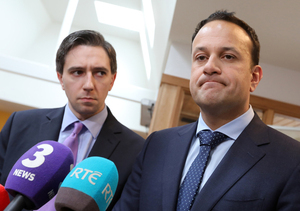
From top: Minister for Health, Simon Harris (top eft with Taoiseach Leo Varadkar will this afternoon let the Dail know what action the Cabinet has approved to deal with the ongoing crisis in CervicalCheck; Derek Mooney

Last week’s Dáil furore and the heightened tensions between Fianna Fáil and Fine Gael persuaded me to use this week’s column to discuss the worsening relations between the main government and the main opposition parties.

I still intend to do that, but in much lesser detail. The scandal engulfing the CervicalCheck scheme and the torment that Vicky Phelan, her family and hundreds of other families have been put through by the State and the HSE makes any discussion of the friction between the parties pale by comparison.

But, as experienced political commentators have noted, the screening scandal has the makings of major political crisis if it were to emerge that more was known by the Department and, by extension, by a Minister.

This is still a big “if” as I write. While it has the potential to be a political crisis, it will not become one on the back of speculation or the trailing of crumbs alone, it will require something more substantive.

Minister Harris has acted and sounded in recent days like a man determined to address the problem and unafraid to call the situation as he sees. An impression re-enforced by the HSE boss saying that he wouldn’t have gone on the media, as Minister Harris did, to express a lack of confidence in the service’s management.

It is as if Minister Harris has studied Michael Noonan’s 1996 Dáil statement on the Bridget McCole case and learned how not to handle such a crisis.

Noonan later admitted that he had made a mistake in listening to the legal advice that he should not intervene in the McCole case and acknowledged how much he regretted that decision and his role in that saga.

Harris, Varadkar and every Minister should learn from Noonan’s situation. But there are no hard and fast rules on when to heed and when to disregard legal advice. That requires political judgement. You either have that, or you don’t – something that a severe Dáil grilling will expose.

The Taoiseach and the Health Minister will come under intense pressure in the Dáil today as try to address the many questions the opposition parties and groupings will hurl at them.

They will be expected, at a minimum, to guarantee that the independent inquiry into the CervicalCheck controversy is established quickly; to ensure that all the information regarding the delayed diagnosis of cervical cancer is provided speedily to those affected and to publish the departmental note the Minister was given about the Vichy Phelan case just before the court hearing began.

They will also have to come up with a proposal for mandatory open disclosure, something that was promised by Varadkar when Minister for Health and then abandoned by him in early 2016.

This will be a big test for the Taoiseach and his ministers. There are no bonus points for coming through it, but there plenty of negative ones if you come across as ill-prepared, ill-informed or unsympathetic. It is a delicate balancing act.

You cannot throw your officials under a bus just to save your own skin, but neither can you come in and act like a departmental official, reading from a closely worded script designed to obfuscate and confuse.

It is a test they are taking against the backdrop of the soured relations with the main opposition party that I mentioned at the outset.

While the focus of the debate and exchanges will rightly be on the lives affected by the delayed and incorrect results, the politics of the past two weeks may also leach into those interactions.

While assorted pundits and political activists may be uncomfortable with the current confidence and supply arrangement, it seems that the electorate are not as disapproving or, at least, they haven’t been up to now. Indeed, successive opinion polls have shown that likely voting intentions would not significantly alter the political make-up of the Dáil.

While the poll shifts affect the margins, the core positionings remains the same – though a new permutation: a majority coalition of Fine Gael and Sinn Féin now appears more arithmetically and politically possible.

That political possibility increased with last Friday’s two Seanad by election results. These mini-elections saw Sinn Féin Oireachtas members vote for the Fine Gael leadership anointed nominees on both panels with a greater zeal than some of their Fine Gael colleagues.

While the anti-brexit, unionist, Northern Irish farmers leader, Ian Marshall, was always likely to take one of the vacancies, the other one – which most of us expected to see go to an anti-brexit northern Irish nationalist, but somehow one was never nominated – ended up as a mano-a-mano fight between two former TDs: Fine Gael’s Anthony Lawlor and Fianna Fáil’s Niall Blaney.

Sinn Féin had a simple choice to make: which candidate represented the party they hated least. The Shinners decided that it was Fine Gael.

These wins stoke up tensions for the confidence and supply deal, a deal which unlike a particular woodstain/paint, does not exactly do what it says on the tin.

As one of the main negotiators behind the Good Friday Agreement explained to me in Belfast a fortnight back, the issue with calling the arrangement between Fianna Fáil and Fine Gael a confidence and supply agreement is that it gives the wrong impression of the relationship and raises unachievable expectations.

While Fianna Fáil did secure commitments on 42 policy specifics on a range of issues such as housing, public services, crime and the economy, not to mention reversing Fine Gael’s plans for Irish Water, it is hard to categorise their implementation under Varadkar’s stewardship as anything but grudging.

My friend’s suggested description of Fianna Fáil’s role is not as a supplier of confidence, but rather as an opposition that is enabling the government to govern. Indeed, the text of the agreement itself uses similar language referring to it as facilitating a Fine Gael led Minority Government to govern. So instead of a confidence and supply arrangement, Fianna Fáil is in an enabling opposition one.

This may appear to be a Jesuitical distinction, but is an increasingly important one, now that the Taoiseach has opted to ramp up tensions and announce that he is telling Ministers and their political staff to keep lists of opposition promises.

There are two curious elements to his warning.

The first is that he feels he must tell them publicly. Irrespective of whether your party is in office or not, you keep a tally on what your opponents are promising. This is what political parties do. It is called opposition research. They don’t need to be told to do it, unless they are incompetent.

The second, is that the Taoiseach singled out Fianna Fáil. Why only Fianna Fáil? Most recent newspaper polls do not show it posing any growing threat to Fine Gael’s lead, so why these sudden shows of twitchiness and tetchiness from Merrion Street?

Could it be a case of getting your revenge in first? The Taoiseach may now fear that Fianna Fáil’s lengthy becalmed position in the polls will leave its leadership with no alternative but to up their game and increase their attacks on Leo and his ministers.

So, it is just political theatre and is for public consumption. Up to now the mantra from government and main opposition party alike is that there is no public appetite for an election.

Might the Taoiseach’s increased twitchiness be a sign of his frustration at relying for his day-to-day survival on squabbling independents and an impatient main opposition party?

Might he have concluded that the best way to bring each to heel is to start shifting the public’s “no mood for an election” disposition by hinting of the possibility of a trip to the polls before year’s end?

If it is, then the Taoiseach should be careful what you twitch for. Political momentum in politics is an odd thing, especially when so many events are beyond your control.

Derek Mooney is a communications and public affairs consultant. He previously served as a Ministerial Adviser to the Fianna Fáil-led government 2004 – 2010. His column appears here every Tuesday Follow Derek on Twitter: @dsmooney

Rollingnews

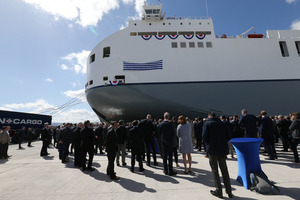
From top: the MV Celine at Dublin Port last Friday; Derek Mooney

Up to last Friday it was difficult to find a good visual representation for Brexit in Ireland. Yes, there were maps showing the six counties in one colour and the 26 in another, but apart from those or some grainy photos of border posts and black coated customs men standing behind old tin signs emblazoned “Stad”, there were few clear, defining symbols for Brexit in an Irish context.

That all changed last Friday.

The change came in the form of a ship. But not just any ship. This one, christened the MV Celine by the Taoiseach and assorted other lesser celebrities, is the world’s largest short sea, roll-on roll-off cargo vessel. It will directly connect Ireland to the European continent via Rotterdam and Zeebrugge, by-passing the UK entirely.

As images go, it is an impressive one. But the image-makers real triumph lay in finding an appropriate nickname for the newly named ship.

While “Celine” may be the official name that adorns the ship’s champagne drenched hull, the spinners on the quayside were intent that the media – and by extension we – call it by their chosen soubriquet: “the Brexit Buster”.

What a coupling, a damned big ship with an on-message nickname. It is a neat piece of messaging, conveying the impression that Ireland is ready and prepared for the worst that Brexit can throw at us.

The MV Celine’s statistics are striking. At 234m in length, the Celine is, in terms of capacity, twice the size of any other ferry currently operating out of Dublin Port. It can hold 580 standard truck trailers along 8km of parking lanes.

But size isn’t everything.

The real significance of the MV Celine is that it points to our post Brexit trading future. A future where Ireland’s EU27 imports and exports no longer must go via the UK and suffer the hassle, time delay and cost of having to going through not one, but two, sets of customs and border patrols as they enter and then exit the UK.

This is important as around 80% of Irish road freight, destined for the rest of the EU, goes across the UK. This is what some call our land bridge to EU, though it is hardly much of a land bridge when you must take a ferry at each end.

If you want a sense of the scale and extent of the delay and inconvenience we will may face in the worst post Brexit scenarios, then consider this simple fact: goods going through Dover from outside the EU take 15 times longer to process compared to those coming from within the EU (45 minutes from outside versus 3 minutes from inside).

Can you imagine the accumulated tail backs there will be at British ports? Now, multiply all those delays by two as Irish goods going to or from the EU across the UK will have to face those potential delays twice: once as they enter the UK and once as they leave it.

In the absence of some alternative direct routes, the UK’s national customs computer system will be handling both the inward declarations of Irish exports to the UK and the transit of Irish goods travelling through the UK and on to mainland Europe.

But, the UK’s national customs computer system is due to be replaced, with the new Customs Declaration Service (CDS) system due to launch in January 2019, two months before the UK brexits. As if that were not worrying enough, a UK National Audit Office 2017 review of the UK customs computer system’s readiness for Brexit found that

“…there is still a significant amount of work to complete, and there is a risk that HMRC (Her Majesty’s Revenue and Customs) will not have the full functionality and scope of CDS in place by March 2019…”

So, assuming the British government does what it currently says it will and exits both the Customs Union and the Single Market as well as the EU, then it is essential that Ireland to look for better routes to send our good to and from the rest of Europe.

These routes are vital for us as an island nation as seaborne freight accounts for 84% of Ireland’s trade in terms of volume and 62% in terms of its value. It is also highly focused on one location with 46% of all seaborne trade (by volume) passing through Dublin Port.

But, impressive as the MV Celine may be, one ship is not going to be the solution to our problems. Neither will two or three such vessels.

The real value and importance of the MV Celine right now is not the number of trucks she can carry every 38 hours to Belgium or Holland, but rather in the policy course she sets.

Should we now be looking at developing new direct shipping routes with mainland Europe, particularly with France, Belgium and the Netherlands?

But that question begets another one, are we right to assume that all these new routes should have Dublin port as their Irish hub? Should we not now be seriously evaluating our infrastructure capacity and looking to develop other Irish ports to serve these new shipping routes?

Some 60% of the trade at Dublin Port involves the UK – would it not make more sense, especially as they are investing in new customs and border facilities at the port, to make Dublin the key point of entry for our UK only good traffic, along with Drogheda and some other ports along the eastern seaboard?

Might this be a way of freeing up some extremely valuable land in and around Dublin Port for much needed high-density development in the centre of the city?

Might Brexit planning provide an opportunity for dusting off the PD’s 2006 New Quarter proposal, though this time with a more sensible and scaled down version that does not see the whole of Dublin Port shut down and shipped Northwards.

We should be considering expanding Rosslare and/or developing a new purpose-built port along the South East or Southern coasts to serve the new fast EU shipping routes.

One of the potential attraction of Rosslare, as Irish Rail was keen to tell the Seanad Special Select Committee on Brexit, is that Irish Rail is the port authority for Rosslare-Europort and so investment plans could be put in place that do not impact on the debt levels of Irish semi-state-owned ports.

Not only that but including Irish ports in the trans-European transport policy (TEN-T) could mean EU infrastructural funding for the “necessary modifications to Irish ports”.

Modification is an understatement. Increased direct shipping volumes with mainland Europe would require major infrastructural investment to provide modern facilities that provide for the speedy and high-tech loading of these faster roll-on/roll off vessels.

Perhaps the image of the ship is all the government wants just for now and so it sees its job as done, for now. Hopefully this is not the case, though it often seems to be this government’s modus operandi.

Hopefully there are contingency plans sitting on a desk somewhere while Ministers and officials wait to see if Theresa May eventually opts, when all other avenues are hopefully closed off, to take the avenue of keeping the UK in either “a” or “the” Customs Union and “a” or “the” Single Market.

If she doesn’t, then we will have very little time to act. So, now is a good time to start the feasibility planning and commence talking to a variety of international experts who know how to build, equip and run these modern ports.

Maybe that way we can turn the floating impression that Ireland is ready and prepared for Brexit into a more anchored reality.

Derek Mooney is a communications and public affairs consultant. He previously served as a Ministerial Adviser to the Fianna Fáil-led government 2004 – 2010. His column appears here every Tuesday Follow Derek on Twitter: @dsmooney

Rollingnews

From top: Isreali Defence Forces at the Qalandiya Crossing, a passageway for Palestinian labourers from the Ramallah area to cross into Jerusalem; Derek Mooney

The story of the kerfuffle caused by the Lord Mayor of Dublin’s trip to the West Bank reminded me of how my own ill-fated trip there, back in 2004.

That visit ended in me sitting in my boxers in a security room in Ben Gurion Airport. A fate fortunately not visited on our city’s first citizen.

I had been visiting Israel and the West Bank along with three colleagues. We were part of a group from Glencree that was organising study visits to Ireland by Israeli and Palestinian politicians to meet key players in the Irish peace process, both North and South.

Our purpose was to catch up with some of those who had been on the last visit and prepare for the next one. Our four-day trip, had been planned in conjunction with our Department of Foreign affairs and had the support of the Israeli Embassy in Dublin.

It included meetings with Israeli politicians and officials in Tel Aviv and Jerusalem and an overnight stay for two of us in Ramallah in the West Bank, where we would meet politicians and officials from the Palestinian side.

The President of the Palestinian Authority, Yasser Arafat, had died a few weeks earlier. So, when the two of us reached Ramallah, which is just a short drive from Jerusalem, the speaker of the Palestinian Legislative Council was now the acting President, and his deputy, a very charming GP who had trained in Dublin, was the Acting Speaker.

The acting speaker could not have been more welcoming, both in his office – where he talked fondly of his time as a medical student in Dublin – and on the floor of the Council chamber where he formally welcomed us to Ramallah and wished our project well.

This was all shown on Palestinian TV later that night – a channel that is watched assiduously by Israeli military intelligence.

He then brought us to visit Chairman Arafat’s tomb, where I was asked to lay a wreath (which I still swear to this day, I had to pay for on the spot). Another event that made it on to the Ramallah 6.01 News.

The following day we returned to Jerusalem via the dreadful Kalandia/Qalandiya crossing where ordinary West Bank Palestinians queue for hours to go through this highly militarised and barbed wire strewn checkpoint to get into Israel.

Before we returned to our hotel in old East Jerusalem we had a quick detour back to Tel Aviv for a last-minute meeting with the Deputy Chief of Staff of the Israeli Defence Forces, Amos Gilead – a meeting which his office had requested, as he wanted to talk with us about the Northern Ireland peace process.

Early the following morning two of us headed for home, leaving our colleagues to stay another night and finish off the itinerary. One of them borrowed my travel adaptor.

The hotel had ordered a taxi to take us to Ben Gurion airport. As you would expect Israeli airport security is tight, very tight. You are advised to arrive at least three or four hours ahead of your flight to allow time for all the checks. We were about four hours early.

As we queued up to leave in our suitcases, I heard an official call my name. I went with him, handed in my suitcase, watched it go through the scanner and then, rather than proceeding through the rest of the lengthy security screening channel with the rest of the passengers, including my colleague, I was invited to join the official in an interview room. Not a good omen.

There two army officers were waiting to have a chat with me. They took my passport, my mobile phone and my laptop bag and put them to one side. I could see pictures of me in Ramallah in the folder in front of them.

They then proceeded to ask me about the purpose of my trip. I produced my letters of introduction from the Israeli ambassador, explained why we were there and indicated generally what we had been doing. The questioning continued for about 40 minutes. The two officers then left the room.

When they returned they said they wanted to search me. I was told to remove my belt, shoes, trousers and jacket, these all were taken away. I was then asked to unbutton my shirt. “Would you not buy me a few drinks and dinner first?” was the question that popped into my mind – but luckily it stopped there and never made it to my mouth.

They next turned their attention to my mobile phone and laptop. Through habit I had turned my mobile off as I was queing up. They asked for my pin number. I refused.

They then tried to turn on my laptop. I had not switched it off properly the night before and so the battery was flat. They found the charger but saw that it came with big UK/Ireland three pin plug. Israeli sockets are like US ones, though with V shaped slots.

They asked for the adaptor. I explained that I had given it to one of my colleagues. How could they charge my laptop to see what was on it, they asked?

Seeing that we were in an airport, I suggested that one of them pop down to the travel shop and buy one. They were not amused. I then explained that even if they could get the laptop recharged that I had no intention of giving them the password.

I then reminded them that my visit had been organised in conjunction with the Israeli foreign ministry and that I the night before I had been meeting with their boss, Amos Gilead at the Israeli Defence department. They were unfazed.

After a few more pointless questions and even more pointless answers, they left me alone in the interview room for another hour or so.

About 20 minutes before my flight was due to depart, I was handed back my phone and laptop, given my boarding pass and the rest of my clothes and then rushed through the terminal and escorted on to the flight. I was the last one to board.

Luckily, I was allowed to make my own way to my seat, though arriving in a state of semi undress did mean that the elderly woman seated next to me avoided all eye contact for the whole of the flight.

I mention this as I have a business contact who once ended up being marched up to his seat in handcuffs.

His ‘crime’ was doing a quick overnight trip to speak at a conference in Tel Aviv and not being able to tell airport security afterwards the name of the hotel where he stayed – he hadn’t booked it and all business hotel rooms look alike – or explain why the sum total of his luggage consisted of old socks and briefs tucked into his laptop case.

So, apart from now being an amusing anecdote, is there a serious point to all of this? Yes, there are two.

The first, is that the Israeli authorities treat their friends and allies every bit as badly as they treat their foes. This goes for Israelis as much as it goes for outsiders.

Which brings me to the second and more important point. While we are right to be highly critical of the Israeli government, especially Netanyahu’s hawkishness, we should not forget that there are many moderate and progressive Israelis who still believe in the two-state solution and who recognise that, just as in Northern Ireland, there are no sustainable security solutions to a political problem.

I am appalled by how successive Israeli governments have moved from the policies of Yitzhak Rabin and Shimon Peres, but I do not see how Ireland adopting the BDS strategy of boycott, divestment and sanctions, as urged by some in Dublin City Council, does anything except play into the hands of the hawks.

Instead of urging sanctions we should insisting that the Government act on its commitment on page 144 of the Partnership Programme for Government:

‘…to recognise the State of Palestine as part of a lasting settlement of the conflict’

In December 2014 the Dáil agreed a motion to ‘officially recognise the State of Palestine on the basis of the 1967 borders with East Jerusalem as the capital…’

Another Dáil Motion tabled on 22 June 2016 and signed by most members of the opposition, called for the government to finally act on these commitments and do what eight other EU  Member States have done and recognise Palestine.

It is long past time that we did it.

Derek Mooney is a communications and public affairs consultant. He previously served as a Ministerial Adviser to the Fianna Fáil-led government 2004 – 2010. His column appears here every Tuesday Follow Derek on Twitter: @dsmooney

Pics: Haretz

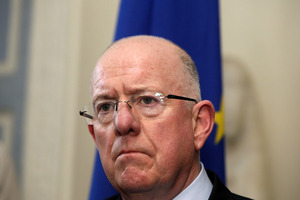
From top: Minister for Justice Charlie Flanagan; Derek Mooney

I am not a big fan of the Minister for Justice, Charlie Flanagan TD Though he is a thoroughly decent and honorable guy and is doubtless motivated by a deep belief in public service, as a Minister he has shown a decidedly minimalist approach.

He was an underwhelming Minister for Foreign Affairs, who often looked and sounded completely at sea when dealing with Northern Ireland affairs.

By all accounts Flanagan was unhappy to leave that Department to make way for the lightning bolt that is Simon Coveney, and boy does it show in his current work as Minister for Justice.

The disregard I hold for Minister Flanagan, would appear to be mutual. He blocked me many years ago on Twitter. He was not a Minister then, just the Chairman of the Fine Gael parliamentary party.

The cause, if memory serves me correct, was my taking a swipe at him for tweeting “Bon Debarras (good riddance) Sarkozy” on the night the former French President lost the election.

I had the temerity to suggest, via Twitter, that this was hypocritical as, only a few months earlier he and Fine Gael, was very publicly embracing its EPP colleague. A point I remade in an Evening Herald column a week or so later.

My reason for mentioning this bad blood, is to put my next comments in context. Yesterday, for the first time in many years I felt moved to tweet kudos to Minister Flanagan.

This followed remarks he made in an interview with Sean O’Rourke on RTÉ Radio’ 1’s Today show.

Flanagan told O’Rourke that he was determined to ensure that the referendum debate would be devoid of Fake News.  The Minister was absolutely to flag up this issue and to signal real concerns about the misuse of social media, by either side, in the campaign.

But, when you are the government minister who is responsible for Data Protection legislation you need to go beyond just voicing concerns about Fake News, you need to do something concrete about it – especially when the referendum campaign is effectively under way and voting is only about nine weeks away.

You should, along with your Cabinet colleagues, be doing something to tackle the issue – and yet the Government is not.

What makes this inactivity all the stranger, is that it cannot be motivated by a lack of inspiration as it has a possible remedy not just at its fingertips, but one that already has the backing of the Dáil.

The Online Advertising and Social Media (Transparency) Bill 2017 drafted by James Lawless T.D. could go a long way to tackling the problem. It also has the huge benefit of having already been approved by the Dáil at the end of its 2nd Stage debate by 58 votes to 56.

So why is the government not pursuing it? Why was the Tánaiste so eager to rubbish the Bill last week when the Green Party leader, Eamon Ryan asked when the government proposed to advance Deputy Lawless’s Bill.

Two interesting points arise here.

Firstly, why did Fine Gael and the government oppose Deputy Lawless’s Bill so vehemently last December?

Secondly why is Fine Gael, which does not have a Dáil majority, so determined to ignore the will of the Dáil on this and many other issues?

The answer to the first may be to do with simple hubris, the answer to the second may be a bit more sinister.

First the hubris. Part of Fine Gael’s antithesis to the Social Media Bill is that they see it, not so much as way of ensuring transparency in Social Media advertising and campaigning, (here is a link to a note explaining the Bill) but more as Fianna Fáil taking a swipe against the Taoiseach’s much loved Strategic Communications Unit.

To be fair, Fianna Fáil did use some of the Second Stage debate on the Bill to take a couple, or twenty, sceilps, at the SCU, but the Bill about a lot more than just that and Fine Gael should see beyond the political point scoring and recognise that the Bill tackles real issues and fills a glaring gap in our electoral law: the world of online campaigning.

Which leads me to the second issue.

Frankly, Fine Gael and the government needs to grasp that it failed to stop the Bill and that the Dáil decided that it wanted to pursue it.

This is how it is Dáil politics is going to work for the foreseeable future. No one group or one party gets to have it their own way all the time.

If the Government wants to get its agenda through, then it needs to seek consensus with others and it has an advantage in this, as it has range of options it can pursue. It can go to Fianna Fáil or, as it has on Shane Ross’s Judicial Appointments Bill, it can go to Sinn Féin.

But even though the government still has an upper hand in the building of consensus, this apparently is not enough. It wants it all ways.

Not only is the government ignoring the reality that Deputy Lawless’s Bill already has Dáil backing, it is ignoring last week’s vote of 85 to 49 in favour of disbanding the Strategic Communications Unit and:

“…the establishment of an independent panel, appointed by the Oireachtas, to examine the most effective way of operating Government communications to ensure value for money and freedom from political interference.”

This contempt for some decisions of the Dáil, namely those that have the backing of those other than Fine Gael is also partly responsible for the latest fiasco over Minister Ross’s ill-judged (you see what I did there?) Judicial Appointments legislation, aka the Dog’s Dinner Bill.

Over the past few days we have seen a series of walking and talking Fine Gael Press Office speaking notes saying how the Bill was now a dog’s dinner because the opposition was insisting on tabling amendments.

Eh, tabling amendments to legislation as it passes through the Oireachtas, particularly during its Committee and Report Stages, is precisely how the opposition parties attempt to change and amend legislation when it is before the Dáil and Seanad.

It is how our inelegant and often clumsy parliamentary system of legislative scrutiny works. As Leo McGarry remarks in the West Wing, borrowing heavily from a quote erroneously attributed in turn to Bismarck: There’s two things in the world you never want to let people see how you make ’em: laws and sausages.

If Fine Gael wants to change things back to the days when the government side controlled the agenda and had its way on all things, then all it has to do is call an election and go out and hold on to all the seats it currently has and win 30 extra ones. Simple, really.

Until then, play the hand the electorate dealt you and please stop trying to play your Jokers as Aces.

Derek Mooney is a communications and public affairs consultant. He previously served as a Ministerial Adviser to the Fianna Fáil-led government 2004 – 2010. His column appears here every Tuesday Follow Derek on Twitter: @dsmooney

From top: The Cover of Fine Gael MEP discussion paper on Ireland’s defence/security policies; Derek Mooney

As I am out of the country for a few days I missed last night’s RTÉ One Claire Byrne Live discussion on Irish Defence policy.

Based on the social media commentary it seems the talk was as much, if not more, about neutrality, or the myriad different interpretations of neutrality, than it was about policy.

Regrettably, most attempts to try to have a sensible discussion on national security and the threats that face us flounder on tired, ill-informed and hyper charged arguments on neutrality.

Neutrality is not unimportant, but arguing continually over its definition and who is more neutral than who means we miss the core issue – how do we develop and maintain the capability to protect ourselves and to contribute to increasing global security?

So, let us get the definitions out of the way. Ireland is militarily neutral. This means more than simply not being part of a military alliance.

It means that we decide for ourselves how much we spend on defence, what strength defence force we want and how we deploy them.

It also means that we support multilateralism, via the United Nations. It has long been Ireland’s position that one of most tangible contributions we can make to global peace and stability is to deploy our troops on Chapter 6 and 7 multilateral peace enforcement operations, mandated by the United Nations.

It is why we sent approx 1,600 troops per year to do precisely that in the decade leading up to 2009.

Whether a mission has been NATO led, EU led or whatever, has not been an issue, once it has been mandated by the United Nations – a sensible position for a small nation that believes in international law.

Now back to policy: this latest attempt to start a debate appears to have been provoked by the short discussion document entitled: Ireland and the EU: Defending our common European home from Fine Gael’s group of MEPs.

Provoked being the key word. The document so outraged the good folk in Sinn Féin that one of their number was moved to thunder on about how the FG MEPs were set “…to tear up Ireland’s military neutrality and expose[s] their extremist and dangerous far-right position on European security”.

While the Fine Gael four do indeed urge us (wrongly in my view) to “redefine the concept of Irish neutrality” and to “Amend Ireland’s Triple Lock system”, it is a gross over reaction wrong to call their document extremist or far-right.

In my opinion; its biggest problem is that it is light-weight.

It’s not there aren’t some other decent ideas in the document, there are, but a paper, even a discussion paper, making 10 recommendations “for a progressive future Irish security and defence policy” should stretch to a bit more than just seven A4 pages of text in a 16-page pamphlet?

National Defence and security are big issues. There is a serious debate to be had, so if you are going to kick start one then offer something more closely argued and researched than a poor reheating of bits of Gay Mitchell’s 2003 Beyond Neutrality policy document.

Though, to be fair, this time Fine Gael does manage not to call our military neutrality a “sham” or dismiss the triple-lock as an “abdication of national sovereignty”

Still, fifteen years later and no one in Fine Gael can make a better case against the Triple-Lock than citing a lone 2003 EU peacekeeping mission to FYR Macedonia?

If this is the only reason Fine Gael can come up with to get rid of the Triple-Lock, then advocates, like me, of the Triple-Lock have no case to answer.

Even Fine Gael’s discussion of the origins of the Triple Lock misses the point.

Read the FG paper and you would think it dates to the 1990s.

Wrong. The Triple Lock mechanism itself goes back to the 1954 and 1960 Defence Acts. It essentially states that a Triple Lock of UN mandate, government and Dáil approval is required to send contingent of more than 12 armed troops overseas.

It is worth noting here that Fine Gael frets that we would not be able to assist in a humanitarian crisis or natural disaster, but misses the point that the UN mandate part only applies when sending armed contingents of more than 12, there is no restriction on unarmed contingents assisting with natural disasters.

Though they do not make it this time, the other charge levied against the Triple Lock is that it is slow.

Yet in 2007/8 when Ireland took part in and commanded the EUFor mission in Chad we were among the first on the ground and were waiting for other non-triple lock countries to catch up.

It was during the preparations for this EU led mission that I had the pleasure of hearing the then UK Defence Secretary Dr John Reid sum up (using the words of George Robertson) the approach of so many interminable EU ministerial gatherings, saying:

“Everything that needs to be said has been said, but it hasn’t yet been said by everybody.”

This slight segue allows me to a chance to acknowledge some of the MEPs’ more positive suggestions before I return to my other major complaint.

The MEPs rightly focus on the need to establish a “cohesive National Cyber Security Strategy”.

This is an issue that Fianna Fáil’s James Lawless TD. raised yesterday when he urged the government to prioritise the National Cyber Security Centre following reports that the Russian intelligence services are taking an unhealthy interest in the Irish technology and scientific sectors.

The MEPs also call for the creation of a both a Central Intelligence Unit and a National Security Council. These are two proposals that should have been considered years back, but as with many things in Defence, they have not been a priority for almost a decade now.

Which neatly brings me back to where this document collapses in on itself.

While the Fine Gael MEPs deserve credit for bringing defence to the fore, albeit via a flimsy vehicle, their calls for increase defence spending on capabilities, research and personnel, they ignore the fact that it has been their own party leaders, who have both served as Defence Minister as well as Taoiseach since 2016, who have not just failed to act, they have looked the other way.

Since 2011 one single Minister of State has effectively run the show – and although he is a well-intentioned guy who is happy to travel overseas as to visit troops and take the salute at reviews, he has never had the political clout to make defence an issue at the cabinet table.

I am not laying all the blame for all the cuts at Fine Gael’s door. I was there when we cut the Defence Force strength from 10,500 to 9,500 on foot of the Bórd Snip Nua report in 2008/09. But that was intended as a temporary measure.

Yet, a decade later, the Government struggles to even keep it at 9,500. At the same time, the numbers serving on overseas operations has over halved, with a hefty consequent effect on soldiers pay, and that’s on top of other unaddressed issues from the Lansdowne Road Agreement.

The major progress made in modernising and improving the Defence Forces in terms of training, equipment and conditions on foot of the 2000 Defence White Paper, the first of its kind, has been all but lost.

We need now to commit to getting back to where we were in 2006/7 in terms of equipment, pay and capabilities.

A major step in that direction would be to appoint a Defence Minister at Cabinet level, for whom the role is not part time and mandate them to bring Óglaigh na hÉireann back up to 10,500. They will find that there will be no shortage of suitable and willing recruits ready and waiting to join.

Derek Mooney is a communications and public affairs consultant. He previously served as a Ministerial Adviser to the Fianna Fáil-led government 2004 – 2010. His column appears here every Tuesday Follow Derek on Twitter: @dsmooney

Earlier: Luke Flanagan on PESCO

From top: Sherlock Holmes and Dr Watson in ‘The Adventure of the Copper Beeches’; Derek Mooney

Though Sherlock Holmes is a fictional character… almost as fictional as the Strategic Communication Unit’s Taoiseach Leo, but let’s not go there this week… his creator used Holmes to bring the skill of calm, logical reasoning to a wider audience.

Conan Doyle crafted intricately complex scenarios and then allowed his hero the time required to think and analyse the situation logically. He called it Holmes’s iron rule:

When you have eliminated all which is impossible, then whatever remains, however improbable, must be the truth.”

If only someone inside the British government could just stop and think, applying Holmes iron rule to the current Brexit conundrum, particularly as it relates to the border running across our island.

So, this week I want to apply the Holmes iron rule to how Brexit affects the Irish/Irish border and show why the U.K. is: 1). on the wrong course and 2) ignoring a far less painful option.

Option One: Ireland rejoins the UK. OK, I am leading-off with an absolute non-starter, yet there are, bizarrely, those on the other island who think one way to avoid a hard border is for us to see the error of our ways and return meekly to the current United Kingdom of Great Britain and parts of Northern Ireland.

These people are wondrously ignorant of modern Irish history, but then again there are former Northern Ireland Secretaries of State who are happy to tear up the Good Friday Agreement to save their imagined Brexit. So, for the avoidance of doubt, let me borrow some words from the late Mrs Thatcher that they can understand: this option is out, out, out.

Option Two: Irexit. This one is just as ludicrous as Option One, but with the dubious bobus of having some Irish advocates. You may have seen them a few weeks back, moistening the seats of the RDS as they listened to Nigel Farage and the only stopped clock never to be right even once a day: Anthony Coughlan, amongst others.

The harsh reality for these folks is that there is no backing for Irexit. The latest Eurobarometer poll, published just over a week ago, reported that 66% of us believe Ireland is better off inside the EU and that our attachment to the EU is at its highest level in 15 years.

Why would we give up our attractiveness as a base for foreign direct investment looking to access the European market?

Outside the EU the only major market access we could offer would be to the UK market – but why invest in Ireland to gain UK market access when you can invest in the UK directly and cut your cross-channel transport costs? Oh, now I see why Farage is pushing the idea, though why he would have Irish backers is still a mystery.

Option Three: UK quits the Customs Union and Single Market: If the UK is outside both the Customs Union and the Single Market then the border that separates the six north-eastern counties from the rest of this island will become an external frontier between the EU and a third country, the UK.

That is a fact. Don’t take my word for it, read what Dr Katy Hayward and Dr David Phinnemore of Queen’s University, Belfast have said:

Let us be under no illusion: with the UK outside the single market and a custom union, there will be an unavoidable increase in border controls.

The people who backed the Good Friday Agreement in 1998 – North and South –voted to replace the “border” that divided us with a cross border approach that brought communities together.

That Good Friday Agreement is more than just a hard-won political agreement, it is an international treaty between two sovereign governments.

The cross border approach it enshrined is incompatible with the sort of border and customs arrangements which Mr May mentioned last week, a reheat of paras 46 – 54 in the UK’s August 2017 NI position paper. It was a non-runner then and as Fintan O’Toole reminds us today, it’s a dud now.

Option Four: A Canada/USA style border: This option arose just yesterday when Mrs May was asked for an example of a border between two countries that were not in a customs union. She replied:

“There are many examples of different arrangements for customs around the rest of the world and indeed we are looking at those, including for example the border between the United States and Canada”

This on the day that President Trump was announcing tariffs on steel and aluminium imports from other countries, including Canada. Eh, no thanks.

Having crossed that border twice, a few years back, in a car from Seattle to Vancouver, queuing in traffic for about five hours not including the time spent out of the car at the huge customs post filling in forms, I can vouch that this one is a non-runner.

Option Five: No Brexit. I added this one as a counter balance to the previous four Irish centric, impossible options. The British people have voted to leave the EU and there is no hard data to suggest that the result of a rerun referendum would dramatically reverse that decision.
And before anyone points out that we have re-run EU referenda here, let me remind them that those first round turnouts were low, not a factor in the Brexit vote as I outlined here before.

The elimination of Option Five brings us to the one and only remaining option, no matter how improbable it may seem now. That is for the UK to leave the institutions of the EU, to quit the EU Council, Commission, Parliament etc., but to remain in the Customs Union and Single Market.

This, effectively, would see the UK return to the old EEC era – the common market. It is the solution that my friend, and former UK Europe Minister, Dr Dennis MacShane has been advocating from the moment of the Brexit vote. As Anna Soubry and Chuka Umunna have said, there is a cross party majority in the House of Commons to back staying in both.

It also has the added cachet of according with the outlook of the already mentioned Mrs Thatcher, a fact lost on the likes of Jacob Rees-Mogg who forget that Mrs T was a big supporter of the Single Market.

After almost two years of chasing Brexit fantasies the Brexiteers need to face up to the logic of their own position and stop pursuing the impossible.

They also need to start coming up with real, possible alternatives, so let me end by offering the bare bones of a proposal for Mrs May and the DUP.

Though I am a firm believer in a United Ireland and a strong advocate for more all island approaches, I can understand why Mrs May and the DUP baulked when they saw the the EU’s draft legal agreement proposing a backstop “common regulatory area”.

I don’t accept their objections to the draft text which, after all only turns in legalese what the EU27 and UK already agreed last December, but I can still understand how they might feel that it undermines the “constitutional integrity” of the United Kingdom.

So, I suggest that they look to Hong Kong for some inspiration. If it is possible to have one country, two systems, then it is not also possible to have two different economic regimes in one country?

Rather than moaning at Barnier, London should be looking to actively exercise its “constitutional integrity” and itself make Northern Ireland a “special economic zone” within the UK.

Make it a “special economic zone” which is linked via the “common regulatory area” to Ireland and hence to the EU.

A “special economic zone” which secures the important trade flows from Northern Ireland to Ireland (and vice versa): Northern Ireland to Great Britain and, of course, Northern Ireland to the EU.

This leaves the Irish/Irish border frictionless and invisible, as it is now, with the UK operating its own e-checks at crossing points to Great Britain, but not imposing tariffs on goods incoming from Northern Ireland.

It is not nearly as effective and workable a solution as remaining in the Customs union and Single Market, but no matter how improbable it may seem, it is a lot less impossible than options one to five above and it is entirely within their own hands.

Elementary, huh?

Derek Mooney is a communications and public affairs consultant. He previously served as a Ministerial Adviser to the Fianna Fáil-led government 2004 – 2010. His column appears here every Tuesday morning. Follow Derek on Twitter: @dsmooney

Illustration: Sidney Paget

A tweet on Saturday From Dubin Fire Brigade about the Taoiseach’s visit to North Strand 


Derek Mooney writes:

It’s not that Leo Varadkar’s Strategic Communications Unit has “blurred” the lines between governmental and political, between the State and FG… it has demolished them completely.

Fine Gael spin is compromising State agencies who are just trying to do their best.

Earlier: Tony Groves: The Original Strategic Communications Unit

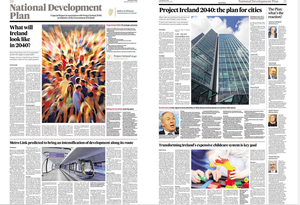
From top: paid for pages in the irish Times; Derek Mooney

In November 1962, in what would become known as the “last press conference”, a tired and agitated Richard Nixon spoke with journalists gathered at his hotel as the results of the Governor of California election became clear. Nixon had lost.

It was his second major political defeat in as many years having narrowly lost the 1960 presidential election to John F Kennedy.

The defeat in his home State was about to end his political career. A political career that already had been mired in controversy and a difficult relationship with the press.

He finished his comments with the following plea:

I believe in reading what my opponents say and I hope that what I have said today will at least make television, radio, the press, first recognize the great responsibility they have to report all the news and, second, recognize that they have a right and a responsibility, if they’re against a candidate, give him the shaft, but also recognize if they give him the shaft, put one lonely reporter on the campaign who will report what the candidate says now and then.

It is the plaintiff cry of almost every politician of the modern era – give me all the stick you want, but please make sure that somewhere, somehow my unfiltered and unmediated comments can get through to the public.

It is not an unfair request.

Elected politicians should have their statements and speeches reported fairly. Voters are entitled to hear what the people they elect to high office say reported accurately and without prejudice. They are also entitled to hear alternative viewpoints reported fairly. It is about balance. In a democracy you need to hear both sides.

But the Nixon who pleaded for fairness in 1962 is also the Nixon whose flunkies and henchmen were, seven years later, drawing up “enemies” lists, sanctioning break-ins at the homes and offices of opponents and banning the Washington Post from the White House.

Nixon demonstrated that there can be a slippery slope from asking that your message be fairly heard to deploying all the levers at your command to drown-out all critical analysis.
The slide is by no means inevitable, but it is a risk that even less Nixonian political leaders can face, especially when they close their eyes and ears to the warnings.

Last November the Government’s press secretary was telling journalists that the Government’s new “Strategic Communications Unit” would be staffed by up to five people when it becomes fully operational.

Last week, An Taoiseach informed Micheál Martin and other party leaders en passant during a supplementary reply to a parliamentary question that there are now 15 people working in the unit. Fifteen. Three times the number originally suggested.

When this was put to An Taoiseach and leader of Fine Gael on the day he sought comfort in citing a Fianna Fáil-led government including a budget for strategic communications in the 2007 National Development Plan.

It is also the line that Fine Gael backbencher Noel Rock, a sort of millennial Bernard Durkan, was pushing yesterday as he tried, very non-strategically, to draw attention away from reports that provincial papers were pressured to make government advertorials look like normal news stories.

Yes, many major projects, both public and private, do have a strategic communications element. It is sensible to want to publicise that particular initiative and communicate information about it effectively. In most cases this involves a key element of modern strategic communications, a two-way interaction.

But that is not what we have here. The Taoiseach’s Strategic Communications Unit is far more preoccupied with campaign marketing than it is with public information. Its communications are anything but two-way. They are decidedly one way and that one way is from the top down – from a beneficent team of FG ministers to grateful public. There is nothing especially modern about that. It is decidedly old fashioned and mid-20th century.

It pushes a very particular image of not just the government as a concept, but of this specific government – and some key players in it – as a unique and marketable brand.

Indeed, one of the many tender contracts that the Strategic Communications Unit have awarded is for branding, the contract for the “Development of Government identity system for roll out across Government Departments” going to the people behind the Irish Water logo, a matter that Broadsheet discussed before.

One presumes this “identity system” is not a form of Public Services Card that every government department is compelled to carry anytime it wants to make a claim or renew its driving licence, but rather a rebranding system that creates a consistent identity for government departments and agencies á la UK model.

If it is just about a government logo, though I thought the 14th century Brian Ború Harp was not just the official State logo, but the government logo too, then it may be something worth exploring.

But the other contracts for “media strategy planning and buying services” and the provision of “marketing pitch specialist services” suggest that the focus is more political. These are phrases more familiar to those preparing party political election campaigns rather than cross government information projects.

But, as we have seen time and again with the Strategic Comms Unit the focus is not on all of Government with all its many departments and agencies.

It is not on all of Government, in the Art 28 constitutional definition of the 7 – 15 members who form the Cabinet.

It is not even on all the Fine Gael ministers who sit in Cabinet.

Rather, it is on a subset of those ministers: a coterie that can be marketed and sold as a fresh, young Government, newly arrived and freshly minted in 2017.

It is a cadre that includes the Taoiseach, Tánaiste and the Ministers for Finance and Environment as regular cast members with the Ministers for Health and Social Protection playing occasional walk-on parts, as required.

As last week’s Dáil exchanges highlighted, the 15-man cheerleading machine… sorry… Strategic Communications Unit is the one big initiative the Taoiseach has taken since assuming office it now dwarves, in terms of staffing and resources, other units in the Taoiseach’s department, notably the social policy division.

Yesterday and today’s revelations regarding the placing of advertorials in provincial papers that were not to be marked as sponsored should make for interesting Dáil exchanges this week.

So will answers to questions on who is getting paid outside to produce all this material and when will the Dáil be shown the plans and progress reports on all these projects, which are all paid for with public money?

Who knows, if the public discussion continues in this vein, maybe we won’t have the Strategic Communications Unit to kick around any more?

Derek Mooney is a communications and public affairs consultant. He previously served as a Ministerial Adviser to the Fianna Fáil-led government 2004 – 2010. His column appears here every Tuesday morning. Follow Derek on Twitter: @dsmooney

Rollingnews