
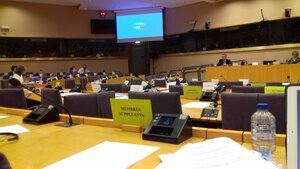
This morning.
Luke ‘Ming’ Flanagan MEP writes:
European parliament’s Budget Control Committee. Committee that controls EU spending. Meeting began at 9am. Where are the MEPs?
Thanks Ronan Emmett



This morning.
Luke ‘Ming’ Flanagan MEP writes:
European parliament’s Budget Control Committee. Committee that controls EU spending. Meeting began at 9am. Where are the MEPs?
Thanks Ronan Emmett

Front page of today’s Irish Times
The EU’s refugee relocation programme – which was to relocate 160,000 asylum seekers from Greece and Italy in two years from September 2015 – is moving at a glacial pace.
The Irish Times today reports on Ireland’s involvement in the scheme.
A front page report headlined, “‘Very low’ take-up of EU refugee programme in Ireland – Only 20 asylum seekers have applied to Ireland so far as part of relocation plan’ may imply that asylum seekers currently waiting in Greece and Italy are able to choose the country in which they would like to live.
Like picking a holiday location.
However…

According to the European Asylum Support Office states (above) in a brochure for asylum seekers :
“It is not possible to choose the country to which you are relocated.”
Further to this:


Previously: Pawns In The Game
Thanks Subpri.me
UPDATE:
The Irish Times has updated its headline…


Omar Sarhan writes:
New map on migration, my first in 2016, based on older (pre-2015 refugee) figures, but I think the patterning is pretty interesting and echos other maps I’ve created, an obvious split between EU and Eurozone member states.

Former Greek Finance Minister Yanis Varouvakis.
Into the eyes, not around.
Varoufakis, who resigned a week ago, has been criticised for not signing an agreement sooner, but he said the deal that Greece was offered was not made in good faith – or even one that the Troika wanted completed. In an hour-long telephone interview with the New Statesman, he called the creditors’ proposals – those agreed to by the Athens government on Friday night, which now seem somehow generous – “absolutely impossible, totally non-viable and toxic …[they were] the kind of proposals you present to another side when you don’t want an agreement.”
there was point blank refusal to engage in economic arguments. Point blank. You put forward an argument that you’ve really worked on, to make sure it’s logically coherent, and you’re just faced with blank stares. It is as if you haven’t spoken. What you say is independent of what they say. You might as well have sung the Swedish national anthem – you’d have got the same reply.”
There were people who were sympathetic at a personal level, behind closed doors, especially from the IMF.” He confirmed that he was referring to Christine Lagarde, the IMF director. “But then inside the Eurogroup [there were] a few kind words and that was it: back behind the parapet of the official version. … Very powerful figures look at you in the eye and say ‘You’re right in what you’re saying, but we’re going to crunch you anyway’.”
Varoufakis was reluctant to name individuals, but added that the governments that might have been expected to be the most sympathetic towards Greece were actually their “most energetic enemies”. He said that the “greatest nightmare” of those with large debts – the governments of countries like Portugal, Spain, Italy and Ireland – “was our success”. “Were we to succeed in negotiating a better deal, that would obliterate them politically: they would have to answer to their own people why they didn’t negotiate like we were doing.”
Yanis Varoufakis full transcript: our battle to save Greece (Yanis Varoufakis, The New Statesman)
Thanks Nelly Bergman
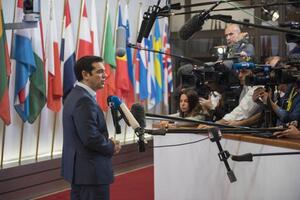
Greek’s Prime Minister Alexis Tsipras this morning
Bounced into a bailout?
Or returned to GROWTH?
Only you can decide.
We have been fighting hard for six months now, and we fought until the end to achieve the best possible outcome, an agreement that will enable the country to get back on its feet, and for the Greek people to be able to continue to fight.
We faced tough decisions, tough dilemmas. We assumed responsibility for the decision in order to prevent the most extreme objectives from being implemented — those pushed for by the most extreme conservative forces in the European Union.
The agreement calls for tough measures. However, we prevented the transfer of public property abroad, we prevented the financial asphyxiation and the collapse of the financial system — this was planned to the last detail – having recently been designed to perfection, and in the process of being implemented.
Finally, in this tough battle, we managed to gain the restructuring of the debt and a financing process for the medium-term.
We were aware that it would not be an easy task, but we have created a very important legacy. An important legacy, and a much-needed change throughout Europe. Greece will continue to fight, and we will continue to fight, so that we can return to growth, regain our lost national sovereignty. We earned our popular sovereignty. We sent a message of democracy, a message of dignity throughout Europe and the world. This is the most important legacy.
Finally, I would like to thank all of my colleagues – ministers, colleagues and associates who gave, along with me, a very tough fight. A fight, which at the end of the day, will be vindicated.
Today’s decision will maintain Greece’s financial stability and provide recovery potential. However, as we knew beforehand, the agreement will be difficult to implement. The measures include those that Parliament has voted on. Measures that will inevitably create recessionary trends.
However, I am hopeful that the growth package of 35 billion euro that we achieved, debt restructuring, as well as securing funding for the next three years will create market confidence, so that investors realize that fears of a Grexit are a thing of the past — thereby fueling investment, which will offset any recessionary trends.
I believe that a large majority of the Greek people will support the effort to return to growth; they acknowledge that we fought for a just cause, we fought until the end, we have been negotiating through the night, and no matter what the burdens will be, they will be allocated – we guarantee this – with social justice.
And it will not be the case that those who have shouldered the burden during the last years will be stuck footing the bill once more. This time, those who avoided paying – many of whom were protected by the previous governments – will pay now, they, too, will shoulder the burden.
Finally, I want to make this commitment: Now, we need to fight just as hard as we fought to achieve the best outcome abroad – in Europe, to rid vested interests in the country.
Greece needs radical reforms in favor of social forces, and against the oligarchy that have led to the country’s current state. And this commitment to this new effort begins tomorrow.
Greek’s Prime Minister Alexis Tsipras speaking this afternoon.
Prime Minister Alexis Tsipras’ statement following the conclusion of the Eurozone Summit
Previously: Greece In Our Time


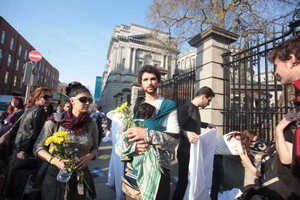

This evening.
Demonstrators outside Leinster House, Kildare Street, Dublin protesting at the “failure” of the European Union to save the lives of migrants crossing from Africa to Europe via the Mediterranean, where some 1,750 migrants have drowned so far this year.
(Leah Farrell/Photocall Ireland)
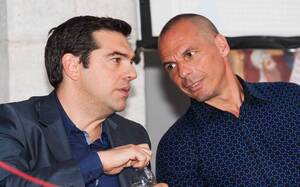
Greek Prime Minister Alexis Tsipras and finance minister Yanis Varoufakis
Germany and its allies are ready to let Greece leave the euro unless Prime Minister Alexis Tsipras accepts the conditions required to extend his country’s financial support, according to Malta’s finance minister, Edward Scicluna.
Greece’s creditors are cranking up the pressure on Tsipras as he seeks a deal to prevent his country defaulting on its obligations as early as next month. By bowing to German demands, the premier risks a domestic backlash from voters and party members whom he’s promised an end to austerity.
German-Led Bloc Willing to Let Greece Leave Euro: Malta (Bloomberg)
Alternatively…
As Greece heads toward 11th-hour funding talks with its euro-area membership on the line, bondholders are surprisingly sanguine about its failure so far to secure a deal.
Forget the strategists at Commerzbank AG who say there’s a 50 percent chance it’ll leave the currency bloc, and those at Barclays Plc who put the exit risk higher even than in the 2012 debt crisis. The Bloomberg Greece Sovereign Bond Index shows those with money at stake aren’t seeing a significant increase in the chances of a euro-zone departure….
Investors Still Don’t Think Greece Will Exit the Euro Bloomberg)
Reuters


Germany has rejected Greece’s application to extend its loan agreement and renegotiate the terms of its bailout, raising the very real threat of Athens running out of money in the coming weeks.
The Berlin government said on Thursday that Greece’s application for a six-month extension of its loan and a renegotiation of some its terms was “no substantial solution.”
Germany rejects Greece’s application to extend its loan agreement (CNBC)
Historic Depths of Greece’s Economic Misery, Charted (Salon)
Graphs via Salon
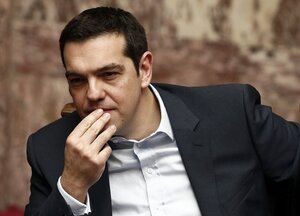 Greek Prime Minister Alexis Tsipras
…Asks Zero Hedge
Who adds:
Moments ago Bloomberg blasted a headline which has to be validated by other members of the European Commission as well as Merkel and the other Germans (and may well be refuted, considering this is Europe), which said that:Commission To propose Six Month Exension – sources So did Greece just win the first round of its stand off with Brussels? It remains to be confirmed, but congratulations to Greece if indeed it caused Merkel and the ECB to fold….
Thanks Sido

If Greece goes.
Can we be far behind?
RUN!
Economist Roger Bootle writes:
…the real risk for the eurozone, though, is that Greek default and euro departure go relatively well, and after a year or so Greece is beginning a vigorous recovery on the back of a weak drachma. In that case, the people of Italy, Spain and Portugal would ask: “if Greece can do it that way then why can’t we?” And there wouldn’t be a good answer. The euro-zone would do the splits as soon as you could say Jean-Claude Juncker.
Of course, virtually no one in the Greek establishment wants Greece to leave the euro. Yet the country desperately needs decent economic growth. An end to austerity and a debt write-off would only do half the job. The other half is improved competitiveness. Achieving that through sustained deflation would be slow and painful, and would intensify the debt problem all over again.
It is not unusual for governments to cling on to what is the source and origin of a painful economic predicament. This is a version of what is known in the psychological world as Stockholm Syndrome, when prisoners become emotionally dependent upon their captors and do not want to escape.
‘Grexit’ Could Happen By Accident (Wall Street Journal)
Alternatively: No Exit For Greece (Josef Joffe, New York Times)
Pic: Business Insider