

One Israeli death is a military victory for Hamas; one Palestinian death is a PR victory.
— George Hook (@ghook) July 21, 2014



One Israeli death is a military victory for Hamas; one Palestinian death is a PR victory.
— George Hook (@ghook) July 21, 2014

Hookie.
He’s fallen out of love with a piece of technology.
“The main story in sport is not TV3 winning the World Cup, because it was a bid, they bid more than than the other guys, it was a simple bid, right. However, the decision of the GAA to sell the rights to SKY is far more dramatic – for the future of Gaelic Games in this country.
It’s not actually about paying for the matches – it is that it will mean an inexorable drive now to professionalism in Gaelic Football and Hurling. That means that Gaelic Football will eventually become – and Hurling will become the province of about 150 players who will be highly paid, then the whole idea of Gaelic Games – the parish and all that will be gone – a bit like rugby – gone.”Rugby pundit and former Sky shill George Hook on TV3’s Tonight with Vincent Browne last night.
Any excuse
Previously: Sly Sports
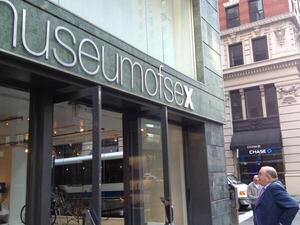

George Hook outside the Museum of Sex on 5th Avenue, New York.
Years of therapy will not erase the thoughts you may have had when viewing these photos.
via: Mark Simpson
 httpv://www.youtube.com/watch?v=mxGGtcz7lGM
Ah now then.
George Hook gets his Savile on for RaboDirect in 2009.
*shudder*
George’ll Fix It (Newstalk.ie)
Earlier: Jimmy Savile In Dublin
Thanks B
 Denis O’Brien and INM, media diversity and good news versus bad news. Last night’s Tonight with Vincent Browne featuring Gavan Titley, George Hook and Carol Hunt.
Gavan Titley: “If you look at what [Sunday Independent editor] Anne Harris is arguing she’s saying there’s an absolute firewall between management and editorial. In this instance [Mahon and Moriarty tribunals], it hasn’t been proven to the final legal point that corruption took place. But what these give us together is a highly oligarchic.”
Vincent Browne: “Final criminal…”
Titley: “Exactly..a highly oligarchic picture of Irish public life. We come to these issues around media ownership and normally, in other countries, when they debate issues of media ownership, it’s in relation to the impact of different percentages of media ownership, cross media ownership, the accumulation of power in relation to democracy. When we get here to start talking about the impact of media coverage on the media, it immediately comes back down to these angels-on-a-pinhead debates.
What we can see from the tribunals and what we can see from the way in which this story is covered is a small network of people with immense power, immense power which has been beneficial to each other over long periods of time. Immense power which has not been beneficial to vast swathes of the population in this country. And the real questions come down to this. We now have some form of public accounting of what happened in governance in Ireland, through the tribunals, with all their wastage, over a significant period of time. What we have now is an indication of the kinds of values, as we can see in these articles, that inform the way in which mainstream media, a lot of mainstream media in this country, approaches their job in relation to holding power to account, representing plurality or the public or whatever it might be. So we don’t need to prove, for example, that there isn’t a firewall between editorial and management, this is always one of the most difficult things to prove when it comes to looking at the impact of major media coverage. Looking for the smoking gun, or looking for causal factors have always been difficult to prove. But what you can look at over periods of time is what are the questions that are asked, what are the issues which are addressed, whose identities, whose social experiences, whose lives simply don’t feature in any of these newspapers or media coverage? And that’s what we should be talking about in an Ireland that’s in crisis. Not looking at this kind of royal court of oligarchs.
George Hook: “Who do you want to own the Independent?”
Titley: “I really don’t care who owns the Independent.”
Hook: “But you just said that it would benefit the Irish people. That’s what you actually said. How does a newspaper benefit the Irish people, in terms of the information it prints?”
Titley: “But when you talked about who benefits from this. You were mainly talking about the shareholders. The traditional, and somewhat quaint, idea of a newspaper, is that it informs people and that it informs people so they can act as citizens. These don’t feature in our debates in media in Ireland at all. We’re extremely comfortable with…
[They Talk over each other]
Hook: “So you don’t want it to be a public company anymore then?”
Titley: “That doesn’t follow from what I said at all. It really doesn’t bother me whether the current arrangements in the Independent Media group persist or whether Denis O’Brien takes over. What bothers me is the overall picture in terms of media diversity and it’s very interesting to look at that, in terms of the recent conference in which Nessa Childers (Labour MEP) had on media diversity where one of the things that she did for that, and I looked at the report earlier, was she did a survey of 100 journalists.
Now 100 journalists in Ireland, when you look at it is a reasonable-sized survey and what she asked them was: Has Ireland got adequate media diversity as things stand? 32% of them strongly agreed but 36.6% disagreed strongly and 20.4% disagreed quite generally. 77.5% thought that media diversity is at risk due to trends in media ownership. So while most journalists in this survey, who are quoted, would very much agree with you that when it comes to the day-to-day work of what they do and what they produce that there isn’t any kind of direct hand on their shoulder what they do see is that under current conditions we have problems with media diversity. And that has knock-on impacts on democracy. And that’s putting in brackets the fact that we don’t actually live in a proper democracy.”
[Later]
Titley: “John Lloyd, one of the editors of the Financial Times, who was also speaking at this conference on media diversity, made the point exactly as you said, strong regulation is one dimension of it. But regulatory frameworks in Europe, and elsewhere, are in trouble at the moment because of changes in the media economy. How do you regulate properly across media, how do you regulate digital media? This is quite difficult at the moment. But the other point that he makes which is well worth making is, as he put it, the reasons why owners own media rather than Apple shops is important. Now let’s go back to looking at that nexus between politics and media in Ireland. The Ireland First document, if you remember the Irish Times turned over part of its online section to this massive PDF, which was put together kindly for us by three tax exiles, who nevertheless wanted to tell citizens how they want to rejuvenate our democracy. Tony O’Reilly, O’Brien, Dermot Desmond, there were many others involved in it. Ray McSharry, John Bruton, Peter Sutherland. One of their recommendations for political reform was to look at the media and, to quote, “There needs to be a positive engagement between editorial and ownership senior management of media organisations in order to ensure we have balanced coverage and good news stories are covered”. Now, as one element of political reform what this group of politicians, and former politicians, media owners and consultants, were arguing, was that there need to be, essentially, political interference in the media in Ireland to guarantee good positive stories. We know what good positive stories means. They mean you don’t report in anyway the fact that we have a massive crisis of capitalism in Europe or elsewhere because a report on that would endanger the conditions for the sovereignty of profit, which is ultimately all they are interested in. Now that’s why this is of interest in this discussion, more than Murdoch in the States. Because this is particular to Irish democracy at this moment in time.
Browne: “There’s an issue that arises out of what Gavan has just said. The coverage of our circumstances and the economy right now. Eamon Gilmore said, at the Labour party conference that the present Government can turn the economy around. Enda Kenny said more or less the same at the Fine Gael party conference a few weeks ago. The reality is that we are in dire circumstances yet again. Last year, by the most reliable measurement of economic performance, namely GNP, the economy contracted again by 2.5 per cent. And in the last quarter of last year, it contracted by 7 per cent. Now how is it that that hasn’t got much attention in the media at all, that we are in the midst of a really vicious double-dip recession. It’s a bit odd.”
Hook: “Do you want an answer to that?”
Browne: “Yeah.”
Hook: “The reason is that people don’t actually want to hear it. And that’s the primary reason. People don’t want to hear it. That you cannot start at dawn in radio, television or newspapers, until nighttime, with a diet of bad news.”
Carol Hunt: “Or excessively good news, unless it’s true.”
Hook:” The old idea that bad news sells newspapers no longer exists. Because such is the nature of the bad news that people are actually turning off their radios and are ceasing to buy newspapers.”
Browne: “But is that good enough? If we have an obligation to tell it how it is, how come we’re not telling it how it is? How come the media are not telling it how it is?”
Watch here
Thanks Jack Fairbairn
At 5 pm we discuss if the age of Twitter is over?
— George Hook (@ghook) March 12, 2012
the entire country appears about to sink into the sea with dog poo – arklow, bray, drogheda, cork..
— George Hook (@ghook) February 8, 2012
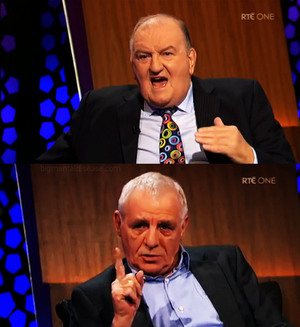 Goading, by Ryan.
George Hook’s egged on rant about Eamon Dunphy on last Friday’s Late Late.
Ryan Tubridy: “Welcome Mr Hook.”
Hook: “Thank you Mr Tubridy.”
Tubridy: “It was at approximately this time last week, that in that very same seat, Eamon Dunphy claimed Ireland to be a kip and a dump.”
Hook: “Yeah.”
Tubridy: “How did you feel about that?”
Hook: “Eh, well Dunphy and I have a weird and wonderful relationship. He’s weird and I’m wonderful.To be fair it’s a fairly balanced relationship; I don’t like him and he doesn’t like me. But, I mean Dunphy’s largely irrelevant, you know, and I’m telling you, telling you that this great country is a kip and a dump is just… I mean Dunphy isn’t a patriot. I knew he wasn’t a patriot the day Ireland played the Cameroon in the World Cup and he went on television wearing the Cameroon colours. So his patriotism is fairly skin deep.”
Tubridy: “He would argue that that’s mean, that he was just doing that for…to be a messer. I’d say he’d be very proud of this country. You’d disagree with that?
Hook: “Oh yeah, comprehensively. How can you call this place a kip or a dump? Like this place has survived, this country has survived famine, pestilence, war, and like we’ve stuck through it. There aren’t many countries that would have survived the famine, there aren’t many countries that might have survived the awful 1930s here. I grew up in the 40s and 50s when times were tough. The 80s were tough but we came through them all. For people in a public position, and he does have a public position, although I don’t listen to it, but he has a public position, to actually say to young people and to people who are struggling to pay a mortgage and bring up their kids, they’re doing it in a dump is outrageous. And I’ll tell you what we need more than anything, your hero, John F Kennedy*. Kennedy said famously, and it rings as true now as it did then, ‘ask not what your country can do for you, but what your country, eh what you can do for your country’.
We have a problem, we have a problem. The pied piper, Bertie Ahern, made us, because he told us all like this will never end, he made us selfish, he made us think it would go on forever, he made us think that what was important was the cost of something not the value of something. Therefore we have to get back to where we were. We have to get back the old values that made this country great. And we will.
Tubridy: “OK, Eamon Dunphy had plenty to say, and I think it’s an almost a right to reply scenario for things like what he said about Newstalk which wasn’t exactly the most complimentary scenario on that. Would you have thoughts on that George?”
Hook: “Well, I mean I would. It’s about the country aswell really. I mean this country gave him a bloody good living and to turn around then and say it’s a kip is a bit much. But Newstalk gave him a bloody good living and to turn around then and say it’s a kip is a bit much. He was the highest paid broadcaster in Newstalk on an hourly basis bar none. And then to turn around and to say to these young people, because you know that broadcasting is a young people’s business, apart from O’Herlihy and myself, it’s a young people’s business, and to say to these young broadcasters in Newstalk who’ve got degrees in journalism, who’ve got masters in journalism, and in some ways they’re just ciphers for Denis O’Brien, that they have no mind of their own, and let me tell you that by extension he said that I was just a cipher, well Eamon if you’re watching you can put that in your football and kick it.
He talked about these young people, sure he was there so little he wouldn’t even know their names, but what is far more important, what is far more important, anybody sitting here in this audience, anybody listening to this program, if they think that tomorrow’s Independent carries an article that Tony O’Reilly asked me to write, if they think that on television this weekend I am going to say things that the Director General asked me to say, if they think on radio I am going to say something that Denis O’Brien told me to say they don’t know me, and I’ve spent ten years of my life broadcasting on radio, 15 years of my life broadcasting on television, and I never did what somebody told me, and I’m not about to start now. But it’s not me, it’s not about me.”
Tubridy: “Well, Eamon Dunphy, what I think he was implying, were that the conditions in Newstalk weren’t particularly favourable to people, in fact he felt sorry for people [there]. He felt they were hard done by.”
Hook: “Did he try on that with this programme as well? Ah come on, give me a break. Like Ireland’s a kip, Newstalk’s a kip, where else is a kip? Like, has he not got a good word to say about anybody? Like, this is a radio station that employs the guts of 100 people who bust their gut every day, seven days a week to do the best broadcasting they can and he’s the best paid guy, he’s getting more money than anybody, and he’s saying that. The tragedy of this is because he has a public position you put him on the Late Late.”
Tubridy:” And we put you…”
Hook: “And you didn’t put the 100 people.”
Tubridy: “Well, we were never going to do that. Are you speaking for them tonight?”
Hook: “Absolutely, I am speaking for them tonight. And not a single one of them would agree with what he said.”
Tubridy: “What do you think about Eamon? Speak your mind.”
Hook: “Well, like, he knows an awful lot more about soccer than I do.”
Tubridy: “What do you think of him?”
Hook: “I don’t like him. I mean my …[you] might change your introduction of me. Like where you say ‘sometimes controversial’. I’ve never been controversial in my life.”
Tubridy: “Now, why is the audience hooting like that?”
Hook: Because controversial infers that you are saying something for effect.”
Tubridy there. It’s called ‘squeezing the middle.
* JFK reference timing fail.
I am on the Fionn Davenport show tonightat 11 pm talking about sex!!
— George Hook (@ghook) January 26, 2012
