Tag Archives: Grace

Screen-Shot-2017-02-20-at-10.26.01

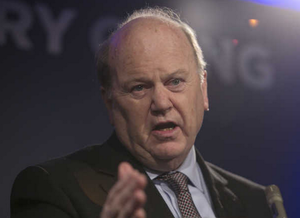
Michael Noonan, Minister for Health (1994-1997)

‘Grace’ was born to a single mother in the southeast of Ireland in the late 1970s. She was supposed to be put up for adoption but, instead, was put into foster care soon after her birth.

She was born with microcephaly and was mute.

From 1989 until 2009, Grace lived with a set of foster parents.

The foster father – who was diagnosed with Parkinson’s in 1999 and who died in 2000 – was accused of sexually abusing another child in their care in 1996, at which point it was decided that no more children would be placed in their care.

So, why did Grace live there for another 13 years?

What effect did two letters sent to Minister for Finance Michael Noonan, who was then the Minister for Health – calling on him to intervene and to reverse a decision to remove Grace from the home – play in the ultimate reversal of that decision? 

Why did a school principal lobby the Minister Noonan about the case, in favour of the foster parents?

And why did the health board say this principal’s view would be taken into account in “reaching their recommendations in relation to the future care of [Grace]”?

The partially redacted and anonymised HSE-commissioned Conal Devine report, which was completed in 2012 and only published on Tuesday, states the following:

1989: Grace started to live with this set of foster parents on the premise that she would remain there until a residential place was made available for her. She was on a waiting list for such a place.

There is no evidence that the foster parents were assessed at any level as required under the Boarding Out of Children Regulations 1983 or that references were obtained as per those regulations.

There’s also no evidence of any documented visit by the health board to determine the suitability of the home before Grace went to live there.

September 1989: A visit by health professionals is made to the foster home and while the location is praised, there are concerns raise about the following: a lack of other children with whom Grace could socialise; the age of the foster father; and the fact Grace isn’t attending school.

December 1989: The foster parents are informed that a school place has been reserved for Grace from the middle of December.

November 1990: Following a visit to the home, it is noted that Grace hasn’t been back to school since Christmas 1989.

Apparently the reason for the poor school attendance is transport problems but there is no evidence of any effort being made to deal with whatever the obstacles are.

1991: There are no documented six monthly reviews, as required by law, and there is still no evidence of any efforts to accommodate Grace’s school needs.

1992: A request is made for a residential placement for Grace from a residential facility in the birth mother’s home town. The name of the person or organisation that made the request is redacted in the report.

1993: No evidence of any activity around Grace and no documented review visits, as required per law.

1994: There were brief handwritten notes indicating two possible home visits – one on Feb 13 and one on June 17. But no evidence of any documented review visits as per law.

1995: A residential placement for Grace in an area outside of the immediate health board is sought for Grace and it’s noted that this request is due to the foster parents “becoming elderly”. Again the name of the person or organisation who sought the placement is redacted in the report.

May 1995: A psychological assessment notes Grace hasn’t really progressed intellectually or in terms of self care skills since her previous assessment some six year previous, in 1989. It is noted she would benefit from regular attendance at a day care facility – in terms of stimulation and social contact.

However, during a home visit in August 1995, it is noted the foster father did not agree to Grace going to a “workshop” because “there was nothing could be done with her”.

Despite this stance, it was organised for Grace to go to a day care facility. She starts attending the facility on September 4, 1995.

October 17, 1995: During a home visit, it is noted that Grace is taking her clothes off when she gets home in the evening.

October 19, 1995: An incident report from the day care facility, states: “While toileting Grace in the arm, large bruise noticed on left hip, appears tender to the touch. Bruises noticed also on the left elbow and right elbow just visible and not tender to touch. In good form”.

October 25, 1995: Another incident report form, from the facility, states: “For the first time in [the facility] while on social programme training…Grace completely stripped herself for no apparent reason, notified previously of these stripping incidents at home by [redacted]”.

March 1996: The mother of a female service user, at this point living in the UK, claims her daughter was sexually molested while she had spent a week on holiday/respite at Grace’s foster home.

The Devine report notes there was no substantive investigation in respect of this sex abuse complaint.

April 2, 1996: Further to the UK complaint a meeting takes place between the relevant health board professionals. At this meeting, it’s decided that Grace – who is now 17 – will be placed elsewhere.

The Devine report states this is a direct result of the sexual abuse complaint and the age and ill health of one of the foster parents.

Within a week of the meeting, arrangements are made to secure a residential bed for Grace in a facility for people with intellectual disabilities.

The foster father is also told of the sexual abuse complaint made against him at this time.

April 22, 1996: The foster family are notified of their right to appeal the decision to remove Grace.

April 23, 1996: There is a case conference attended by “all the relevant professionals”, of which there are no minutes taken. There’s also no evidence of anybody from the day care facility being invited to attend – even though Grace had been attending the facility for seven months.

Although there are no minutes kept, it’s noted that the case conference is told “Grace was reverting to her former agitated behaviour” but it’s not known who made this claim or where it came from. It didn’t come from the day care facility.

Also, at that case conference, it is noted the foster parents would appeal the decision to remove Grace and those present agreed to await the outcome of that process before proceeding with Grace’s removal.

In addition, at this case conference, it is noted that the health board will no longer use these foster parents.

April 24, 1996: The foster father requests that the family be given time to allow their grandchild get used to Grace leaving and they suggested Grace be allowed to remain with them until the autumn. There’s no evidence of that letter being replied to or being discussed further by those involved in the making the decision to remove Grace.

But we know, from the Devine report that, at some point, a bed that was left vacant for Grace from April that year was filled on the basis that a placement would be made available for Grace at the end of that summer.

May 17, 1996: The foster parents put their case before two professionals – Ms Marie Kennedy and Dr Marie Ryan – as to why they should be allowed to keep Grace. The minutes of that meeting recorded three questions which required clarification.

There is no mention of what the foster father had requested in his letter of April 24 – that Grace be allowed to stay with them until the autumn.

The questions are:

– Was Grace reviewed during the course of her placement and were the foster parents aware that alternative placements were being explored for her?

At what level did discussions take place in relation to moving Grace to an alternative placement?

– What reasons were given to the foster parents in relation to the proposed move.

There’s no record of these questions being followed up and there’s no record of the two professionals making any decision or recommendation, following the meeting.

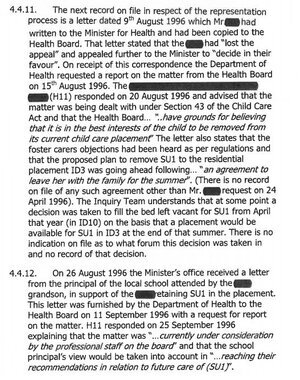
August 9, 1996: The foster family sends a letter to the then Minister for Health Michael Noonan which had been copied to the health board. This letter states they had “lost their appeal” and that they were appealing to the minister to “decide in their favour”.

The foster father also writes:

“We have looked forward to having Grace for a few more years in fact until my wife reached retirement age. How anyone can say the type of move envisage for Grace is in her best interest beats all.”

Our grandson is 8 years of age who lives with us has always regarded Grace as his sister and to suddenly part them would be very upsetting for him particularly as his mother died last year.

“…I can see no valid reason for this move…”

August 15, 1996: Six days later, according to the Devine report, the Department of Health requests a report on the matter from the health board.

August 20: Five days later, the Department of Health is notified that the matter is being dealt with under Section 43 of the Child Care Act. The health board tells the Department of Health it has “grounds for believing that it is in the best interests of the child to be removed from its current child care placement“.

The same letter to the Department of Health says the foster carers’ objections were heard “as per regulations” and that the plan to remove Grace was going ahead following “an agreement to leave her with the family for the summer”.

But there’s no record or file of any such agreement. There’s only the April 24 letter in which the foster father requested this arrangement, citing his grandson’s relationship with Grace.

August 26, 1996: The Minister for Health Michael Noonan’s office receives a letter from the principal of a school attended by the grandson. The principal writes in support of Grace staying with the foster family.

September 11, 1996: The Department of Health gives this school principal’s letter to the health board with a request for a report.

September 12, 1996: A day after Minister Noonan’s department passes on the letter from the school principal to the health board, it’s recorded that, during a visit to the home, the foster parents say they are going to oppose Grace’s removal and that they have written to Michael Noonan.

September 25, 1996: In response, the Department of Health is told the matter is “currently under consideration by the professional staff on the board” and that the school principal’s view would be taken into account in “reaching their recommendations in relation to the future care of Grace.”

October 24, 1996: A case conference takes place. The Devin report notes:

“There is some dispute in recollection between the professionals as to whether a decision was taken not to remove [Grace] prior to the case conference held on 24th October 1996. There is also a dispute as to why the decision to remove confirmed at the case conference in April 1996 was effectively overturned in October 1996. The [redacted] is of the view that the decision was taken at the case conference  while the [redacted] was of the view that the decision not to remove was because “the appeal” by the [redacted] was successful.”

If you recall, in his letter to Minister Noonan, the foster father said he lost the appeal.

In addition, the Devine report noted:

The Inquiry Team, on the basis of the evidence available, would be of the view that the two persons designated to hear the representations made by the [redacted] did not uphold the appeal of that decision. The inquiry Team would also be of the view that the decision taken at October’s case conference to effectively reverse the outcome of the April case conference was taken by the professionals concerned including the [redacted], [redacted] and the [redacted]. It is not clear however if this decision was made prior to the October case conference or was taken at the case conference.”

Either way, at the case conference of October 24, 1996, it is noted “there is no evidence that anything happened to Grace or that her well being or welfare are not being met..” but, at the same time, the conference is also told neither the health board or any intellectual disability service provider would be placing any further children at that home.

November 14, 1996: The foster parents are told that Grace will be staying with them.

2000: The foster father died.

February 27, 2001: During a visit to the home, the foster mother says she’s relying on the income that she receives for looking after Grace and says she’d like Grace to stay with her and her grandson until he turns 18, which would be in 2006.

March 27, 2009: After it’s noticed that Grace had suspicious bruising on her thigh and breast, she’s taken to A&E and then a Sexual Assault Treatment Unit. A statement is also taken by gardaí. She was later returned to the foster home as it was “the least worst option”.

Grace remained at the home until July 17, 2009.

Protected disclosures by whistleblowers in relation to the treatment of Grace are made in late 2009 and early 2010.

A total of 47 children with profound intellectual disabilities were placed at the home between 1985 and 2013.

Read the Conal Devine report here

Previously: ‘Confidence In The Institutions Of The State Is In Unequivocal Jeopardy’

Screen-Shot-2016-02-23-at-17.00.58C5ygRGYWAAIABK-
much better than those three giant png files that were slowing down screenloading. Anyone?

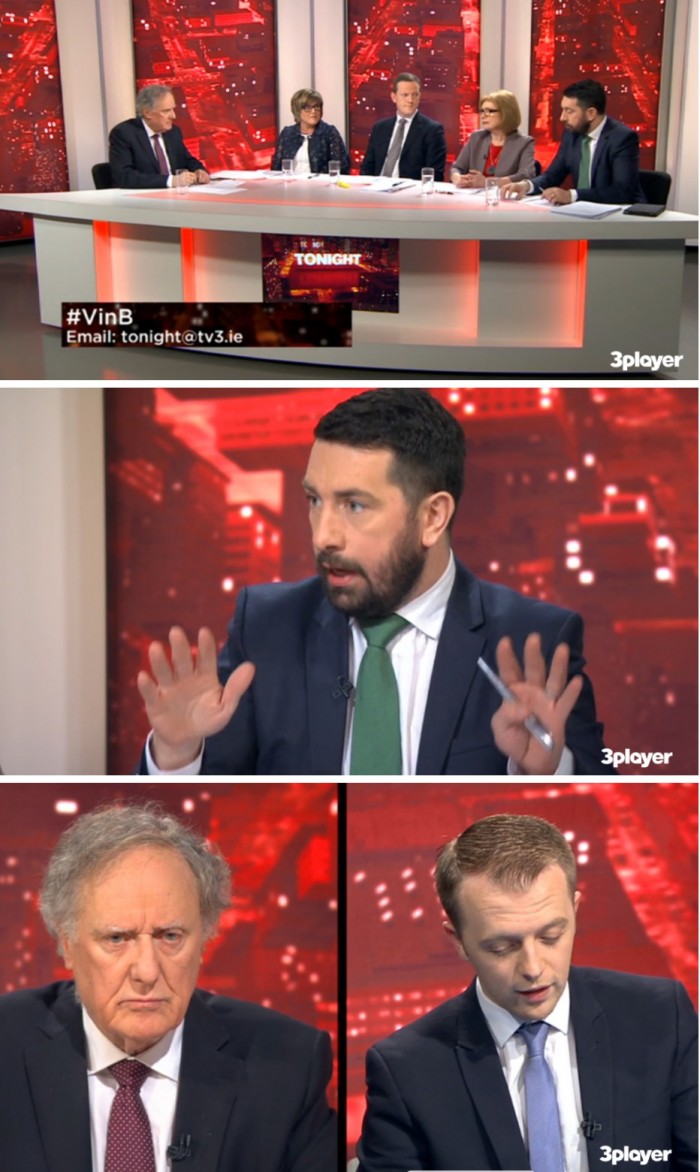
From top: Letter from Grace’s foster parents to then Minister for Health Michael Noonan in 1996; page 30 of the Conal Devine report; the panel on last night’s Tonight with Vincent Browne; Daniel McConnell; and Vincent Brown and Gavan Reilly, of Today FM

Last night.

On TV3’s Tonight with Vincent Browne, the panel – Fianna Fail TD Mary Butler, Fine Gael TD Alan Farrell, Labour TD Jan O’Sullivan and political editor at The Irish Examiner Daniel McConnell – discussed the Grace case.

It followed the publication of the 2012 Conal Devine and 2015 Resilience Ireland reports into the case yesterday.

Grace is a non-verbal, intellectually disabled woman,  now in her 40s, who lived with an abusive foster family for 20 years, until 2009.

Grace lived in the home for almost 13 years after the local health board decided to stop placing children at the home.

An original 1996 decision to remove Grace from the abusive home, amid allegations of sexual abuse, was overturned following representations to the then minister for health Michael Noonan in August 1996.

During the discussion, Gavan Reilly, of Today FM, read out tweets that were being directed at the show.

From the show…

Daniel McConnell: “Vincent, one of the starkest things that came out of the press conference today and also the interviews from the HSE’s designated spokesperson was, when it got to the idea of accountability, the three people who were involved in the decision to leave Grace in the home in 1996 – which was an overturning of an earlier decision to remove her from the home – they’re no longer with us, so, therefore, we can’t pursue that angle.”

The HSE don’t have powers of compellability so we can’t even ask them. So, therefore, it’s just, they’re gone, they’re off the hook. There are 11 other healthcare workers, remaining in the system, but yet the HSE are convinced that there’s no difficulty or there’s no risk to child. How do they know if they haven’t even asked the people who were involved, as to what went on?

Later

Gavan Reilly (after reading several tweets):  “It has to be said, Vincent, there’s one other common thread in the tweets and it’s something that I think relates back to a point that Daniel just made a few moments ago which is a lot of people are querying why there hasn’t been more made today, in the media coverage, about the role that Michael Noonan played in this, bearing in mind that Michael Noonan was the Minister for Health in 1996, when a decision was made to remove Grace from this particular home. The foster family, themselves, approached Michael Noonan, he passed it down the line and, ultimately, a decision was made, further down the line, not to remove Grace from that home.”

“Now, as Daniel has said, there’s obviously significant shortcomings in the fact that the three people responsible for that decision have yet to be approached by the HSE because, it says, it doesn’t have compellability – that is, possibly, the only lingering reason why a Commission of Investigation would still be a good thing. But, just to finish this point, Vincent.”

“The report today, and it has to be said, and there is other commentary around Michael Noonan, and no doubt there are questions to answer, the reports today, particularly, the Conor Dignam report, there is nothing damning about the handling of this case by Michael Noonan in that, quite simply, because it doesn’t go into any detail at all.”

“The only instance where Michael Noonan is invoked in that is  that the family wrote to Michael Noonan, Michael Noonan passed it down. There is no indication that Michael Noonan gave any instruction, either way, that’s something that has to be sounded out. But I just, I think, it should be said because a lot of people are wondering, they think that the coverage  is a little bit lacking because it doesn’t incorporate the role of Michael Noonan and I think the point just has to be made: that the reports today didn’t make any comment on the performance of Michael Noonan and it doesn’t shed any light on that.”

Watch back in full here

Related: Grace files: Grace scandal officials given senior roles (Irish Examiner)

Previously: ‘Confidence In The Institutions Of The State Is In Unequivocal Jeopardy’
Grace, Noonan and Monageer

Pic: Irish Examiner and Namawinelake

noonan093016-Garrett-O-Halloran

From top: Michael Noonan; Garry O’Halloran

Garry O’Halloran is a barrister, former Fine Gael councillor and former chairman of the South Eastern Health Board.

Readers may recall a previous post outlining how, in 1997, Mr O’Halloran attempted to speak with the Minister for Finance Michael Noonan – then Minister for Children – about allegations of child sex abuse in relation to Fr Jim Grennan, who had abused several children in Monageer, Co. Wexford, the diocese of Ferns. 

According to Mr O’Halloran, Mr Noonan ran away from him when he attempted to speak to him about this at a Fine Gael Ard Fheis in 1997. One of Fr Grennan’s victims was with Mr O’Halloran at the Ard Fheis.

Mr O’Halloran resigned from Fine Gael following the incident.

Mr O’Halloran came forward to recall his non-meeting with Minister Noonan at the Ard Fheis in 1997 – after he heard Minister Noonan give an interview with Richard Crowley on RTÉ Radio One on Thursday, February 4, 2016.

During that interview Minister Noonan was briefly asked about the letters he received about Grace.

Mr O’Halloran knew nothing of Grace when he heard the interview – but it jogged his memory in relation to Fr Grennan. Mr O’Halloran also felt it was important to explain that the case of Grace was not an isolated incident.

Further to this, and the publication earlier today of the Conal Devine report and the Resilience Ireland report into the Grace case…

Mr O’Halloran writes:

A few questions and answers:

Q1: How many inquiries does it require to establish the truth in respect of a single event?

If the event was to overturn a lawful decision taken by social workers to remove a young woman with disabilities from her residence, and that decision was overturned following the intervention of then Health Minister Michael Noonan, the correct answer at this moment in time is ‘at least six’.

The inquiry presently being set up has been preceded by

  • 2007 report of a SEHB (South Eastern Health Board) social worker;
  • 2009 report of a non-SEHB social worker;
  • 2012 report by Conal Devine;
  • 2015 report by Resilience Ireland;
  • 2016 report by Conor Dignam SC.

It is not known how many Garda reports may be in existence.

Q2: Three reasons why this issue is important:

A beautiful young woman, whose disabilities rendered her unable to verbally communicate and whose mental age remained at 12 months old, was exposed to possible daily rape and other forms of torture for an additional 9 years as a result of the Noonan intervention.

The parents/guardians of 47 other persons with disabilities who had been sent to this Kilkenny residence were never informed of the disclosures of rape and torture. Respect for the rule of law and confidence in the institutions of the State are in unequivocal jeopardy.

Q3:  What actually happened?

A case conference in May 1996 on ‘Grace’ determined that she be removed from her foster-carers. This decision could not be implimented immediately as there were no placements available for persons with a disability. When arrangements were made, the foster-carers were informed in September and given the standard three days to deliver up the child.

The foster-carers appealed this decision, as was their entitlement under the 1995 Foster-Care Regulations. The oral appeal was held before Ms Marie Kennedy and Dr Marie Ryan, and the decision to remove Grace was upheld.

By letter dated August 9, 1996 (see copy exhibited in a report by the political editor of The Irish Examiner, Daniel McConnell), the foster-carers appealed directly to Minister Noonan.

Minister Noonan acted on this letter, notwithstanding that the whole area was governed by statute, and including the new Foster-Care Regulations.

Minister Noonan passed the matter on to his junior ministerial colleague, Minister Austin Curry (as again happened in the ‘Monagear’ case a few months later).

Minister Curry passed it on to an official of the Department of Health (DoH). The DoH official passed it on to the SEHB.

The SEHB operated under a hierarchical structure. At the top was the CEO, John Cooney, who was assisted by programme managers in the areas of general hospitals, special hospitals (ie psychiatric and geriatric hospitals) and community care (covers foster-care).

The Programme Manager for Community Care in the SEHB, Martin Hynes, responded to the DoH official by stating that this was possibly the first decision taken under the provisions of the Foster-Care Regulations, and the decision stood.

A further case conference late in 1996 was informed by the chair, Sandra Merity, that the decision to remove ‘Grace’ was overturned. No clear reason was given, but mutterings about legal advice and a possible three-person meeting in September have proved elusive to all those who have followed the paper-trail.

However, Dr Cathal Morgan of the HSE told Keelin Shanley on RTE’s News At One today that he knew the identity of the three as-yet unidentified persons ‘who were responsible for implimenting the decision of the case-conference’, and he further noted ‘they have left the service’.

In addition to his profuse apologies, Dr Morgan also referred to ‘a HR procedure’, that a Garda investigation is ongoing (he omitted the fact that it appears to have commenced in 2007), and he made repeated reference to the over-riding need for Due Process. This final comment is particularly ironic since it was the interference with due process which condemned Grace.

Q4: How useful are inquiries?

The ‘real news’ about inquiries is that they are invariably set up with a view to kicking the truth down the road – for years, decades, or permanently.

The ‘facts’ established by Inquiries cannot be used in criminal proceedings.

The matters at issue in the ‘Grace’ case are criminal in nature – the decision-makers who subjected Grace to daily torture for over nine years cannot claim immunity from the criminal law. That includes Minister Noonan.

Q5: How can the truth be established?

The very small number of decision-makers and facilitators could just say what happened.
When this does not happen (after the 5 previous inquiries and reports), it is necessary to personally identify the crew, get just one to free himself or herself from the glue, and then expose both the lie and the liars. After that, the truth will find its own level.

Earlier: Failing Grace

Previously: Grace, Noonan and Monageer

Rollingnews

C5v6VSwWcAEKOk2

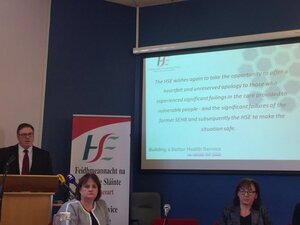
HSE officials holding a press conference in Kilkenny this morning

This morning.

Following the seven-year efforts of social worker whistleblowers, the HSE is publishing two reports into serious failures at a foster home in Waterford.

A press conference on the matter is currently under way in Kilkenny.

The reports, the Conal Devine and the Resilience Ireland reports, were commissioned by the HSE and both looked at the services provided by this particular foster family – who had looked after 47 children intermittingly over a 20-year period, up to 2013.

One of these children was Grace, a non-verbal, intellectually disabled woman who is now in her 40s and who lived with the family for 20 years, until 2009.

Grace lived in the home for almost 13 years after the local health board decided to stop placing children at the home.

The 148-page Conal Devine report was completed in 2012, while the 92-page Resilience Ireland report was finished in 2015. Copies of both reports were issued to service users and families of service users yesterday and some journalists have had sight of them.

In this morning’s Irish Examiner, Daniel McConnell and Fiachra Ó Cionnaith report:

The 2012 Conal Devine Report and the Resilience Ireland Report into the foster abuse scandal reveal Grace suffered significant physical injuries before being removed from the home in 2009. The two reports are due to be published today.

The injuries include black eyes, bruises to limbs, and carpet burns on her back, while she also suffered horrendous neglect in terms of her physical condition.

The Devine Report details how an original 1996 decision to remove Grace from the home, amid allegations of sexual abuse, was overturned following representations to the then health minister Michael Noonan.

It shows that a seperate allegation of “sexual molestation” against a second child in 1995 was not properly investigated because of the absence of a formal complaint to gardaí.

20 years of horror: Grace returned to foster home after hospital saw her for bruising on thighs and breasts (Daniel McConnell and Fiachra O Cionnaith, Irish Examiner)

Meanwhile…

Last night, on RTÉ’s Claire Byrne Live…

Screen Shot 2017-02-28 at 10.07.03

One of the social workers who blew the whistle on the Waterford home spoke to Claire Byrne last night.

Her identity was protected during the interview (above).

While speaking with Ms Byrne, the woman told how, after raising concerns with the HSE, the Department of Health, the Department of Children and Youth Affairs and the gardaí, she felt she had to go to the Public Accounts Committee – to highlight the wastage of taxpayers’ money – in an effort to get answers.

The move resembled that of Garda whistleblowers Sgt Maurice McCabe and former Garda John Wilson, who also approached the Public Accounts Committee – to highlight the loss of money for the State – when they were trying to highlight the quashing of penalty points.

From last night’s interview:

Claire Byrne: “Grace is currently a client of yours and, before we begin, it’s important for me to ask: is she in a safe place now?”

Social worker: “She is.”

Byrne: “Allegations of sexual abuse, physical abuse and neglect. When did the extent of the allegations, regarding the foster care facility become known to you?”

Social worker: “It really started in 2009 that my colleague and I began to become aware of some concerns that we were, I suppose, unaware of, up to that point. But, really, over the last seven to eight years, we’ve become aware of more and more, a litany of failures I suppose to address these concerns, more concerns about different types of abuse, the number of people involved. And right up to today with the publication of these reports, it’s the first time that we’ve become fully aware of what was known to the health board and the HSE at various times.”

Byrne: “And it’s estimated that 40 individuals would have passed through this care home?”

Social worker: “Yes, what we know from today’s reports is that, in total, there were 47 children and vulnerable adults with disabilities, some of them for long-term placement, some of them for short-term respite care breaks.”

Byrne: “Now, when Grace was living at the home, the local authorities became aware of serious allegations by a previous resident and steps were taken, at that time, to remove the resident still living there, but Grace went on to live in that home for a further 13 years. Isn’t that the case?”

Social worker: “That’s correct.”

Byrne: “Now, seven years ago, you began a process of uncovering why Grace had remained in that care home, despite the complaints that had been made and the concerns that had been raised. You blew the whistle on what you believed had happened. To whom and which organisations did you speak to?”

Social worker:We made a protected disclosure to the Department of Health, in the first instance, we then went to the Office of Protected Disclosures, within the HSE. At various times, I’ve been to the Office of Ombudsman, the Department of Children and Youth Affairs, several different departments within the HSE itself, right up to the very top echelons of the HSE. I’ve been to An Garda Siochana, we’ve had numerous inquiries, reviews and investigations out of those processes and, still, I suppose, in 2014, late 2014, I was in a position where I still didn’t know what had happened. I still had no answers… I hadn’t achieved anything other than endless inquiries, reviews, significant amount of taxpayers’ money – over half a million on inquiries at this stage, plus I would say, an equal amount on legal fees and management consultant fees. And so I decided to investigate the procurement processes in relation to those and that gave me, I suppose, a circuitous route to the Public Accounts Committee. And I was quite fortunate there that, upon meeting John McGuinness, and explaining to him my concerns around wastage of taxpayers’ money on unpublished reports, you know, answers we weren’t getting, learning that wasn’t happening, that we weren’t protecting vulnerable adults or learning from these failures. And John McGuinness, very quickly, took on board that there were more substantive issues, really than procurement. And it really is because of the work of the Public Accounts Committee that we are where we are today – waiting on a proposed Commission of Investigation.”

Byrne: “And where we are today, the HSE-commissioned reports, two of them will be published tomorrow [Tuesday]. Now there was one that was published back in 2012, that was the Conal Devine report. Another report was completed in 2015 by Resilience Ireland but neither report was published, as we know. They will be published tomorrow [Tuesday]. You have seen them, what do you make of the findings?”

Social worker:While I was prepared for the lack of answers, we still don’t really know what happened. There seems to be, by and large, a failure to establish the facts, a failure to establish why certain things went wrong. We know that it went wrong, we just don’t know why yet. What I really wasn’t prepared for is the litany of failures. The word ‘failure’ it just seems to appear over and over again. Reading those reports today and seeing 47 individuals who were put at risk, there’s no other way around it. Their lives, these are people’s lives, they’re not just cases. They were put at risk. And I wasn’t prepared for how stark the reports would be in outlining 30 years of repeated failures. We know that the terms of reference for the Conal Devine report and the Resilience Ireland report were far too narrow to ever investigate what happened fully.”

Byrne: “Well, the Government has committed now to a Commission of Investigation into this foster home scandal and the minister in charge, Minister Finian McGrath will publish those terms of reference shortly. But what you’re saying is, the end result here, the one that you would hope for, is accountability in these cases?

Social worker: “That has to happen. I think, at this stage, that, if the taxpayer sits back and doesn’t demand accountability on this, if they say, ‘well, I’m happy to pay for repeated inquiries and reviews and reports for a system that never holds anybody accountable’ – the same system, without any change, can’t affect different results in the future. That’s my concern. That, really, how can that system protect people if failures and a duty of care to the most vulnerable in our society – if we let that system become a risk to the very people it’s there to protect, how can that system ever protect vulnerable people?”

Byrne: “All of this, and given what you’ve just said. It must be hugely concerning for the families with those people with intellectual disabilities who are relying on the State to provide care facilities for them. I mean can we be sure that this isn’t happening now? Are the checks and balances in place now, do you believe?”

Social worker: “Oh I don’t think so. I think if I believed that, I wouldn’t be sitting here tonight, for a start. I wouldn’t have spent the last seven years, intend to spend the next couple of years working towards the Commission of Investigation’s findings to affect that kind of change. But, at the moment, I don’t think the system can adequately protect people. I think what we’ve seen, even around policy direction, what we have is people leaving foster care with an intellectual disability and there is no system for them to go into. They’re discharged from the care of Tusla. The HSE has a duty of care to them but doesn’t actually have a system of monitoring, vetting, oversight, training of the placements where they stay, if they’re in family-based placements. What we need is that for every child with a disability leaving foster care, if we learn anything from this, we need now for those placements to be regulated, for them to have oversight, to ensure that their needs are being met, to ensure if there are concerns, that action is taken and that there is a structure in place and that there is a system of regulation in place.”

Byrne: “Finally, we’ve heard an awful lot about whistleblowers and how they’re treated in this country. How was your experience, as a whistleblower?

Social worker:It’s been appalling. You know, it’s been a very difficult seven years and I think that, all through that, I was very lucky because I work for a very small agency that, when I came to that agency in 2009 – I was only a newly qualified social worker – this was actually the first case I ever had in disability social work. And, when I started raising those concerns, I had the support of the management team within the organisation I work, I had the support of the board of directors and the voluntary agency I work for. And that allowed me to go to all of the various departments I went to. To go to the Office of the Ombudsman, to go to the Public Accounts Committee. At no stage, did anybody – I suppose despite the impact that that had on a small agency – at no stage did anybody attempt to discourage me from that within the organisation.”

The difficulties I faced within the HSE were significant and my concern is that for any other social worker now, who might be out there, who might know of another Grace today, that’s not a system that would entice anybody to make a protected disclosure, to blow the whistle on it.”

Byrne: “Thank you very much for your time.”

Watch back in full here

Previously: Grace, Monageer And Noonan

Top pic: Gavan Reilly

Screen-Shot-2016-02-23-at-17.00.58-1024x988

Tuesday’s Irish Examiner showing the letter sent by the foster father of Grace to the then Minister for Health Michael Noonan in August 1996

Further to yesterday’s post about Grace, Finance Minister Michael Noonan and barrister Garry O’Halloran’s calls for Mr Noonan to resign…

Two sisters, Bridget and Margaret, spoke to Joe Duffy on RTÉ’s Liveline this afternoon.

They did the interview because a third sister, who has limited speech and poor mobility, lived in the same foster care home as Grace for brief respite periods on several occasions – in 1983, 1987 and 1989.

Bridget and Margaret said their sister, who is now in her 40s, was first placed there by her South Eastern Health Board social worker, when she was aged 12.

At the time, she would have had the mental age of a two-year-old.

The sisters both recalled an incident where the foster parents contacted the sisters’ family, abruptly telling them to take the girl home. When the family went to collect her, the girl was left alone at the end of the foster home’s driveway.

Asked if the sister could have communicated with them, if she had been abused, Bridget said:

“I don’t think so, no. Only through crying and being terribly anxious.”

Margaret explained that the gardai had contacted her 18 months ago to say that “there was a minor complaint made, nothing to worry about.”

Margaret then gave them a statement about the incident in which her sister was left at the end of the driveway.

Then, on December 9, 2015, Margaret received a letter from the HSE saying that her sister would be a part of a Resilience Ireland report.

She also received an apology from the HSE and clarification that a Garda investigation was under way.

Margaret said she cannot get any other details and is facing having to make requests for information under the Freedom of Information Act.

She also made an appeal for other families affected – it’s believed 40 children lived in the foster home – to get in touch.

Margaret said: “If [any other families affected] would like to talk or come together as a support group, I mean we should have been told before it came out in the media really. We should have been informed, we should have been warned. Not hear about our family member in the media.”

Bridget also said that they’d like to hear from the social worker who was working with their sister. She said the HSE hasn’t offered any support or contact with any other families involved because of “confidentiality” reasons.

Bridget added: “And they said it could be a long time before we found the truth out really, you know, and that’s, that’s hard as well to take on.”

Towards the end of the interview, Mr Duffy asked the sisters to articulate what they’re hoping for.

Bridget: “Just, well, we just hope that she, she wasn’t in this situation but we don’t know and just for other families out there, who are feeling the same way as us, if they want to get in contact, we can [be] stronger in numbers really and to just sit down and talk about it. If they’ve got any, any information that could help us…”

Joe Duffy: “And Margaret is a part of you saying, ‘actually maybe we shouldn’t dig?’

Margaret: “No.”

Duffy: “Maybe…”

Margaret: “No. Sure we have all the right to dig.”

Duffy: “Oh, I know that, I know that, I know that, absolutely. But is part of you saying, ‘oh god..'”

Margaret: “Oh of course you’re afraid what you’re going to find out…”

Bridget: “And what do you do with the information when you get it?”

Margaret: “Who’s going to be held responsible for all of this? The HSE? Who?”

Mr Duffy didn’t ask the sisters about the Irish Examiner’s report earlier this week which showed that Grace remained in the foster care home for another 13 years after the foster father – now deceased – sent a letter to the then Health Minister Michael Noonan asking that she be allowed to stay.

The letter was sent after the health board ruled that Grace be removed and after the family lost an appeal against that decision.

Mr Duffy also didn’t ask the sisters for their thoughts on barrister Garry O’Halloran’s calls for Mr Noonan to resign and for Commissioner Noirin O’Sullivan to investigate Minister Noonan.

Listen back in full here

Previously: Grace, Noonan and Monageer

Screen Shot 2016-02-23 at 17.00.58

Screen-Shot-2016-02-16-at-14.01.13-1

Yesterday’s Irish Examiner showing the letter sent by the foster father of Grace to the then Minister for Health Michael Noonan, above, in August 1996

You may recall the story of Grace, the mute child – now a woman in her 40s – who remained in a foster home with an abusive family in the south east of Ireland for more than a decade after other children had been removed.

The other children were taken out of the home in 1995, after concerns were raised with the then Southern Health Board in 1992.

Yesterday’s Irish Examiner reported how – after the health board initially decided that Grace be removed – Grace’s foster family appealed against this decision but lost.

Following that, the foster father, in 1996, sent a letter lobbying the Minster for Health Michael Noonan to allow Grace stay in the home.

It’s unclear what exactly happened after this letter was sent but Grace did stay at the home for another 13 years.

Daniel McConnell, of the Irish Examiner, spoke with Matt Cooper on Today FM yesterday evening to explain the significance of the letter.

He said:

“Whether, it seems, by accident, or inadvertently, the intervention seems to have had a chilling effect because what’s detailed in the documents is that Grace’s removal was delayed on foot of the request from the foster father. Then that removal never happened.”

“…We put a series of detailed queries through the Fine Gael press office, to him [Noonan], last [Monday] night and he said he had nothing more to add…”

Separately.

Readers may also recall the allegations made by former Fine Gael councillor and barrister Garry O’Halloran in relation to Minister Noonan.

Mr O’Halloran has claimed that, at the 1997 Fine Gael Ard Fheis in Dublin, Michael Noonan ‘ran away’ from him even though Mr Noonan was scheduled to meet with him.

Mr O’Halloran wanted to speak with Mr Noonan – not about Grace – but about the late Fr Jim Grennan, who had abused several children in Monageer, Co. Wexford, the diocese of Ferns. One of Fr Grennan’s victims was with Mr O’Halloran at the Ard Fheis.

At this point, in 1997, Fr Grennan was already dead, having died in 1994.

Mr O’Halloran, who was chairman of the then South Eastern Health Board, wished to speak with Minister Noonan to request that he order an inquiry into the health board’s response to abuse allegations made by 10 children against Fr Grennan back in 1988.

Mr O’Halloran explained:

“The allegations were raised in 1988 and they were validated immediately. There was a local teacher, a local social worker and a local guard who all did a very good job. But after that, a superintendant came along and destroyed the file and the guards did nothing, the health board did nothing.”

He [Grennan] went on to carry out devastating rapes after that, with devastating consequences.”

Mr O’Halloran was prompted to lobby Mr Noonan in 1997 – three years after Fr Grennan died – because Mr O’Halloran had learned that one of Fr Grennan’s victims had been gravely abused for several years, on a regular basis, after 1988.

The day after Fr Grennan died, on May 9, 1994, aged 61, a child of 13 took an overdose of medication and was admitted to hospital. On May 30, the child told their mother they had been molested by Fr Grennan, in the months prior to Fr Grennan’s death.

Mr O’Halloran explained:

I was asking questions. I was in the health board and everything was being denied. The acceptance of any clerical child abuse was denied. When we got the thumbs down from the authorities, there was only three of us working on it at this stage – Billy Moroney, a farmer from New Ross, journalist Veronica Guerin, and myself.”

“We worked closely together. But Billy and myself set up a group called Survivors and we used to meet every month  in Waterford and, very quickly, we had people coming and all the situations were the same. All the victims had raised a complaint about being raped and abused and they were all ignored.

The eventual Ferns Report, which was published in 2005 and looked at 100 allegations of child sexual abuse made between 1966 and 2005 against 21 priests in the Diocese of Ferns, confirmed all of Mr O’Halloran claims and those of Fr Grennan’s victims.

In light of the findings of the Ferns Report, readers may wish to read Mr O’Halloran’s recollections of the Ard Fheis. He said:

“[Noonan] kept us waiting all night, no sign of him. Eventually I spotted him leaving the podium and he was heading for the door and, when I followed him, he sprinted as fast as he could and when I reached the door he was already in his car and there was black smoke whirring up into my face, from the wheels spinning. And Phil Hogan was standing alongside me and Phil said to me, ‘you relax, the Minister for Children [Austin Currie] is meeting your deputation, everything will be fine.‘”

“So we met him [Currie] and, after about half an hour, he said, ‘right you have your inquiry’. So that was fine. I contacted his secretary on the Monday morning to progress the matter and she said, ‘hang on a minute’. And then she came back and said, ‘No there isn’t any inquiry’.”

“And I said, ‘Oh yes there is, we met the [junior] minister on Saturday night, he said we have our inquiry.’ And she said, ‘oh no he [Currie] didn’t. What he told you was that he would inquire into it and, having inquired, there’s no substance to your claims and allegations’.

Last Saturday, Mr Currie denied this was the case, telling the Irish Times:

“I said I would inquire into their allegations when I got back to the department on Monday. The next thing I heard in the press I had promised an inquiry. I had not. I know I brought that family’s concerns to the officials in the department.”

So what does Monageer have to do with Grace?

It should be explained that Mr O’Halloran came forward to recall his non-meeting with Minister Noonan at the Ard Fheis in 1997 – after he heard Minister Noonan give an interview with Richard Crowley on RTÉ Radio One on Thursday, February 4.

During that interview Minister Noonan was briefly asked about the letters he received about Grace.

Mr O’Halloran knew nothing of Grace when he heard the interview – but it jogged his memory in relation to Fr Grennan. Mr O’Halloran also felt it was important to explain that the case of Grace wasn’t an isolated incident.

Ever since his allegations about the Ard Fheis were published, many people have contacted Mr O’Halloran about Grace.

Further to this, he has written to both the Garda Commissioner Noirin O’Sullivan and Minister Noonan.

He has asked Ms O’Sullivan to investigate Minister Noonan’s conduct – for his time as Minister for Health from 1994 to 1997.

In addition, he’s asked Minister Noonan to resign.

Mr O’Halloran, a barrister, explained his reasons for this:

“In 1995, having received repeated evidence of complaints of child sex abuse in the particular foster care facility, it was decided to place no further children in that facility and to remove Grace forthwith. The foster parents had an entitlement to appeal that decision and they did appeal it.”

“The appeal committee accepted that the original decision was a proper decision and that it was in the best interest of the child that she be removed forthwith from that facility. In response to that the foster father wrote directly to the minister stating that they did not accept those decision and hence they were putting in a further appeal to him.”

“Notwithstanding the fact that he had no statutory function in the matter, he passed the matter on to his officials and his junior minister. He was notified by the health board, the matter was governed by Section 43 of the Childcare Act, which meant that if there was any ongoing concerns that a judge of the District Court should make the decision on the basis of what was in the best interest of the child.”

Instead of the matter going to a judge, it ended up with a further appeal committee – the composition of which remains unknown to this day – deciding that the child be left at this foster care facility, and there she remained for a further 13 years until a social worker recently appointed to her case, brought the matter to attention.”

“As far as I’m concerned [Minister Noonan] is a man that shouldn’t be holding high public office and he merits investigation.”

Listen back to Mr McConnell’s interview in full here

Letter shows ‘Grace’ remained in home after foster father lobbied Michael Noonan (Daniel McConnell and Fiachra Ó Cionnaith, Irish Examiner)

Austin Currie drawn into case of girl at ‘foster’ home (Kitty Holland, Irish Times)

Irish Examiner/Rollingnews

Screen-Shot-2016-02-16-at-14.01.13

Finance Minister Michael Noonan

You may recall barrister Garry O’Halloran’s claim that, at a Fine Gael Ard Fheis in 1997, Finance Minister Michael Noonan “ran” away from him as he attempted to discuss abuse allegations at a foster home in the south-east of the country.

Mr Noonan was the Health Minister at the time.

The Irish Examiner reported the claims on Tuesday and couldn’t get a response from Mr Noonan, despite contacting the Fine Gael press office, the Department of Finance, the Department of Health or the Department of Children.

Today, the claims were put to Minister Noonan and his response was recorded by Gavan Reilly, from Today FM.

Minister Noonan said:

“Well, first of all, I was asked by Richard Crowley two weeks ago about anything I know about this. And I gave him a full answer. When I heard about it, I asked for the file in the Department of Health – there was two pieces of correspondence there. It’s 20 years ago, I’ve no clear memory of it and there was a complaint in and I referred it through the officials, back to the South Eastern Health Board that were the authority at that time and we were told that the young woman in question, or young child in question, had been removed from the foster home.”

“Some weeks later, it transpired that the South Eastern Health Board officials, who had made the decision, had reversed the decision for some reason. Now Austin Currie was the junior minister with responsibility to children at the Department of Health at that time and we referred it on to him.”

“Now I understand Cllr O’Halloran, whom I don’t know, I mean I’m sure I met him when I was minister because I met a lot of councillors, I’m not sure whether he was Waterford or Wexford but he was on in the South East anyway and I reject his versions of events. The minister for children was Austin Currie and an arrangement was made for Gary O’Halloran I understand and some people with him to discuss the issue with Austin Currie.”

“Beyond that, I don’t know anything but I’m prepared to cooperate with whatever inquiry is put in place after the election.”

In response to a follow up question [impossible to make out] from the Irish Examiner’s Daniel McConnell, Mr Noonan said:

“No, no, no, you’re making, as I understand it what we have, at present, is a series of allegations that need to be inquired into. I understand there’s no proof on either side. And I don’t want to say anything that gets me into legal difficulty to satisfy your curiosity. I’ve given you an absolute straight answer on everything I know. I can’t be responsible for third parities who make allegations about me which I refute.”

Noonan denies claim he ran from abuse meeting (Today FM)

Previously: ‘He Spotted Me And Ran’

Rollingnews.ie

093016-Garrett-O-Halloran

Screen Shot 2016-02-16 at 14.01.13

From top: Barrister Garry O’Halloran and Finance Minister Michael Noonan

You may recall the foster home abuse case involving a woman referred to as Grace, in the media, and a recent interview Finance Minister Michael Noonan did with Richard Crowley about the case on RTÉ’s News At One.

During the interview, Mr Crowley asked Mr Noonan about his knowledge of the concerns raised in relation to abuse, and a letter the foster father had sent to Mr Noonan in 1996  – when he was Minister for Health.

Further to this…

Journalists Daniel McConnell and Fiachra Ó Cionnaith, in this morning’s Irish Examiner, report that a former Fine Gael councillor, barrister Garry O’Halloran – who was a former chair of the South Eastern Health Board – claims Mr Noonan literally ran away from a meeting to discuss concerns about sex abuse involving children.

They further reported that Mr O’Halloran quit Fine Gael because of Mr Noonan’s actions.

They reported:

In a statement to the Irish Examiner, Mr O’Halloran said at the 1997 Fine Gael Ard Fheis, Mr Noonan had arranged to meet him and some abuse victims.

“We arrived, he kept us waiting for hours, eventually I spotted him leaving the stage and heading for a door about 40m away, I was about 60m away and started to follow him in the direction of the door,” Mr O’Halloran has said. “He spotted me and ran, I then ran but he got to the door and when I arrived I was met with a cloud of black smoke as his garda driver sped away,” he added.

Mr O’Halloran and his delegation then met junior minister Austin Currie who concluded there was no substance to the claims of abuse.

“I went to the taoiseach, John Bruton, who said it was a matter for the minister for health. When I got no place, I then submitted by resignation from FG,” he added.

In addition…

Yesterday, the Irish Examiner first attempted to put queries about this matter to the Fine Gael press office, but we were directed to the Department of Finance.

The Department of Finance said as this was a health matter, they could not comment.

A Department of Health spokesman said he could not speak for Mr Noonan and referred us back to the Department of Finance, but also suggested we speak to the Department of Children.

At the time of going to print, no comment was forthcoming from Mr Noonan.

There you go now.

Michael Noonan ‘didn’t want to know about sex abuse claims’ (Irish Examiner)

Pics: Leah Farrell/Rollingnews and Law Library

Screen Shot 2016-02-04 at 13.49.26

Finance Minister Michael Noonan at Fine Gael’s Long Term Economic Plan launch in Dublin this morning

On Tuesday, in the Dáil, United Left Alliance TD Clare Daly raised the case of ‘Grace’ and the foster care home in Waterford in which she suffered extreme physical and sexual abuse for many years.

She remained in the home for 13 years after other children had been removed because of concerns raised.

Ms Daly told the Dáil:

“In 1996 a decision was made by the social workers on the ground to remove that young woman. That is a fact which is backed up. We know that subsequently the foster father contacted the then Minister for Health, Deputy Noonan, and petitioned to have what he called his “beloved daughter” kept with the family… A documented case conference decision to remove that young woman from the foster home before August was subsequently reversed in October 1996 and the young woman, Grace, remained there up until 2009. People need to know who made that decision and who will pay the price for it.”

Ms Daly added:

One of the whistleblowers at the centre of this case has made the point that, sadly, it is not the only such case. In his opinion, it represents dozens of others in the same region over a 20 to 30-year time span. It is fair to say there is a systemic problem in the HSE. It is very much the old attitude that when the church or State is threatened, the response is to say nothing, admit nothing, call in the lawyers and see what happens.”

Further to this, Finance Minister Michael Noonan spoke to Richard Crowley on RTÉ’s News At One and Mr Crowley raised the matter of the letter…

Richard Crowley: “As you know, Clare Daly raised an issue in the Dáil this week. This was in relation to the abuse allegations in the South East area and she mentioned that a letter had been written by the foster father in the controversy, directly to you as Minister for Health, this was in 1996, by the foster father. Can you, I know it’s 20 years ago and you received lots of letters, thousands of letters at that time no doubt, have you had a chance to check you files or do you have any recollection of that case? At that particular time? Or at any time you while you were minister for health?”

Michael Noonan: “No, I’ve no clear memory of it but I did check the position of Department of Health and seemingly two letters arrived, one to me, and one to the junior minister for health, Austin Currie. And the letter, to me, I contacted, I got my officials to contact the South Eastern Health Board and my understanding of it was the person would be removed from foster care. But subsequently, information came through that there was some kind of appeal and that that didn’t happen and then, after that, because it was a question of the possible abuse of a child, the data was given to the minister of state who had responsibility for children. And I’m not sure what happened after that.”

Crowley: “So you had no further contact with the issue or the people involved?”

Noonan: “I’d no further contact after that and I didn’t have the power to direct and I didn’t direct. But the initial information I got was that yes, there was an issue and the child was removed. And, subsequently then, I forget the exact details but it was some kind of  appeal process and the decision of whoever took it down in the South East wasn’t implemented at that point and then it went on to Minister Austin Currie.”

Crowley: “Minister Noonan, thank you very much for coming in…”

Listen back in full here

Clare Daly claims foster father lobbied Michael Noonan (Irish Times)

Previously: Still In The System

Clare Daly transcript via Kildarestreet.com

Sam Boal/Rollingnews

Screen Shot 2016-02-02 at 11.04.01

Director General of the HSE Tony O’Brien

You may recall how the HSE repeatedly told the Public Accounts Committee it had apologised to ‘Grace’ – the mute woman with intellectual disabilities who suffered extreme physical and sexual abuse while she was in a foster care home from 1983 until 2009.

The Irish Examiner, on Monday, January 25, reported that the whistleblowers involved in the case claimed the HSE, in fact, had not apologised to Grace.

On Saturday, January 30, the HSE released a statement admitting no official apology had been given to ‘Grace’ or her mother – or the 46 other people who had contact with the foster home over the years.

Further to this, Fianna Fáil TD and chairman of the Public Accounts Committee, John McGuinness, on Today with Seán O’Rourke, said:

“We got a letter into the Public Accounts Committee, from the HSE, which basically rubbished the report that was written by the Irish Examiner, and referring to the apology as one of ‘for the poor quality of service’. These individuals, allegedly, were raped, abused and treated in the most abominable way and then, after that, we received, the following week, we received, the Public Accounts Committee received a letter from the agency concerned and they said they were being treated as despicable today, their treatment, as it was on day one when they raised this issue. What does that say about the protectors of those who are weakest, the HSE?.”

“Those that discovered this, that were professional enough and brave enough to come forward, did so, the whistleblowers. Unfortunately, the system within the HSE served them very badly and the whistleblower legislation, it would appear, is not worth the paper it’s written on. Because the whistlebowers fear for their professional futures.”

“We want to hear [from HSE director general Tony O’Brien] the full truth, we want to hear him tell us exactly what he knows from beginning to end, as much as he can – because we know there’s a Garda investigation going on. What we don’t want is for them to hide behind that investigation…”

HSE director general Tony O’Brien will appear before the Public Accounts Committee at noon today.

Related: Foster care scandal: The drip-drip of misinformation and mistruth (Irish Examiner)

Previously: No Saving Grace

‘What Was In The Records?’

Mark Stedman/Rollingnews