Tag Archives: Irish Times letters page

I see that the new bus system will include changing from numbering to letters A to F, inclusive.

While Billy Strayhorn wrote Take the A Train for jazz pianist Duke Ellington in 1939 (lyrics by Joya Sherrill, 1944), it may be a while before “Take the A Bus” comes into popular use in Dublin. Somehow a revised Bagatelle song Summer in Dublin won’t sound quite the same with “I jumped on the A to Dún Laoghaire”, rather than the iconic 46a.

Patrick Judge,
Dún Laoghaire,
Co Dublin.

Any excuse

Dublin Bus route redesign (Irish Times letters page) 

Image: Clickworks

Previously: Redesigning Dublin Bus

When My Humming Was Smothered

Ella McSweeney’s article on bees highlights the loss of wildflower and meadow habitats and the mass extinction of invertebrates.

An immediate remedy would be to curb herbicide use in verges and hedgerows and introduce a yearly (July/August) cut-and-clear-debris regime to facilitate wildflowers.

Herbicides kill most perennial plants and encourage coarse weeds- nettles, cow-parsley and cleavers, and need to be used again the next year.

Cut-and-clear weakens coarse weeds and promotes biodiversity, with the return of species such as cowslips, ox-eye daisies and native orchids.

New wildflower meadows are a possible solution – they require cut-and-clear if they are not to revert to scrub, or become dumping grounds.

If introduced in existing public parks and grassy spaces, such as the Phoenix Park, a cut-and-clear regime (hay-making, instead of the current mulch-mowing), combined with introduction of the native yellow rattle (which weakens coarse grass and thus facilitates perennial flora), would over a few years create wide acres of “new” wildflower meadows at little public expense.

Dr J Holden,
Kilmainham,
Dublin 8.

To bee or not to bee (Irish Times letters page)

Related: A third of all bee species in Ireland could be extinct by 2030 (Ella McSweeney, Irish Times, June 28, 2018)

Pic: Donegal Diaspora

Redwood trees in California

Darragh Murphy asks “Why is just 10 per cent of Ireland covered in trees?”

Crann – Trees for Ireland is a voluntary organisation whose aim is to promote the planting of trees, especially those native to Ireland. A joint initiative, of which I am the project group chairwoman, in partnership with Birr Castle, is Giants Grove (giantsgrove.ie), the planting of a thousand redwood trees in the grounds of Birr Castle in Co Offaly.

Redwoods were once native to Ireland, and at Birr we are bringing them “back home”, creating the largest plantation of giant and coastal redwoods outside of California.

Crann’s patron, President Michael D Higgins, said at the launch of Giants Grove, “The planting of these mighty trees, here, at the heart of Ireland, is not just an extraordinary silvicultural undertaking. It has been devised to symbolise, too, the abiding bonds that unite those who have passed away and their loved ones and the equally strong bonds through which Irish people all over the world are connected to this island”.

He further said: “We all know how vital trees, forests, and woodlands in general are to our collective future”.

These redwoods will be growing for the next thousand years, creating the perfect ecosystem, of which we can all be proud.

Clara Clark,
(Chairwoman, Project Management Group, Giants Grove),
Blackrock,
Co Dublin.

Trees and the long-term view (Irish Times letters page)

Giants Grove

Pic: Lonely Planet

Vicky Phelan

The letter by Dr Katharine Astbury regarding cancer screening programmes causes me great concern.

The writers, all 12 of them actively involved in the important work of cancer screening, chose to take issue with the legal process rather than question the medical failings that have caused death and serious harm to so many women through failures in the cervical screening programme.

They chose not to address the issue of the clear failure of the colposcopists working with CervicalCheck to inform women for, in some cases, years of the truth about their screening history and the serious errors that they and CervicalCheck alone knew about – errors that the vast majority of the women only learned about after my own legal proceedings made hiding the truth no longer possible.

Sadly for those 18 women who have already died, that truth remained hidden from them to the end. Denied to them also was the small comfort of knowing that their families would be provided for, at least to some financial degree, after their death.

Instead, the writers claim: “Approaches to redress need to recognise that automatic financial compensation for future false negative cases could lead to all screening programmes being abandoned”, and elsewhere that claiming that politicians and commentators have called for “uncontested compensation” for “all individuals who have false negatives on audit review”.

This is not the case. Women who have a false negative smear result do not have any legal recourse. It is only women whose smear has been incompetently read and who have suffered harm as a consequence who can bring legal proceedings.

Incompetence has no place in any screening progamme and to seek to give shelter to such incompetence at the expense of even one woman’s health, let alone 209, is wrong. It is also incorrect to argue that the choice is a safe and accountable screening programme or no cancer screening programme at all.

After all, it was not the legal process they criticise that caused all this harm.

The writers call for those reacting to this controversy to act responsibly in the sole interest of the health of Irish women since the stakes are extremely high.

As the woman who exposed this controversy, as an Irish woman and as a woman whose life is at stake as a result of medical and management failings, I am acting in the sole interest of the health of Irish women.

Unfortunately, the same cannot be said of many others.

Vicky Phelan,

Cian O’Carroll,

Annacotty,

Co Limerick.

Vicky Phelan on cervical screening scandal (Irish Times letters page)

Attending RTÉ’s Late Late Show in September 1998, I received a “one for everyone in the audience” prize of a long-life bulb. I placed it in the utility room and despite being used every day since (many times it was left on overnight), it still works. Is this a record?

Michael O’Connor,

Waterford.

Light-bulb moment (Irish Times letters page)

I heard on the radio this morning that the Chinese are no longer willing to recycle our recyclable waste and now we may have to pay additionally for that. I also heard that if there are any food remains in a single green bin then the entire lorry-load is discarded. If this is correct then the green bin is a waste of time.

I was born in south Dublin in 1966 and we had one bin about half the size of the current black bin and it was collected every week by the council.

The greengrocer called into the house every Thursday and delivered eggs and vegetables for the week. The breadman came and delivered the bread every day. The milkman came and delivered bottles of milk every day and took away the empty ones. There was no packaging.

At some point in time, all of these services were sent into oblivion because big companies could sell poorer quality produce cheaper. The people “running” these companies never did and never will understand anything other than “profits”.

The cost to the consumer today is that we will have to pay on the treble or the quadruple for succumbing to what appeared at the time to be a “sweet deal”.

I encourage consumers to seek out suppliers who produce and sell directly so that we might encourage a return to the ways of the 1960s and 1970s.

Ciarán Sudway,
Dublin 2.

Green bin charges (Irish Times letters page)

A woman walking in the snow in Glasnevin on March 4

I note that the current hospital bed crisis is in part due to pressure from slip and falls that occurred during the recent storm.

One contributing factor must be our apparent inability to clear snow from public paths and around homes.

This is not due to laziness or lack of civic pride but rather equipment failure.

I cleared 20 metres of snow at 8am each morning with a €7 snow-shovel.

I noticed other people using spades, garden hoes and even fireside shovels in futile attempts to keep paths clear.

What would be the cost saving to thousands of €7 shovels being left in town centres and on street corners during such weather events – allowing us all to play our part in keep this country moving and injuries down?

We could even allocate Tidy Towns points for additional motivation!

Adrian Mulryan,
Dún Laoghaire,
Co Dublin.

For the price of a shovel (Irish Times letters page)

Leah Farrell/Rollingnews

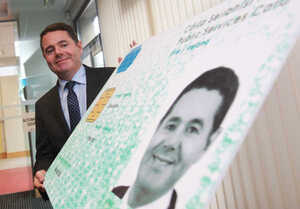
The then Minister for Public Expenditure and Reform Paschal Donohoe at the launch of the Public Services Card in 2016

The Road Safety Authority (RSA) is now informing the Irish public that to renew a driver licence we will need a public services card (PSC). The RSA also states that the PSC will be the only form of identification acceptable for this application. This, we are told by the Government, is for security purposes.

As my licence will soon be due for renewal, I will have to obtain a PSC. To obtain this PSC I will have to visit, at my own time and expense, a government office where I imagine I will have to prove my identity. Not having a PSC, I will have to offer my driver licence or passport as proof of my identity. The person taking my application will, I hope, accept my passport or driver licence as proof of my identity.

So the situation will soon be, that for security purposes, my passport will be good enough to get my PSC, but not good enough to renew my passport.

With all the problems that need to be addressed and that require large sums of money, is this really the best use of the millions that have been spent on this?

Or has the Government come up with an expensive solution to a problem that did not exist?

Trevor Troy,

Baile Átha Buí,

Co na Mí.

Public services card (The Irish Times letters page)

Former Fianna Fail TD and GOAL chairman, director general of the Institute of International and European Affairs Barry Andrews

Barry Andrews is at pains to portray Pesco as separate from full defence integration at EU level. But his point is surely contradicted by the president of the European Commission who stated that Pesco “lays the foundations for a European defence union”.

The EU’s high representative for foreign affairs backed this up by stating that “in practice it is the foundation of a future European defence”, chiming with numerous supporters of a common EU defence who have welcomed Pesco’s establishment.

It would be better if the Institute of International and European Affairs simply stated this so that we can have a full and proper debate on Ireland’s place “at the heart of Europe” and all the obligations that this will entail.

Kevin Hiney,
Brussels.

Pesco and EU defence co-operation (The Irish Times letters page)

Related: EU defence co-operation is no threat to Irish neutrality (Barry Andrews, The Irish Times)

Benbulben, Co Sligo

Reading Roger Garland’s letter (September 27th) reminded me of an unpleasant incident about 20 years ago.

My wife and I were leading a group of young French walkers in the Sligo area. One day we climbed onto the rough grazing land of the Benbulben plateau, to be confronted by a foul-mouthed, angry farmer telling us in no uncertain terms to clear off.

The French visitors may or may not have visited Ireland again but this type of behaviour hardly encouraged them or their friends. Nor would they be encouraged to know that this could happen anywhere in Ireland, not just in this area.

That was the situation on access to the countryside then and it is the situation now. Nothing has changed.

In stark contrast to other European countries, landowners have absolute rights over their lands, no matter how unused, no matter how remote. With untold damage already caused to our tourism interests (among others) one would expect the State to do something other than sit on its hands. Some hope!

David Herman,
Benllech,
Wales.

FIGHT!

Access to Benbulben (Irish Times letters page)

Previously: Missing Sligo?

Pic: Active Me