

Somewhere in Dublin this afternoon.
Disabled and installing water meters.
Can’t be easy in fairness.
Via Squid Limerick



Somewhere in Dublin this afternoon.
Disabled and installing water meters.
Can’t be easy in fairness.
Via Squid Limerick

Abtran office in Cork
Company handling post for Irish Water confirms it received information pack smeared with excrement – Gardai called to investigate. #ntfm
— Jonathan Healy (@jonathanhealy) November 27, 2014
Jaykers.
The Irish Examiner reports:
“The company handling customer queries for Irish Water has denied a report that a staff member was “rushed to hospital” after a customer pack including human excrement was received.”
“Cork’s 96FM reports the staff member noticed a cut on his hand, and was brought to hospital, and that another staff member fainted and was also brought to hospital by ambulance.”
“While confirming that an “offensive” item was received yesterday, Abran said no members of staff had been impacted – “other than it being an offensive matter”.”
Meanwhile…
“They have not received over 700,000 letters back it’s more like 600,00 now this IS including the no consent forms, they actually don’t know how many have signed up because ALL the letters are in a warehouse in Cork, so people that have filled in the forms, their PPS details are in an unsupervised warehouse. The reason being is because people sent back sh*t and bangers and other stuff in the letters…”
Part of an anonymous email to Broadsheet on October 31
Irish Water pack containing human excrement sent to call centre staff (Irish Examiner)
Pic: RTE
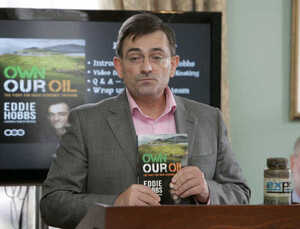
Eddie Hobbs
Water, oil, shale.
They should be ours.
Eddie Hobbs writes:
Unlike many European countries, Ireland took explicit ownership of natural resources in its Constitution. While the Constitution recites its role in acting in the common good, the State reinforced its hegemony by ensuring that these principles of law, including the alienation of the people from their natural resource endowment, cannot be actionable through the courts under Article 45, which leaves the people marooned by the State when, acting as trustee, it fails in its duty of care.
Had this flaw not been engineered, today’s water protesters could be fighting through the courts and not in the streets for what the UN General Assembly in 2010 declared to be a human right: “The right to safe and clean drinking water and sanitation as a human right that is essential for the full enjoyment of life and all human rights.”
Ireland abstained from the vote on the UN declaration.
We could also be holding our Government to account for its reckless policy in handing ownership of large tracts of offshore territory to private oil and gas explorers. We are told our water will not be privatised. You can be sure that’s true. For the time being, no sane private company would want to take it on. But the State, trading at the extreme edges of debt servicing, will sell the family silver to preserve itself first and look after anything else second .
There is only one way to protect the Irish people from the incompetence, callowness, and self-preservation that is second nature to our political leaders and that is to amend the Constitution, not just for water but for all our natural resources. This means overturning Article 10, placing unfettered ownership with the people and trusteeship with the State, reducing it to acting as a fiduciary, not as the owner. The State’s behaviour in such a role could then be actionable through the courts.
Amending the Constitution at any level ought to be done carefully, consulting widely and involving constitutional lawyers to properly address requirements for balance on the question of sustainability for future generations, to allow for temporary leasing to private interests while retaining ownership, and to impose a responsibility to use the resource efficiently.
But the State will not accept diminishing its grip lightly — not without challenge. That challenge has manifestly arrived with the water protests. What is required now is a redirection of the debate towards revisiting the 1937 Constitution, recognising that the fundamental issue here is not about pricing water for the next few years but about the imbalance of power as between the people and the State on the question of Irish natural resources. That means digging under the foundations of State power. That is where we are compelled to excavate, recognising that Irish natural resources could, in a few decades, become the defining intersection in our relationship with the outside world, especially with the EU to whom we have already given up so much.
Eddie Hobbs: Constitutional betrayal of our right to water (irish Examiner)
(Mark Stedman/Photocall Ireland)
Yesterday: Well This Is Awkward

In fairness.
Further to Kathy Sinnott’s column in the Irish Times asserting that, under an EU ruling, Ireland is exempt from water charging.
Jim Faulkner writes:
Just off phone to Irish Water after telling them under article 9.4 of EU water directive in 2000 Ireland secured an exemption of paying for domestic water, so I told them under EU law I dont have to pay for my water, they said this is the first they heard of this! They put me on hold and came back and said the Irish govt had changed the law! I said the Irish govt cant change EU law so I am exempt…I also said to change that exemption in Ireland would require a referendum……they said they will ring me back…
More as he gets it.
Meanwhile: TD finds footnote that ‘exempts Irish Water from new appointment rules’ (BreakingNews.ie)
Thanks Patrick


This afternoon
Mark Moloney writes:
Irish Water contractors have reportedly withdrawn from Fassaroe, Bray, Co Wicklow, due to protests by local residents…
More as we get it.
Meanwhile…

Tay and sandwiches in Arklow, Co Wicklow this afternoon.
Thanks Kate Hunt

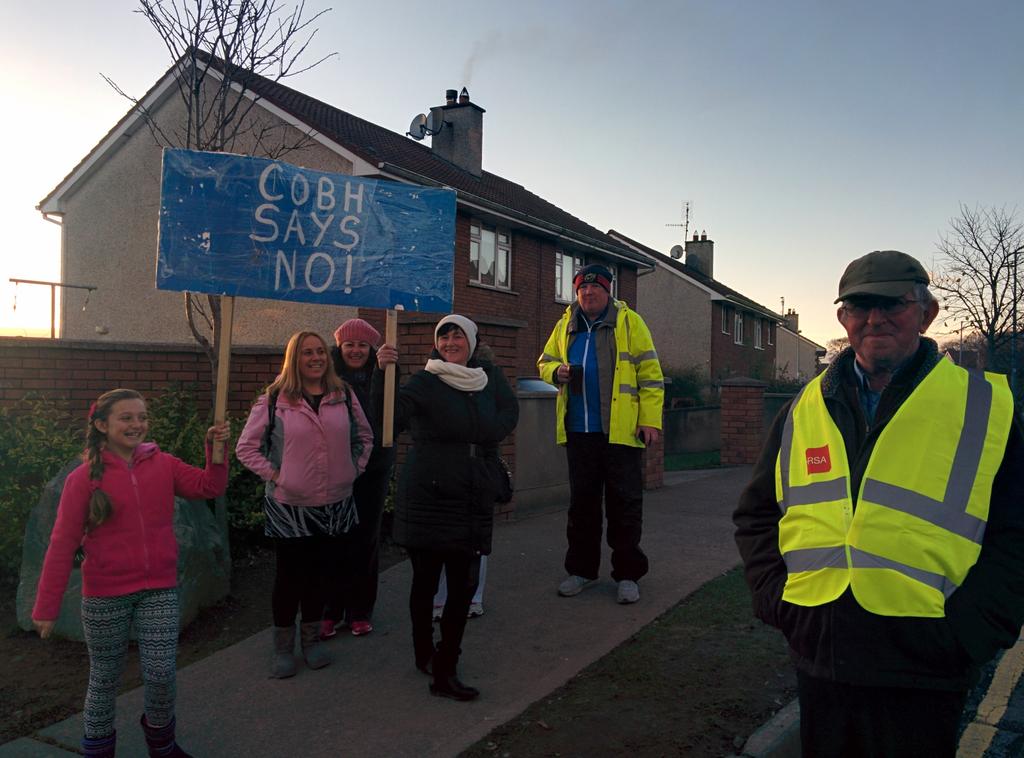

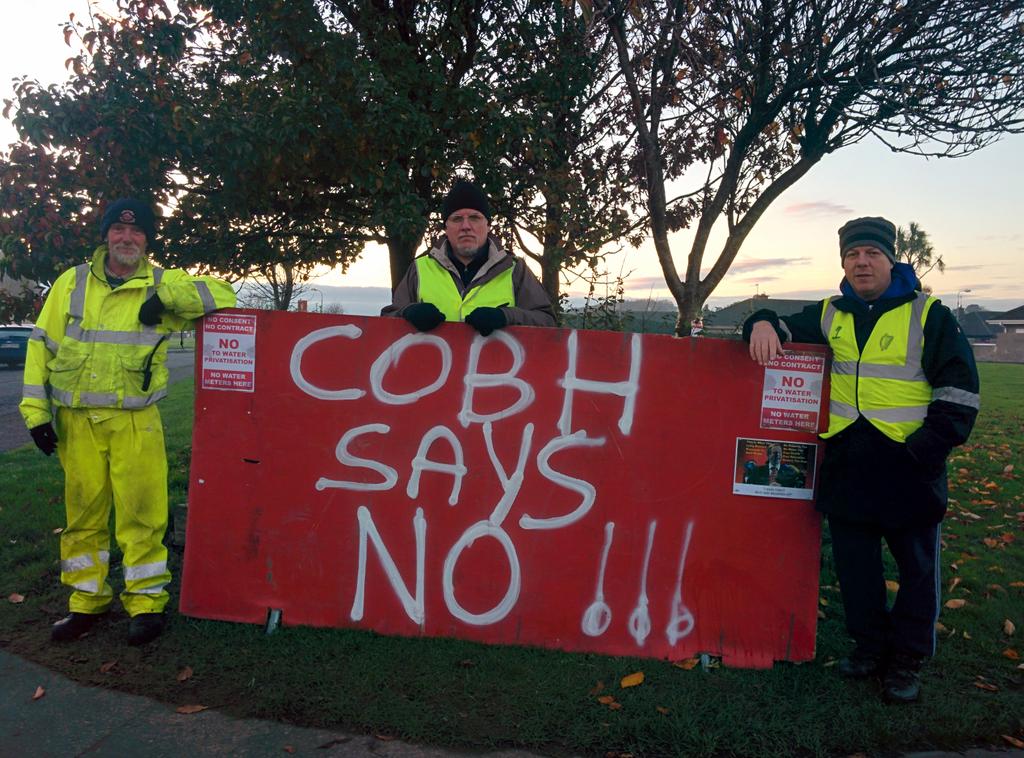
Russell Heights (top) and Rushbrook Manor (above), Cobh, Co Cork this afternoon
Gavin Sheridan, of The Story.ie writes:
A Variety of party political backgrounds. A week on from [Environment Minister] Alan Kelly’s speech and no sign of people leaving. Ready with tea and food, local residents run on shifts with over 200 houses in estate.

Heavens.
Mercedes Kevill writes:
Just protesting peacefully here on the Riverview estate, Scariff, Co. Clare and happened to notice an English number plate on the JCB. Surprise? Not really.
Update:
Oh.
Anarchists.
Previously: Wash It For This?
Thanks Norm


Irish Independent coverage (top) and Dr Julien Mercille.
Isis, crisis and kicking against the bricks.
Dr Julien Mercille writes:
The Irish establishment has reacted hysterically to popular opposition to the water charges. In an almost comical performance, the media has focused laser-like on Joan Burton’s feelings while trapped in her car and on the protests’ alleged ‘violence’. But it has turned a blind eye to the violence of austerity across the country.
We’re not supposed to talk about it because it lends direct support to the protests, but the background to the recent events is that since 2009, austerity has attacked communities, families and individuals throughout the country, and the poor and vulnerable have paid the heaviest price.
Here is a short list:
-There are now 1,230,000 people suffering from deprivation, or 27% of the population—up from 12% in 2007.
-Between 2009 and 2014, health spending was cut by a mind-boggling 27%. On top of that, we know that privatised, for-profit health care systems result in more people who die, worse care, and more money wasted, but the government is doing nothing apart from cutting even more.
-Communities have been faced with a string of cuts over 2008-2014, including:
-Violence against women programme: -38.2%
-Women’s organisations: -48.7%
-Projects for youth: -44.1%
-Community development: -43.6%
-Voluntary social housing: -50.0%
-Drugs programmes: -37.0%
-Family Support Agency: -32.5%
-The number of people sleeping rough in Dublin is at its highest since records began, having tripled in five years. There are 700 homeless children living in emergency accommodation; the number of homeless families in this situation has more than doubled in the past year.
We could go on, but the point is that it should come as no surprise that people are out in the streets trying to force politicians to back off. It would be surprising if it didn’t happen.
But we were told that the protests signaled that we in Ireland were ‘heading to an ISIS situation’, in reference to the violent fundamentalist Islamic State group in Iraq and Syria. In a ‘sinister twist’, a ‘sinister fringe’ has ‘infiltrated’ and ‘hijacked’ the protests (Tom Brady, Niall O’Connor and Fionnan Sheahan, Irish Independent). The protesters are responsible for the ‘creeping anarchy’ threatening the peace by engaging in ‘rampant law-breaking and thuggery’ (Stephen O’Byrnes, Irish Times).
TD Paul Murphy has been a special target, described as a ‘ridiculous’ and ‘immature’ posh kid who is ‘privately educated’ and ‘unapologetic about the ugly antics of protesters’. The Irish Independent pictured Murphy on the front page of its Weekend Review with a big communist logo in the background. Clearly, he must be friends with Stalin, no? (Kim Bielenberg, Fionnan Sheahan, Irish Independent).
The fears of Joan Burton when trapped in her ministerial car have received an incredible degree of attention. If that passion for details was applied to the hardships of ordinary people living under austerity, there would be no secrets left about how bad austerity is as an economic strategy.We have been told that Burton was ‘abused’ and that her ‘necklace was broken’. She said ‘I was frightened’.
But if the media was serious about discussing feelings of fear and abuse, it would investigate those of the hundreds of thousands of people throughout the country suffering from deprivation, or who fear losing their jobs, or fear not to make ends meet because they lost their jobs, or fear to end up on the street because they can’t make ends meet, or fear they can’t provide for their kids because they can’t keep up anymore. Or look at those who fear death from cancer because waiting times are too long because the health care system is privatised and wasteful. Or those who fear they will have to emigrate because there are no jobs available in Ireland.
But the media cares about the interests of those in power, so it won’t talk about that. The focus is on the two hours Joan Burton spent in her car.
There has also been much talk about the ‘intimidation’ and ‘violence’ associated with the protests. There have been endless assertions that: Throwing a water balloon is violent; throwing an egg is violent; tapping on a car is violent; shaking a car is violent; intending to shake a car is violent; a megaphone is very suspicious.
The media likes to narrow it down to those questions only because it diverts attention from what really matters. It ensures that we don’t ask the questions that should be asked:
Is suicide or depression due to austerity-induced unemployment violence against the unemployed? Is lack of access to a rape crisis centre closed by cutbacks a form of violence and intimidation against victims? Is being forced into homelessness humiliation and intimidation? Is someone forced to die of cancer because of waiting lines a victim of violence? Is enforced deprivation intimidation?
The media and the establishment may reflect on those matters. Everybody else knows the answers.
Julien Mercille is a lecturer at UCD and the author of The Political Economy and Media Coverage of the European Economic Crisis: The Case of Ireland (Routledge).
The Media And The Water Protests (Julien Mercille, Right2Water.ie)
Previously: Julien Mercille on Broadsheet

This afternoon.
Menace asks:
Water meter being installed???

He’s not putting up with any more guff.
A gentleman with a self-penned song in his heart and a message for them ‘up in Dublin’ at an anti-Irish Water rally in Killarney, Co Kerry at the weekend.
Like a better-voiced, protest-era Bob Dylan.
Mmf.
Transcript to follow.
