

Tag Archives: John Banville

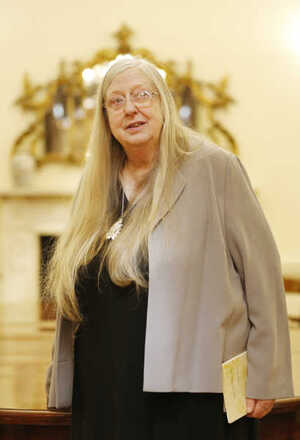
From top: Irish Times columnist and critic Fintan O’Toole; Eamonn Kelly

Fintan O’Toole stepped into the Patriarchy/Trans minefield on December 1 triggering a succession of small explosions on Twitter. The piece in question is hidden behind an Irish Times paywall and comments are disallowed, which is not terribly democratic, but perhaps wise under the circumstances.

But wokes will not be denied and the response to Fintan’s musings was taken up on Twitter. By close of business Fintan’s name was trending fiercely as the experts of patriarchal argument poured forth with woke jargon at the ready to participate on the specially created #fintan thread.

Twitter replies came in battalions; essays hidden in long lines of numbered tweets taking Fintan to task for all manner of infractions, many of which went over my head. What is a TERF? I had to resort to Wikipedia.

A TERF is a “trans-exclusionary radical feminist” who hold that trans people are not women, but men, which they are, actually. But they are men who identify as women and Fintan was clearly taking their part, needlessly embroiling himself in an awkward woke squabble and getting absolutely no thanks for his troubles from anyone.

But though Fintan appeared to be writing from a woke position he still managed to raise ire on all sides, and even ire on some sides I didn’t even know existed. If there’s one thing about wokeness, it’s got no shortage of ire. Fintan, it seemed, was raising ire simply by being there.

Wrong Bodies

Some tweeters discerned in Fintan’s article an unconscious white male construct being smuggled into wokeness under the pretext of being pro-woke or pro social justice or pro whatever it was Fintan thought he was being pro.

One commenter accused Fintan of writing an article that only a man would write and that by doing so he was implying that women and trans people can’t write for themselves. That he was in essence attempting to supplant women and trans and their various woke affiliates by doing what he does for a living. That his article was in reality a prime example of over-educated and entitled mansplaining.

The writer of this comment was also a man. It was nice of him to take the time to mansplain Fintan’s political objectives.

Another commenter accused Fintan of blaming feminists for what was the fault of the Patriarchy, while yet another accused him of blaming the Patriarchy for what was the responsibility of feminists.

The existence of the Patriarchy was accepted on all sides without question, even by Fintan himself, one of our leading cultural critics, who never for a moment considered the possibility that the idea of the Patriarchy might itself also be a theoretical construct.

Another commenter pitied Fintan in making the mistake of writing such an article, regarding the act as a kind of mental aberration in an otherwise apparently healthy mind and healthy political position. Implicit in this comment was a kind of threat that Fintan’s infractions, and there appeared to be many of them, would not be forgotten.

Tweeter after tweeter wrote knowledgably and confidently in similar impenetrable woke jargon that you begin to suspect is not meant to be understood. The idea seems to be that you will surrender to the endless flurries of academic concepts and buzzwords and just agree, if only to make them stop re-phrasing the same general ideas in jargon laden sentences so that you can run away and find an aspirin.

Newspeak

Woke language is eerily similar to Orwell’s Newspeak, and like Orwell’s Newspeakers, the ones who can speak the jargon rapidly, without the aid of full stops, are considered the wisest of the wise by other wokes.

However, Orwell’s Newspeak was designed by authoritarians to stultify original thinking, to replace thought, which can be dangerous, with a mechanical substitute that people will believe is intellectualising, but which is actually just parroting set phrases without thinking.

A couple of days later, one of our multi-award-winning writers, (his wins including a Booker), the precise and exact John Banville, was also being pelted in a woke twitter storm for expressing a negative opinion of wokeness in an interview for the Hay Festival Winter Weekend.

His comment, that he “despised” wokeness, was held up as hate speech, inspiring social justice warriors to go to war in the name of equality to attempt to deny that writer freedom of opinion, and not one of them capable of seeing the irony of this crazy double-standard.

Instead, one commenter remarked that Banville’s motive for despising wokeness was a fear of losing status and that any loss of status he might suffer was justified in recompense for the privileges he had once enjoyed, until, presumably, wokeness came along to save the culture from his like.

This is a common charge, that the perceived privileged deserve to be demoted and denied, raising the suspicion that much woke uproar is driven by simple spite.

Eamonn Kelly is a freelance Writer and Playwright.

Previously: Eamonn Kelly on Broadsheet

RollingNews


John Banville

Author John Banville, one of the signatories of an open letter last week from artists and academics and others decrying cancel culture, spoke to Brendan O’Connor on Saturday’s Weekend on One on RTÉ Radio One.

Brendan O’Connor: “There’s an important distinction to be made here. This letter is talking about people losing their livelihoods, this is not to suggest that people can’t be taken on, on their views, if their views are offensive or outdated, correct?”

John Banville
: “Yes, of course. Of course they can be taken on. But part of the problem is that so many people in positions of power and publishing houses, in academia are losing their nerve and are getting rid of people on hearsay, on having made mistakes. Goodness sake, we all make mistakes. If we were to be driven out of our jobs because of making mistakes, we’d all be unemployed.”

O’Connor: “But I suppose that the people who are in favour of cancel culture and calling people out would argue this is about people who are powerless, unlike those powerful people in publishing, people who are powerless and that this is the only weapon they have to hit back at people who they would say are powerful and entitled and have platforms to spout these views.”

Banville
: “The way to work for civil rights and for tolerance is to be kind and work…there’s a wonderful essay by John McWhorter, who just happens to be black, in an online magazine called Reason. He’s one of the signatories of this letter. And it’s [inaudible] because he’s saying, you know, this movement, especially among young white liberals in America has all the trappings of a cult, of religion and I think he’s right. And I’ll just quote a little bit from it, very, very short, I think it’s very apt. He says:

‘Martin Luther King was under no impression that all white people were going to fully “love” all black people. He spent his time working for gradual change in the world as we know it via endless exchange and consultation with the powers that be, not agitating for a vague utopian conception of a society devoid of any racist sentiment. In King’s day, radicalism was not centered around this recreationally aggrieved performance art, much less obsessively seeking to excoriate and destroy people suspected of impure thoughts.’

“It’s a wonderful quote and we should all think about that, that kind of sentiment.”

O’Connor
: “Yeah, Margaret Atwood wrote that great essay, ‘Am I Bad Feminist‘. She talks in it about how writers deal in kind of moral ambiguity and everything and they will often have characters who aren’t nice people and who say bad things and everything but what she said in it, is that we’re at, this is a revolution and we are at, I think she called it, the purge and destroy part of the revolution. Words to that effect, that this is just about, that we’re taking people out now.”

Banville: “That probably is the case. But one must raise one’s voice against that kind of mob culture even a mob, you know, that is well meaning, is still a mob and to hound people…and, you know, I’ve been to America, I’ve seen instances of it myself. A friend of mine was an academic, almost lost a job because she suggested to a Chinese student, not a Chinese immigrant, but a Chinese-born student that he needed to work a bit on her (sic) basic English. The Chinese student complained and my friend was almost fired by her university. There are numerous instances of things like that.”

O’Connor
: “Do you know writers who have had their work suppressed?”

Banville: “Yes, yes. I’m not going to name names that would be embarrassing but I do – suppressed by their, suppressed by their publishers. And that is very, very dangerous.”

O’Connor: “Yeah. You would regard yourself as a liberal obviously, you are a liberal and you’ve worked in America and everything and you would be very pro civil rights and everything, I know. What do you think of the character of the Black Lives Matter movement and how it’s playing out at the moment?”

Banville
: “I think it will waken some people, it certainly brings our attention to the problem. But America is absolutely divided now. I mean it’s just divided down the middle. It’s back almost to civil war politics in America. It’s a frightening place to be at the moment. That is not going to be cured by ousting people from their jobs. There’s a wonderful phrase in French which says, you know, the extremes touch. In other words, you know a right and left meet at the back and become just a [inaudible] of each other and I think many ideas, from liberal young people, while they mean well, but they are falling into a religious cultism. And you know that’s all about making yourself feel better.

“Did you see that clip of Barack Obama talking about the woke movement and saying, you know, it’s so easy to point to people and say ‘you’re a sinner’. You know, you’re doing all these things wrong and I’m much better than you and then you go away feeling wonderful about yourself. This doesn’t do any good.”

O’Connor: “You say a lot of people now feel muzzled, that they’re worried about saying the wrong thing?”

Banville: “Certainly in America, that’s the case.”

O’Connor: “John, outside of cancel culture altogether, you have a book out in October?”

Banville
: “I have but I can’t use this occasion to plug a book, this is much too serious

Listen back here

Previously: Hello, Yes, I’d Like To Cancel My Subscription To Harper’s

Rollingnews

90369720903697289036972990369726Last night.

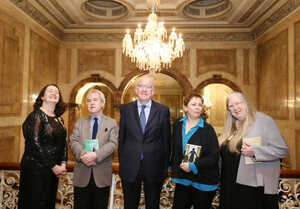
Minister for Foreign Affairs and Trade, Charlie Flanagan Twelcomed Ireland’s leading writers to Iveagh House to mark “21 years of partnership between the Department of Foreign Affairs and Trade and Ireland Literature Exchange in the Department of Foreign Affairs and Trade, Iveagh House, St Stephen’s Green, Dublin 2.

Nice pad, in fairness.

From  top: (l-r) Sinead Mac Aodha Director of Ireland Literature Exchange, John Banville,  Minister for Foreign Affairs and Trade, Charlie Flanagan  Anne Enright, Inaugural Laureate for Irish Fiction and poet Eilean Ni Chuilleanain; Banville, Enright and  Ni Chuilleanain.

(Sasko Lazarov/Photocall ireland)