
Tag Archives: cancel culture

Musician Winston Marshall (above) who has left the band Mumford & Sons

This afternoon.

Musical differences?

No.

Musical similarities?

Stop that.

Via Winston Marshall

At the beginning of March I tweeted to American journalist Andy Ngo, author of the New York Times Bestseller, Unmasked. “Congratulations @MrAndyNgo. Finally had the time to read your important book. You’re a brave man”. Posting about books had been a theme of my social-media throughout the pandemic. I believed this tweet to be as innocuous as the others. How wrong I turned out to be.

Over the course of 24 hours it was trending with tens of thousands of angry retweets and comments. I failed to foresee that my commenting on a book critical of the Far-Left could be interpreted as approval of the equally abhorrent Far-Right.

Nothing could be further from the truth. Thirteen members of my family were murdered in the concentration camps of the Holocaust. My Grandma, unlike her cousins, aunts and uncles, survived. She and I were close. My family knows the evils of fascism painfully well. To say the least. To call me “fascist” was ludicrous beyond belief.

I’ve had plenty of abuse over the years. I’m a banjo player after all. But this was another level. And, owing to our association, my friends, my bandmates, were getting it too. It took me more than a moment to understand how distressing this was for them.

Despite being four individuals we were, in the eyes of the public, a unity. Furthermore it’s our singer’s name on the tin. That name was being dragged through some pretty ugly accusations, as a result of my tweet. The distress brought to them and their families that weekend I regret very much. I remain sincerely sorry for that. Unintentionally, I had pulled them into a divisive and totemic issue.

Emotions were high. Despite pressure to nix me they invited me to continue with the band. That took courage, particularly in the age of so called “cancel culture”. I made an apology and agreed to take a temporary step back.

Rather predictably another viral mob came after me, this time for the sin of apologising. Then followed libellous articles calling me “right-wing” and such. Though there’s nothing wrong with being conservative, when forced to politically label myself I flutter between “centrist”, “liberal” or the more honest “bit this, bit that”. Being labeled erroneously just goes to show how binary political discourse has become. I had criticised the “Left”, so I must be the “Right”, or so their logic goes.

Why did I apologise?

“Rub your eyes and purify your heart — and prize above all else in the world those who love you and who wish you well.” — Aleksander Solzhenitsyn once wrote. In the mania of the moment I was desperate to protect my bandmates. The hornets’ nest that I had unwittingly hit had unleashed a black-hearted swarm on them and their families. I didn’t want them to suffer for my actions, they were my priority.

Secondly, I was sincerely open to the fact that maybe I did not know something about the author or his work. “Courage is what it takes to stand up and speak,” Churchill once said, “courage is also what it takes to sit down and listen”. And so I listened.

I have spent much time reflecting, reading and listening. The truth is that my commenting on a book that documents the extreme Far-Left and their activities is in no way an endorsement of the equally repugnant Far-Right. The truth is that reporting on extremism at the great risk of endangering oneself is unquestionably brave. I also feel that my previous apology in a small way participates in the lie that such extremism does not exist, or worse, is a force for good.

So why leave the band?

On the eve of his leaving to the West, Solzhenitsyn published an essay titled ‘Live Not By Lies’. I have read it many times now since the incident at the start of March. It still profoundly stirs me.

“And he who is not sufficiently courageous to defend his soul — don’t let him be proud of his ‘progressive’ views, and don’t let him boast that he is an academician or a people’s artist, a distinguished figure or a general. Let him say to himself: I am a part of the herd and a coward. It’s all the same to me as long as I’m fed and kept warm.”

For me to speak about what I’ve learnt to be such a controversial issue will inevitably bring my bandmates more trouble. My love, loyalty and accountability to them cannot permit that. I could remain and continue to self-censor but it will erode my sense of integrity. Gnaw my conscience. I’ve already felt that beginning.

The only way forward for me is to leave the band. I hope in distancing myself from them I am able to speak my mind without them suffering the consequences. I leave with love in my heart and I wish those three boys nothing but the best. I have no doubt that their stars will shine long into the future. I will continue my work with Hong Kong Link Up and I look forward to new creative projects as well as speaking and writing on a variety of issues, challenging as they may be.

Why I’m Leaving Mumford & Sons (Winston Marshall)

Pic via Winston Marshall

Learn her that will.

Gina Carano Fired from The Mandalorian Following “Abhorrent” Social Media Posts (COS)

Gulp.

Burning heresies by Kevin Myers

Previously: Hoist With her Own Petard

Pic: Hodges Figgis

John Banville

Author John Banville, one of the signatories of an open letter last week from artists and academics and others decrying cancel culture, spoke to Brendan O’Connor on Saturday’s Weekend on One on RTÉ Radio One.

Brendan O’Connor: “There’s an important distinction to be made here. This letter is talking about people losing their livelihoods, this is not to suggest that people can’t be taken on, on their views, if their views are offensive or outdated, correct?”

John Banville
: “Yes, of course. Of course they can be taken on. But part of the problem is that so many people in positions of power and publishing houses, in academia are losing their nerve and are getting rid of people on hearsay, on having made mistakes. Goodness sake, we all make mistakes. If we were to be driven out of our jobs because of making mistakes, we’d all be unemployed.”

O’Connor: “But I suppose that the people who are in favour of cancel culture and calling people out would argue this is about people who are powerless, unlike those powerful people in publishing, people who are powerless and that this is the only weapon they have to hit back at people who they would say are powerful and entitled and have platforms to spout these views.”

Banville
: “The way to work for civil rights and for tolerance is to be kind and work…there’s a wonderful essay by John McWhorter, who just happens to be black, in an online magazine called Reason. He’s one of the signatories of this letter. And it’s [inaudible] because he’s saying, you know, this movement, especially among young white liberals in America has all the trappings of a cult, of religion and I think he’s right. And I’ll just quote a little bit from it, very, very short, I think it’s very apt. He says:

‘Martin Luther King was under no impression that all white people were going to fully “love” all black people. He spent his time working for gradual change in the world as we know it via endless exchange and consultation with the powers that be, not agitating for a vague utopian conception of a society devoid of any racist sentiment. In King’s day, radicalism was not centered around this recreationally aggrieved performance art, much less obsessively seeking to excoriate and destroy people suspected of impure thoughts.’

“It’s a wonderful quote and we should all think about that, that kind of sentiment.”

O’Connor
: “Yeah, Margaret Atwood wrote that great essay, ‘Am I Bad Feminist‘. She talks in it about how writers deal in kind of moral ambiguity and everything and they will often have characters who aren’t nice people and who say bad things and everything but what she said in it, is that we’re at, this is a revolution and we are at, I think she called it, the purge and destroy part of the revolution. Words to that effect, that this is just about, that we’re taking people out now.”

Banville: “That probably is the case. But one must raise one’s voice against that kind of mob culture even a mob, you know, that is well meaning, is still a mob and to hound people…and, you know, I’ve been to America, I’ve seen instances of it myself. A friend of mine was an academic, almost lost a job because she suggested to a Chinese student, not a Chinese immigrant, but a Chinese-born student that he needed to work a bit on her (sic) basic English. The Chinese student complained and my friend was almost fired by her university. There are numerous instances of things like that.”

O’Connor
: “Do you know writers who have had their work suppressed?”

Banville: “Yes, yes. I’m not going to name names that would be embarrassing but I do – suppressed by their, suppressed by their publishers. And that is very, very dangerous.”

O’Connor: “Yeah. You would regard yourself as a liberal obviously, you are a liberal and you’ve worked in America and everything and you would be very pro civil rights and everything, I know. What do you think of the character of the Black Lives Matter movement and how it’s playing out at the moment?”

Banville
: “I think it will waken some people, it certainly brings our attention to the problem. But America is absolutely divided now. I mean it’s just divided down the middle. It’s back almost to civil war politics in America. It’s a frightening place to be at the moment. That is not going to be cured by ousting people from their jobs. There’s a wonderful phrase in French which says, you know, the extremes touch. In other words, you know a right and left meet at the back and become just a [inaudible] of each other and I think many ideas, from liberal young people, while they mean well, but they are falling into a religious cultism. And you know that’s all about making yourself feel better.

“Did you see that clip of Barack Obama talking about the woke movement and saying, you know, it’s so easy to point to people and say ‘you’re a sinner’. You know, you’re doing all these things wrong and I’m much better than you and then you go away feeling wonderful about yourself. This doesn’t do any good.”

O’Connor: “You say a lot of people now feel muzzled, that they’re worried about saying the wrong thing?”

Banville: “Certainly in America, that’s the case.”

O’Connor: “John, outside of cancel culture altogether, you have a book out in October?”

Banville
: “I have but I can’t use this occasion to plug a book, this is much too serious

Listen back here

Previously: Hello, Yes, I’d Like To Cancel My Subscription To Harper’s

Rollingnews

Meanwhile…

Damn you, Smugface.

Meanwhile…

Meanwhile…

This morning/afternoon.

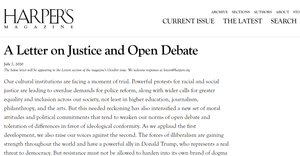
Some reaction to yesterday’s open letter from prominent liberals decrying ‘cancel culture’.

Yesterday: Hello, Yes, I’d Like To Cancel My Subscription To Harper’s

‘Our cultural institutions are facing a moment of trial. Powerful protests for racial and social justice are leading to overdue demands for police reform, along with wider calls for greater equality and inclusion across our society, not least in higher education, journalism, philanthropy, and the arts.

But this needed reckoning has also intensified a new set of moral attitudes and political commitments that tend to weaken our norms of open debate and toleration of differences in favor of ideological conformity.

As we applaud the first development, we also raise our voices against the second. The forces of illiberalism are gaining strength throughout the world and have a powerful ally in Donald Trump, who represents a real threat to democracy.

But resistance must not be allowed to harden into its own brand of dogma or coercion—which right-wing demagogues are already exploiting. The democratic inclusion we want can be achieved only if we speak out against the intolerant climate that has set in on all sides.

The free exchange of information and ideas, the lifeblood of a liberal society, is daily becoming more constricted. While we have come to expect this on the radical right, censoriousness is also spreading more widely in our culture: an intolerance of opposing views, a vogue for public shaming and ostracism, and the tendency to dissolve complex policy issues in a blinding moral certainty.

We uphold the value of robust and even caustic counter-speech from all quarters. But it is now all too common to hear calls for swift and severe retribution in response to perceived transgressions of speech and thought.

More troubling still, institutional leaders, in a spirit of panicked damage control, are delivering hasty and disproportionate punishments instead of considered reforms.

Editors are fired for running controversial pieces; books are withdrawn for alleged inauthenticity; journalists are barred from writing on certain topics; professors are investigated for quoting works of literature in class; a researcher is fired for circulating a peer-reviewed academic study; and the heads of organizations are ousted for what are sometimes just clumsy mistakes.

Whatever the arguments around each particular incident, the result has been to steadily narrow the boundaries of what can be said without the threat of reprisal. We are already paying the price in greater risk aversion among writers, artists, and journalists who fear for their livelihoods if they depart from the consensus, or even lack sufficient zeal in agreement.

This stifling atmosphere will ultimately harm the most vital causes of our time. The restriction of debate, whether by a repressive government or an intolerant society, invariably hurts those who lack power and makes everyone less capable of democratic participation.

The way to defeat bad ideas is by exposure, argument, and persuasion, not by trying to silence or wish them away. We refuse any false choice between justice and freedom, which cannot exist without each other. As writers we need a culture that leaves us room for experimentation, risk taking, and even mistakes.

We need to preserve the possibility of good-faith disagreement without dire professional consequences. If we won’t defend the very thing on which our work depends, we shouldn’t expect the public or the state to defend it for us.’

An open letter signed by Noam Chomsky, JK Rowling and Malcolm Gladwell and others.

A Letter on Justice and Open Debate (Harper’s)

Meanwhile….

FIGHT!

Nigel Farage in Dublin in 2018

This afternoon.

Earlier: There’s Nothing For You Here

Rollingnews

A statement from Dublin-based animation company JAM Media severing ties with Helen and Graham Linehan (top) who had created the joint BBC production of live action musical ‘Tiara Jones’

Cú Chulainn writes:

Throw the creative persons under the bus because they have a different opinion…

JAM Media

Previously: BBC, JAM blast off with Tiara Jones