
Tag Archives: Leo Varadkar

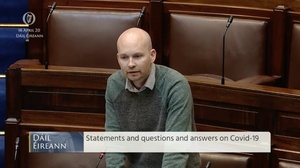
Rise TD Paul Murphy

This afternoon.

Rise TD Paul Murphy asked Taoiseach Leo Varadkar if a newspaper report today – stating that the estimated monthly cost of the State’s leasing of private hospitals will be €115million – a month is accurate.

Mr Varadkar replied:

“That’s deputy, that’s an estimate. So it’s as accurate as any estimate can be. If that answers your question, it may be right, it may be wrong but it’s an accurate estimate. It’s not necessarily what the accurate cost will be because we won’t know that until the end ’cause the costs, they’ll have to be calculated.

“But the agreement that was made between the HSE and the Private Hospital Association was told that this would be done on the basis, on a not-for-profit basis, so it’s the covering of the costs of the hospitals.”

EARLIER:

Independent TD Catherine Connolly

This afternoon.

Independent TD Catherine Connolly told Taoiseach Leo Varadkar:

I gave my support to draconian legislation where absolutely no attempt was made to contextualise such legislation within a human rights perspective or to frame, indeed, the operation of the powers given to Garda and undefined medical officers so that such powers would be time-limited and used in a proportionate and undiscriminatory way.

I was full aware of the implications of such legislation and I gave my support reluctantly, on the basis of a number of issues. One, we improve the legislation as best we could. Two, we made it time-based. Three, we insisted that it would come back before the Dáil.

“But the most important one on which I gave my consent was that we would have full and frank disclosure, full information on every issue from you and the Government. And I have to say, significantly, and unacceptably, that part of the bargain has not been kept.

“I look at testing. I look at the information on that, totally contradictory and I know, as we all do, of people waiting for tests. Four weeks on Saturday, in relation to the one that I’m mentioning.

“In relation to the operation of laboratories, whether they’re functioning or not functioning.

“On the first of April we were told that it was sufficient to meet the demand. Perhaps the first of April is an indication of how we should take that piece of information.

“In relation to nursing homes, I’m absolutely appalled that they weren’t number one on the list with a risk assessment carried out.

“On the 30th of January, the public health emergency was recognised. On the 11th of February, it was given a name: the coronavirus. On the 11th of March, a pandemic was declared by the World Health Organisation. And I haven’t heard one simple explanation from ye, as to why the nursing homes, direct provision centres and residential centres weren’t number one on the list, where our most vulnerable people live. 

“Why an assessment wasn’t carried out. I have looked through all of the briefing documents prior to coming in here, I have eight from the month of April. Of all those briefing documents, we’ve two lines on nursing homes, to tell us there would be screening introduced, never was it mentioned again.”

EARLIER:

People Before Profit TD Richard Boyd Barrett

This afternoon.

People Before Profit TD Richard Boyd Barrett put to Taoiseach Leo Varadkar:

How do Fianna Fáil and Fine Gael believe that they are fitted to return to power or that we should believe their promises of a new political departure when, after the last financial crisis of 2008 they made the same promises and then proceeded to absolutely savage the staffing levels and capacity levels of our health service prior to this public health emergency.

“To the point where we have some of the lowest levels of ICU capacity, GP cover and staffing levels, hospital bed numbers in the whole of the Western world.

“Isn’t it the case, Taoiseach, that the privatisation and austerity policies that were pursued for the last ten years by these parties have contributed to the emergency that is now emerging, tragic emergency that’s emerging in our nursing homes because of a largely privatised, completely fragmented, under-resourced, under-supported nursing home sector.

“Isn’t it, Taoiseach, unacceptable but a legacy of the policies and priorities of those two parties. That 600 private consultants can hold this country over a barrel in the face of a public health emergency. It is absolutely shocking.

Can you please explain to me the incredible situation where this country has one of the biggest pharmaceutical and medical equipment industries in the world and yet we are suffering chronic shortages of Personal Protection Equipment, vital medical equipment and chemical reagents necessary to bring the level of testing up to that which we need to exit this crisis.

“And where [HSE CEO] Paul Reid cites proprietorial issues as an explanation for this. In layman’s terms, that means private patents and profit seeking by the companies that own these patents for chemical reagents.

“Can the Taoiseach explain why a private consultant, with no medical expertise whatsoever, was given the job of recruiting from the 70,000 heroic volunteers on the Call for Ireland, to recruit those people and integrate them into the health service.

“A job, from when I look at the numbers, doesn’t look to be going too well in that integration, CPL, CPL.

Can the minister explain the extraordinary appointment of a management consultant from an accountancy firm, Ernst & Young, to spearhead the ramping up of the testing and contact-tracing regime which we desperately need rather than public health experts, scientists and medics and that that same person has now been given the job to spearhead the transition back to, quote, ‘business as usual’.

“Rather than the public health experts, the scientists and the doctors, who should be deciding when we lift restrictions, how we lift restrictions, how we transition back to the normality that our citizens desperately want to return to…”

EARLIER:

Labour leader Alan Kelly in the Dáil this afternoon

This afternoon, Labour leader Alan Kelly asked Taoiseach Leo Varadkar:

“Today, Taoiseach, we, in the Labour Party are proposing to you and to the rest of this House that we would pay all of our healthcare workers a one-off €1,000 solidarity gesture on May 1 [International Workers’ Day] in these unique circumstances when we know that all these workers are going way beyond anything they’ve ever done before or anything they’ll ever, ever do again.”

EARLIER:

From top: Minister for Culture, Heritage and the Gaeltacht Josepha Madigan and Taoiseach Leo Varadkar; Fianna Fáil leader Micheál Martin in the Dáil this afternoon

At 2pm.

The Dáil, with reduced numbers, got under way with Taoiseach Leo Varadkar, Minister for Health Simon Harris, and Minister for Finance Paschal Donohoe scheduled to answer questions concerning the State’s response to Covid-19.

During his opening comments, Mr Varadkar said he doesn’t know if the current movement restrictions will be relaxed on May 5, saying they would need to be relaxed over several months.

He said:

“I don’t know yet if we’ll be able to relax restrictions on the 5th of May. But I do know that if we can, at all, it’s going to be gradual and will happen over a number of months. As we know from Asia, they may even need to be reimposed  again because only a scientific breakthrough, a vaccine or an effective anti-viral medicine will truly allow life to got back to being as it was.

“Other breakthroughs, like a reliable anti-body test, could really help though. And I am optimistic about the capacity of the brilliant minds in our international pharmaceutical companies and universities to deliver.”

During his initial contribution, Fianna Fáil leader Micheál Martin told the Dáil:

“Unfortunately, I have to report to the House that I know of at least one case where relatives of a person in a nursing home has been informed that the nursing home has been told by the Department that it should not give out information about the number of cases in the home.”

The proceedings can be watched above or here.

The last time the Dáil sat, on April 3, Fine Gael TD and Minister for Culture, Heritage and the Gaeltacht Josepha Madigan refused to answer a single question that TDs raised about health matters concerning Covid-19, after castigating the TDs who called for the Dáil to sit.

Among the contributions from TDs was that of Fianna Fáil Stephen Donnelly who told the Dáil that he was told that out of 200 members of staff at one nursing home, 70 had tested positive for Covid-19 and that 19 of the home’s 100 residents had also tested positive.

Ms Madigan told the Dáil:

“I thank the deputies for their contributions. However, the members here today who have insisted on this Dáil sitting have shown a complete disregard for our national fight to contain Covid-19. Shame on you.”

More to follow.

Earlier: ‘A Growing Sense Of Public Unease’

Previously: A Refusal To Hold Themselves Accountable [Updated]

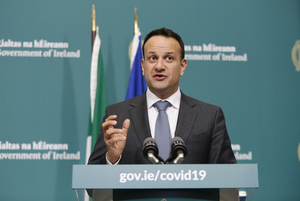
Taoiseach Leo Varadkar speaking at Government Buildings this afternoon

Just now.

At Government Buildings.

Taoiseach Leo Varadkar announced that the restrictions he announced two weeks ago will continue for another three weeks until May 5.

Minister for Education Joe McHugh has also announced that schools will remain closed and will not reopen until health experts advise that it’s safe to do so.

Earlier, RTÉ’s Education Correspondent Emma O’Kelly reported that the Leaving Cert exams will take place in late July/early August while the Junior Cert exams will likely take place in September – subject to health advice.

Watch the Taoiseach’s speech live here or here

UPDATE:

Taoiseach Leo Varadkar and Minister with Responsibility for Defence Paul Kehoe (above) visiting the Defence Forces Joint Task Force in McKee Barracks, Dublin, today

This afternoon.

Taoiseach Leo Varadkar gives journalists the latest on his re-registering as a medical practitioner in order to work one shift a week to help out during the coronavirus crisis.

Related: Taoiseach rejoins medical register to assist with Covid-19 crisis (RTÉ)

Rollingnews

Taoiseach Leo Varadkar (top) at a press briefing in Government Buildings last night

Last night.

During a press briefing in Government Buildings.

Taoiseach Leo Varadkar said he had “heard stories of people who had asked their employers to lay them off because they’d be better off” on the €350-per-week Covid-19 Pandemic Unemployment Payment than working 20 hours a week for €11 per hour.

Do the maths, yourself,” he told journalists.

This is the full exchange Mr Varadkar had with a journalist about the matter.

Journalist: “Just in relation to…I think we saw 280,000 people or so applying for the PUP and having it accepted. I’ve seen some reports of people who perhaps, have got this payment, who didn’t have a job beforehand.

“I’ve even saw reports of somebody in Australia who’s received this payment. Are you are worried about people who are receiving this payment who haven’t, who aren’t entitled to it?”

Leo Varadkar: “Well, certainly, I certainly would be worried if anyone would receive the payment who’s not entitled to it and that would go for any payment that the Government gives.

“A lot of our response was a response that was an emergency response that we wanted to make sure that what we did for people who lose their jobs, for people who are self-employed whose businesses close, for businesses that needed to keep on workers but who couldn’t afford to pay them. We wanted to make sure that whatever we did got money to companies and to people quickly.

“And also was easy to administer. So you’ll see, in contrast you’ll see, in other jurisdictions, in the UK for example, the money that self-employed are getting, they won’t get until June. Whereas self-employed people in Ireland are already in receipt of the payment if they need it.

“And not all of them but a lot of them. And again we want to make sure that companies were getting the money right away. And they are.

“But inevitably the perfect is the enemy of the good and what we did was good, I think, in terms of supporting people’s incomes and supporting business. It’s not perfect and there are going to be loads of anomalies.

“And I know one of the anomalies has arisen is that there are people who are working part-time, for example, who were earning less than €350 a week who lost their jobs and now, actually, might be slightly better off. And then there are other people who are getting the payment but are losing more, if you like.

“But it was always going to be the case that when we acted quickly, as we did, that anomalies would arise. And we’ll try and deal with them as we go along. But our main objective was to make sure that nobody was going to run out of cash.

“That people had a safely net for them. And in having a much generous safety net than is the case in other jurisdictions, again for example, north of the border, people are applying for Universal Credit and it’s about hundred pounds a week. Contrast that with €350 a week here. You know, we didn’t want to overcorrect the other way, where we’d be leaving people short. So there will be some people who’ll actually end up better off as a result.

“But they will be small in number and that was price worth paying to make sure that the vast majority of people had a decent proportion of their incomes protected.

“And, you know, I have heard stories of people who have asked their employers to lay them off because they’d be better off on the €350 payment than maybe working 20 hours a week for €11. You know, do the maths, yourself.

“And I would just say to anyone who is thinking of that, we are all in this together and nobody, in any walk of life, should seek to be better off, or seek to make profit out of this crisis.”

Anyone?

Watch back in full here

Previously: Welfare Cheats Cheat Us All on Broadsheet

Health Minister Simon Harris

This afternoon.

A reduced number of Dáil members are meeting to hear statements on health and social protection matters concerning the coronavirus.

It followed calls for the members not to sit.

Meanwhile…

Yikes.

Anyone?

Watch live here

Earlier: Meanwhile Not In The Dáil

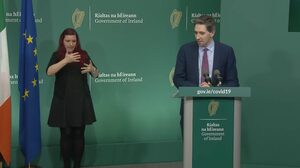
Taoiseach Leo Varadkar and the Minister for Health Simon Harris at a press conference at Government Buildings this evening

This evening.

Taoiseach Leo Varadkar and the Minister for Health Simon Harris are holding a press conference at Government Buildings to speak about the new public private partnership with private healthcare providers in response to Covid-19.

During the press conference, Hugh O’Connell, of the Irish Independent, asked Mr Varadkar if he could indicate when Ireland might “start to return to normality”.

Mr Varadkar said he didn’t know.

The question follows Dr Jenny Harries, deputy chief medical officer for England, saying yesterday that normal life will not likely resume in the UK for at least six months.

In his response, Mr Varadkar said:

“To be honest with you, we don’t know for sure. You know, this is a new virus and you can only be so much of an expert on a virus that’s only been known to the world for three or four months and some of the estimations and assumptions we might have had two or three weeks ago are different now and they may be different again in two or three weeks again.

“What is going to happen this evening is Philip Nolan, who’s heading up our group on modelling, is going to speak at the press conference tonight with the chief medical officer [Tony Holohan] and the idea is that every week or so the model will be updated and that will be shared with the public because we want to be as transparent as possible.

“But in being transparent we need people to understand that by putting information out there, and we want to put all the information out there, it may turn out to be incorrect and you’ll just have to bear with us on that in many ways or it may change over time.

“Certainly what the UK is talking about and I think what a lot of people around the world are talking about now is that there will come a point after the epidemic is peaked and the number of new cases starts falling, when we will start to ease the restrictions and then we’ll have to see what happens so we won’t be in a situation whereby I suddenly go on TV and make an address to the nation and say everything is going back to the way it was on the 11th of March.

“That’s probably not what’s going to happen. What is likely to happen is that the number of new cases will continue to rise, we’ll reach a peak, hopefully that will be in a few weeks’ time and not in a few months’ time.

“The number of new cases will start to fall and will reach the point where we can start to ease some of the restrictions and then see what happens, whether the number of cases starts to rise again or not.”

Nucleocapsid?

Meanwhile…

Later, Jennifer Bray, of The Irish Times, asked Mr Harris about the shipments of personal protective equipment (PPE) that Ireland has ordered from China.

Ms Bray asked if Ireland has any “guarantees” about the quality of the items, in light of the Netherlands recalling hundreds of thousands of masks that it received from China.

This morning, China’s Ambassador to Ireland He Xiangdong told RTÉ’s Rachael English that China would do its best.

Mr Harris said:

“In relation to the quality of the PPE coming into the country, Paul Reid [CEO of the HSE], the head of the HSE, has publicly said that any PPE purchased by the HSE needs to meet World Health Organisation standards and also will be checked on arrival.

“So it’s a job that the HSE needs to do, they’ve a duty of care to their staff and we obviously need to ensure that any PPE distributed throughout the health service meets the WHO standards and they certainly said that’s absolutely their intention and view in relation to the equipment they bought.”

Earlier: “I Think That We Will Try Our Best”

This evening.

Taoiseach Leo Varadkar (top), Health Minister Simon Harris and the Department of Health’s Chief Medical Officer Tony Holohan held a press conference about the Government’s latest response to the coronavirus, in which Mr Varadkar announced further restrictions on the public’s movements.

It follows the latest figures from the Department of Health confirming that three more people have died as a consequence of Covid-19, one of whom was a healthcare worker. This brings the total number of deaths to 22.

The figures also show 302 new cases have been confirmed, bringing the country’s total to 2,121.

During this address, Mr Varadkar said:

“I said there would be a calm before the storm and the aim of every single action that we’ve taken is to reduce the impact of that storm in our country, to slow the virus down, to push it back, to contain it.

“Throughout all of this, the Government has acted on the advice of the chief medical officer and national public health emergency team, an expert team of public health doctors, virologists and scientists.

“Today they informed the Government that the number of confirmed cases has now exceeded 2,100 and sadly the number of deaths now is 22 and there is a day-on-day increase in the number of admissions to intensive care units. In fact the number has doubled since Monday.

“Transmission in the community now accounts for more than half of all cases. And there continues to be an increasing number of clusters, many of which are in nursing homes and residential care settings.

“Earlier today the Government received further recommendations on the actions that we need to take to protect our people. These are in addition to all the measures that are already in place.

“So with effect from midnight tonight, for a two-week period, until Easter Sunday, the 12th, everybody must stay at home in all circumstances, except for the following situations.

To travel to and from work, for the purposes of work, only where the work is an essential health, social care or other essential service that cannot be done from home. A list of these will be provided.

To shop for food or household goods, or collect a meal. To attend medical appointments and collect medicines and other health products. For vital family reasons such as providing care to children, elderly or vulnerable people.

To take brief, individual, physical exercise within two kilometres of your own home which may include children from your own household, as long as you adhere to two metre physical distancing.

For farming purposes, that is food production and the caring of animals. All public and private gatherings of any number of people outside a single household living unit are prohibited.

“The virus might be in your house already so please don’t spread it to anyone else’s.

“Sadly, this prohibition includes family visits that are not for vital reasons which I already mentioned.

“A further range of non-essential shops and services will be closed. The guidance given earlier this week in respect of essential retail outlets will be revised to reflect this.

Adult community education centres and local community centres will be shut. All non-essential surgery, health procedures and other other non-essential health services will be postponed. All visits to hospitals, residential healthcare settings, other residential settings and prisons are to cease with specific exceptions on compassionate grounds.

Shielding or cocooning will be introduced for all of those over 70 years of age and specified categories of people who are extremely vulnerable to Covid-19. Detailed guidance will be available.

Travel to our offshore islands will be limited to residents of those islands. Pharmacists will be permitted to dispense medicine outside of the current period of validity of limited prescription, in line with the pharmacist’s clinical judgment.

All public transport and passenger travel will be restricted only to essential workers and people providing essential services. Apart from the activities that I’ve listed there should be no travel outside of a two-kilometre radius of your home for any reason.

“These are radical actions aimed at saving as many people’s lives as possible in the days and weeks ahead. We’re not prisoners of fate, we can influence what’s going to happen to us next. There is no fate but what we make for ourselves.”

Rollingnews

Meanwhile…

Ah here.

Watch back in full here.

UPDATE:

Tonight, just before 10.45pm…

An Garda Síochána released the following statement:

An Garda Síochána has this evening started a major nationwide policing operation focused on supporting public compliance with public health measures over this weekend.

Following recent announcements by An Taoiseach of the necessity for people to undertake a range of public health measures to help stop the spread of COVID-19, there will be high visibility patrolling by Garda members across the country during the weekend.

The focus of this activity will be on encouraging people to adhere to public health measures as announced by An Taoiseach.

The policing operation runs from 7pm tonight until 7am on Monday morning (March 30) and will involve thousands of Gardaí on foot, bike and mobile patrols.

While An Garda Síochána will seek to encourage people to maintain the necessary public health measures, it will intervene where venues/ outlets are not in compliance or where groups of people are not adhering to recommended measures.

An Garda Síochána acknowledges that the vast majority of the public are being responsible and making great efforts to implementing public health measures including social distancing guidelines, this includes staying active as a family unit and availing of fresh air and exercise.

However, the presence of large crowds in any one area reduces the effective impact of social distancing.

An Garda Síochána asks people and families to continue to be responsible, not to attend popular locations for overly long periods and where the numbers of persons starts to increase at any location to leave such areas.

Announcing An Garda Síochána’s operation for this weekend Commissioner Drew Harris said, “An Garda Síochána’s priority is keeping people safe and that will continue this weekend. There will be a major policing plan across the country with high visibility of Garda members at key locations.

“It is vital that people adhere to the social distancing guidelines. This will reduce the spread of COVID-19 and save lives. The vast majority of people are complying with the guidelines and we want that to continue this weekend. By all of us working together, we can flatten the curve and keep our loved ones safe.”

Deputy Commissioner, Policing and Security, John Twomey said, “These high visibility patrols are to provide re-assurance and social distancing advice to the public.

“Garda members will pro-actively engage positively with people. An Garda Síochána will police as it has always done with the consent of the people. It is in everybody’s interest that people comply with these measures.”

COVID-19 – An Garda Síochána Begins Major Policing Operation in support of public compliance of public health measures (An Garda Síochána)

This morning.

In the Dáil.

Taoiseach Leo Varadkar begins the debate on the latest emergency legislation as a consequence of the coronavirus.

The Dáil sitting, involving a severely reduced number of TDs, is scheduled to sit for 12 hours.

The 40-page Emergency Measures in the Public Interest Bill can be read in full here.

Meanwhile…

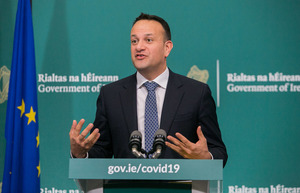
Taoiseach Leo Varadkar at the launch of a Covid-19 public information booklet at Government Buildings this morning

This afternoon.

Pat Leahy, in The Irish Times, reports:

Taoiseach Leo Varadkar has said there is unlikely to be 15,000 confirmed cases of the coronavirus in Ireland by the end of this month as he had previously warned.

However , Mr Varadkar warned against any complacency in the fight against the spread of the disease.

Mr Varadkar said in recent weeks that the number of cases could reach 15,000 by the end of March, but with 1,329 confirmed cases as of Tuesday night, this level is unlikely to be reached in the next week.

Speaking during briefing at Government Buildings in Dublin, Mr Varadkar cautioned that while this accounted for confirmed cases, “there are many, many more cases out there that are not confirmed”.

Coronavirus: Varadkar revises downwards estimate of 15,000 cases by end of this month (Pat Leahy, The Irish Times)

Rollingnews