This morning/afternoon.
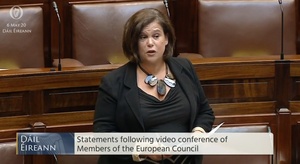
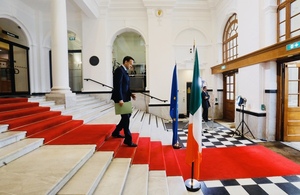
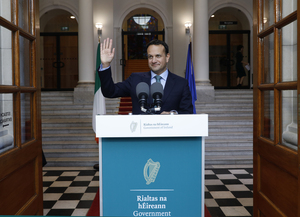
Dail, Leinster House.
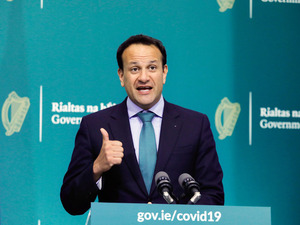
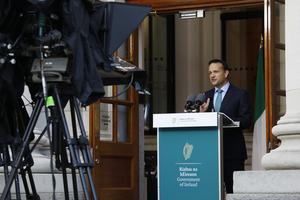
Taoiseach Leo Varadkar said
“As an Oireachtas and as a nation our thoughts are with the families and loved ones of those who have lost their lives to COVID-19.
As of last night, 1,497 people have died in our State and 449 more in Northern Ireland. Our thoughts are also with all those who are working to fight the virus every day, as well as all those fighting with the virus.
In total 23,400 people in the Republic of Ireland have been diagnosed with Covid-19. 17% or 19,470 have made a full recovery.
Thanks to the majority of people across our country following the guidelines we have slowed the spread of the virus. It has not been easy and it has had an impact on all of us in many different ways.
Some have lost loved ones, others have missed out on the events which strengthen the ties of family and friendship, such as weddings, birthdays, or the birth of a new arrival.
Many have lost their jobs or fear losing them. Others wonder if their businesses will ever re-open.
This has been a test of our solidarity and resilience, and it is one we are passing as a nation every day. We are seeing what we can achieve when we put the needs of the many above the needs of the few.
COVID has had a devastating economic impact. Our mission is to get people back to work, get businesses open again, and get the economy humming so that we have the resources we need to build a better society. A great society worthy of the great people we have proven ourselves to be.
The first steps to reawaken our economy will be done in a slow and gradual way. At all times we will maintain an intense focus on the virus and follow four guiding principles – isolate; test; trace and treat – so that we can quickly react if things go wrong and there is an increase in cases.
As we are seeing around the world this is not a straight path. Sometimes progress is halted and there are set backs and we have seen examples of this in Germany, South Korea and most recently again in Wuhan. The crucial thing is to keep doing the right things, to stick to the strategy, and to maintain our focus.
To expect and look for new clusters and flare ups.
This virus is a ‘fire in retreat’.
We must quench its every spark.
And stamp out every ember.
Whilst every new case and death is a cause for serious concern, over the last 7 days we have seen the lowest daily number of cases and deaths since March.
As a result, we are increasingly confident that we will be able to move to phase one on Monday. NPHET is meeting today to conduct its assessment and Cabinet will make its decision tomorrow after we receive its advice.
It is worth remembering that we are still in Phase Zero. All things going to plan, Phase One will begin on Monday, if and only if it is safe to do so. The moment we assume that our progress through the phases is inevitable we will risk regressing.
I acknowledge that as we open more workplaces, we will see more workplace clusters and we need to be vigilant about that. The ‘Return to Work Safety Protocol’ has put measures in place that will prevent the spread of COVID-19 in the workplace. It is a living and evolving document that ensures we protect those at work as well as customers and clients.
The Health and Safety Authority will help business to achieve compliance in a co-operative manner, but will close workplaces if necessary. I want to extend my thanks to the unions and the employers bodies for working with us to develop the protocol and for playing their part in this time of national crisis.
We may in the coming weeks, as Germany has, see an increase in the R number as we ease the restrictions.
So, after May 18th, we need to be more disciplined and act more responsibly than ever before when it comes to vital public health actions – no handshakes, keeping a physical distance of 2m where possible, washing our hands regularly, sneezing or coughing into a tissue or our elbow, staying at home and self-isolating if we become sick.
Face coverings, visors, sneeze guards, while they have a role, are no substitute for any of this. I have every confidence in the Irish people to embrace this new normal.
As we know, extensive travel restrictions are in place. We are requiring that all people arriving in our ports and airports must complete a Public Health Passenger Locator Form and self-isolate for 14 days.
There are exceptions like supply chain workers or those people stopping over in one of our airports before travelling onwards. Or, of course, people on their way to and from Northern Ireland. We’re examining ways of strengthening these actions in the next few days.
However we must also remember that we have a land border with Northern Ireland that we want to stay open, a Common Travel Area with the UK which we want to preserve, and our right as European citizens to travel, study and work anywhere in the European Union which we want to uphold.
While these rights may be restricted for a time due to the pandemic and public health emergency, it is our policy to resume normal travel for business, leisure, study and visits to friends and relatives as soon as it is safe to do so, but not before. This is something the European Commission is currently working on.
However, it’s going to be months not weeks before this is possible.
Testing is ramping up and over a quarter of a million tests have now been carried out. 44,000 tests have been carried out since we last met in this format. We understand that we are the first country, after than San Marino, to test all nursing home staff and residents. This is now being recognised as best practice and other countries are following suit.
Testing is now underway in care homes for people with disabilities and also mental health facilities.
It is now an emerging fact, sadly, that across the developed world, a very high percentage of deaths with COVID have involved residents of care homes, with a very high percentage also in countries where total numbers are low like Norway, Canada and New Zealand.
As the numbers come in, those percentages continue to rise, including in Ireland. While it is an easy analysis to blame nursing homes affected or the HSE, or HIQA or the Department of Health, it might yet prove not to be fair or factual to do so. It doesn’t seem that any country has been wholly successful in keeping COVID out of its care homes.
We are not alone in experiencing this tragedy. That however is no comfort. No matter what their age, every life shortened is a life lost. Families grieve and many have been unable to say goodbye in person or have a proper funeral.
While measles and meningitis targets the young, coronavirus targets older people, the frail and those with pre-existing conditions.
It has been suggested by some that the best way to protect our care homes is to lock them down, residents and staff for months on end and ensure they have no contact with the outside world. I am not sure this is the model of care we want for our seniors in the long-run.
We need to consider alternatives. For example, more and better homecare. This Government was able to afford to increase the homecare budget by 40%. It’s unlikely the next Government will have such resources. So we’ll need a new funding model and place it on a statutory footing.
The outgoing Government did some excellent work developing alternatives like supported housing and housing with care, and the new Government can and should build on and operationalise this work.
We need to consider a move away from large modern newly built 150-200 single room nursing homes towards smaller units like we have done in the disability sector. And also re-examine clinical governance.
We must integrate nursing homes better with the health service, enable therapists and geriatricians and infection control nurses to reach in, avoid hospital as much as possible, and ensure there is a medical director as well as a ‘person in charge’.
I don’t have all the answers. But I am thinking about them every day and I know other deputies are as well.
There are lots of examples of good practice already. We need to identify them and mainstream them. This will be a major challenge for the next Government. It should be approached in an open-minded, non-judgemental, evidence-based way that respects the dignity and agency of older people.
This emergency has hit our country very hard. As we reopen our country and rebuild our economy we have the opportunity to reshape our society in ways that will benefit our citizens for generations to come.
We should seize those opportunities. Greater homeworking; online education; e-health and telehealth; reduced unnecessary domestic and air travel; lower greenhouse emissions and cleaner air.”
FIGHT!
Meanwhile….