

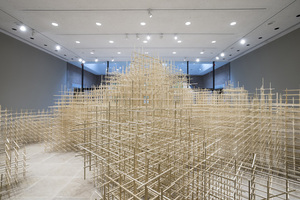


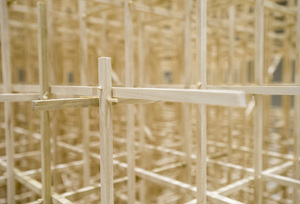
Unbounded – a huge sculpture by Ben Butler made from 10,000 sticks of poplar wood snaking through the art gallery of Rice University in Texas.
It’s all about complex phenomena emerging from simple processes.
But you knew that.



Unbounded – a huge sculpture by Ben Butler made from 10,000 sticks of poplar wood snaking through the art gallery of Rice University in Texas.
It’s all about complex phenomena emerging from simple processes.
But you knew that.


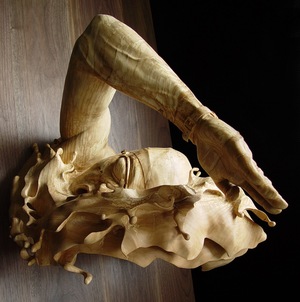


The incredibly detailed wood sculptures of New York based artist Stephanie Rocknak.
Above: details of two recent pieces, ‘The Swimmer’ and ‘The Queen’.

Kinetic artworks by magician and juggler Antoine Terrieux for an exhibition last December at the Maison Des Jonglages (House of Juggling) in La Courneuve, France
He also incorporates hair dryers into his live performances.


Cut Microbe – an impossibly intricate 1.12m cut paper sculpture inspired by the Salmonella and E. Coli bacterium – the fruit of four months of painstaking work by artist Rogan Brown.
The piece will be on display at Eden Project in Cornwall this summer.


Artist Janusz Grünspek’s extraordinary real-world wireframe sculptures of everyday objects created by cutting, bending and glueing thin wooden dowels.


Evocative forms hewn from old rusted bolts found at a barn in Bergsladen, Sweden by blacksmith Tobbe Malm.
More here
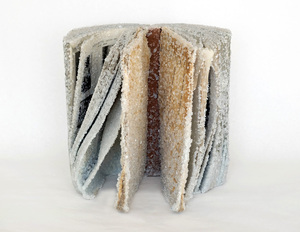

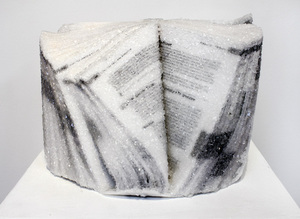


The results of San Francisco based artist Alexis Arnold’s fascination with the notion of preserving discarded books by ‘growing’ them into glittering sculptures with the addition of borax crystals.


Kinetic lamps with embedded CPUs, motors and LEDs by Korean sculptor U-Ram Choe
(Pix: Gallery Hyundai)

3D printed zoetrope sculptures created by John Edmark. To wit:
These are 3-D printed sculptures designed to animate when spun under a strobe light. The placement of the appendages is determined by the same method nature uses in pinecones and sunflowers. The rotation speed is synchronized to the strobe so that one flash occurs every time the sculpture turns 137.5º—the golden angle. If you count the number of spirals on any of these sculptures you will find that they are always Fibonacci numbers. For this video, rather than using a strobe, the camera was set to a very short shutter speed (1/4000 sec) in order to freeze the spinning sculpture.