
Tag Archives: taft on tuesday

From top: Paschal Donohoe, Minister for Finance, Public Expenditure and Reform, at a Covid-19 press briefing last week; Michael Taft

The Sunday Independent headline was certainly dramatic:

Reality bites: Watchdog warns on tax hikes and pension age as recession kicks in

The article featured comments by the Chairperson of the Irish Fiscal Advisory Council Sebastian Barnes which, on closer reading, weren’t as dramatic.

But it nonetheless raises the issues of how we are going to fund the economic and social repair job once this emergency is over; never mind the increase in investment necessary for not-for-profit housing, a fully universal health service, affordable childcare and, not least, a Green New Deal.

Here I just want to focus on one issue; how we can increase tax revenue without increasing taxes. For this we need to go outside the usual fiscal box and look into a recent paper written by Paul MacFlynn of the Nevin Economic Research Institute, ‘The Impact of Collective Bargaining on pay in Northern Ireland’.

This is not a paper about raising taxes. It concerns industrial relations. But the implications of the findings could have a positive benefit on public finances.

Paul shows that there is a pay premium for those workers who bargain collectively with their employer; that is, those who bargain through a single agency – usually a trade union. These workers earn, on average, 13 percent more in pay than those employees who bargain on their own with their employer. He writes:

‘ . . . workers negotiating as a collective are able to mimic or replicate the unity that employers have when they negotiate with their workforce. The market logic is that in any transaction, the power lies on the side with the least number of participants.’

Of course, the situation in the Republic could be different. A similar study might not find a similar premium level. A significant difference is the presence of multinationals, though Eurostat reports that in the multinational sector the average wage, including employers’ social insurance, is lower in the Republic than in any EU country in our peer group.

The OECD estimates that 33 percent of Irish employees are covered by collective bargaining agreements. Approximately half of this would be in the public sector. So we would find only a small proportion of private sector workers covered under collective agreements – certainly fewer than one-in-five.

Let’s assume there is a premium of 10 percent, the level found in this study. Were collective bargaining to be extended throughout the private sector, the level of wages would rise.

This is all pre-crisis but the point is nonetheless valid even if the magnitude is different: collective bargaining raises wages. And with that, tax revenue.

This can be seen in the labour share – wages as a percentage of national income. In this measurement Ireland comes up short.

Were the wage share to rise towards the average, we should expect tax revenue to rise. In 2018, Irish employees paid, on average, 28 percent of their wages in income tax, USC and PRSI. If this held as wages rose, a one percent increase in the labour share would increase personal tax revenue by €400 million.

This should be seen as indicative. One would have to factor in the distribution of the wage increase (towards the low-paid or the high-paid); and the impact on profits and investment.

However, this doesn’t take account the positive impact on consumption taxes (VAT). And as Paul and Tom McDonnell point out, there is a link between collective bargaining and productivity, which means that rising wages are not zero-sum. Companies engaged in collective bargaining benefit from the increased productivity. They write:

‘Seeking these types of pay increases is more likely to be associated with agreements on upskilling and innovation, which provide benefits to the firm as a whole. In this sense, collective bargaining provides a route for firms to boost wages without suffering competitive loss to firms who do not follow their lead.’

Another way the economy would benefit would be the ability of collective bargaining to reduce precariousness in the workplace. Precariousness costs the individual worker and the economy at large.

Workers with uncertain, intermittent income find it hard to forward-plan their expenditure, limiting their full participation in the consumer economy. This leads not only to in-work poverty, it also leads to reduced tax revenue and higher social protection income supports.

Coming out of the lockdown we will need every fiscal edge we can find. Extending collective bargaining to every workplace where employees so wish can help maximise the gains of the recovery and the substantial subsidies that will be provided for business.

The last thing we should do is squander public subsidies as we did with the VAT reductions for the hospitality sector in the last crisis.

Collective bargaining is a win-win-win process – higher wages and tax revenue, higher productivity and reduced precariousness.

Providing every worker with the right to bargain collectively with their employer would have a verifiable and beneficial impact on public finances. Paul makes the point that:

‘Collective bargaining thus represents one of the few policy levers that government has in order to increase wages and ultimately the labour share of income.’

The same could be said for increasing tax revenue. And this without increasing taxes.

Michael Taft is a researcher for SIPTU and author of the political economy blog, Notes on the Front. His column appears here every Tuesday.

Rollingnews

From top; the low-paid can be among the ‘agents of recovery’ in post-lockdown Ireland, writes Michael Taft

The low-paid, the precarious worker, the gig worker and temporary agency worker, the under-employed, the undocumented and the marginalised in the labour market: these are the women and men we now recognise as vital agents in networks delivering essential goods and services in these crisis times.

Where we once, as a society, assumed such poor quality employment was the inevitable result of new business models or low value-added sectors or the competitive nature of markets, we are starting now to see such work and these workers differently.

And as we begin the long unlocking of the lockdown we have an opportunity to assign these men and women a new role; namely, agents of recovery.

The Government projects that consumer spending will fall by 14.2 percent. To put that in perspective, in the worst year of the last crisis – 2009 – consumer spending fell by less than 5 percent.

The Government projects consumer spending will bounce back next year – by 8.7 percent; however this will still leave it at 93 percent of 2019 levels. We certainly won’t see a full recovery until at least 2022 and possibly 2023.

Even when the current emergency has passed (bearing in mind that there is no permanent exit without a vaccine), consumer spending may struggle. Large numbers of people will be out of work (and, so, unable to spend much).

Even those in work may be reticent to spend – especially in discretionary sectors such as hospitality due to fears of a second wave or of lack of social distancing. Fear and behavioural change may undermine a consumer recovery for years.

Driving a consumer recovery will involve many elements; in particular, privileging the ‘spenders’ – those who have a high propensity to consume. This means privileging lower-income groups and average income households with children.

If you give €100 to someone with a low income they are likely to spend all of it; a high-income earner is likely to save some if not most of it. In uncertain times, it makes sense for a household to save but that doesn’t help the overall economy.

This goes further than just redistribution. It is about giving those on low pay and precarious contracts the tools to effect this progressive distribution. Let’s look at some of these tools.

Collective Bargaining

Collective bargaining has been shown to lift wage floors for the low-paid. The ability of employees to come together to negotiate with their employer strengthens their bargaining power which, in turn, contributes to higher wages and better working conditions than would have prevailed under individualised or market-based bargaining.

Collective bargaining could be extended throughout the economy in two ways:

1) Provide every employee with the legal right to bargain collectively; where a substantial number of employees in any enterprise opt for this method of bargaining, the employer must acknowledge this and engage

2) Establish sector-wide bargaining where representatives of employees and employers negotiate wages and working conditions across a sector (e.g. retail, hotels, agriculture, food manufacturing, etc.). This would protect both workers and ‘good’ employers from businesses that use low-road business models (reduced wages, working conditions) to gain a competitive edge.

Such a model, which prevails in many European countries, provides flexibility (sectoral agreements can be adjusted at enterprise level to take account of enterprise conditions) and promotes productivity through high-road strategies (shifting emphasis on to product and service quality, innovation, customer satisfaction, and investment). Most of all, it lifts the wage floor for the lowest paid, providing additional income for ‘the spenders’.

Precarious Contracts

If people experience uncertain income they cannot plan their expenditure and, so, cannot fully participate in the consumer economy. Collective bargaining can address many of these issues at sector and enterprise level, but there will still need to be policy interventions.

Given the range of contracts, there is no magic bullet to solve precariousness but here’s one small example. Bogus self-employment, whereby employees are treated by their employer as self-employed (to avoid higher social insurance payments, holiday pay, etc.), has long been a feature of the construction sector but is now spreading to other sectors.

This deprives employees of benefits while the state loses out on social insurance payments. In effect, this is an attempt to drive down wages and income.

A very simple rule could be introduced: all employment contracts are considered a standard employer-employee contract unless the employer, with the agreement of the employee, can show that it is truly a matter of self-employment.

If they can’t do that, with reference to Revenue Commissioner and Department of Employment Affairs and Social Protection guidelines, then the contract is assumed to be standard. This would set a new floor for workers in sectors affected by bogus self-employment.

Part-Time Flexibility

Employees should be provided with the flexibility of moving between part-time and full-time work in an enterprise where the hours become available. This was the intention of the European Directive on Part-time Employment but it was never fully transposed into Irish law.

This would give workers some autonomy over their working hours, reducing them when they have other commitments (usually caring) and increasing them when they need extra income.

Regularisation

There are an estimated 17,000 undocumented workers (pre-emergency). These workers are subject to considerable exploitation which has the effect of driving down wages and working conditions for all employees at firm or sectoral level. Alan Desmond, law lecturer at the University of Leicester, suggests we:

‘ . . establish a mechanism allowing for automatic transition to legal status for irregular migrants who have spent a specified minimum period of time, say five years, in the state.

While such a mechanism may justifiably be accompanied by requirements like the absence of a criminal record, such limitations should be few in number to ensure that as broad a swathe as possible of the irregular migrant population can avail of the regularisation measure.’

Automatic and accessible regularisation would remove another low-road element in our business model and help workers to become more fully integrated into the consumer economy.

* * * *

These and other reforms – the Living Wage, pay-related social insurance payments, a guaranteed minimum income – would raise the income and living standard floor, privileging low-paid and precarious workers and, so, boosting a critical aspect of recovery: consumer spending.

What’s even more important is that these structural reforms would actually give workers themselves the tools to drive the recovery by improving their living standards.

Orthodox theory suggests that restoring growth – restoring profits, employment, investment and fiscal confidence – will address these issues, but that is patently not the case.

Prior to the emergency Ireland had one of the highest levels of low pay in the industrialised world, while the Nevin Economic Research Institute found that up to 500,000 employees were at elevated risk of contractual precariousness with another large cohort at risk of precarious living standards (in-work deprivation, inability to meet an unexpected expense).

Orthodox theory is wedded to trickle-down economics. What we need is a new surge-up economics – raising wages, working condition and living standard floors. And what’s the best way of achieving that?

Give workers the tools and the choice to address their issues – through collective bargaining, precariousness reduction, flexibility, and regularisation.

Do this, and they will become for all of us the agents of recovery.

Michael Taft is a researcher for SIPTU and author of the political economy blog, Notes on the Front. His column appears here every Tuesday.

Rollingnews

From top: Green Party Leader Eamon Ryan; Michael Taft

The Green Party is currently debating whether to enter government with Fianna Fáil and Fine Gael. There are legitimate arguments on all sides of this question.

However, before making a decision I would strongly advise the Greens to read the fine print; in particular, the fine print of the Stability Programme Update (SPU) – the Government’s latest economic and fiscal projections.

Of particular interest are the fiscal projections, the Government’s estimate of public spending in 2021. This is a baseline, a product of layering the Medium Term Fiscal Strategy on to the Budget 2020 projections and then adding the impact of the crisis (falling tax revenue, rising unemployment and healthcare costs, etc.).

This baseline reveals the challenge for the Greens and their programme – a programme which emphasises investment to address climate chaos, a new social contract, the housing shortage and other elements of their 17 demands.

Let’s compare the SPU projections with those contained in Budget 2020 (the latter was put together last autumn). This comparison is useful because it shows the leeway the Government is now giving to the radically altered post-coronavirus economy. The problem is the Government is not giving much leeway.

In 2020, spending will greatly exceed the Budget 2020 projections – by €5 billion. This is driven by increases in social payments (unemployment payments, wage subsidy scheme) and healthcare expenditure. However, in 2021 the SPU pulls public spending back to the Budget projections.

Overall public spending (primary expenditure excludes interest payments) and spending on public services are being pulled back to pre-coronavirus projections. In fact, when we exclude social payments, public spending under the SPU actually falls below that projected in the budget last year.

The real question is: how are people’s demands for enhanced public services, especially a single-tier health service, going to be met using pre-crisis budget projections? What about the enhanced income supports? Or a renewed public housing programme?

What about the multi-billion Euro stimulus programme for business that will be needed? Now, add in a significant Green New Deal investment programme. All that on the basis of spending projections presented prior to the current crisis.

Then there’s the orthodox mood music. The Minister for Finance stated in the Dail recently:

‘Our deficit will have to be reduced, our national finances must return to a position of balance again.’

Why? Why must we ‘return’ to a position of balance? Even the Fiscal Rules, as orthodox a set of rules you’ll find anywhere, allow for deficits.

The rationale for a deficit-spending strategy is set out here. Any attempt to pursue a balanced-budget strategy in the medium term will unnecessarily restrict social, environmental and economic investment.

Sebastian Barnes, the acting chair of the Irish Fiscal Advisory Council, writes in the Irish Times:

‘Compared with the 2008 crisis, it should be possible to avoid severe austerity.’

That’s good but note the word ‘severe’.

Continue reading →

From top Minister for Finance Paschal Donohoe; Michael Taft

The Irish Times headline had a familiar, ominous ring:

“We must not forget coronavirus bill will have to be paid someday”

Donal Donovan went on:

‘Clearly, the deficit will be a huge number and likely to be followed by more significant red ink in 2021. Who will pay for this? . . . at some stage Ireland will have to pay the bill associated with the virus . . . Payment will come in the form of higher taxes or postponement of otherwise planned expenditures.’

We’ve been here before. Who will pay for this? The question is framed in the wrong way. It is not about who will pay but what will pay.

Cliff Taylor talks about the ‘tough choices to be faced on tax and spending’. But the real issue is making the right choices. Neither tax increases nor spending cuts are going to ‘pay’ for the substantial debts arising from the crisis, unless we want to risk an extended period of stagnation.

The ESRI has projected a deficit of €12.7 billion for this year, or 4.3 percent of GDP – but that was early on in the crisis. The Central Bank has estimated a deficit of 6 percent of GDP, which could work out close to €18 billion.

We are likely to see a significant reduction in the deficit in 2021 as people return to work. However, much will depend on to what extent employment and enterprises are permanently destroyed, the pace of the return to work, and progress towards a vaccine.

There are few estimates about what the economy might look like next year; understandable given the unprecedented nature of the crisis.

The OECD claims that Ireland will be one of the least affected economically by the crisis, given the presence of medical and big-tech multinationals.

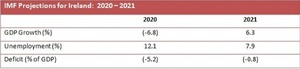
However, there could be significant sectoral and regional variations. The IMF produced a set of projections which look promising if they turn out to be true:

Irish output levels will nearly recover in 2021. The deficit will return to nearly a balanced budget situation. And unemployment, while high, will be reduced to single figures.

There is a major caveat. The IMF uses a global GDP model applied to all countries. It is not an analysis of the detailed conditions for each country. So this GDP model could well over-estimate the Irish economy’s resilience.

Even if the deficit recovers quickly in 2021, we will hear calls to reduce our overall debt levels. There are few projections for these, but with a €15 to €20 billion deficit this year, and the likelihood of this continuing into 2021, debt will rise.

In the short term, general tax increases and spending cuts of the type we saw in the last crisis will only make the recovery more difficult. Unemployment will still be high after the emergency. Households and businesses could fall into debt.

Disposable incomes will be reduced. And this doesn’t count the demand to maintain the positive features of the Government’s response to the crisis: a more equitable healthcare system, a fully subsidised childcare system, enhanced income supports.

Rushing to a balanced budget, never mind a surplus, to pay down this debt would be a mistake. The best way to repair the economy, build on social equity, and reduce the debt would be to embark on a medium-term strategy of deficit spending.

This might seem counter-intuitive – deficit spending to reduce the debt – but that’s exactly what Ireland did coming out of the stagnation of the 1980s.

Even though the Government ran a continuous deficit over this decade, and the actual amount of debt rose by 25 percent, the debt burden (debt measured as a percentage of GNP) fell substantially. Of course, one can’t make straight-forward comparisons.

In the 1988/97 decade, government revenue was boosted by a tax amnesty, privatisation proceeds (which actually flattered the deficit), EU funds, and growth rates, especially in the latter half.

Nonetheless, while running deficits, the debt burden fell by 46 percent even as the actual debt pile grew. Even if growth rates were a third less, the debt would have fallen in excess of what the fiscal rules would have required, if they were operating back then.

It’s actually just common sense. If growth rises faster than the deficit, the debt burden falls.

Let’s run this through an extremely simple exercise.

Let’s assume that GDP falls back to 2018 levels (€325 billion) and debt increases to €250 billion (or 20 percent above 2018 levels).

Further, let’s assume the deficit runs at 2 percent per year while GDP growth rates are 4 percent (between 2012 and 2018 GNI* averaged nearly 8 percent annual growth).

Over a 10-year period, with an accumulated deficit of nearly €50 billion, the debt burden still falls; and that’s with a subdued growth rate.

One would hope for higher growth, obviating the need for a deficit in each of these 10 years. Nonetheless, this simple illustration shows that you can reduce the debt burden while running deficits.

And we should also note that the Fiscal Rules, which are for the time being suspended (thankfully), still allow for deficit spending. And that suspension, along with continued ECB interventions, is likely to continue. In 2021, the IMF predicts a deficit of nearly 4 percent for the Eurozone as a whole.

Fiscal policy, however, cannot rely on deficits alone.

It needs to encompass other initiatives such as productive investment, judicious use of our cash balances (estimated to be over €20 billion), shifting taxation on to assets, and increasing employers’ social insurance (but only when we are fully out of the emergency), and collective bargaining rights to raise wage floors.

If we fall back on fiscal clichés, the recovery will be harder, the social damage will be greater, and our ability to vindicate people’s desire for stronger public services and income supports will be greatly reduced.

And if that happens we should at least know that it will be a political, not an economic choice.

Michael Taft is a researcher for SIPTU and author of the political economy blog, Notes on the Front. His column appears here every Tuesday.

Rollingnews

From top: Grafton Street, Dublin 2 on Saturday; Michael Taft

We’re all fiscal expansionists now. From the fiscal orthodoxy to the radicals of the Left there is one message: throw money at it, don’t worry about the deficit, do whatever is necessary and worry about the cost later.

Absolutely correct. But progressives should now start debating the implications of that ‘cost later’. Because after the emergency the issue will turn to ‘who’s picking up the bill’.

A good starting point is the ESRI’s current Quarterly Economic Commentary. While normally these contain forecasts, such is the uncertainty that the authors produced a scenario instead. For 2020:

GDP falls by 7.1 percent

Unemployment more than doubles to 12.6 percent

The deficit rises to nearly €13 billion with a deficit-to-GDP ratio of -4.3 percent

And the ESRI says this scenario could be on the ‘benign’ side; that is, it could be worse. They assume a short sharp hit in the second quarter, with the recovery coming on stream in the third and fourth quarters.

However, we don’t know how big the hit will be, when the recovery will start or how robust it will be.There are assumptions layered on assumptions.

For instance, the ESRI assumes the trajectory of unemployment to be:

The unemployment rate in the second quarter of 18 percent suggests nearly 450,000 unemployed, falling to approximately 260,000 by the last quarter if the national and international recovery starts in July.

However, what happens if the second quarter is worse and the recovery is more sluggish? What if there is no vaccine or effective treatment found by the end of the year? Will we see another round of infections, isolation and lockdowns? Even the fear of a fresh round would depress investment and consumer spending, prolonging the recession.

In terms of the budget, what should have been a surplus in 2020 will now be a deficit of nearly €13 billion in the ESRI’s scenario, or -4.3 percent of GDP.

Though the ESRI doesn’t provide a scenario for public debt, we can extrapolate. Based on the pessimistic Brexit budget projections, the Government estimated a debt level of nearly €200 billion, or 56 percent of GDP (97 percent of GNI*).

They produced new more optimistic projections earlier this year, but didn’t include debt numbers. However, based on the budget projections, the debt could rise to over 70 percent of GDP and over 120 percent of GNI* under the ESRI scenario.

A return to growth should help to bring this ratio down, but it may be some time before it returns to pre-crisis levels.

What can we expect?

1) On the other side of the emergency, the Government will need to engage in another bout of spending to resuscitate business activity. These will be the stimulus measures (the current measures can be better described as ‘disaster prevention’).

Those measures may include nvestment increases (though this takes time to come on stream), VAT cuts, cuts in employers’ PRSI, continued liquidity to businesses, etc.

2) At some point, the argument over fiscal retrenchment will start – to rein in the deficit and debt. It will be austerity but it will be called something else (‘consolidation’, ‘stabilisation’, etc.).

However, there could be political limits. For instance, after experiencing a single-tier health system, will people tolerate a reversion back to the two-tier regime and the old normal of waiting lists and over-crowded A&Es? Will people tolerate the reduction of Illness Benefit from €350 per week back to €203?

3) Nonetheless, the fiscal orthodoxy will want to use the pre-crisis levels of public spending as a baseline, even if demand-based expenditure (e.g. social protection, healthcare) cannot be easily reduced. And it is doubtful whether increasing taxation will form a significant part of an austerity/baseline strategy and with some good reason – increasing taxation while an economy is recovering would have the same negative impact it did in the last crisis; but, then, so would cutting public spending.

How should progressives respond? Some starting points to discuss:

First, the elevated expenditure on health care and income supports during the emergency – on public services and social protection – are not sustainable on the current tax base.

Second, in the election some progressive parties proposed substantial tax cuts. These proposals should be scrapped. There may be room for limited, forensic tax reductions where social equity and economic efficiency can be shown. But as a rule, tax cuts should be treated as guilty until proven innocent.

Third, strategies to make the ‘rich’ and ‘corporations’ pay for the crisis will disappoint. For instance, corporate tax receipts will decline in the medium term. This was on the cards prior to the crisis. After the emergency, countries will be even more desperate to find extra revenue.

This will accelerate (and rightly so) the clampdown on international corporate tax avoidance. Given that we are a beneficiary of such avoidance, this will hit Irish tax revenue.

And while there is nothing wrong with soaking the rich (or giving them a good splash), higher tax rates on high incomes, withdrawal of tax credits, etc. would make up about 1 percent of total Government revenue. A

nd a new wealth tax would have to take into account the fact that most wealth is tied up in people’s homes, business and farming assets. So, yes, increase progressive taxes but don’t think it will be sufficient to fund a new dispensation.

There are no easy solutions. A key part of progressives’ response should be to explore all the potential and ramifications of fiscal reform. In particular, we should develop a medium-term strategy based on deficit-spending that can still reduce the debt ratio.

But this could be hemmed in or curtailed by the return of the fiscal rules and their enforcement by conditional European Central Bank funding.

However, the response cannot be limited to fiscal measures. The fiscal is a consequence of the economic, and the economic is the totality of power relationships.We need to look at systemic reforms which can lay the foundation for a successful fiscal policy.

At the end of the day, getting a few hundred million Euros from the rich, or even a couple of billion, is not the key question (though, please, let’s have it). It is the system that privileges the rich – whether we understand that as individuals, corporate and financial institutions, or simply the logic of capital accumulation.

And if you think the latter is a bit esoteric, just track where the money being pumped in by governments and created by central banks eventually ends up.

If we want to ensure the new normal doesn’t end up looking like the old normal, this is the territory we must occupy.

Michael Taft is a researcher for SIPTU and author of the political economy blog, Notes on the Front. His column appears here every Tuesday.
Rollingnews

From top: Minister for Social Affairs Regina Doherty; Michael Taft

The Tánaiste, Simon Coveney, stated on RTÈ Radio One’s This Week:

“If people have sensible proposals that are costed and thought through, that they believe are necessary and will make a difference, we want to hear about them.”

ICTU and SIPTU have done just that, proposing a wage compensation scheme whereby the Government would take over 75 percent of employee wages in sectors and companies that are facing closure, with the employer providing the remaining 25 percent.

This is based on the Danish initiative and is being rolled out in a number of EU countries. Even the UK is putting together a wage compensation scheme.

SIPTU has also called for those who have been laid off to also receive 75 percent of their wage at the time they lost their job, with employers being allowed to top up.

The Government has stated it is working on such a scheme and the Minister for Employment Affairs and Social Protection Regina Doherty  has promised to unveil their own programme in a matter of days.

Good. A number of commentators have lined up behind such wage compensation proposals. It has within a few days become the common sense of the economic emergency we’re facing.

So what is the cost of the benefit this income support will bring? Because let’s be clear, protecting people’s income is a benefit that will pay democratic dividends when the emergency subsides. It will protect households from falling into deprivation and debt and, so, will hasten the recovery.

Let’s start with a baseline of 100,000 employees. Further, let’s assume the average weekly earnings of €688 in the private sector for 2018 and add another 4.5 percent to bring it up to spring of this year. That comes to €719 weekly.

For every 100,000 unemployed, it will cost the state €59 million. Minister Doherty has acknowledged that as many as 400,000 could lose their jobs as a result of the pandemic.

Let’s assume that 300,000 will remain in their jobs as a result of this scheme. That’s 700,000 – who have lost their job or whose employers are at risk of closure; hopefully, a worst case scenario.

This raises the weekly cost to €377 million per week, or €1.6 billion per month. If this emergency runs four months, this scheme could cost up to €6.5 billion. That would appear to be a significant amount. But it isn’t.

First, the hospitality sector took the initial hit and average weekly earnings are much lower (€347 per week) so the cost of wage compensation would be lower. Many of the high-income sectors are unlikely to be hit as hard – financial sector, ICT and big tech, professional services and modern manufacturing.

Second, under a wage compensation scheme, workers’ income would still be taxed (just as Jobseekers’ and Illness Benefit are). So the net cost would be lower.

Third, we have to estimate the cost of unemployment benefit in the absence of this wage compensation scheme. For the 400,000 that may become unemployed, the state would still have to pay Jobseekers’ Benefit.

If we assume the current full rate of €203 per week (not all would get this after the first six weeks, while others with adult and child dependents would get more), the cost would be €1.4 billion.

Taking all this into account, the total cost could be in the area of €5 billion, and could be less depending on the composition of the unemployed and protected workers under the scheme.

€5 billion – how would we pay for this?

We have cash balances of over €20 billion. We have a rainy day fund of €1.5 billion. We can borrow at nearly 0 percent. €5 billion represents only 2.5 percent of the national income (GNI*) that we generated last year.

National income is likely to fall, but even if it collapsed by 25 percent in nominal terms (the amount it fell during the bank recession), it would still only be a relatively small 3.3 percent. I don’t think I need to compare this cost with that of the bank creditors’ bail out.

Keeping businesses in business, supporting people’s incomes, avoiding debt and deprivation, putting the economy in a position to quickly recover after the pandemic emergency – the cost of a wage compensation scheme shouldn’t be seen as a cost. It is an investment, economically sound and socially equitable.

Let’s go for it. And start the conversation of how we put income protection on a permanent footing when the emergency passes.

Michael Taft is a researcher for SIPTU and author of the political economy blog, Notes on the Front. His column appears here every Tuesday.

Rollingnews

From top: Dublin city centre yesterday; Michael Taft

There is now a danger that the economy will suffer deep and long-lasting harm arising from the coronavirus.

Unfortunately (but inevitably), the virus has exposed major flaws in our income protection system, industrial institutions and public service capacity.

With an estimated 140,000 already laid off, this will quickly turn into a recession. Now is the time to design emergency policies based on key principles:

Maintain as many people in work as possible and keep as many businesses going – even at reduced capacity and hours

Where businesses are closed down due to Government instruction (pubs, restaurants, crèches), ensure they are in a position to recommence business once the emergency is over – and that workers have a place to go back to work

Maintain as much as possible people’s income during illness and unemployment

Negotiate emergency protocols across sectors, starting with those most vulnerable to a downturn, between representatives of employees, employers and the government

And, most of all, supply the cash that is needed – in economic terms this is first and foremost a liquidity crisis. If we don’t do this, we could quickly see this turning into an insolvency crisis with high levels of permanent business destruction.

Income Support

Our social protection system has been exposed as ill-equipped to deal with the crisis. This was conceded early on by the Government when it reformed the Illness Benefit system, eliminating the six-day waiting period and increasing payments by €102 per week.

While many employees will have the protection of occupational sick-pay schemes which provide high levels of income protection, these will be mostly found in higher-income sectors such as financial and professional services, big tech, modern manufacturing and the public sector.

However, well over 50 percent of private sector workers may have no such protection – meaning that up to one million employees are totally reliant on the state’s Illness Benefit.

There is no sense in getting into comparisons with sick pay on the continent. Suffice it to say that all employees are protected by a combination of employers and the state/social insurance funds providing up to 100 percent of pay in the first few weeks.

We should have that same universal income-related protection for all employees but we don’t, and designing such a system would take months. The government acted in the only way they could regarding Illness Benefit.

We should do the same thing for Jobseekers Benefit and immediately increase it by €100 per week. Again, on the continent, unemployment benefit is income-related, something we should have put in place during the recovery.

Such payments protect living standards and prevent households falling into poverty and debt. The increase of €100 – while still not adequate – will at least help protect the incomes of the low-paid.

In addition, the Government could consider bringing in instructions that, for the duration of the emergency, there will be no evictions, foreclosures, utility shut-offs or discontinued health insurance for those on Illness and Jobseekers’ Benefit. This will give some sense of security to households who will be struggling to cope.

Business Supports

At the start of the crisis the Government announced a series of business supports. However, some of these were already in place, while others were designed to deal with a much different Brexit-related crisis (e.g. Enterprise Ireland’s Rescue and Restructuring Scheme).

We need strategic policies designed for, in the first instance, the sectors impacted by Government closure orders.

(a) State Protection Regime

In the case of restaurants, public houses, crèches and other impacted sectors, zero percent loans or a range of repayable grants should be provided for firms to help continue paying fixed costs while closed: rates, rents, utilities, insurance, postponement of VAT, PRSI payments, minimal maintenance staff, the new Government measures to subsidise employment, etc.

With no revenue coming in (though larger establishments may have reserves or insurance policies that cater to these type of emergencies through business interruption insurance), we have to at least ensure they can survive the emergency period and be in a position to re-open when some normalcy returns. Workers need a place to go back to work.

These businesses could be put under a special state-sponsored protection regime. While there would be a high up-front cost, in theory these subsidies would be repayable over a number of years; though in many cases businesses will go under permanently.

(b) Dealing with Reduced Demand

In other sectors which are struggling with reduced demand (such as non-supermarket and other food retail outlets), a range of measures could be introduced such as subsidised short-timing, postponement of tax payments (VAT, etc.), subsidies for rates, rents, etc.

These subsidies would be based on the particular sector’s capacity to absorb the damage incurred by the coronavirus-related downturn.

All this is dependent on whether the emergency is extended beyond the end of the month, but we should assume that it will be.

Industrial Relation Institutions

In Denmark, an agreement has been reached between representatives of employees, employers and the government whereby the state will pay employees in the private sector 75% of their salary if there is no guarantee they can work because of the coronavirus crisis, in exchange for employer commitment to keep employees in work and an employee exchange of working during some of their holiday leave.

This shows the power of collective and solidaristic bargaining, acting quickly, urgently and flexibly. For the most part we don’t have such institutions at the national or sector level. Therefore, the ability to address economic issues through stakeholder cooperation is limited.

We can’t rewrite industrial practice or create new industrial institutions in the short term. However, it is open to the Government to convene sectoral dialogue covering, in the first instance, the hardest-hit sectors.

This could mean sectoral dialogue in the restaurant, hotel, retail, and childcare sectors. And if any stakeholder doesn’t want to attend, then the dialogue and negotiated mandatory protocols will be conducted without them. No one should have the right to veto emergency action.

A Progressive Fiscal Framework

The coronavirus-related impact on the economy will trash all previous projections (I understand the Department of Finance was going to produce new projections this week; however, so fast is the emergency unfolding such projections will probably be out of date within a few days).

Let’s be clear about two things: first, this will be an expensive package upfront. However, much of this would be repaid to the state over a number of years when the economy recovers.

Further, if firms are permanently closed, if employees fall into poverty and debt, the recovery will take longer and will be even more expensive. This is not a stimulus programme. This is a defensive one.

Second, we have the resources. Prior to this emergency, the Government anticipated an accumulated surplus of €20 billion to €25 billion over the next five years. This will be reduced due to the economic downturn and the need to support health services.

However, the Government is working off a different, fiscally-healthier baseline than it did prior to the 2008 recession. In addition, it has €20 billion in cash balances and it can borrow at near 0 percent, meaning it can access free money.

As investors flee the stock exchanges for safe investments, these interest rates could fall well into negative numbers (which means that investors are paying us to buy our debt).

At the EU level, the Government should campaign to ensure that increased expenditure and reduced revenue owing to the coronavirus should be exempt from the fiscal rules; in particular, the force majeure clauses (disasters which government can’t control). The EU Commission has already provided increased flexibility and exemptions for Italy.

How much can we afford? As much as it takes. A package of €10 billion to deal with the crisis (not including the additional resources for the health services) would be a reasonable amount.

As stated above, much of this would be recouped from businesses when the economy recovers, and would save money if it helps a faster recovery.

* * * *

Such a programme would pre-figure important post-emergency reforms: a national sick-pay scheme underpinned by an enhanced social protection system. This could lead to further reforms with pay-related benefits for a number of contingencies (unemployment, invalidity, parental leave) as applies on the continent.

We could also see new industrial relation institutions such as firm-level and sectoral collective bargaining to ensure greater participation and protection for all stakeholders.

Most of all, this could represent, as Bue Rübner Hansen puts it, ‘a step towards a new post-neoliberal economic paradigm’. This crisis shows that its resolution lies in the combined forces of a cooperative civil society and a public sector that privileges people’s health over profit.

These can be powerful forces in the transformation of economic and social relationships and can become the driving forces in overcoming climate chaos, blurring the distinction between the public and private (e.g. business supports are just forms of socialisation and a realisation of the limits of the market), reducing inequality of living standards through enhanced social protection supports and public services, and reducing inequality in the workplace through collective bargaining.

But that lies in the future. Today we face the challenges of defeating the virus, saving lives and protecting the economy. These are challenges that will require resources and solidarity.

Fortunately, we have both in healthy abundance.

Michael Taft is a researcher for SIPTU and author of the political economy blog, Notes on the Front. His column appears here every Tuesday.

Rollingnews

From top: IBEC Ceo Danny McCoy; Michael Taft

According to Danny McCoy, director general of employers’ lobby group, Ibec:

‘The public sector is too small for the size of the private sector, and that is really something for Ibec to say. The lack of doctors, the lack of guards etc. You can feel it.

We agree there needs to be an allocation of resources towards issues that affect people’s everyday lives, like housing.’

He went on to say the Government must deliver a surging demand for public infrastructure and public services with more investment in public sector jobs and subsidised child care. Yes, that’s something coming from employers.

But common-sensical, too. High costs – whether measured in childcare fees, private rents, A&E over-crowding and health waiting lists – degrade the productive economy and put costs on both households and businesses.

So it makes good ‘business sense’ to call for investment in public services.

And this social investment will require higher levels of public sector employment. You can’t consume a service that hasn’t been produced by women and men.

The problem is that over the long-term, the proportion of public sector jobs has declined relative to total employment.

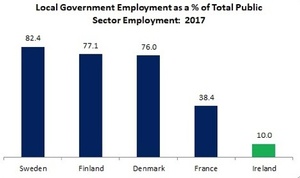
In the early 1980s nearly one-in-five worked in the public sector. This has fallen to less than 15 percent. If we were to return to 1980 levels, we would have to employ 100,000 more in the public sector.

Ireland’s level of public sector employment is quite low compared to our peer group in the EU.

If Irish levels reached the average of our EU peer group, we’d have to employ another 150,000. To reach Swedish and Danish levels, we’d have to nearly double the number of public sector workers (i.e. another 300,000 employees). Note: Germany and the Netherlands are excluded as employment data doesn’t include public health employees.

Some might wince at these levels of public sector employment though they are pretty mainstream on the continent. But public sector employment there has a radically different structure.

Countries with high levels of public sector employment are also countries with a high level of decentralisation; where local government plays a more substantial role.

It is difficult to make these comparisons across Europe as many countries have a federal structure, where there are local and regional tiers.

But in those countries with an Irish-style central/local tier structure, local government accounts for the greater part of public sector employment.

To drive Irish public sector employment we should look to empowering local government to take over more functions that are currently reserved for central government. This, of course, is a long-term reform given the highly-centralised nature of Irish government and the complexities involved in decentralisation.

This process could involve a regional structure with a local tier. For instance, a Greater Dublin Council could be created, amalgamating the four local authorities with provision for smaller councils (e.g. Tallaght, Donnybrook, Inner City, Blanchardstown, Clondalkin, etc.).

This would build scale and localise at the same time.

There would also be benefit to the political culture from this process. Eurobarometer shows a higher level of trust regarding local authorities:

61 percent tend to trust local authorities (as opposed to 34 percent who don’t)

Only 42 percent tend to trust the national government (as opposed to 51 percent who don’t)

Moving from a ‘too small’ public sector (as IBEC puts it) to a European-style balance between public and private sectors will be a truly radical reform. This is one of many issues that didn’t arise during the election. But it will be an issue facing the incoming government, regardless of ideological hue.

Satisfying the demand for enhanced public services could well determine the popularity of any new government. And employing more people will be necessary in meeting that demand.

Radically decentralising government may be the best way to achieve all that.

Michael Taft is a researcher for SIPTU and author of the political economy blog, Notes on the Front. His column appears here every Tuesday.

Rollingnews

From top:, Leader of the Green Party Eamon Ryan (centre), speaking to the media at the party’s last press conference before the vote in General Election 2020; Michael Taft

Just because climate chaos didn’t feature much in in the campaign doesn’t mean that it shouldn’t feature prominently in a Programme for Government. A Green New Deal is absolutely essential. And it will cost.

How much?

The National Development Plan (NDP) committed an additional €750 million per year over a 10-year period from the Exchequer. This was before the crisis became a major political topic – before the Interdepartmental Panel on Climate Change’s warning we have 15 years to turn things around and the international school strikes.

Indeed, the Climate Action Plan made a virtue of not committing resources:

“While the plan sets out a major programme of change, this cannot be approached as a call for a new programme of spending for the Exchequer to meet.”

Instead it relies on the funding envelope contained in the NDP. We will need considerably more than what is allocated to ‘turn things around’.

So without getting into the specific content, let’s look at how we can finance a transformative Green New Deal. And let’s estimate the expenditure at €10 billion over a five-year period (the amount and the period is not the key point of this post – merely where we can access the funding).

In showing how we can finance a special investment programme we need to consider the following.

First, any Green New Deal must be additional to what the Government has already proposed to spend in the ten-year NDP. Any attempt to ‘repackage’ or double-count spending will hopefully be exposed as a manipulative PR exercise.

Second, is the spending a once-off or does it commit the Government to continuous spending. Example: is the €200 million earmarked for a once-off public transport project (once built it doesn’t need to be built again)?

Or is it an ongoing expenditure such as subsidies to public transport to reduce fares? Ideally, a Green New Deal should be earmarked for capital projects but this needn’t be an iron law.

Third, is the expenditure a commercial investment and, therefore, not a charge on the Exchequer? For instance, Bord na Mona management once had an expansionary vision of a transition to sustainable business activity such as resources recovery, wind energy, biomass, environmental products, district heating and eco-tourism, encapsulated in its New Contract with Nature.

As these would have been commercial ventures, state investment would be ‘off-the-books’ (recently, however, Bord na Mona management has adopted a downsizing strategy wherein redundancies are described as investment in decarbonisation).

Another example of commercial activity would be a public stake in a consortium to build large-scale offshore wind farms. Being a commercial activity, the investment would not be a charge on the Exchequer. Commercial investments would be part of a Green New Deal but would not be a cost.

Fourth, all expenditure creates new revenue streams – either tax revenue or national income. For instance, providing free retrofit for households would be a significant upfront cost to the state.

However, the state would recoup the expenditure through a number of sources: repayments based on income or energy savings, the construction activity (income tax, etc.), household savings spent in other non-energy areas, reduction in fossil-fuel imports, reduced EU fines, etc.

Identifying revenue streams is important to costing a Green New Deal because there is a tendency to assume that €10 billion investment means that our national debt would rise by €10 billion. It doesn’t.

The impact on the national debt would be much less and, in the long term, would save money compared to the scenario where there was no investment.

Taking all this into account, where could we find €10 billion in a fiscally-efficient way.
First, the government is planning an accumulated surplus of €24 billion out to 2025.

This surplus is not required under the fiscal rules. In fact, those rules would allow us a deficit in each of these years though that is probably not advisable. However, a slightly lower accumulated surplus to fund a green investment programme is.

Second, we will have considerable cash balances (i.e. savings) out to 2023 and in all likelihood beyond. These are cash and assets available to the Government. In the years 2021 to 2023, cash balances will average €24 billion annually. It is doubtful that a small reduction in our ‘savings’ will have any negative impact on a finances which are firmly in the black.

Third, we could borrow money through Green bonds. With interest rates at rock-bottom (so rock-bottom that many of the bonds are selling at negative yield), the market is essentially paying us to borrow. So we can start racking up the finance now at almost no cost over the next 10 years.

Fourth, reduce the tax cuts proposed in manifestos. Fianna Fail proposed approximately €2 billion in tax cuts; Sinn Fein proposed €2.4 billion while Fine Gael proposed €3 billion.
From these four sources (and this doesn’t include rainy day funds), we have the ability to finance a Green New Deal.

Indeed, the financing is probably the easy part. The hard part would be finding the capacity to implement the programme. It is already questionable whether we have the labour to launch a major housing construction programme. A major retro-fit programme might run into severe bottle-necks for the simple reason that we don’t have the labour.

However, if any new Government wants to be taken seriously it will have to substantially increase the investment into climate justice over its lifetime – whether they call it a Green New Deal or something else.

If it’s not there in the big or fine print of a new programme then we will know that status quo succeeded and references to ‘change’ are just so much green-washing.

Michael Taft is a researcher for SIPTU and author of the political economy blog, Notes on the Front. His column appears here every Tuesday.

Rollingnews

From top: Sinn Fein President Mary Lou McDonald voting last Saturday; Michael Taft

It was a three-way race after all. As of the time of writing there are still a number of seats to be filled but we have the popular vote.

Not only has there been a substantial increase in support for progressive parties; this bloc is far ahead of the individual conservative parties. Even when we combine the Fianna Fail and Fine Gael vote, the contest is pretty even.

If the progressive vote has increased substantially, it is largely due to Sinn Fein’s performance. They are now the dominant party in the progressive bloc.

In 2016, Sinn Fein took less than 50 percent of the total progressive vote. Today, they have nearly 60 percent. Social democracy has seen its influence diminished, while the radical parties are also falling back. The Greens are now challenging for second place.

Many of the seats of the non-Sinn Fein progressive parties are potentially on loan. Having adopted an understandably cautious candidate policy, in any subsequent election Sinn Fein will field two candidates if their support holds up in the polls.

It won’t be just the high-profile transfer-beneficiary TDs who will be at risk (e.g. Dublin South West, Dublin South Central); thousands of Sinn Fein surplus votes in other constituencies helped progressive candidates. Sinn Fein could soon have a firmer grasp on the progressive vote.

The Sinn Fein vote has been described as a ‘surge’. Could we be seeing a ‘what-goes-up-must-come-down’ once-off phenomenon? We have seen party surges in the past.

In 1948, Clann na Poblachta took 13 percent of the vote two years after being formed. They fell to 4 percent in the next election and limped along until the 1965 election – the last time they elected a TD.

In similar fashion, the Progressive Democrats took 12 percent in their first outing in 1987 but fell back to 5 percent in the next election and lasted until its dissolution in late 2008 (a little historical note: that ol’ immigrant-basher, Noel Grealish, was the PDs’ last leader).

Labour experienced two surges – the 1992 ‘Spring Tide’ and the 2011 ‘Gilmore Gale’. These surges didn’t last. In 1997, Labour lost half its votes and seats. In 2016, the party went into meltdown. Both occurred after being in coalition.

Is this Sinn Fein’s fate? Doubtful.

Unlike the examples above, where the surge came off a first election, or after a period of stagnation, Sinn Fein grew steadily – from 7 percent in 2007, to 10 percent in 2011, to 14 percent in 2016 and now: 24 percent. While continuous growth is not guaranteed, they have built a decent foundation.

It is more difficult to predict the evolution of Irish politics. This is the third disruptive election in a row. Some will refer to 2020 as a seismic political shift, but it is just the latest twist in a volatile political landscape that started back in 2008/09.

First disruption:

During the banking crisis Fianna Fail undid its historical broad-class alliance by siding with finance capital against its working class base. This resulted in their collapse in 2011 and the rise of the Labour Party. However, instead of becoming the main opposition for the first time since the 1920s, Labour made the fateful decision to enter government and continue implementing Fianna Fail’s austerity programme.

Second disruption:

In 2016 we saw Labour’s meltdown and the fragmentation of the progressive vote. But most important was the first formal governmental arrangement between a revived Fianna Fail and a chastened Fine Gael.

Third disruption:

Now we have the rise of Sinn Fein, aided by an unpopular confidence and supply government where the historically distinct brands of the conservative parties dissolved to the point that people couldn’t detect any difference between the two.

So will this volatility continue or will we settle into a lengthy period of three party electoral competition? Much may depend on what happens next.

Sinn Fein has rightly begun with an attempt to construct a progressive-led government. Even if it is going through the motions (there are probably not enough seats to achieve this – yet), the mere exercise shows that progressive politics has arrived and points to future probabilities. Before a political force comes to power it must act like it has power.

After that, it gets hazy. Will Fianna Fail open up to a Sinn Fein coalition? What compromises will have to be made on both sides – and will such compromises be acceptable to the respective parties’ bases?

Or will the two conservative parties patch up another governmental arrangement? If none of this works, are we looking into a summer election? And what would happen then? Speculation time.

But other progressive parties face their own challenges. The Greens’ highly successful election shouldn’t blind us to the fact that climate chaos did not play a significant role in the campaign.

They may enter government, but without popular demands for climate justice policies they may struggle to convince their coalition partners of the need for significant policy departures, thus undermining their rationale for being in government.

With Labour and Social Democrats on the same number of seats, there will be calls for the two to merge. However, this avoids the more fundamental question: what can social democracy offer that Sinn Fein can’t?

For all the talk of ‘radical’ policies from housing, health, education and pensions, to workers’ right and more – Sinn Fein’s manifesto is not a whole lot different from what a robust centre-left party would offer, with the possible exception of tax-base-eroding proposals.

Without addressing that question, you can merge parties, change their names and logos, but the fundamental problem will remain.

The radical parties may be relieved to have escaped a seat-drubbing, especially after poor elections last year. However, they, too, have challenges.

Yes, people want change – but not necessarily socio-economic regime change. At 2.6 percent of the vote and, in many constituencies, reliant on Sinn Fein surpluses, how can these parties keep their ideological edge while making themselves relevant to a larger section of the electorate?

And the biggest question of all is whether the parties that make up the progressive bloc will commit to cooperation and a new alignment which can eventually replace the weakening hold that the conservative parties have over government.

It may well be that answering this question in the affirmative will help the individual parties to meet their individual challenges.

And lead to the fourth disruption.

Michael Taft is a researcher for SIPTU and author of the political economy blog, Notes on the Front. His column appears here every Tuesday.

Rollingnews