
Tag Archives: taft on tuesday

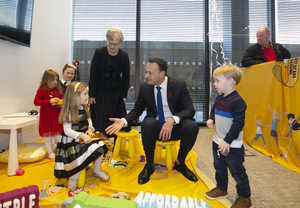
From top: Minister for Children and Youth Affairs Katherine Zappone and  Taoiseach Leo Varadkar launching the National Childcare Scheme in the Department of Children and Youth Affairs last December; Michael Taft.

Tomorrow (Wednesday, February 5) there will be an unprecedented protest by childcare professionals in Dublin, organised by the Early Years Alliance.

With crèches closing down, workers from around the country will descend on the capital to protest not only their working conditions but the very system of childcare that exists today – a system that penalises workers, parents, providers and children.

Childcare in Ireland is a fragmented, exploited sector made up almost entirely of women. When other European countries were developing childcare and early years’ provision as a public service in order to promote women’s participation in the labour force, childcare was an afterthought among Irish policy-makers.

Employees were subjected to low pay and poor working conditions – precarious contracts, lack of in-work benefits, etc. They still are.

Over the last decade greater official attention has been paid to childcare and the Early Years Sector. Free early years education was established; programmes to professionalise the sector were rolled out; means-testing provided greater access for low-income households while subsidies to providers were increased.

However, these measures did not address the fundamental flaws in the childcare model. This has resulted in the highest childcare fees in the EU and some of the worst-paid employees in the economy.

Simply put, the current model of childcare is broken.

Broken and unsustainable: staff turnover rates in full-time childcare are over 40 percent. In a SIPTU/Big Start survey of early years’ professionals, two-thirds of employees stated they would not be working in the sector in five years’ time if things don’t change, while over 40 percent are actively seeking other work.

The providers’ organisation – Early Childhood Ireland – reports that over a third of providers are unable to recruit employees, with half unable to retain staff. If these trends persist, there will be severe labour shortages leading to fewer providers.

These problems are due to treating childcare as a ‘market’.

This model means that providers must raise at least as much revenue as they spend (like any other business). This places an impossible burden on providers. If they want to improve wages and working conditions (and, so, attract and retain staff), they will have to raise fees, making childcare even more unaffordable.

If, however, they want to reduce fees they will have to reduce expenditure and, since labour makes up over 70 percent of providers’ expenditure, this means squeezing labour. This would only exacerbate low pay and poor working conditions.

It is against this backdrop that the protest is taking place – a protest being driven by the childcare professionals themselves.

They have joined the SIPTU trade union in their thousands; they have collectively begun to put forward their own analysis. The key to unlocking the potential of the sector, to transforming it into a modern public service, is the workers themselves.

When the protest was first announced, some elements in the media and officialdom attempted to turn the story into how protesting employees were burdening parents by closing down childcare provision for a day.

However, even the most cursory review of what was happing on the ground showed substantial support for the one-day action from across the community.

The workers have made alliances with many providers – both in the community and private sectors.

And the parents themselves know there is a major problem; they are aware of workers’ poor working conditions, and are asking themselves why fees are so high. The interests of the childcare professionals, the providers and the parents coincide.

The workers, therefore, are protesting not only their own conditions; they are also mounting a fundamental challenge to the childcare system itself on behalf of all stakeholders.

Political parties have picked up on this and, for the most part, have made significant resource commitments to the sector. That is good. But the modernisation of the sector rests on three principles:

1) The state – through whatever mechanism – will have to subsidise the overwhelming proportion of the operating costs of providers.

2) This will have to be accompanied by a fees cap – once the subsidies, investment and provider sustainability are put in place

3) Wages will have to rise significantly, accompanied by an improvement in working conditions (e.g. permanent contracts, in-work benefits, etc.). Currently, over 60 percent of childcare professionals are paid below the Living Wage

Starting from where we are now, it is a matter of supporting private and not-for-profit providers as deliverers of this public service. Even in countries where there is a large public sector component to childcare provision, the state still supports private and not-for-profit providers.

That childcare is now becoming a major issue in this election is due to one development – the entry of childcare professionals themselves into the public debate.

Quite simply, workers have found their voice and now, speaking out on behalf of a new model of childcare, they are helping us to find our own voice. We can use that voice, in our hundreds of thousands, when we go to vote next Saturday.

Michael Taft is a researcher for SIPTU and author of the political economy blog, Notes on the Front. His column appears here every Tuesday.

Rollingnews

Protest Details: Wednesday, February 5, Parnell Square, Dublin at 11.30am.

From top: Merrion Street, Dublin 2: Michael Taft

Is there any justification, any rationalisation in maintaining that election 2020 is a two-way race between Fianna Fail and Fine Gael?

In the Irish Times/MRBI poll – the first poll whose fieldwork came after the election was called – the Progressive bloc garners 38 percent of the vote, with Fianna Fail trailing at 25 percent and Fine Gael falling further behind at 23 percent.

The two conservative blocs total less than half the vote.

Earlier this month I suggested this contest could be seen as a three-way contest. The first two polls (the Sunday Times B&A poll having come out on Sunday) seem to confirm that.

But we shouldn’t be too surprised. The growth in support for progressive parties has been growing since the early 1980s. During much of this time, this growth was taking place below the radar as we were still captured by the idea that Irish elections are a contest between Fianna Fail and Fine Gael.

Now, however, that growth gas burst into and throughout the radar. Indeed, support for Progressive parties is now beginning to challenge the combined strength of the two conservative blocs.

Of course, there are the usual caveats: this is just one poll; it is ‘early days’, etc. Parties can grow or fall back over the course of the campaign.

A real problem is that, not being cohesive, there may be a problem in maximising seats between progressive parties (though, as pointed out previously, voters are increasingly transferring within the progressive bloc). These and other questions will fuel speculation in the days ahead.

However, this speculation should be rooted in the fact that the first two polls show that Progressives are contenders, not also rans, not just mere fillers for a conservative-led coalition.

The challenge is to build on these results. In an earlier post I suggested a modest strategy for progressives – to boost the votes of all progressive parties (the party of your choice) and to urge progressives to transfer within the bloc to maximise seats.

Most of all, progressive parties – activists, spokespersons – should now start acting and talking like poll leaders.

We need to convince more people that progressive policies will make a real and positive impact on their day-to-day lives.

To do that requires people having confidence in the candidates and parties they vote for. We should start acting like the leaders that the polls show that we are.

Now is the time for trade unionists to make these arguments, either individually or collectively.

Now is the time for civil society activists who might not be associated with any particularly party to urge support and transfers for progressives.

And it is time that party activists to make their voices heard within their own party. Support for progressives has never been higher in an election poll. Let’s not throw away the opportunities this presents.

It might be a stretch to say that the old order is collapsing while the new order is trying to emerge. History rarely vindicates poetic aspiration.

But we can confidently say that there is a lot of people trying to tell us something, trying to tell us that they are not satisfied with either conservative bloc, trying to say they are willing to support a progressive party and, potentially, a progressive alternative.

The question is – are we listening?

Michael Taft is a researcher for SIPTU and author of the political economy blog, Notes on the Front. His column appears here every Tuesday.

Rollingnews

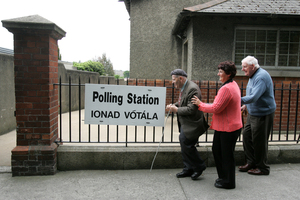
From top: voting in Drumcondra, Dublin during the 2007 Generel Election; Michael Taft

This post follows on from last week’s post which suggested we don’t have to see Irish politics as defined by a two-way contest between Fianna Fail and Fine Gael.

There is a potential for a three-way contest that includes the combined progressive parties.

Now that the election has effectively been called we can reasonably assume there will be no pre-election alliance among the progressive parties. However, this should not be fatal to the progressive project.

Let’s look at Portugal.

In 2015, after four years of austerity policies implemented by the centre-right PSD government, the Portuguese went to the polls. The result was a minority Socialist government supported by the Left Bloc and Communist Party.

In the run-up to and during the campaign such a formation was not considered nor did it appear on the agenda of any of the progressive parties – in large part because Portugal never had such a government.

The race was seen as between the PSD and the Socialists. When the result was in, both parties fell well short of a majority. However, even on election night the Socialist leader Antonio Costa seemed to reject a progressive coalition.

Nonetheless, a progressive government eventually emerged after protracted negotiations, a failed attempt by the PSD to form a government, and a hostile President.

Though progressive politics in Portugal and Ireland are not comparable (Portugal has a strong Left tradition with a European left/right divide), there are some potentially interesting parallels:

* Such a governmental arrangement was not contemplated during the campaign; not by the public nor any of the political parties.

* It only became a prospect after the election, especially with the strong performance of the Left Bloc which did not come at the expense of the either the Socialists or Communists.

* The parties – especially the Socialists and Communists – overcame their historical conflicts to cooperate in the new arrangement.

* It was a unique arrangement, never having been tried before, except briefly in the aftermath of the 1974 revolution.

The individual progressive parties worked separately prior to the election and, without planning, ended up together. Could that happen here?

Grassroots Action

The reality is that a progressive consensus can only be forged in a post-election scenario – and even here this will depend on political will and the relative and combined strengths of the parties. Therefore, what we do and say during the election should help lay the ground for what could happen afterwards.

We shouldn’t expect the parties themselves to take the lead. They will, as organisations, be understandably concerned with their own agendas, manifestos and constituency campaigns.

But this doesn’t mean the grassroots can’t act – party members and activists, trade union and civil society activists. Two small things that can be done:

Propagate a progressive analysis: quite simply, put forward the idea of a three-way contest wherever they can – in the media, social media, in meetings and engagements of every kind.

This would help put greater public (including media) focus on the individual progressive parties without precipitating any decision a party might make after the election.

Keep the votes in the progressive house: to help drive up the number of seats and create progressive cohesion – call for transfers to other progressive parties. As shown in the last blog post, without any guidance, voters for progressive parties are increasingly transferring within the progressive bloc.

One doesn’t have to name names; a simple call to ‘vote for the progressive party of your choice and transfer to other progressive parties’ would help.

We don’t have to rely on, or wait for, party leaderships and executives to act. Any supporter of progressive politics can take these steps in whatever small (or big) way they can.

A Modest Strategy

This still leaves open the question of what happens after the election. However, as the 2015 Portuguese election showed, a positive result is not predicated on pre-election agreements.

We can make this work to our advantage. If progressive parties won’t rule out a post-election accommodation with either of the conservative parties (and most won’t) then consistency would at least mean they don’t rule out acting cohesively, as a bloc. This can help insinuate the logic of a three-bloc contest into the debate.

Maximising gains across the progressive spectrum is more likely to increase options. A poor result would make it easier for the conservative parties to co-opt one or two progressive parties.

A strong result, however, would require the conservative parties to deal with almost the entire range of progressive parties. This sets up the potential for those parties to construct a common purpose based on their own policy similarities.

And a very strong performance could even open the possibility of a progressive-led government. Or force the two larger parties closer together, opening up the possibility of a progressive realignment in the medium term.

Irish politics teaches us to be wary about predicting post-election scenarios.

* In 1989 Fine Gael and the Progressive Democrats entered into a pre-election alliance, but following the election the PDs entered into a coalition with Fianna Fail. This was notable for being the first time Fianna Fail entered a coalition, in a deal between two long-time enemies: Charlie Haughey and Des O’Malley.

* In 1992 Albert Reynolds and Dick Spring tore strips off one another prior to the election but entered into a historic coalition afterwards – the first time Fianna Fail and Labour coalesced.

* At the same time John Bruton declared he would never enter into coalition with Democratic Left, accusing them of still having links with paramilitaries. Two years later they were coalition partners.

* In 2016, Fianna Fail formally supported a minority Fine Gael government, a first for these parties.

Things can change dramatically and unexpectedly following an inconclusive election. And this includes a cohesive progressive intervention.

This is a modest strategy. This is not about generals moving pieces on an electoral chessboard that doesn’t reflect political conditions

. The point in any progressive struggle is to root strategy in reality, to identify what is possible, to make a credible assessment of the actors’ capacity in any particular conjuncture.

The priority is to rule-in the possibility of a third bloc in the public debate. This requires maximising cooperation, respecting the legitimacy of other parties’ positions or strategies (even if we don’t agree with them) and ending sectarianism.

In some corners of the progressive landscape, sectarian attacks are still made. This undermines progressive cooperation and reinforces the rule of the conservative parties. Fortunately, the propagators of such attacks are becoming less influential.

The post-election scenario could be a lengthy affair. In 2016 it took over two months to reach a post-election conclusion. Election 2020 could see an even longer period, depending on the result and the number of parties involved in negotiations. Therefore, there will be considerable time to make arguments and interventions.

Some will be concerned that such an open-ended strategy would allow some parties to take the gains and subsequently reject any post-election cooperation, choosing to go it alone.

That is, of course, a risk. Is it worth taking? Is it worth participating in a broad, if messy, church where there is always the danger people will do things that we oppose?

If we don’t think the risk is worth taking, we can always retreat into our small contented chapels. But we know where that leads.

So let’s go out and support our respective parties and candidates, talk up a three-way contest, ask supporters to keep their transfers within the progressive house, refrain from sectarianism and do everything possible to push up the progressive vote so we can maximise opportunities following the election.

And on the day after the results, let’s start the debate about how progressives, if they act together, can achieve a lot more than if they act separately.

Michael Taft is a researcher for SIPTU and author of the political economy blog, Notes on the Front. His column appears here every Tuesday.

Rollingnews

From top: Leader of Fianna Fáil Micheál Martin, President of Sinn Féin Mary Lou McDonald, Taoiseach Leo Varadkar, Leas-Cheann Comhairle Pat The Cope Gallagher and Social Democrats co-leader Roisin Shorthall at the switching on of the Christmas tree lights outside Leinster House last month; Michael Taft

While elections can throw up surprises there is one thing we can be fairly certain of: either Fine Gael or Fianna Fail will lead the next government.

Will they combine, repeating the confidence and supply experience (with roles potentially reversed) or enter into an ideologically-compatible grand coalition? Or will they win the support of other, smaller parties and rule separate from each other?

Whatever the final outcome, we know the answer because the only question is – will Fianna Fáil or Fine Gael lead the next government. It’s a two-way race. In this construction, progressive parties are confined to a supporting role.

However, one can construct the electoral landscape in a different way, at least at a categorical level. There are four broad progressive currents:

Nationalist Left: Sinn Féin

Social Democratic: Labour and Social Democrats

Radical: People before Profit, Solidarity, Workers Party, Rise

Greens

In addition, there are independents loosely associated within Independents4Change (I4C) as well as other unaffiliated independents.

Together, these four currents constitute a ‘progressive bloc’ – parties that have more in common with each other than they do with either the conservative parties; on a policy level, at least. If this is the case, then we can see Irish politics as – or evolving into – a three-way contest.

Let’s take the European and local elections as an example. The results were not considered good for progressives. Sinn Féin and the radical parties suffered considerable losses, Labour treaded low-tide water while the Social Democrats failed to make significant inroads.

Only the Greens managed to make significant gains. Yet, despite this, progressives as a bloc competed with the two larger political blocs.

As a bloc, the votes for progressive parties were approximately equivalent to what Fine Gael or Fianna Fáil received. It should be noted that the above does not include ‘independents’; in particular, the I4C candidates. Therefore, support for progressive candidates in the European election is understated.

An Emerging Progressive Bloc

It would be convenient if the public debate understood that the next election was a three-way competition between these competing blocs. Unfortunately, this is a categorical construction, not a political one.

The different elements that make up the progressive bloc are not cohesive. They do not have a common purpose or recognise a common destiny with each other. Progressives are not conscious of constituting a bloc.

The progressive bloc may exist only as a potential but this potential has some concrete validity.

First, there is considerable agreement on policies and principles between the different parties that make up the progressive spectrum – housing, labour rights, public services, low-pay and poverty.

They are closer to each other than they are to either conservative party. This cohesiveness is underlined by voting patterns in the current Dail where progressives tend to support each other.

Secondly
, supporters of progressive parties self-identify as politically ‘left’. In the 2016 RTE exit poll, voters were asked to self-identify as either ‘Left’ or ‘Right’ on a scale from 0 (the most left-wing) to 10 (the most right-wing). Anything below 5.0 can be considered progressive, or left-of-centre.

AAA/PbP voters identified themselves as the most ‘left-wing’, followed by Sinn Fein. The Greens, Labour and the Social Democrats were grouped closely together as left-of-centre.

Third, transfer patterns in the recent European election show supporters of progressive parties transferring in far greater numbers to other progressive parties than to conservative parties.

Over a third of voters for progressive parties transferred to candidates from other progressive parties. This compares to eight and six percent for Fine Gael and Fianna Fail respectively. Among voters, anyway, a progressive consciousness is starting to emerge. In this tabulation, the two I4C candidates were included as they feature prominently in their respective constituencies.

Fourth, there is a long-term decline in support for the Fianna Fáil and Fine Gael blocs and an increase in support for the combined progressive parties.

In the 1980s Ireland was described as having a two-and-a-half party system: Fianna Fáil, Fine Gael and Labour with the latter (even in combination with the Workers’ Party) trailing the larger parties by a substantial margin. 35 years later, support for progressive parties has nearly trebled, with all three blocs now receiving nearly equal support.

Policy compatibility, voter identification, transfer patterns and historical trends: the tragedy for progressives is that they collectively have not connected these dots (even though voters may have started to), and are not yet capable of constituting an alternative to the conservative blocs.

* * *

Some may dispute the categorisation of progressive parties. How can some of the parties who have been in coalition with conservative parties, or who are open to coalition with them, be considered ‘progressive’?

There are legitimate concerns that parties will tack one way prior to an election and tack a completely different way when the results are in. However, this is not something confined to progressive parties (Fianna Fail didn’t campaign in the last election on the basis of supporting a Fine Gael minority government).

What is important is not to let the past dictate or circumscribe our ability to create new and better alliances, or pursue strategies that can achieve concrete gains for progressive parties and their supporters.

Some have suggested that the fundamental starting point of a progressive alliance is the rejection of any post-election accommodation with either of the conservative parties. However, the logical conclusion of this position is to radically shrink the progressive bloc to almost nothing; in effect, to eliminate the it altogether.

Progressive parties in other countries have refused to allow past actions to limit future relationships. If Podemos had rejected any contact with the PSOE (who implemented painful austerity measures), then Spain would not be on the verge of a progressive government.

If the Left Bloc and Communists / Greens had, similarly, rejected the Socialists (who also implemented austerity), then Portugal would not have benefited from one of the most progressive governments in Europe.

With voters already moving over the long term to a more progressive position, reinforcing that in transfer patterns, it is imperative that progressive parties vindicate the emerging preferences of their support base. In the next post I will propose a way of doing that as we enter into election 2020.

Michael Taft is a researcher for SIPTU and author of the political economy blog, Notes on the Front. His column appears here every Tuesday.

Rollingnews

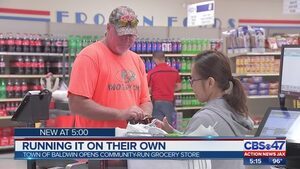
From top: news coverage of the community-run grocery store in Trump-voting Baldwin, Florida; Michael Taft

People had a problem in Baldwin, Florida – a small rural town of 1,600. Their only grocery store closed down.

The town tried in vain to find another tenant, but the premises were too small for a big chain like Walmart, and too big for smaller grocery firms.

And the town didn’t have the resources (and didn’t want to raise property taxes) to incentivise retailers with generous incentives.

People drove to nearby Macclenny or even further to battle Jacksonville’s sprawling suburbs. However, for many, especially the elderly, this wasn’t an ideal situation.

So they came up with a plan.

The City Council opened up a new grocery store. The eight employees are on the public payroll (i.e. public sector workers) and the store is publicly owned.

The Mayor, Sean Lynch, said:

“We’re not trying to make a profit. We’re trying to cover our expenses, and keep the store running. Any money that’s made after that will go into the town in some way.”

It’s not that people in Baldwin were striking out on a new ideological strategy of collectively-owned, government-run enterprises.

Indeed, in the last presidential election, 68 percent voted for one Donald J. Trump.

But as Mayor Lynch stated:

“We take the water out of the ground, and we pump it to your house and charge you. So what’s the difference with a grocery store?“

Not a whole lot really.

Baldwin is not unique. Some time ago I wrote about a similar experiment in another small town in the American south – Somerset, Kentucky – which set up a publicly-owned petrol station to fight the cartel of petrol stations that was strangling the town’s potential tourist industry and charging residents above-average petrol prices.

Throughout the US, local governments own and operate businesses in the market sector. In Minnesota, municipal owned liquor stores (off-licenses) are highly profitable. Similarly in Pennsylvania. Other cities and states benefit from this trade.

From grocery stores to cinemas to professional sports, retail merchandising, training and consulting, fertilizer and soil enhancer production, venture capital provision, methane recovery/energy production, equity investment in commercial development, bottling tap water for sale, and auto-towing: there is a rich tradition of local public enterprises.

The logic for these activities is many:

Fill gaps in the market where private capital is unable or reluctant to participate (such as Baldwin)

Provide competition against monopolies or cartels (such as Somerset)

Act as revenue-raising streams which obviates the need for taxation or provide additional spending

Promote employment and incomes, especially in disadvantaged areas

Serve as benchmarks on a range of economic and social issues

An example of this latter point: there has been considerable commentary on the poor wages and working conditions in the hotel sector. What if a local authority started up a hotel and collectively bargained efficiency wages – wages that exceeded the market rate?

If it could survive commercially, it would compete with other hotels for staff and skills, driving up wages in those traditional businesses. In this way, local public enterprises can act as market benchmarks, creating a virtuous cycle upwards.

Such enterprises could foster greater employee participation. Indeed, this would be necessary if it wanted a competitive edge given that greater employee participation raises productivity and firm performance. They could partner with local private and/or community capital and buy in managerial expertise.

All such enterprises would have to be commercially competitive. However, in that context, there is little cost implication. State and local enterprises that engage in market activities are considered ‘off-the-books’ for the purposes of fiscal rules. All they have to do is act like any other market operator.

But being a market operator doesn’t mean they act like private companies.

Local public enterprises would have a different mission – eschewing private profit (though profit is necessary to pay for the cost of capital and re-investment), encouraging worker and community participation, seeing the environment as a partner, rather than something to exploit. There are many ways to operating in the market – and one of those ways is the high road.

Local public enterprises are common throughout Europe. There are over 15,000 local public companies in the EU, employing over one million people, with a combined turnover of €130 billion. And every year more and more public companies are being set up.

Many of these companies would be in the infrastructural sectors (electricity, transport and water companies) but many would be in market sectors. Ireland is at a disadvantage here given the weakness of local government. Indeed, a progressive rural strategy would devolve greater power and resources to local government and regional agencies to start up enterprises in disadvantaged areas.

This could be applied to areas such as the Midlands in pursuit of a Just Transition in areas facing closures related to decarbonisation. An entrepreneurial, rather than a grant-aiding, approach would achieve better results.

Of course, none of this can be considered ‘socialist’ in the strict sense of the word (though Somerset officials were accused of Bolshevism for setting up a public petrol station). Local public enterprises easily fit into capitalist markets and must operate with market rules.

However, they have potential to be more democratically accountable and more flexible in addressing local economic and social concerns.

Most of all, it provides cities, towns and small communities an alternative strategy to relying on foreign capital, domestic private interests and government subsidies. It is about mobilising public capital and local skills into enterprising activities that produce goods and services that people want to buy.

In this respect, it is the most pragmatic thing to do.

Michael Taft is a researcher for SIPTU and author of the political economy blog, Notes on the Front. His column appears here every Tuesday.


From top: Morning commuters in Dublin city; Michael Taft

The EU Commission makes an interesting observation on in-work poverty:

‘ . . . in-work poverty is certainly becoming more prominent in policy discourse and action . . . However, the concept of “in-work poverty” is often not used as such, and discourse focuses on alleviating poverty in general.’

That’s not surprising. It is difficult for many policy-makers and commentators to discuss in-work poverty for the simple reason that employment is portrayed as way out of poverty.

When it is shown not to be for significant sections of the population, the pathway argument collapses.

Similarly, in Ireland: ‘in-work poverty’ is not generally discussed (though there has been considerable discussion of the Living Wage). Hopefully, the Nevin Economic Research Institute’s latest findings will contribute to changing that.

There are a number of ways to measure in-work poverty. The main statistical measurement is relative, or ‘at-risk’, poverty. This measures the percentage of workers whose income is 60 percent below the national median income.

The national median income is the midway point (50 percent above, 50 percent below) for all people in society, not just those in work. On this measurement Ireland looks good when compared with our EU peer group.

However, when comparing median incomes we’re not on the same pitch. This means that in Ireland, work income would have to be significantly lower than the other countries to be classified as ‘at-risk of poverty’, or 60 percent of median incomes.

That’s because Irish median income is significantly poorer.

That is why when using relative measures we have to look at not only the rate but the denominator (median income) as well. This is not to dismiss relative measures; only that we need to be aware of what we are measuring.

There are other measurements – soft measurements. These are not statistically based like ‘at-risk of in-work poverty’. These measurements, collected by the CSO and Eurostat, are based on asking people about their living standard.

This is what NERI presented last week, using two measurements: deprivation and inability to afford an unexpected expense.

(a) Deprivation

The CSO defines deprivation as experiencing two or more deprivation experiences ranging from an inability to keep house warm, affording two pair of strong shoes or a warm waterproof coat, to affording a substantial meal every two days, or a morning/evening out in the last fortnight.

NERI’s findings are concerning:

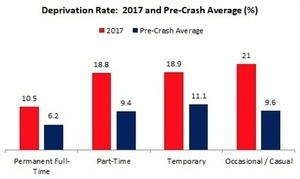
Over 10 percent of permanent full-time employees are officially classified as living in deprivation conditions while part-time, temporary (fixed-term) and occasional employees come in at approximately 20 percent. These are dismal numbers.

Deprivation rates are still well above pre-crash averages (the average for 2002 – 2008) despite significant increases in national income. They have, at least, declined from recession highs. For instance, deprivation among full-time employees was 16.7 percent in 2014.

However, between 2016 and 2017, the rate barely fell by 0.2 percentage points. In fact, in 2017 the deprivation rate for two-income households actually rose over the previous year – from 9.2 percent to 10.7 percent.

(b) Inability to Afford an Unexpected Expense

Nearly 30 percent of permanent full-time employees are unable to afford an unexpected expense. This rises to nearly 40 percent for part-time employee and even higher for temporary employees.

Occasional and casual workers fare the worst with over half unable to afford an unexpected expense. The numbers are significantly higher than pre-crash numbers.

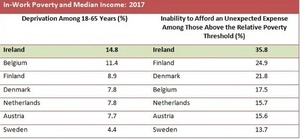
Unfortunately, we don’t have European comparisons for either deprivation or unexpected expenses for those in work. The following looks at deprivation rates among all 18-65 year olds.

This, at least, captures the working age population. The unexpected expenses data relates to those above the relative poverty threshold so, again, this is likely to be largely made up of people in work.

While indicative, the data shows Ireland topping the deprivation and unexpected expenses tables.

There is no magic bullet that can bring down rates of deprivation and precarious living conditions. One thinks of increasing the minimum wage – and there’s nothing wrong with that.

However, we shouldn’t assume that all the households affected are on the minimum wage.
Much depends on circumstances. If you’re paying €1,500 a month in rent, a few extra Euros in the pocket isn’t going to make much of a difference.

However, cutting rent by a couple of hundreds of Euros would be a significant gain in living standards.

Similarly, with families facing childcare costs, school costs, etc. – reducing these costs would go much further than a wage increase.

Getting a few extra hours of work would have significant benefit for those on low-hour precarious contracts.

Addressing these issues requires a number of inter-locking strategies:

Reduction in living costs

Collective bargaining

Reduction in precarious work contracts

Stronger statutory or sectoral wage floors

If we truly want employment to be a route to prosperity, if we want to reduce poverty in the economy, we need to take in-work poverty seriously. The first step is to start actually naming it so we can start debating it. These are the first steps to eventually abolishing it.

Michael Taft is a researcher for SIPTU and author of the political economy blog, Notes on the Front. His column appears here every Tuesday.

Rollingnews

From top: CSO infographic on wage trends; Michael Taft

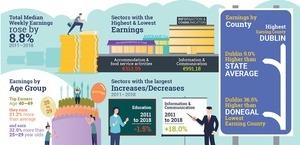
The CSO has published new data that will greatly assist in analysing wage trends. Here I just want to focus on a small selection of the data provided in Earnings Analysis Using Administrative Data Sources 2018 and Econometric Analysis of the Public / Private Sector Pay Differential 2018; in particular, high and low pay, and public / private sector pay.

A useful measurement that the CSO has produced is median pay. This measures the mid-point in wages where 50 percent are above and 50 percent below.

This contrasts with average, or mean, pay which can be skewered by high earners. For instance, in 2018:

Average weekly pay was €740

Median weekly pay was €593

Even though average pay was €740,63 percent of employees earned less than this. 50 percent of employees actually earned less than €593. That is the distinction between average and median.

Where are the High and Low Earners?

Information & communication leads the table which is not surprising. The mid point in weekly earnings is nearly €1,000, followed by the Public Administration and Financial sectors.

At the bottom is Wholesale & retail, Arts and recreation and, the lowest sector, Hospitality (hotels and restaurants). It should be noted that reduced working hours contribute to low weekly earnings.

For instance: Information & communication average weekly earnings are 3.6 times that of Hospitality However, Information & communication average hourly earnings are 2.5 times that of Hospitality

The difference is working hours. Information & communication average working hours are 36 hours per week compared to a Hospitality average of 27 hours.

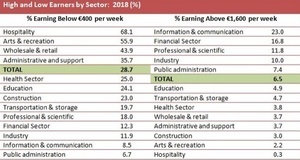
We can identify high and low earners by sector. The following shows the percentage of workers earning less than €400 and more than €1,600 per week.

29 percent of all employees earn below €400 per week. However, over two-thirds of Hospitality workers earn below this amount while workers in the arts, distributive and administration sectors also have a disproportionate share of low earners.

At the other end we find the Information, Financial and Professional sectors had the highest percentage of employees earning more than €1,600.

There is one interesting sector – Public Administration. This is made up of civil servants, Gardai, prison officers, employees in non-commercial semi-states and agencies – approximately 100,000 employees. This sector is 100 percent public sector, unlike the Health and Education sectors where there is a considerable proportion of private sector workers.

While Public Administration had the second highest median weekly earnings, it had the lowest level of low-income earners. But it didn’t have a big proportion of high earners either.

This suggests a more ‘egalitarian’ pay structure; that is, the gap between the highest and lowest earners was smaller than other sectors. To test this suggestion, let’s turn to the CSO’s second release on the public / private pay differential.

Public and Private Sector Pay

Headline data shows public sector weekly earnings significantly exceeding private sector earnings.

But there are serious flaws in this headline comparison. First, there are many jobs in the private sector that don’t exist in the public sector – hospitality, retail, etc. Second, weekly earnings don’t take account of hours worked. Third, the comparisons are not like-for-like.

Thankfully, the CSO has performed an analysis which attempts to compare similar jobs in the public and private sector. This means factoring in a range of variables: gender, age, full-time/part-time status, supervisor status, temporary/permanent status, hours worked (including shift work and overtime), length of service with current employer, union membership and enterprise size.

When factoring in these variables, they compare permanent, full-time jobs for people aged between 25 and 59. This is what they found (a negative figure indicates that public sector pay is below their private sector counterpart).

The CSO uses two measurements – including and excluding enterprise size (as there is debate over how relevant that is). Overall, on a like-for-like basis, public sector pay is between 3 and 4 percent below the private sector.

Public sector men earn between 10 and 11 percent less than their private sector counterparts

Public sector women earn between 3 and 5 percent more

The result for women is understandable given that the gender pay gap is much less in the public sector. Eurostat shows that, in the Irish private sector, the gender pay gap was 19.7 percent; in the public sector the pay gap was less than half that at 9.6 percent.

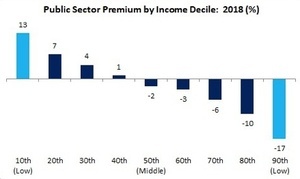
In testing the proposition that the pay structure in the public sector is more equal than in the private sector, the CSO shows the following:

Here we find that the public sector has a premium for low and average income earners. In the lowest 10 percent, public sector wages are 13 percent higher than their private sector counterparts.

At the higher income levels, public sector employees earn 17 percent below their private sector counterparts. In short, the gap between the highest and lowest-paid is much narrower in the public sector.

* * * *

What can we draw from this selection of CSO data?

First, the level of working hours is an important contributor to low weekly earnings. 75,000 work part-time because they can’t find a full-time job. However, 200,000 work part-time because they have family and caring responsibilities.

Clearly, precarious contracts are an issue. But lack of social supports (in particular, childcare and eldercare) may limit people’s ability to take up more work.

Second, the public sector succeeds in reducing both inequality and the gender pay gap because their wage structure is ‘managed’ through collective bargaining. Collective bargaining is a key tool in reducing inequalities.

Greater employee-based management (through the right to collective bargaining) of wages throughout the economy could have a beneficial effect.

Reducing precariousness, increasing social supports, and wage management – if we are serious about a more equal society that can boost living standards, we will need to create policies to achieve these ends.

Michael Taft is a researcher for SIPTU and author of the political economy blog, Notes on the Front. His column appears here every Tuesday.

Rollingnews

From top: Taoiseach Leo Varadkar (centre) flanked by Minister for Finance Paschal Donohoe (left) and Minister for Health Simon Harris; Michael Taft

In the debate over healthcare we get a lot of commentary on how the health budget is out of control with continual overruns, combined with waiting lists and A&E overcrowding.

In this mix we sometimes get statistical comparisons which purport to show that we already spend more than almost any other European country on health.

It’s a statistical and comparative minefield trying to get a sense if we are spending too much or not enough, never mind if we are getting value for money.

One blog is not going to answer these questions definitively. But let’s see if we can ground the debate in some hard numbers by comparing our health spending with countries in our EU peer group, using relevant indicators.

In 2017, Ireland total health expenditure was 2.8 percent above the average of our peer group, ranking 4th in the table. This would seem to suggest that we spend enough money on health care.

However, this represents all spending in the economy – government, voluntary health insurance and household out-of-pocket spending. A big contributor to Ireland’s average health care expenditure is the amount people pay on voluntary health insurance:

In Ireland, voluntary health insurance payments amounted to €634 per capita

The average in our EU peer group is €216 per capita

So the headline numbers can undermine clarity in the debate over government spending on healthcare.

Let’s focus on Government and compulsory healthcare schemes.

When we focus on Government and compulsory health expenditure (e.g. state-mandated occupational or private insurance) we find Ireland falling below average.

When comparing Euro spending per capita, Ireland would have to increase health spending by 9.5 percent.

However, when we factor in prices, Irish spending falls even further, requiring an increase of 29 percent to reach our EU peer average.

However, we have to be cautious regarding PPS (i.e. purchasing power standards). The above uses Eurostat PPS. OECD has a different PPS measurement though both work off the same data.

Using Eurostat’s PPS, Ireland would have to increase Government healthcare spending by 29 percent to reach our EU Peer average

Using OECD’s PPS, the necessary increase would be 20 percent

While the OECD shows a smaller gap between Ireland and its EU peer average this seems seems to have widened in 2018 to 23 percent, though these are only provisional figures.

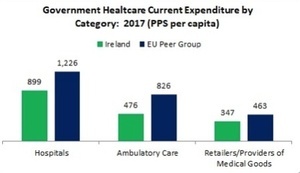
We can also compare some key healthcare categories using Eurostat’s PPS.

In hospital expenditure, Ireland lags far behind its EU peers. Irish spending on ambulatory care (which includes GPs and medical specialists for outpatients) is even further behind while spending on medical goods (pharmaceuticals and other goods) is closer to the EU peer average.

There are three important issues following on from all this.

First, the Eurostat data only takes us up to 2017. Between 2017 and 2020, real healthcare spending per capita rose by approximately 10 percent. This is likely to be higher than our EU peer group so the gap should have closed somewhat.

Second, demographics are a significant driver in healthcare spending. The older the population the more spending there will be. Ireland has a lower older demographic and, therefore, need to spend less on health. So, while Ireland is a health under-spender, is this merely a function of demographics. Could it be that Ireland, once age-related spending is factored in, is actually an average health spender or even higher?

It is difficult to test this given the paucity of data. The OECD does provide data from the Netherlands regarding spending on different age groups.

If we use this data and apply it to German and Irish age structures we might be able to get an insight as to whether Ireland spends too much or not enough – at least in comparison with Germany. I emphasise this is a stylised estimation and should be treated cautiously.

The gap in actual spending between German and Ireland is 16.8 percent. Demographic-based spending is 18.4 percent. This suggests that, after factoring in age, Ireland spends 1.4 percentage points more than Germany. However, when price levels (PPS) are factored in, Irish spending drops back down again as we saw above.

This is just an exercise and more data would be needed to confirm this. A similar exercise done with Dutch levels of spending shows the same outcome – near parity when age is factored in but a large gap re-emerging when prices are factored in.

Third, even though Ireland appears to be an under-spender, this shouldn’t lead us to think that merely increasing expenditure will solve all the problems in healthcare.

Whether it’s waiting times or A&E overcrowding, more resources would be welcome but we can’t be sure whether some of these issues are structural.

And then there is the upfront cost of Slaintecare – with additional costs arising from free provision of healthcare and the ending of private use of public assets.

However, what the above shows is that, when comparing like-with-like, Ireland does not appear to spend too much on healthcare and may well be a significant under-spender when factoring in both age and prices.

If this turns out to be the case then basing policy on the assumption that we spend too much will undermine sustainable and positive reform.

Michael Taft is a researcher for SIPTU and author of the political economy blog, Notes on the Front. His column appears here every Tuesday.

Rollingnews

From top: The Central Bank, Dublin Quays; Michael Taft

In last week’s article I argued that, while increasing taxation on the rich was desirable, it would not be enough to raise tax revenue to the level of our EU peer group.

But if we want to be an average tax and spend economy (by European terms) what does this mean?

Income tax increases?

Big VAT hikes?

How is the Irish tax structure different than our peer group?

Let’s attempt to identify the key driver in Ireland’s ‘low-tax’ status.

Personal Income Tax

There is one issue we can dispense with quickly: income tax.

For those countries with a comparable tax/social insurance structure (Finland, Belgium, Netherlands and Austria), Irish income tax revenue is in the middle, slightly above the average of the four countries.

We exclude Denmark and Sweden. The former doesn’t have a social insurance system; therefore, income taxes are higher. In Sweden, employees’ don’t pay social insurance (though, unlike Denmark, employers do). Therefore, higher income taxes make up for the lack of employees’ social insurance.

In short, income taxes, which include USC, are not the cause of Ireland’s low-tax status.

Other Main Tax Categories

The other two main tax categories are consumption and household capital taxes. They are approximately average. It should be noted, however, that increasing capital taxes by 0.7 percentage points to reach the EU peer group average would raise €1.2 billion. Even fractional differences can be significant.

Last week we saw that corporate tax revenue was above the peer group average. Here we find that in the other main tax categories Ireland is average. Income, consumption, capital and corporate taxes: they make up over 85 percent in tax revenue.

So if we are average or even slightly above average in these categories, where do we fall down?

Social Insurance

Social insurance (PRSI): Ireland is at the bottom of the league – not only in comparison with our peer group but with all EU countries. Only Malta and Denmark (which doesn’t have a social insurance system) are lower than us.

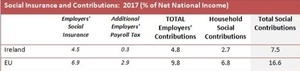
Total social contributions are less than half our peer group. Headline social contributions would have to rise by some €15 billion though when demographic spending is factored in, the gap shrinks somewhat. This is the driving reason behind Ireland lagging behind other countries.

With some exceptions, social contributions are paid into a social insurance or similar fund. They do not get paid into the Exchequer. These funds are not for financing education or police or public sector pay.

They specifically finance in-work benefits, including pensions. In some countries healthcare is wholly or partially funded out of social insurance funds. There are two parts to social contributions.

1) Employers’ social contributions are considered part of employees’ compensation. For example, if an employer pays a worker €20 per hour, they pay €2.15, or 10.75 percent, to the Social Insurance Fund (SIF).

The total compensation to the employee is €22.15. If the worker experiences an insurable contingency – temporary unemployment, sickness, pregnancy, occupational injury, etc. – they can access benefits from the SIF. That is why this part of social insurance is sometimes referred to as the Social Wage.

2) Household social contributions are made up of employee and self-employed social contributions. They act like insurance payments as they insure against particular contingencies and are paid directly out a workers’/self-employed wage.

Increasing social contributions would be a huge challenge and constitute systemic reform. It would have to be phased in over the long-tem (e.g. 10 years) and would impact on all businesses and income groups.

There are two aspects to this.

First, according to conventional analysis, an increase in employers’ social insurance would be shared out between both the employer and employee. Half would be absorbed by the employer and half absorbed by the employee.

Take the example of a one percentage point increase: employees would pay 0.5 percent, meaning that instead of getting a two percent wage increase, they would get 1.5 percent increase.

They would, however, gain through increases in benefits. This is how workers in many firms negotiate through collective bargaining: they reduce their pay demands in order to win a better pension plan or increased sick-pay. Thus, increasing the social wage is, or should be, part of a collective bargaining process.

Second, regarding increased contributions directly from workers and the self-employed, there is one advantage to social insurance.

Unlike general taxation which finances public services, uninsured social protection payments and investment (for many this is like money going into a black hole), I know where my social insurance contributions go.

They go to finance specific benefits related to work and my needs. In that respect, social insurance is more transparent.

Why are contributions so much higher in other countries?

Because their in-work benefits are much more generous. Take maternity benefit: in Ireland it is a flat-rate payment of €245 per week.

An average full-time employee will only receive a payment equivalent to 25 percent of their wage. In other EU countries, maternity benefit is paid out at 100 percent of the workers’ wage, which means households do not lose income during a high-cost period.

Temporary unemployment benefits, illness benefit, occupational injury benefit, old age pensions – all these are low flat-rated payments in Ireland. In other countries they are pay-related and, therefore, much higher.

And in some countries free healthcare is fully or partially paid through social contributions. That is what we might get if we paid European level of social insurance.

* * * *

As stated in the previous post, we should still seek to increase revenue through taxes on wealth and capital, and high incomes.

But if we want to make a European-style breakthrough, increase benefits for workers and the self-employed, and drive living standards, it won’t be done through taxation. It will be done through social insurance.

Progressives should make every effort to direct the debate towards social insurance and the benefits it can provide society.

A good start would be a catchy slogan that upends the usual tax-and-spend image progressives have. How about: ‘a low-tax, high-insured economy’.

Michael Taft is a researcher for SIPTU and author of the political economy blog, Notes on the Front. His column appears here every Tuesday.

Rollingnews

From top: The cost of retrofitting our building stock to low carbon status is estimated at €35 billion; Michael Taft

Going by Budget 2020, you wouldn’t think there was a climate emergency.

There was bits-and-pieces funding for greenways and urban cycling, electric vehicle infrastructure and purchase, installation of solar panels, emerging ocean technologies and uptake of alternative fuels such as biomass; a 14 percent increase for the Department of Transport, Tourism and Sport, and a Just Transition Fund for the Midlands along with a Just Transition ‘Commissioner’.

All in all, little enough funding and even less urgency.

The Government’s big ambitions for retrofitting the building stock in their climate change strategy don’t seem to have been matched by the budget. Yes, there will be an increase to the Warmer Homes Schemes – to €53 million – but that is a means-tested scheme for those on low incomes.

The climate change strategy envisages 500,000 building retrofits to reach a B2 BER, along with the installation of 400,000 heat pumps.

According to Social Justice Ireland, the Sustainable Energy Authority estimates the cost of moving our building stock to low carbon status at €35 billion. IBEC has a price tag of €25 billion. Whatever the sums, it will be significant.

We will also need, as IBEC puts it, a systematic upskilling programme to develop nationwide expertise and know-how in new low-carbon technologies, energy efficient design, building services and retrofitting. We can’t assume that, if the Government provides the investment, the retrofits will follow.

Most of all, we need affordability. Under the Deep Retrofit Scheme – which was launched, closed down and then slightly re-opened – applicants have to pay 50 percent or more of the total costs.

This is beyond most households’ ability (especially given that 42 percent can’t afford an unexpected financial expense). In effect, such grants constitute regressive subsidies to higher income households.

This is one of many acid tests of Just Transition. If people are locked out of the retrofitting programme or can only participate at considerable cost, then not only will it fail to achieve its climate objective; it will violate social equity.

There is a commitment to develop a retrofitting plan to ensure that the grant schemes, new finance models and the delivery system are effectively integrated. This plan is to be published by the autumn of next year.

A number of proposals have been put forward: to allow repayments through energy bills or through increased property taxes. Here is one more suggestion.
Accessible and Affordable

The first principle is that retrofitting – to the maximum possible depth (deep over shallow retrofitting) – should be free upfront. Retrofitting brings wider social benefits; in particular, the reduction in carbon consumption.

It also brings economic benefits such as the reduction of fossil-fuel reliance and imports. The benefits are spread well beyond the fiscal and environmental benefit to the household.

The financing model could be a variant on Fine Gael’s proposed National Recovery Wholesale Bank:

‘Fine Gael proposes that a “National Recovery Wholesale Bank (NRWB)” will be created. The NRWB will provide funds to the utilities to allow them to start retrofitting the 1.2 million houses with poor energy ratings.

The NRWB will provide the up-front funds to the power
utility companies, who will then subcontract the work to construction companies.
They will, in turn, install insulation and other energy efficient fixtures in applicant houses.

The money invested in the retrofit programme will be recouped through “Pay as You Save” schemes, which will allow consumers to pay back the costs of the retrofit over a number of years out of the fuel savings generated.’

While the operation through utility companies may not be optimal, the principle of free up-front retrofitting is recognised.

The second principle is that repayments should be affordable. Ideally, they could be linked to ability to pay. This may or may not be achieved through repayments based on energy bill reductions.

It could be achieved through a small levy on income, to be collected by the Revenue Commissioners or Department of Social Protection on an agency basis.

The repayment period shouldn’t be an issue. The Bank would have a lien on the property and the balance could be cleared on the sale or transfer of the house.

The state could still step in with grants, but now they would be open to everyone. Further, any house that is sold or transferred would be required to have a deep retrofit executed before the sale/ transfer is legally completed. In addition, this Bank could similarly fund retrofitting of rental accommodation and commercial / industrial premises.

These principles – accessibility and affordability – can be extended to other climate repair initiatives. There could be a programme of providing similar loans based on ability to pay to purchasers of electric vehicles.

The loan could be based on the cost difference between purchasing a regular car (petrol or diesel) and an electric vehicle, and rolled out in rural areas where car-reliance is highest.

Such initiatives could also play a role in ensuring best labour and consumer practices. Only construction companies that apply the highest level of labour protection would be allowed to participate in the scheme, while there would be a bank-guarantee for the work done with bonds posted by installers.

If Just Transition is to have any substance we will need to ensure that everyone is enabled to participate in climate repair initiatives. This is only one example. The principles of accessibility and affordability can be extended throughout the range of activities required by decarbonisation.

But this will require new programmes, financial innovation and a little bit of imagination. Unfortunately, all these were absent in Budget 2020.

Michael Taft is a researcher for SIPTU and author of the political economy blog, Notes on the Front. His column appears here every Tuesday.

Rollingnews