



This afternoon.
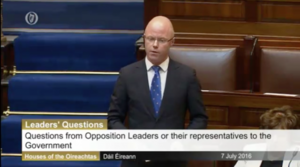
During Leaders’ Questions, Social Democrats TD Stephen Donnelly raised the case of a family – Sarah, Dominic and their two children – who are being evicted from their home in Kilkenny.
The eviction comes after the Government sold the family’s mortgage to US investment firm, Mars Capital.
Stephen Donnelly: “Sarah and Dominic live in Kilkenny with their two kids and they bought their home in 2007. The shop in which Sarah worked in Kilkenny closed and the couple were unable to service their mortgage fully, although they are getting back on their feet. Two years ago, the Minister’s Government sold Sarah and Dominic’s mortgage to a US investment firm, which is now evicting Sarah, Dominic and their two children. Last week, the journalist Niall Brady reported that the Government sold Sarah’s mortgage and that of thousands of others to the US investment firm at a 58% discount. That would have brought Sarah’s €350,000 mortgage to approximately €140,000, which is approximately the value of the property and a mortgage that Sarah and Dominic can afford. The firm is Oaktree Capital and Sarah and Dominic know them as Mars Capital, which is the company that Oaktree set up to buy thousands of mortgages in Ireland.”
“At the time of the sale, the Government refused to allow Sarah and Dominic, or any of the Irish mortgage holders, to bid on their own mortgages. Instead, it sold them to Mars Capital with a discount of 58%. Mars Capital structured the deal in such a way that the real discount it got was closer to 70%, which would have brought Sarah’s mortgage down from €350,000 to approximately €100,000. She cannot service the €350,000 so she is being evicted, which is bad news for her, Dominic and the kids but very good news for Oaktree Capital. Its accounts indicate that for its €80 million investment, it will get a return of €400 million.”
“It gets worse. An examination of Mars Capital’s accounts is a masterclass in tax avoidance. The accounts indicate that the interest income minus the interest costs for the year come to €4,559,904. Astoundingly, the figure for administrative expenses against that is €4,558,904, leaving exactly €1,000 in taxable profit. The company has three shares issued to three different charitable trusts. The finances are also structured to ensure all interest payments and mortgage payments from Sarah and Dominic and everybody else, as well as all capital gains, can be offset against costs, ensuring there are no taxes owed.”
“Why did the Government sell an asset that required just €80 million to buy and that one of the leading hedge funds in the world believes is worth approximately €400 million? What does the Minister and his Government say to Sarah, Dominic, their children and the many others being evicted by these foreign firms or struggling to pay their taxes? Does the Minister accept the State will receive almost no benefit in taxes, either on profits or capital gains from these companies? Will the Government launch an investigation into the tax affairs of all these funds that purchase these mortgages in Ireland to ensure not just tax compliance – as tax avoidance is legal – but that the real profits and capital gains that these funds make will be declared properly in Ireland and taxed accordingly?”
Later
Richard Bruton: “…The Government is acutely conscious of the needs of vulnerable people who are in this situation and we are seeking to develop more effective services, both legal and otherwise. As Deputies know, under the insolvency courts, financial institutions can no longer block an agreement that has been developed by a practitioner in this sphere. The courts can be used to overturn resistance by a lender to giving approval to a reasonable deal.”
Donnelly: “With respect, my question was not about the crash mats the Government is putting in place for people it has pushed off the wall. My question is about tax. Tax avoidance is not an issue for the Revenue Commissioners because it is legal.”
“It would appear that this Government is guilty of facilitating wholesale tax avoidance by international investment firms making windfall profits in Ireland off the backs of ordinary, decent people trying to pay their mortgages, like Sarah and Dominic. We do not know where Mars Capital is sending this money. They are called “notes”. We do not know where they are going, but what we do know is that Oaktree Capital, if one looks at the SEC filings, holds multiple investment firms in the Cayman Islands.
An Ceann Comhairle Seán Ó Fearghaíl: “The Deputy is just out of time.”
Donnelly: “Ceann Comhairle. Let me ask the following questions. Was the Department of Finance, directly or indirectly, shown the tax avoidance structures that these firms, like Mars Capital, were going to use? Why was it not made part of any sale that all profits and capital gains accruing to these firms would be…”
Ó Fearghaíl: “The Deputy is now out of time. The clock applies to him…”
Donnelly: “…would be..”
Ó Fearghaíl: “…in the same way as it applies to everybody else.”
Donnelly: “Thank you.”
Ó Fearghaíl: “The time has elapsed, so will the Deputy resume his seat?”
Donnelly: “Thank you, Ceann Comhairle. Can I ask the Minister…”
Ó Fearghaíl: “No. I am not speaking for the sake of speaking. It is my job to enforce the Standing Orders. The time has elapsed. Will the Deputy resume his seat?”
Donnelly: “To reiterate the question, will the Minister consider an investigation and report back to the House on the extent of the tax avoidance we are seeing here?”
Bruton: “The Finance Acts provide for anti-avoidance measures and the Revenue Commissioners execute those. They have the powers to deal with them effectively. Those powers have been enhanced every year, in every Finance Bill over the years. If additional reform to the Finance Acts is necessary, it is open to the Deputy to bring forward such amendments, but in respect of the existing Revenue arrangements, they will enforce those.”
“If the Deputy has details of some new avoidance mechanisms that ought to be scrutinised by the Revenue Commissioners they will more than pleased to consider them and bring forward to the House measures to protect against them in time for the next Finance Bill. I do not have access to the information the Deputy has about the specific avoidance structures he describes but the Revenue Commissioners are there to enforce the rules. There are general anti-avoidance provisions in the Finance Acts and they are overseen and executed by Revenue.”
Transcript via Oireachtas.ie
Related: IBRC sold mortgages to Mars at 58% off (Niall Brady, The Sunday Times)