Tag Archives: tax

Private rooms and houses/apartments listed on Airbnb’s Dublin lettings on August 19, 2018; Airbnb logo

Yesterday.

In the Sunday Business Post.

Ian Guider reported:

An Irish-registered unit of Airbnb made a profit of €80 million last year, the first time the financial arrangements of the accommodation bookings giant in Europe have been revealed.

The profit generated by Airbnb International Unlimited Company compared with a loss of nearly €72 million in the previous year.

The recently-filed accounts show for the first time the profitability of Airbnb in Ireland, and are a result of a change in Irish company law that now requires businesses with unlimited liability status to file details of their finances.

The company, which has a registered address at a Dublin law firm, is responsible for Airbnb’s operations outside the United States and China.

The filings show the company paid $42 million in tax out of its profits during the year, but does not disclose the countries in which the tax was paid.

Meanwhile…

In the same newspaper yesterday, Aaron Rogan reported:

Dubliners who live in luxury are being asked to nominate their homes for a “super-exclusive” new Airbnb-style platform.

Will McGlade, the 28-year-old son of Paul McGlade, the founder of Champion Sports and the beauty clinic chain Therapie Group, has launched HipHipStay, which he said aims to manage the top 1 per cent of short-term lettings in the capital.

To be considered, the properties must be located in lively areas of the city centre, and their decor must have a certain “cool kind of swagger”, McGlade said.

Irish arm of Airbnb made €80m in 2019 (Ian Guider, Business Post)

Owners of high-end Dublin homes sought for ‘super-exclusive’ website (Aaron Rogan, Business Post)

Previously: Red Alert

Pic: Rob Cross

This afternoon.

Nick’s Coffee Shop, Ranelagh, Dublin 6

Web Summit founder Paddy Cosgrave talking to RTÉ’s Philip Boucher Hayes and addressing media about his role in a campaign that anonymously targeted European Facebook users in 10 countries with advertisements about Ireland’s corporate tax system saying it was his ‘patriotic duty’.

Web Summit founder Paddy Cosgrave has spent what he described “a very small amount” of about €20,000 on Facebook ads highlighting Ireland’s corporation tax regime.

He said he would not be taking any more measures to highlight the country’s tax regime, adding that he thinks “the game is up” and that Ireland should “start to close down all of these things.”

…In respect of his own company Amaranthine, a San Francisco-based venture capital fund, which is incorporated in Delaware, Mr Cosgrave said

“it is more tax efficient to incorporate out of Ireland, but that fund is operated out of the United States…it is the standard procedure for venture capital funds [to set up there].”

20k.

What we wouldn’t do.

Cosgrave spent €20,000 on ads highlighting corporation tax regime (Independent.ie)

Leah Farrell/RollingNews

Meanwhile…

Meanwhile..


IDA Ireland logo; Web Summit co-founder Paddy Cosgrave

Earlier this week.

Co-founder of the Web Summit Paddy Cosgrave tweeted about Ireland’s tax structures which, he said, allow companies to “avoid all taxes” and “enjoy no-touch regulation”.

He went on to link to a Wikipedia article about the same before warning his followers that the Irish Government, through the IDA, pays people to edit tax-related articles on Wikipedia.

He tweeted:

Further to this…

Anyone?

Paddy Cosgrave

Thanks Bebe


Figures compiled In today’s Irish Times by EY DKM Economic Advisory

Oh.

If you want to pay less tax on your income every month, get married or have a child. Don’t give up your job and live with someone without getting married.

While society has moved forward in so many ways over recent decades, our tax system still exerts a “fiscal preference” for families – particularly those where the parents are married.

FIGHT!

Single, married or cohabiting: Who pays the least tax? (Fiona Reddan, The Irish Times)

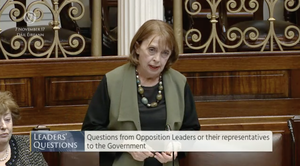
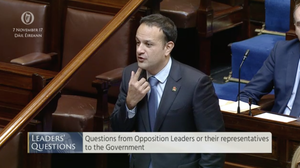
From top: Social Democrat TD Roisin Shortall and Taoiseach Leo Varadkar

This afternoon.

In the Dail.

During Leaders’ Questions.

Social Democrat TD Roisin Shortall raised the Paradise Papers with Taoiseach Leo Varadkar.

Ms Shortall said:

“Taoiseach, I want to raise the issue of the Paradise Papers and the information which is now emerging in respect of Apple’s tax arrangements.

“The facilitation of these arrangements, by successive Irish Governments and the considerable negative impact which this is having on Ireland’s reputation.

“The central theme, running through the Paradise Papers, is the relentless quest of the wealthy and the powerful , the great and the good, to find ways of avoiding paying tax.

“We saw this most startlingly in the operation of the Double Irish and its use by Apple and the subsequent ruling by the European Commission that this favourable treatment constituted state aid.

“In that regard it certainly seemed that the facilitation of tax avoidance was an intentional strategy, adopted by Government, and its agencies, in 1991, and updated in 2007.

“It was very hard to understand why the Government in Septmeber of last year, with the full benefit of hindsight, could stand over the manner in which the sweetheart deals were done and vouch for their full compliance with the law.

“The public, generally, cannot understand why the Government should now be spending considerable, additional millions in appealing that ruling.

“Then Minister Michael Noonan’s position was very hard to understand.

“In 2013, he signalled that he intended to close down the Double Irish on which the tax avoidance arrangement was based.

“The impact of this was considerable for Apple’s tax liability. We know that there was much engagement between Apple and the Department of Finance around this time.

We also know, thanks to the Paradise Papers, that Apple went on a jurisdiction shopping spree in search of another tax-dodging deal.

“We know that following the closing of the Double Irish that Apple restructured their companies, that they registered two of their Cork companies in Jersey and took up tax residency in Ireland where their remaining Cork company Apple Operations Europe.

“This combined with the changes made to the Capital Allowance regime in 2014 allowed Apple to sell their IP back to the Irish registered company and avail of the massive tax breaks which this measure facilitated.

“So, Taoiseach, the questions are: Was our Capital Allowance regime changed to allow Apple to keep it’s formerly stateless profits entirely untaxed?

In other words, was it done to compensate Apple for the loss of the Double Irish?

“Had Apple, or their representatives, requested a change to the Capital Allowances regime?

“And how much has Apple benefited by this change?

“And how much as the State lost?”

In response.

Mr Varadkar said:

“The answer to your question is: No, or at least, not to my knowledge. It maybe a question that you want to put to the Minster for Finance who would have more information thanI do on those particular matters.

“I don’t have a detailed knowledge of any companies’ tax affairs or any individual’s tax affairs for that matter?

“Tax avoidance is very much an international problem. And international problems require international solutions.

“And, as we found, when it comes to dealing with tax avoidance, by large companies, once one country acts, the company just moves to another jurisdiction.

That is why we need an international solution to this problem if we’re going to bring about a situation whereby companies pays their fair share of tax.

“In this regard, Ireland is an international leader. The OECD, the organisation for economic co-operation and development, based in Paris, is the international organisation that deals with taxation and deals with this area, making sure that companies aren’t able to exploit differences in tax law from one jurisdiction to the next.

The OECD has designated Ireland as one of only 22 countries in a world of nearly 200 where we’re entirely tax compliant, or compliant rather with tax transparency

“And we’ve also signed up to information sharing. So we’re going to share information from one country to the next as to how much tax each company pays in different jurisdictions. That’s going to be very useful.”

The Double Irish is gone. Stateless companies are gone as well. And also the current Finance Bill which is going through changed the way that we tax intellectual property.

“However we don’t accept at all that Ireland was involved in any special arrangement or state aid for Apple and that is why we are fighting that case.

“Because it’s simply not the case that Ireland was involved in State aid.”

Ausra shopping centre, Lithuania (top) part owned by Bono (above) in an elaborate tax avoidance scheme

Bono has expressed horror that a Lithuanian shopping centre business he invested in may have fallen foul of the country’s tax rules.

In a statement, the U2 frontman said he would be “extremely distressed if even as a passive minority investor … anything less than exemplary was done with my name anywhere near it”.

He reacted after Lithuania’s tax authorities said they were preparing to examine the details of the business over concerns that it avoided profit tax.

Bono ‘distressed’ by fears firm he invested in may have avoided profit tax (The Guardian)

Yesterday: Mall That You Can’t leave Behind

Pics: Getty

Meanwhile…

Oh.

90427616

Michelle Moran and Roughan MacNamara of Focus Ireland launching the charity’s campaign calling for legislation to fully protect Irish homes from vulture funds in August

First-Time Buyer writes:

Effective lobbying is done as quietly as possible behind the scenes, ensuring that you get the result you were looking for without anyone else being the wiser…

Back in September, Minister for Finance Michael Noonan proposed a number of changes to Section 110 of the Taxes Consolidation Act 1997 which contains the provisions for Ireland’s securitisation regime.

This was on the back of various concerns raised in the media that “investors” (foreign funds) were using the legislation to avoid paying tax on Irish property by using S110 Special Purpose Vehicles (“SPVs”) for their transactions.

The Irish securitisation regime is very generous in that it permits certain companies to deduct interest payments on profit participating debt (i.e. loans where the interest rate is directly linked to the underlying profits of the SPV rather than a set rate).

In effect, this means that these SPVS could wipe out all of their profits with interest deductions leaving only a very small taxable margin (usually €1,000). These SPVs were making tens of millions from Irish property, but effectively were only paying as little as €250 to Revenue.

The aim of the amendments to the regime were to ringfence profits arising from a property business and ensure that a deduction was not available for profit participating interest.

This would protect the Irish tax base by ensuring these SPVs would pay tax at 25% on all of its Irish property profits, rather than only on the token €1,000.

A property business was originally defined as one which is involved in the holding or managing of “any financial asset which derives its value, or the greater part of its value directly or indirectly, from land in the State”.

When interpreted this would include property loans and mortgages but also shares in a company which derive its value from Irish property (e.g a Limited company that holds property, also known as a “Propco”).

What nobody noticed though was that in the time between the publishing of the original legislation in September to the publication of the Finance Bill in October a very deliberate change was made to narrow the definition of ‘specified mortgage’.

Such a narrowing means this anti-avoidance legislation is now only confined to loans and specified agreements deriving their value from Irish land but not to shares in a Propco (more on why below).

At the same time of this deliberate change, the Government included another, seemingly unrelated, measure to restore 100% interest deductibility for landlords of residential properties. This generous tax break encourages Propcos to be highly geared, to ensure their rental profits are significantly reduced by interest deductions.

When you combine these two measures it means the ‘investors’ will warehouse their Irish properties into simple Propcos, rather than the complicated SPVs, QIAIFs or ICAVs that we’ve been reading about in the media.

The investors will own the Propcos, via their existing S110 SPVs. They will fully leverage the Propco with related party debt, maximising the new 100% interest deductibility rules. This will ensure that any income arising will be fully sheltered by tax deductions, thus a continuing ability to avoid tax on the Irish rental profit.

In addition, the investor can avoid capital gains on a disposal of the property by simply selling the shares in the Propco rather than selling the property asset directly.

The gain on the sale of the shares of the Propco will arise to the S110 SPV and because the definition of ‘specified mortgage’ does not include the sale of shares, the SPV can use profit participating interest to wipe out its gain on the sale.

You couldn’t make this up.

Related: Vulture funds hit by political cave-in on tax reprieve (The Irish Times, November 22, 2016)

Previously: Mars Capital, Matheson And The €250 Tax Bill

Sasko Lazarov/Rollingnews

Screen Shot 2016-09-06 at 11.23.29

A still from gas flaring at at Shell E&P Ireland’s Corrib gas plant in Co Mayo last New Year’s Eve

Yesterday.

At Dublin District Court.

Shell E&P Ireland Ltd pleaded guilty to breaching two counts of the Environmental Agency Protection Act during “flaring” tests last New Year’s Eve.

It was fined €1,000.

Further to this.

Shell to Sea writes:

Yesterday, at Dublin District Court, Shell were fined €1,000 after pleading guilty to causing light and noise pollution from gas flaring at Bellanaboy refinery last New Years Eve. The prosecution was brought by the Environmental Protection Agency (EPA) following complaints from people living around the Bellanaboy refinery.

The €1,000 fine is estimated to be 65 seconds worth of current Corrib sales revenue after Vermilion, who have an 18.5% stake in Corrib gas, recently stated that Bellanaboy had reached “full plant capacity.

It is estimated that Corrib Gas sales revenues have totalled over €240 million so far this year, while no tax has been paid.

It is widely accepted that no or minimal tax will be paid by the developers of the Corrib Gas Project to the Irish State.

Former Managing Director of the Corrib Gas project, Brian O’Cathain previously stated in 2010 “That Corrib will never pay tax“. While a Vermilion investor profile estimated it would be seven years before any tax is paid.

Shell to Sea spokesperson Maura Harrington stated “We’ve seen again lately how subservient the State has become to powerful corporations. Despite making almost ¼ billion euros so far this year from our natural resources, Shell will have a 0.000% tax rate for many years to come.”

Anyone?

Shell fined for ‘noise and light pollution’ Bellanaboy (Connaught Tribune)

Related: Corrib will pay little or no tax: who is to blame? (William Hederman, Irish Oil and Gas, March 8, 2013)

maryhonohan

Mary Honohan, President of the Irish Tax Institute

Oh.

Those guys.

Taxpayer writes:

The Irish Tax Institute (read US Multinational tax Lobby Group) has an Op-Ed in today’s Irish Times [‘Irish income tax system is skewed, uncompetitive and too complex’ by the institute’s President Mary Honohan] looking at the role of Ireland’s personal tax system and its impact on our “global competitiveness.”

It goes on to make an absurd suggestion that Irish employees have no incentive to look for salary hikes or promotions due to “such high levels of personal tax“.

It also puts forward the notion that “skills and talent are in scarce supply” but the last time I looked we had an unemployment rate of 9.7%.

What is really galling though is that we give generous tax breaks for highly-paid executives of US multinationals or “globally mobile talent” as the ITI calls them.

It finishes by asking the whether “it is really sustainable to continue to draw on a small group of taxpayers who already contribute such a sizeable chunk of the income tax yield? We must also ask if it would be better to have broader participation in our tax system?”.

But the real question they are asking is whether the regular Irish taxpayer and those who earn the least in society are willing to INCREASE the amount of tax they pay in order that those at the top (the “talent”) who earn the most can benefit?

Gulp.

Previously: The Myth Of Progressive Taxation (Fintan O’Toole, Irish Times, September 29, 2015)

Pic: Irish Tax Institute