Tag Archives: Tonight with Vincent Browne

star

On last night’s Tonight with Vincent Browne, Vincent was joined by journalists Yvonne Judge and Harry McGee to review the papers.

Bertie the parrot leads in today’s Star.

A Norwegian Blue, surely?

Watch in full here.

Previously: This Monkey’s Gone To Heaven

Rashers Tyranny

90320378Screen Shot 2014-04-30 at 01.28.33

sinead1 sinead2sinead3

vinb

[Sinead Ryan – Irish Independent and Sinead O’Carroll of thejournal.ie]

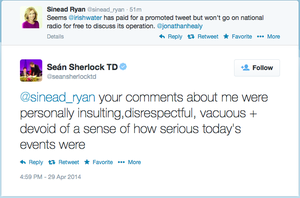
Minister of State Séan Sherlock in a late night tweet to journalist Sinead Ryan.

As seen on last night’s ‘Tonight with Vincent Browne’, Irish Independent journalist Sinead Ryan quoted from the Irish Examiner.

Seán Sherlock’s quotes came from his appearance on yesterday’s Six One News.

Anyone?

Sam Boal/Photocall Ireland

boarphoto

Today’s Irish Star and last night’s Tonight with Vincent Browne.

Joe writes:

The boar was no rapist; he was a sweet caring swine who clearly respected the conventions of romantic courtship. Another travesty of justice inter-species breeders everywhere, and spare a thought for the jilted boar.

eamoenda

The *new* clip.

From Tuesday’s Tonight With Vincent Browne.

Feel the power, the passion, the conviction in Enda’s and Eamon’s speeches from the Senior Citizen’s Protest in 2008.

But that was then sure.

BVcfiaYCEAAdCJY.jpg_large

hitlers go home tweeted:

Best thing happening on twitter tonight.


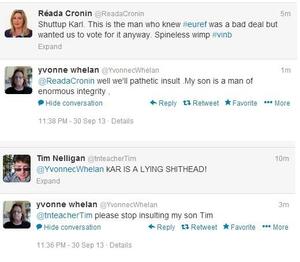
As UCD Professor of Economics Karl Whelan appeared on Tonight with Vincent Browne last night, his Ma was fighting his corner on twitter.

yates

“AIB Boss, David Duffy got a grilling today from TDs in the Oireachtas Committe on Finance. He will be followed tomorrow and later in the week by bosses from Bank of Ireland, Ulster Bank and Permanent TSB. Tonight, we’ll be asking if banks are doing enough to tackle Ireland’s mortage arrears problems. We’ll also look ahead to the new Personal Insolvency Arrangement due to begin next week. Will they work for debtors, or will the banks still hold the balance of power?

Before we start, I’d just like to say, given the particular topic we’re covering, I feel I should bring something to the attention of viewers. Many of you will be aware that I have had a personal history with AIB, arising out of my recent bankruptcy. I have declared strong views about my relatiionship with AIB which have featured in the media recently. I wish to make it absolutely clear that these views will in no way prohibit me from presenting tonight’s show in a fair, objective and impartial manner, as required by The Code of Broadcasting Authority of Ireland and TV3’s editorial policy. I want to assure viewers that my own views will not impede me from carrying out a fair and balanced debate on the issue.”

Ivan Yates, guest presenting on Tonight With Vincent Browne last night.

Awkward enough, in fairness.

Previously: “Arrogant Inhuman Bastards”

rabbitte

BUT….

Minister for Communications Pat Rabbitte appeared on Tonight with Vincent Browne, presented by Sam Smyth to discuss the implementation of the Broadcasting Charge.

Sam Smyth: “Minister, you’re calling it, a ‘Broadcasting charge’, a lot of people are calling it, ‘The New RTE Tax’. Tell me, there is a perception that this broadcasting charge is a big gift to RTÉ, because, whether you like it or not, they did deliver the Presidency, didn’t they? They changed the outcome of the Presidency, and a Labour Party person won it.”

Pat Rabbitte: [laughs] “I read that Sam, when you wrote it the first time, and I think it’s important that I have a good sense of humour, otherwise I’d be down to see some of your friends in the Four Courts. The proposition that you set out was that I’m delivering this charge to RTÉ, because they delivered the Presidency to President Higgins.”

Smyth: “They (RTÉ), said they did, now, they said they did change the outcome of the election.”

Rabbitte: “I’m afraid Sam, we had committed, as the chronological record shows, to introducing a public service broacasting charge long before there was even any candidate in the field for Presidency. And that’s a matter for chronological reecord. And I think The President would be very upset to hear that charge, not to mention the inference that can be drawn, which is that it’s a corrupt transaction.

Smyth: “(I’m) not saying it’s all to do with The President, I got to say, he was an innocent person in this. But it was RTE who did say that they did change the outcome of the presidential election.”

Rabbitte: “Well, I didn’t hear them say that..”

Smyth:“It was the (RTÉ) Head of Current Affairs!”

Rabbitte: “Yeah, fine, fine. But, what’s that got to do with my decision to introduce a house-hold based public service broadcasting charge?

Smyth: “Well, I think there would be those who would say that, and there’s a few of them around the table, (in the studio) who thinks that it is the biggest gift, probably in the history of RTÉ, and perhaps, an opportunity misssed to make it more equitable to other broadcasters.”

Rabbitte: “Well, I mean, let’s hear who’s around the table, other than yourself, who believes that. Because, the fact of the matter is that, it is the progress that has been made in technology, convergence of technologies and scale of evasion that are the two principal reasons for prompting us to keeping up with the rest of the countries in the OECD, that have had to do the same thing. I mean the fact of the matter is as you know, more and more people are accessing public service content on platforms, other than the traditional TV…”

Smyth: “Actually, was there not a poll today that said that that was a load of nonsense? And that, you know, 12-17 year olds, 85% of them watch TV on the TV at home.”

Rabbitte: “I mean sure, if you just look at my own work-place, if a question comes up, for example and we’re in discussion about something, somebody will key it into their Ipad and have the information within a few minutes. In terms of…, if I want to know what’s happening in the newsroom, I plug into RTE News Now.”

Smyth: “I’ve got the figures here, I mean, 85% of 12-17 year olds, 95% of over 55s, 90% of most people, watch TV in their own house on the television set.”

Rabbitte: “But Sam, I’m not saying that the televison is going out of existence, you know certainly the whole development of what is called Connected TV is going to accelerate, and accelerate in the years ahead. But, I’m not saying that the TV is immediately going to go out of existence, that’s not going to happen…”

Smyth: “But, it hasn’t moved on, hardly, when everybody says that it has…”

Rabbitte: “Oh, but it has moved, I mean, 85% is not 100%, and that’s the way it’s going. You know, we can put our finger in the dyke, like the little Dutch boy and pretend that technology is not advancing. Technology is advancing. Secondly, why do you think that countries across Europe are doing the same thing, if the phenomenon is not there? Do you think they’re doing it just for the fun of it? Secondly…”

Smyth:” Maybe like yourself, they thought it was going to happen, and it didn’t arrive?”

Rabbitte: “Maybe they were running Michael D. Higgins for the Presidency as well?”

Smyth: “I don’t know about that now, but, now that you say it, maybe we could look at that, as well!”

Watch here

Previously: The Remote Controller

Pic: TV3

bradford

Independent Senator Paul Bradford (above) joined Journalist Justine McCarthy and Eamon Delaney on last night’s Tonight with Vincent Browne, presented by Sam Smyth to discuss seanad reform. The show is not online yet so no screengrabs are available.

Sam Smyth: “Paul Bradford, six of you met today, two of you were missing, these of course, you have all lost the whip. Did you leave Fine Gael, or did Fine Gael leave you?”

Senator Paul Bradford: “Well, I think there has been a seperation between the group of eight and the official Fine Gael Party. We are all former members of the Parliamentary Party. But it’s not a question of what has happened up ’til now. I’s a question of what happens into the future. So, we met today and had a very informal meeting, a very informal chat about the forthcoming political season, about the upcoming Dail and Seanad sessions and, I think, most importantly about how we, as individual members of The Oireachtas can play a positive and constructive role and try to take on board the issues that the public would expect us to take on board, and try to bring about improvements in policy and politcs. I think that was what our role will be, it’s not a question of being for or against government. It’s a question, I think about trying to bring about better constructive politics. I think we can play such a role.

Smyth: “Although the first test, is, however, the referendum in October. Well, do you at least, and I suspect the majority of your colleagues are going to campaign for a ‘No’ vote on that against the Government?

Bradford:“No, we didn’t have any detailed discussion on that, or indeed any policies today. But, I think it’s fair to say that individually, over the course of the past few months, most I think, of this particular group of eight would have expressed a lot of concern about the ‘Scrap the Seanad’ campaign and I think that one of the issues that we will focus strongly on, is political reform, about making politics work, about engaging the public and having a real Oireachtas. And I, personally, and I’ve been on the record on this matter, over the years, I don’t see abolishing the Seanad as real politcal reform. I see it at a a little bit of a political stunt. I think we do need genuine Oireachtas reform.”

Smyth: “Just looking at that, whatever you guys have, we asked, both Fine Gael and and The Labour Party today, and they wouldn’t put up anybody to speak against you. Now, I don’t presume that’s because they agree with you?”

Bradford: “Now, I don’t believe they’re afraid of me either, but, you know, I’m speaking tonight as an individual member of the Seanad. I suppose I’m very fortunate person in politics, I’ve been in the Dail, I’ve been in the Seanad, so, I…”

Smyth: “And you married well?”

Bradford: “(laughs)… And so, did she! Having seen how the Dail works or sometimes doesn’t work, having seen how the Seanad works. I absolutely and genuinely believe that the Seanad has played and can continue to play a very constructive role in politics. Sometimes, perhaps, we don’t sell our story very well. Sometimes, the public because, not being involved directly in the electoral process, feel that we are distant. It’s ironic that some few weeks before Fine Gael decided to abolish the Seanad, we actually had put forward a very constructive proposal to enhance the Seanad, to allow the Irish people to vote in the Seannad elections, to give the Seanad additional powers. I would like us to go back to that.
“I think that the debate shouldn’t be about bigger politics, or smaller politics, it should be about better politics. It should be about new ideas, new people, and I think the Seanad has a significant role to play. Look, we all want to see the Seanad reformed.”

Smyth: “It’s fair to accept that a lot of people see sixty people there, they are very well paid, nobody is quite sure what they do, and I suppose they look at that and say, ‘why’. I think that’s the argument that you’re going to make, isn’t it, Eamon Delaney?”

Eamon Delaney:“Yeah, I think we need political reform in the way Paul has described. We need wholesale political reform to the system, most of all, in the Dail, and the committee system needs to be strengthened and the regulations…”

Smyth: “All of that, all of that, but first of all, the Seanad?”

Delaney: “The Seanad? Well, first of all, I think the public would be very satisfied to see the Seanad go, it’s a glorified…”

Smyth:“And you’re quite happy with accountabilty about..”

Delaney: “I am. I’ve read all these articles by Michael McDowell and all these others about all these great people who were there, going right back to Brian Boru..”

Smyth: “I’m asking about accountability, you frequently, and have just said there, the government is being held to account?”

Delaney: “I tweeted a very good piece by Aodhain O’Riardon, the Labour TD about this subject earlier on,it’s on [Twitter stream] #VinB, he makes a very good point, and one is that it is already an undemocratic forum, and I think you’ll agree that even the Seanad as it is needs to be reformed, in terms of panel system, the miniscule electorate…(turns to Senator Bradford) Why do you need an undemocratic smaller assembly to oversee and give oversight on the main parliament?”

Smyth: “Let’s make it clear though, that a lot of people, I would suspect, Justine McCarthy, are concerned about, is that this government is not being held into account, it’s supposed to be under the constitution, constitutionally to be held to account by parliament. That is not happening, you have a huge majority there. What do you feel about accountability?”

Justine McCarthy: “Well, I think the centre of accountability is shrinking all the time and you know, there is reason to believe that it is right down to four people at this stage, if you look at the Fiscal Council, or, the Economic Council. So, I’m one of the people who believe that we should keep the Seanad, but, I think we should get rid of the politicians. I think that politicians are the worst thing that has happened to the Seanad. It is an undemocratic institution. It’s an insult to democracy the way it is currently structured. It is elitist, the idea that the vast majority of people in the country have no say in who is elected to this institution is completely wrong in any country, but in a country that calls itself a republic, that is a joke!”

Smyth: “Well, I suppose, in the 1930s, the likes of WB Yeats and people like that, they thought it was a good idea to have it?”

Delaney: “Exactly, the 1930s, it was created as a comfort zone to reassure Protestants, with Independence, by De Valera that they wouldn’t be drowned out in the larger Dail Assembly.”

Smyth: “And you think that’s a bad idea?”

Delaney: “No, I think, in the 1930s, the 1960s – in the 1980s we hear about Mary Robinson and the work rate that she did. But, today, Mary Robinson would be elected to the Dail. We have much more wider, more varied system. But, the Dail needs to be reformed as well and Aodhain O’Riordon point makes that.”

Smyth: “So would you get rid of that too then?”

Delaney: “This is a permanent summer school of free car-parking based in Dublin.”

Pic: FineGael