
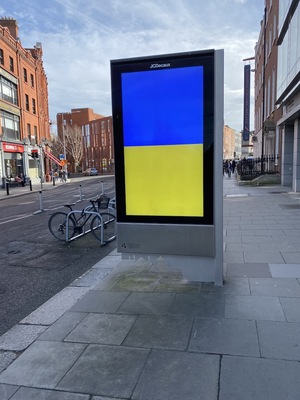
This morning.
Dublin 2.
Thanks Przemyslaw Zbieron



This morning.
Dublin 2.
Thanks Przemyslaw Zbieron
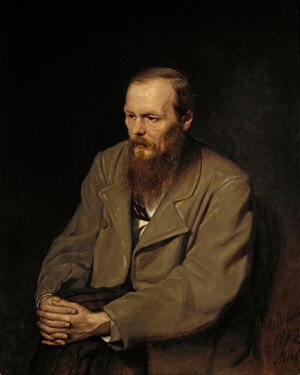
Fyodor Dostoevsky in happier times
This morning.
Milan, Italy.
The University of Milano-Bicocca has reversed a decision to postpone a course by writer Paolo Nori about the work of Russian author Fyodor Dostoevsky following a backlash.
Via Newsweek:
Last night, the university released a statement on its social media accounts confirming the course would go ahead.
“The University of Milano-Bicocca is a university open to dialogue and listening even in this very difficult period that sees us dismayed at the escalation of the conflict,” the statement said.
“The course of the writer Paolo Nori is part of the writing course aimed at students and citizens who aim to develop transversal skills through forms of writing. The university confirms that this course will take place in the established groups and will deal with the contents already agreed with the writer. In addition, the rector of the university will meet Paolo Nori next week for a moment of reflection,” it said.
College Backtracks on Banning Teaching Dostoevsky Because He’s Russian (Newsweek)
Image: Wikipedia

I wonder what Joe O’Shea thinks of the calls for Ireland to take in 20,000 mostly unvaccinated Ukrainians… https://t.co/emmzkwwDXZ
— Dr Jane Holland 🌸 MD PhD (@drjaneholland) March 3, 2022
Gulp.
Only 34.4% of Ukrainians are fully vaccinated, 1.7% received a third dose and 1% have one dose, according to Our World in Data.
Now you don’t know what to do.
Previously: Insight To Hatred
Meanwhile..
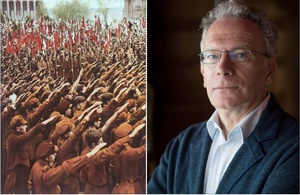
“Every week, it gets harder for a general public that overwhelmingly understands the need for vaccination to stay patient with those who don’t or won’t. People are dying, not just from Covid, but because the unvaccinated are taking up scarce capacity in our already overstretched hospitals.
But rage, however justified, is self-defeating. It merely drives misguided people towards those who want to turn a biological pandemic into a political plague. It adds to the chances that those who won’t get a shot in the arm end up raising that arm in stiff salute.”
Fintan O’Toole, December, 2021
Awkward, in fairness.
Previously: We Don’t Know Ourselves
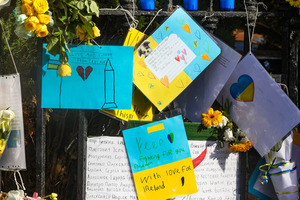
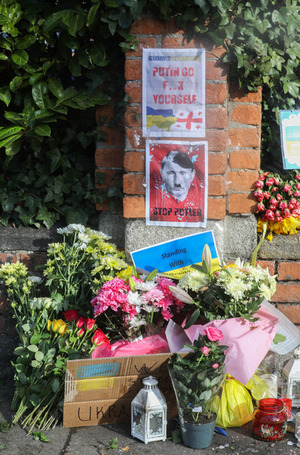
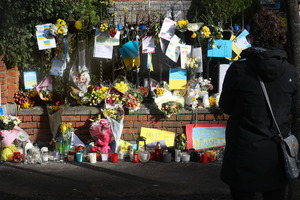
This morning.
Elgin Road, Ballsbridge.
Flowers, posters and messages of support left outside Ukraine’s embassy.
Earlier: Claims And Control
Meanwhile…
We highly appreciate a single, strong voice of Ireland 🇮🇪 when it comes to Russia’s invasion of Ukraine and its barbaric crimes which are being committed on our soil. Thank you @MaryLouMcDonald for standing with 🇺🇦 Ukraine at this tragic time. @OireachtasNews #StandWithUkraine pic.twitter.com/lZeOVVFLcw
— UKR Embassy in Ireland (@UKRinIRL) March 2, 2022
Meanwhile…
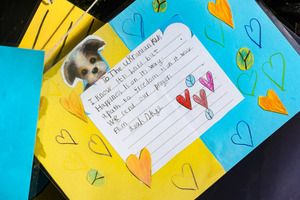
This morning.
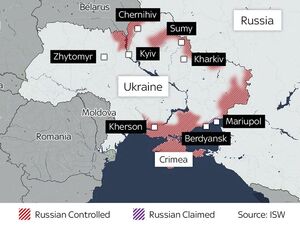
Russian troops were in the centre of the southern Ukrainian port city of Kherson after conflicting claims over whether Moscow had captured a major urban centre for the first time in its eight-day invasion.
Via Al Jazeera
The capture of Kherson, a strategic southern provincial capital where the Dnieper River flows into the Black Sea, is the first significant city to fall since Moscow launched its attack on February 24.
Ukraine’s second city Kharkiv continues to come under heavy Russian shelling, with police and university buildings among the latest struck.
The Organization for Security and Co-operation in Europe (OSCE) says a member of its observer mission died in the shelling.
Russia denies targeting civilians although there have been widespread reports of non-combatant casualties and the targeting of residential areas.
Russia on Wednesday reported its military casualties for the first time since the invasion began last week, saying nearly 500 of its troops had been killed and almost 1,600 wounded.
Shelling continues in Ukraine as Russian forces advance (Al Jazeera)
Meanwhile…
Losses of Russian Army in #UkraineRussiaWar on Feb. 3:
Planes – 30
Automobile techniques – 374
MLRS – 42
AFV – 900
Helicopters – 31
Artylerian systems – 90
Cisterns with fuel – 60
Cutters – 2
Tanks – 217
Antiair defense ways – 11
UAV – 3
Militaries – 9000 pic.twitter.com/rZyTSK3OjP— KyivPost (@KyivPost) March 3, 2022
Graph via Sky News
Meanwhile…
Yesterday.
Independent, crowd-funded reporter Patrick Lancaster reports from the Russian advance in the Volnovakha area of Ukraine.

Ukrainian migrants working in Ireland flew back home to fight against the Russians.
Here is a short message from them: pic.twitter.com/WEg1p8uCJ4
— Visegrád 24 (@visegrad24) March 2, 2022
This afternoon.
Take that, keyboard warriors.
Also: please don’t join the Azovs.
FIGHT!
Thanks Stephen Moran
Meanwhile…
…The Ukraine or simply Ukraine?
Anne Marie Devlin, of University College Cork, writes:
The word Ukraine may be understood in a particular way which can have a profound impact on how the country itself is viewed. For many Russian speakers, the word Ukraine is transparently broken down into two main parts or morphemes.
They are ‘u’ and ‘krai’. ‘U’ can roughly be translated as ‘at’ in English. ‘Krai’ means ‘edge’. As a result, the word ‘Ukraine’ may conjure up an image, not of an independent nation, but of a region at the edge of a sovereign country, which presumably is Russia.
This mental image of a region on the edge of a country was further solidified in Russian and Ukrainian by the preposition which traditionally accompanied the country’s name; and in English by the use of the definite article (The Ukraine).
The word Ukraine had been collocated with the preposition ‘na’ (on) instead of the more common ‘v’ (in) in both Russian and Ukrainian despite the fact that ‘na’ (on) is more commonly used for regions and ‘v’ for countries.
This may seem superficial. After all, it’s only a preposition, but feelings around it run extremely high. In 1993, the Ukrainian government formally requested that the Russian government change the preposition from ‘na’ to ‘v’ in official documentation with the aim of receiving ‘linguistic confirmation of its status as a sovereign state’. While the Russian state reacted nonchalantly, over time, the new linguistic form was adopted by many people.
However, in a 2016 study I conducted into the weaponization of the use of prepositions in Russian social media during the Crimean crisis, results strongly suggest that the use of ‘na’ vs ‘v’ was deliberately used by many people as a political football to demarcate political and ethnic faultlines.
In short people intentionally used ‘na’ to position themselves as pro-Kremlin, thus denying the sovereignty of Ukraine; and ‘v’ to position themselves as anti-Kremlin and to acknowledge Ukraine as an independent nation.
‘na’?
Or ‘V’?
You must decide.
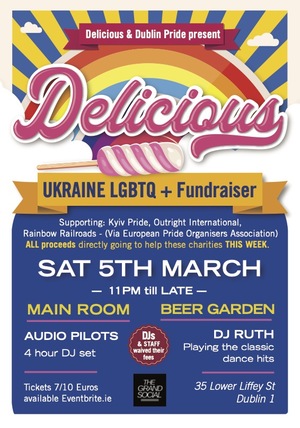 All hands on decks.
A Dublin Pride Ukraine fundraiser at Delicious in the Grand Social, a club night held on the first Saturday of the every month.
Tickets here


This morning.
Kildare Street, Dublin 2.
Students from the Royal Irish Academy of Music play music ‘in solidarity with Ukraine’ outside Leinster House.
Earlier: Info War


This morning.
Dublin 2.
Members of the Ukrainian community in Ireland protest at the Headquarters of Google and Facebook (Meta) calling on the tech giants to remove all Russian state-backed accounts. They delivered an open letter urging the leadership and employees to do “all in their power” to delete Kremlin-backed accounts.
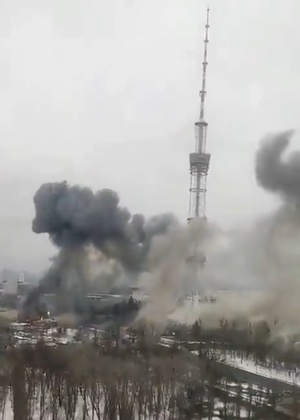
🇷🇺 Russia hit the TV station in Kiev 🇺🇦 pic.twitter.com/om5mArBpO7
— Intelsky (@Intel_sky) March 1, 2022
Zoomed in shot of tower getting struck pic.twitter.com/AeiHVtxFQ0
— Woofers (@NotWoofers) March 1, 2022
This afternoon.
Kiev, Ukraine.
Ukrainian state telly gets hit as the Russian military said it would strike ‘strategically important targets’ used by Ukraine’s military and intelligence, including ‘comms installations’.
Earlier: Let Us In
Meanwhile…
Here is the original news footage (see time 0:08)pic.twitter.com/sCRPWO5f7Z
— Dr. Eli David (@DrEliDavid) March 1, 2022
Ah now.