

Now join the team.
Must tolerate kids.
Jobs page in today’s Irish Sun.
Thanks Jenny McGovern



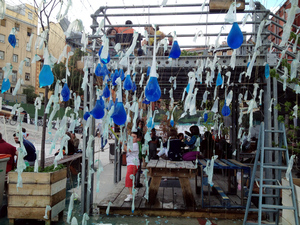
At a local public square and the site of a former neighborhood swimming pool at Campo de la Cebada in Madrid, anonymous art collective Luzinterruptus – with the assistance of bemused locals – filled 800 extra large condoms with blue-dyed water and tiny lights to simulate raindrops. Luzinterruptus sez:
For a day we worked on the installation, aided by both children and the not so young, who approached attracted by the tempting “balloons” and who ended up happily integrating themselves into a production line in which each was responsible for a part of the process.
The youngest of our helpers thought they were making water balloons that would then serve to throw at each other, the slightly older kids were wondering about the strange shape and were excited about touching them and playing with them trying to make sure they did not slip out of their hands, the adults were laughing mischievously and could not stop themselves from pinching the surface and touching them with pure delight.
After the first few minutes of jokes and laughter had passed, everyone ended up accepting that manipulating condoms was like any other activity of daily life, and that, ultimately, was what we wanted to achieve through all of this.
Needless to say, the local kids eventually turned the whole irresistible water-balloonacy of the thing into performance art.
Which is only as it should be.
 illuminations
 (Alan Shatter at a Citizenship Ceremony in the Convention centre, Dublin, last year)
In January 1999, the High Court ruled that Section five (1) (e) of the 1935 Aliens Act, under which the State deported 60 people in 1998, was unconstitutional.
In May of the same year, the Supreme Court upheld this rule.
And in early July, when Fianna Fáil and the PDs were in coalition, the Dáil passed an Immigration Bill before summer recess, with 74 Government and Opposition amendments taken in one vote, which passed 73-64.
The overriding purpose of the bill was to give the Government statutory powers to resume deporting asylum seekers.
However, much of the discussion in the Dáil in relation to the Bill centered on debating one of the amendments regarding whether asylum seekers should be allowed to work or not.
[Then Justice Minister} John O’Donoghue said this was an amendment that the Government was still considering).
In one of the exchanges, Labour’s Jan O’Sullivan called for asylum seekers, who had been in the country for three months, to be allowed to work.
The Irish Times reported at the time:
“Mr Ivor Callely (FF, Dublin North Central) opposed the amendment because “it would give an asylum seeker false hope if, after going through due process, his or her application was unsuccessful. It would create a lot of difficulties and would be unfair.”
He pointed out that 80 per cent of people with disabilities were unable to find employment. “I do not hear people shouting on their behalf or saying they should be given an opportunity to work.”
However
“Mr Alan Shatter (FG, Dublin South) said Mr Callely’s suggestion of false hope for asylum-seekers was “an extraordinarily asinine argument. Allowing them to work allows them the dignity of earning a living while awaiting a decision about their future, no more and no less than that.”
In late July, 1999, the FF/PD coalition decided to allow any asylum seeker who had entered Ireland and applied for asylum before July 26, 1999, to work – on the basis that the asylum seeker had been waiting for a decision on their application for refugee status for 12 months or more.
The Department of Justice estimated that this would allow between 2,000 and 3,000 asylum seekers work.
At the time, there reportedly were up to 6,000 asylum seekers awaiting a decision, while the average waiting time for a new application was 12 months.
The move followed public disagreement between Minister O’Donoghue, who was opposed to allowing asylum seekers work, and the then Tánaiste Mary Harney, who supported the campaign to allow people in that category to work.
As Mr O’Donoghue put it:
“Giving a right to work would simply create another ‘pull’ factor which would put further pressure on the asylum-processing system and continue to delay recognition for genuine refugees in need of protection.”
So, how did the work permit scheme go?
Not very well.
The right to work was on a restricted, non-transferable basis, meaning the asylum seeker was not allowed to work independently of a job specified by a prospective employer, essentially leaving the asylum seeker open to being exploited.
The employer also had to pay a monthly fee of £25 or a one-off annual fee of £125 to the Department of Enterprise, Trade and Employment.
Also, prospective employers had to prove that the vacancy could not have been filled by an Irish or other EU national – both deterring measures by all accounts.
A study by the Irish Refugee Council, in 2000, found that DoETE figures showed just 67 work permits were issued between July 27, 1999 and December 15, 1999.
The non-transferable work permit system ended in December 1999, to be replaced with a system whereby the Department of Justice would provide a letter confirming their right to work. The letter would be shown by the asylum seeker to the prospective employer.
The IRC found that, by the end of June 2000, 1,032 out of 3,241 asylum seekers entitled to work had either found a job or had stopped claiming social welfare – meaning two thirds of those eligible had still to find a job, a year after the scheme was devised.
Earlier this year, in March, as part of Ireland’s EU Presidency, Justice Minister Alan Shatter announced revised EU laws on the processing of asylum claims.
This is part of the Common European Asylum System which has been designed to maintain consistent and equitable treatment of asylum seekers across Europe.
But Ireland has opted out of this.
Why?
Explaining Ireland’s decision in the Dáil, Minister Shatter said:
“The principal reason for Ireland’s position is the provisions of Article 11 of the 2003 Directive which deals with access to the labour market for asylum seekers. Article 11 provides that if a decision at first instance has not been taken within one year of the presentation of an application for asylum, and this delay cannot be attributed to the applicant, Member States shall decide the conditions for granting access to the labour market for the applicant.”
“This is contrary to the existing statutory position in Ireland which provides that an asylum seeker shall not seek or enter employment. This prohibition in Irish law is maintained in the Immigration, Residence and Protection Bill, which I intend to republish.“
“Extending the right to work to asylum seekers would almost certainly have a profoundly negative impact on application numbers.”
And on it goes.
Shatter transcript via Kildarestreet.com
(Sasko Lazarov/Photocall Ireland)
 On Hendricks Street, Dublin 1
(Thanks Sophie Merry)

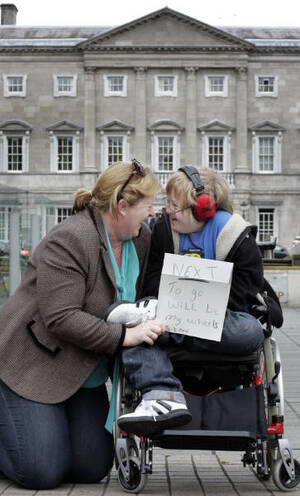
 Fran Kane and her son JJ outside the Dail today protesting the Government’s decision to proceed with an almost 20 per cent cut to the Respite Care Grant.
Nice Tayto tee.
 Fran, JJ and others from the Carers Association gather to lobby members entering Leinster House for the first sitting following Dail recess.
(Mark Stedman/Photocall Ireland)
 From top: Bolton Street, Christchurch, George’s St, Gardiner Street, Parnell Street and Aungier Street
Brendan O’Dowd writes:
More bikes vs cars arguing misses the fact that many cycle lanes are painted on top of car lanes
FIGHT!
 And it’s been great.
But It’s time he moved on.
Dave Darcy writes:
I realise you don’t normally do this but we found this little guy late on Sunday June 9th outside the NCR [North Circular Road] entrance to Phoenix Park [Dublin]. He really wants to go home.
Male, Terrier, Brown & Black with some grey, he’s very well behaved and really friendly. He’s staying very close to where we found him on Infirmary road. He has no tags or chips and all the relevant authorities are informed and the good folks at lostandfoundpets.ie are on the case too. If you can help please contact us through Broadsheet.

 An aerial photo by Yann Arthus Bertrand of an acacia tree in Tsavo East National Park in Kenya – a rare source of food and shade in the thorny savanna – frequented by all manner of wild animals, and to which all trails lead.
 (The Xbox One unveiled at E3 fair in
 Las Vegas Los Angeles and on sale in November)
John Gallen writes:
Not sure if you are aware but when the pretender to the console gaming throne, I mean the new Xbox One, comes out users will only be able to lend their games ONCE.
That’s it.
The stupid rules on lending / trading games for the Xboxone are here and include:
You can only give Xbox One games to people who have been on your friends list for at least 30 days.
Each game can only be given once.
Anyone can play your games on your console — regardless of whether you are logged in.
Microsoft allows you to gift games to friends but they can’t “borrow” them. Microsoft says of this, “loaning or renting games won’t be available at launch, but we are exploring the possibilities with our partners.”
Xbox One will also allow you to give up to 10 family members access to “log in and play from your shared games library on any Xbox One.”
Note: the above does not apply to 3rd party games, yet.
Anyway, Playstation have come up with an instruction video for lending their games :)
