

In a new installment of the PBS Studios series ‘It’s OK To Be Smart’, Joe Hanson explores why we rub faces, swap spit and gum each other like eels.
tldw: because it’s nice.



In a new installment of the PBS Studios series ‘It’s OK To Be Smart’, Joe Hanson explores why we rub faces, swap spit and gum each other like eels.
tldw: because it’s nice.

I’ll mention, in case you don’t know,
Your journeys today will be slow,
And unless you’re a child,
You’ll find yourself riled,
At the sight of our old friend, the snow.
John Moynes
Pic via Jack Shannon

Is that what you want? ‘Cos that’s what’ll happen…
Downtowntrain writes:
Alive! Catholic newsletter, February 2014. Balance in a world gone mad.

John Mooney, of the Sunday Times, and Mark Kelly, of the Irish Council for Civil Liberties, joined David McCullagh on RTÉ’s Prime Time last night to talk about Mr Mooney’s story concerning the bugging of the Garda Síochana Ombudsman Commission building.
Their appearance followed the release of a statement by GSOC which stated there was “no evidence of Garda misconduct” and which also confirmed the existence of “three technical and electronic anomalies”. It also followed the release of a statement by Garda Commissioner Martin Callinan in which he demanded to know why gardaí were “suspected of complicity” by GSOC.
Mr Mooney explained that, while the GSOC statement didn’t detail the ‘anomalies’, he claimed they were in fact: a phone in a conference room was being monitored, a Wi-Fi device was accessed but deleted all data accessed/potentially collected once it realised it was detected, and a shadow Wi-Fi was set up around the GSOC building which “piggybacked” on GSOC’s own Wi-Fi system which allowed for further monitoring.
Mr Mooney said some of the monitoring was traced back to a British IP address which, he said, was “clever” because it prohibited GSOC from pursuing an inquiry into the UK, as such a move would be beyond its remit.
Then Mark Kelly talked about a potential paper trail if the surveillance was legal before Mr Mooney said he knows certain events prompted the surveillance sweep.
Mark Kelly: “There has yet to be an unequivocal statement that there has been no surveillance of GSOC by An Garda because there is a legal power in the [Criminal Justice Surveillance] Act, from 2009 for Special Branch, a section of the Defence Forces, called G2, and also for Revenue Commissioners to lawfully engage in surveillance, but that leaves a paper trail. I think a starting point in answering the central question which is: who bugged GSOC? It’s not about who reported to the Minister [for Justice, Alan Shatter] and when. It’s not about what did GSOC know that they haven’t told us, it’s about who bugged GSOC? And a central part of getting to the truth about that, I think is what people want to hear is eliminating people who are innocent. So, if it is the case that the guards have had no involvement whatsoever, in terms of the existing legal framework, let that clearly be said.”
David McCullagh: “Ok, and for a legal surveillance operation, you need to go to a judge and you need to get approval and all that sort of thing so, as you say, there would be a paper trail, there would be records of all of that and it should be roughly straightforward then to issue a statement?”
Kelly: “It should and I’m quite surprised that hasn’t happened yet been done. Perhaps the minister will do it tomorrow. But then, there’s a second element to a possible investigation. If this surveillance is not being carried out lawfully, and we’ve no reason to think it has been carried out lawfully, or a reason is there for it to be carried out lawfully, has it been carried out unlawfully? But by agents of the state who have access to the appropriate technology…”
McCullagh: “So we’re talking about rogue elements, the possibility of rogue elements?”
Kelly: “The possibility of rogue elements.”
Later
Mooney: “I think it’s just very important as well to ask why did they [GSOC] do this? What made them feel that they were under surveillance and someone was monitoring them? Simon O’Brien, the GSOC chairman, made a reference to RTÉ tonight that this was a general search: I don’t believe that. In fact, I know that there was certain events [that] prompted this particular security sweep. And that is the omission in this [the GSOC] statement that really, urgently needs to be clarified.”
Watch in full here

Hollywood blacksmith Tony Swatton and his team recreate the Energy Sword from Halo, caring not a jot for the fact that the original is ,in fact, made of energy.
Previously: Forging Masamune
(Thanks Sam Nachbar)


More to follow
Thanks Dermot Ahern, Enda Cunningham, Garrett Rowe, Ronan Coveney, Amy Walsh, Enda McCann, Joanne Ahern and Joe Donnelly.
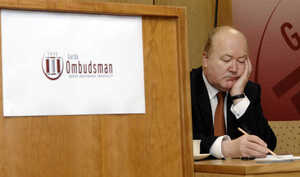
Conor Brady, former member of the Garda Síochána Ombudsman Commission (GSOC) and ex-editor of the Irish Times.
@ConorPMBrady finding proof of who bugged its office should be a greater priority.
— Mark Tighe (@mktighe) February 10, 2014
From the Garda Ombudsman’s office:
Security at and surveillance of Garda Síochána Ombudsman Commission In the course of our operations the Commission has always been conscious of the need for appropriate confidentiality and proper levels of security. The Commission has brought this to the attention of staff from time to time. On two occasions, since commencing operations, security experts have been consulted. A sweep of the building, and tests on the integrity of our telecommunications security, have been undertaken.
A security sweep of GSOC’s offices was conducted on the evenings of 23 to 27 September, 2013. This was conducted by a specialist UK security firm that had been recommended. The overall cost of the security checks undertaken was just under €18,000.
As well as the general check of our building, the Commission also sought expert advice on the sorts of capabilities that exist in relation to the interception of communications, including telephones.
The investigation was completed on 17 December, 2013. It confirmed the existence of three technical and electronic anomalies. These could not be conclusively explained and raised concerns among the investigation team in terms of the integrity of GSOC’s communications security. However GSOC is satisfied that its databases were not compromised. Since the investigation concluded, we have been working to review and enhance our security systems in the light of what the investigation revealed.
There was no evidence of Garda misconduct. The Commission decided to discontinue the investigation on the basis that no further action was necessary or reasonably practicable.
Given the outcome of the investigation, GSOC recognised the need to reinforce the security of our telecommunications systems in the light of the specialist’s advice. We took the difficult decision not to report this matter to other parties. We did not wish to point fingers unnecessarily and we did not believe that widespread reporting would be conducive to public confidence. We took the decision not to report in good faith. We regret that now and this was communicated to the Minister for Justice and Equality by Simon O’Brien, Chairman of the Commission, this afternoon.
Suzie Rafter,
Communications & Research Officer,
Garda Síochána Ombudsman Commission
Earlier: Agents Of This State or other Rogue Elements
UPDATE: A statement from Garda Commissioner Martin Callinan:
I have read very carefully the contents of the Garda Síochána Ombudsman Commission’s statement this evening and note in particular the assertion that there was no evidence of Garda misconduct.
It is a cause of grave concern that the Garda Síochána Ombudsman Commission’s statement contains a clear indication that An Garda Síochána was in some way suspected of complicity in this matter despite GSOC’s overall finding that the existence of technical and electronic anomalies could not be conclusively explained.
I am now seeking clarification from the Garda Síochána Ombudsman Commission in respect of the following issues resulting from its statement.
The nature and extent of the anomalies identified by the UK security consultancy?
Do these anomalies amount to a security breach and is a criminal offence suspected?
The basis for the suspicion of Garda misconduct?
Whether any matters identified now require investigation by An Garda Síochána?


Even uglier in daylight.
Signage at the Screen Cinema, Townsend Street, Dublin in 1987 (top) and this afternoon (above)
The neon lettering [emblazoned above the cinema since its opening in 1984] was removed without notice or permission by owners IMC. They claimed the sign was beyond repair.
Laura asks:
“Why? WHY?”
Writing On The Wall For Screen Cinema (Laurence Macklin, Irish Times, February 7)

