


One day, Fernando Livschitz woke up and saw the world this way.
The right way.



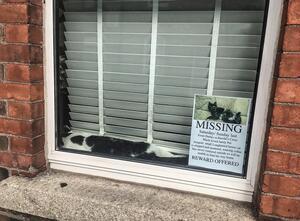

‘sup?
This morning.
Harold’s Cross, Dublin 6.
Inconsolable or napping?
We may never know.
Thanks 3stella

The frequency with which letters of the English alphabet appear at the start, middle and end of English words, graphed up real nice by David Taylor.
Now you know.

Ah here.
This afternoon.
Hawkins Street, Dublin 2
Ropb Loughlin writes:
Can’t get wheelchair, pram or ‘buggy’ by here…
Update:
Hi Rob.This van is not for LCCworks but we have contacted the company & asked them to move it asap & to refrain from parking there in future
— Luas Cross City (@LuasCrossCity) July 14, 2017
Hurrah!
Meanwhile…

This evening.
Lower Abbey Street, Dublin 1
Kevin O writes:
Taking up the path for 15 minutes unloading for Wynn’s Hotel, no space for pedestrians nevermind buggies or wheelchairs.

Splutter!
Northumberland Road, Dublin 4
Peter writes:
BOI branching into johnnys?
Anyone?
Update:
I believe this package contains sweets 🙈 Thanks ^Darren.
— Bank of Ireland (@talktoBOI) July 14, 2017
I think the correct term is flavoured
— peter (@PJDublin81) July 14, 2017
At least they can take a ribbing.
Ribbing.
Suit yourself.

Luke Ming Flanagan (left) and Gino Kenny flank Vera Twomey at Dublin Airport in April after she obtained medicinal cannabis for her daughter Ava in Barcelona. Vera, her husband Paul and Ava are now living in Holland.
Further to the halting yesterday of the Medicinal Cannabis Bill from proceeding in the Dáil with bill sponsor Gino Kenny TD calling the chamber “a kip”…
Luke Ming Flanagan MEP writes:
Vera Twomey and family have been forced to leave Ireland and Gino Kenny’s Medicinal Cannabis Bill has been thrown out of the Dáil.
There’s something amiss! The system is failing to even look after itself.
Political parties like Fine Gael, Fianna Fáil and Sinn Féin have a great reputation for surviving. Their first instinct has always been to ensure that they do not introduce something that will jeopardise their power base. But now they have taken their eye off the ball.
While the FG/FF/SF brigade are a conservative lot at the best of times, it seems that they are allowing the machinations of the Dublin bureaucracy to run the show now – much to their own detriment.
The support for medicinal cannabis is overwhelming. When Vera Twomey walked to the Minister’s office in Dublin, form Aghabullogue in Co Cork, she had tremendous support.
School children came out and marched with her. School brass bands marched with her. Parents shook her hand. Everyone could see that she was fighting for the good of her child Ava. An honest battle, a humane request.
But now Vera, her husband Paul and their 4 children have left Aghabullogue and are living in the Hague in the Netherlands.
I spoke with Vera yesterday. She was extremely sad. Not because she has had to move away from Ireland, from her mother and her family. Not because she has been forced to set herself and her family up in a new country and a new culture (they are managing very well thankfully). None of these reasons.
Vera, like most Irish people, had faith in the ‘system’. She always reckoned that eventually common sense would prevail and that the political parties who run our country would see the light. Unfortunately she has been betrayed by the same system.
What has brought sadness to Vera was the news that Deputy Gino Kenny’s Medicinal Cannabis Bill was brought to a halt in the Dáil. Despite all the evidence presented to the Health Committee on medicinal cannabis, in face of the fact that country after country are making provision for medicinal cannabis, our TDs and Senators have let Ava and thousands of other Irish citizens down.
Those who suffer chronic pain, glaucoma, MS, arthritis, epilepsy and other ailments have been let down.
What amazes me is that the political parties have nothing to lose. This is not a contentious issue. Children in national schools have asked me about medicinal cannabis. They can see that it’s a humanitarian issue. How then has this come to such a sorry state?
The Minister and the other public representatives have not done their job.
They have abdicated their duty to a faceless institution called the Health Products Regulatory Authority (HPRA). We need politicians to represent the people of Ireland.
For as long as the Oireachtas is peopled with abdicators it will be a ‘Kip’.
Luke Ming Flanagan
Fight!
Previously: Vera Twomey on Broadsheet
Rollingnews


From top: Seetac which runs Jobpath; Eamonn Kelly
In the third in a series of articles examining ’employment activation’ schemes for the unemployed in Ireland, Eamonn Kelly looks at the British company behind Jobpath.
Eamon Kelly writes:
When assessing a potential candidate for a job, as any employer will tell you, it is wise to look into their backgrounds to get a measure of the individual.
Since corporate bodies have influenced legislation to be legally regarded as individuals when it comes to being called names and so on, it is only fair that we peek into the backgrounds of Working Links (the British company behind Turas Nua) and Seetec, to see what they were getting up to before the Fine Gael/Labour coalition decided to hire them.
Seetec were the subject of a series of articles in 2014 by Private Eye, among other publications, concerning allegations of fraud, as relayed in an article in the weblog Beastrabban, referencing an article in Private Eye 30th May – 12th June 2014 issue:[1]
“Urgent questions are being asked at the Department for Work and Pensions over a failure to investigate properly allegations of fraud by Seetec, which has various DWP contracts to help jobless people find work.
“Officials assured two whistle-blowers last autumn that the department would investigate claims that Seetec had been artificially inflating the number of jobs it was finding for its disabled clients through the Work Choice Scheme – and pocketing the profits…”
The same blog source references a previous Private Eye issue which reported that Seetec were “the worst-performing of the eight Work Choice contractors” operating in Britain at the time.
A story from May 2014 in the magazine Disabled News carries a report of two whistle-blowers who alleged that Seetec were
“artificially inflating the number of jobs it said it was finding for disabled people”, had offered “clients as free labour to charities and other host organisations” and had logged “placements as ‘job outcomes’, claiming payments from the government.”.
The story goes on to say that the DWP (Department of Works and Pensions), when informed of these allegations via the Disabled News Service, launched an investigation, but did not interview the whistle-blowers, and eventually found that no fraud had taken place. The article says that the DWP were now facing accusations of a cover up.
In 2012, Wales Online reported that “A Company which holds a multi-million-pound contract with the UK Government to find jobs for unemployed people in Wales has been accused of engaging in systemic fraud by its own former chief auditor…Working Links (WL) maintained it had a zero-tolerance approach to fraud, and that all irregularities had been investigated and resolved….”
The report goes on to describe some of the evidence given to a House of Commons Public Accounts Committee by Mr Eddie Hutchinson, former head of internal audit at Working Links, the British parent company of Turas Nua.
“In June 2008 Mr Hutchinson wrote a briefing note for the company’s executive team which quantified the losses from 15 separate frauds and irregularities over the previous 15 months at around £250,000.
Mr Hutchinson is reported to have told investigating MPs:
“The common theme in relation to the DWP contracts was that all of these frauds involved the falsification of job outcome evidence to illegally claim monies from the DWP, together with the false claiming of bonus payments by staff through the company’s incentive bonus system. In my professional opinion, this type of fraudulent behaviour perpetrated by WL staff was extensive, it related to cultures that existed within a number of offices, and was also systemic throughout many areas of WL’s operations on DWP and other funding agency contracts.”
A fresh scandal followed these and related fraud revelations in the Workfare Programme when the DWP exonerated all the companies accused of fraud, including Seetec and Working Links, in what was widely regarded as a political move.
In 2012 the Guardian reported that whistle-blowers had been gagged by Tory MP’s, with the Tories claiming that all cases of fraud had occurred under the Labour Government.
Wales Online closes its report on the fraud allegations with this:
“A DWP spokesman said: ‘These allegations all relate to programmes run by the previous government. We have changed the way we run new welfare-to-work programmes to safeguard taxpayers’ money. We only pay by results and under the Work Programme, claims are verified against benefit and employment records to make sure fraudulent claims are not processed.’
Getting back to the initial idea of checking the background of prospective employees. If I can find this fairly damning material on the two companies in question, how come our government couldn’t?
We can only assume either that our Government did background checks and felt that these two dubious candidates were fine; or that they didn’t bother doing background checks, and just flung public monies out blindly, as part of a wild gesture to make it appear like they were actually taking some action on the employment creation front.
If the latter is the case, then it amounts to negligence on the part of our public representatives. A negligence which is pretty unforgivable, given that the representatives involved were charged with the task of the provision of social protection. This stands in stark contrast to their actions which seem more akin to throwing the poor to the wolves.
And if our elected representatives had dug even a little deeper, they might have found this report in the Guardian, concerning a study conducted by the British National Auditor’s Office which appears to show that employment activation, as practised by the Workfare model, isn’t working.
“An analysis by the Guardian shows that none of the 18 contractors to the flagship Work Programme have reached their target of keeping at least 5.5% of jobless people referred to a scheme job for half a year in the year until July 2012. This is despite the government having spent £435m on the scheme so far. Providers are paid for taking on a jobless person, finding them a job and then ensuring they keep it.”
Scottish MP Mhairi Black concurs with the view that there appears to be a conflict between the stated aims of the concept of employment activation, and the concept’s actual political goals.
In a Youtube video from earlier this year (2017) she claims that the benefits sanctions system in Britain costs more to administer than it actually saves, has the opposite effect of its own stated purpose, ie to create employment, and instead drives people into destitution.
She concludes that the real drive behind the system is an ideological demonisation of the poor.
A proposition that immediately brings to mind the various defamatory and insinuating comments made by our own Leo Varadkar against the poor in recent months.
Eamonn Kelly is a freelance writer.
Previously: JobPath And Class Discrimination
Previously: Jobpath And The Reality Of Employment Activation

From left: Michael Hong, Methodist College Belfast. Diarmuid O’Donoghue, Ashton School, Cork. Alicia Huntley, Regents Grammar School, Newtownards and Aaron Hannon, St Mureadachas, Ballina, County Mayo.
This morning..
Nakhon Pathom, Thailand
The International Chemistry Olympiad (IChO) is an annual competition for the world’s most talented chemistry students at secondary school level.
Dr Cormac Quigley writes:
Three Irish students have achieved bronze awards at the international chemistry Olympiad where they took part in a competition involving 297 students from 76 countries.
Testing their practical and theoretical skills, the competition is the culmination of national competitions in each nation, the students selected representing the best secondary school students at chemistry in their country.
The Irish national competition takes place each year in DCU (details at link below]. The team were accompanied to the competition by myself and Dr. Mercedes Vazquez DCU…
NERDS!
In fairness.

Clair Tobin, centre, and Linda Creamer, right, arriving at the Disclosures Tribunal this morning
This morning.
At the Disclosures Tribunal in Dublin Castle.
It is continuing to hear evidence about how a 2006 allegation of inappropriate touching by a Ms D against Sgt Maurice McCabe became conflated with a 2013 allegation of rape concerning another person entirely and how this false allegation of rape was circulated between the counselling service Rian, Tusla and An Garda Siochana.
It’s part of a wider investigation into allegations of a smear campaign orchestrated by former Garda Commissioner Martin Callinan with the knowledge of Garda Commissioner Noirin O’Sullivan against Sgt Maurice McCabe.
A short-ish timeline of some of the evidence heard to date can be read here.
Yesterday and this morning, the tribunal heard evidence from regional social worker Clair Tobin who has worked with the Sexual Assault Response Team since June 2016. She previously worked with Tusla.
The Sexual Assault Response Team was set up in 2016, the tribunal heard, in response to the number of retrospective allegations which were unallocated and on waiting lists to obtain an allocated social worker.
Readers will recall Sgt McCabe’s flawed case was such a case.
Ms Tobin was allocated Sgt McCabe’s case in August 2016 – some eight months after Kay McLoughlin, of Tusla, sent Sgt McCabe a Barr letter (a letter which notifies an alleged abuser of the allegation made against them) in December 2015 which stated Tusla was investigating Sgt McCabe in relation to an allegation of rape which did not pertain to him at all.
This Barr letter was sent after Ms McLoughlin’s superior Gerry Lowry – who knew this allegation was incorrect – failed to open an email attachment which contained Ms Loughlin’s draft letter containing the fall allegation in May 2015.
Readers will recall that Sean Costello, SC, for Sgt McCabe, wrote back to Ms McLoughlin to say the allegation was wholly untrue in January 2016 but Tusla did not respond to Mr Costello until June 20, 2016.
Further to this, Ms Tobin, of SART, has given evidence to the tribunal about its review of the case and Tusla’s handling of the case.
She explained the purpose of their review yesterday to the tribunal, saying:
“It probably had a dual function in terms of identifying what had or hadn’t happened on the file, but also to indicate what needed to happen.”
Asked if she had any document or guidance in writing, which set out the purpose of the review, she said: No.
Yesterday, Ms Tobin told the tribunal that, on June 27 – seven days after Tusla finally responded to Mr Costello – she and her co-worker, Lisa O’Loghlen, met with MIchael Cunningham, who was the then duty social work team leader in Cavan, and he gave them a number of files and a synopsis of the files.
These files included those of Ms D and Sgt McCabe.
Yesterday, she told the tribunal:
“I suppose when we took the file we were quite, I suppose, for want of a better word, horrified as to how the case had been managed… I suppose our role within SART was to deal with the allegation and the assessment of the allegation and we felt that there was a bigger issue behind that.”
Yesterday and this morning, Diarmuid McGuinness SC, for the tribunal, went through a list of documents pertaining to Ms D and Sgt McCabe and, as he went through them, he asked Ms Tobin if she had seen the said documents in the files they were given.
Some she did, some she didn’t, the tribunal heard.
For example, based on the information given to Ms Tobin, she was unaware that a Garda notification was made in respect of Sgt McCabe by Laura Connolly in 2014. Readers will recall it was Ms Connolly who also created intake records on Sgt McCabe’s then four children, two of whom were adults, under the direction of Eileen Argue.
Ms Tobin told the tribunal she didn’t know of the Garda notification until RTE’s Prime Time aired the matter in February 9, 2017.
In addition, Ms Tobin said the files she was given didn’t make clear that the DPP had instructed no prosecution on the basis that no criminal offence had taken place.
The tribunal heard the minutes of a management meeting on April 21, 2007, in which it was noted that the file returned from the DPP no prosecution, was not in the file given to Ms Tobin.
This morning, as she continued to give evidence under cross-examination, from Michael McDowell SC, Ms Tobin was asked about the material that was and was not on the file.
Ms Tobin said she couldn’t comment on whether some of the material had possibly been deleted from the file or just wasn’t on the file. But she agreed that some material had not been forwarded to her.
Asked if realising this later made her feel more horrified in regards to the handling of the case by Gerry Lowry – Tusla’s area manager – she conceded that yes, she was more concerned and more horrified.
Mr McDowell sought to confirm with Ms Tobin that it couldn’t have been the case that she just skipped through the file and missed crucial documents.
She said:
“I’m very careful and given the gravity of what was on the file, I would have made sure I read everything on the file.”
Mr McDowell also asked if there was no evidence in the file from Mr Lowry in which he admitted something had gone very, very wrong and was accepting of his role. Ms Tobin agreed.
Judge Peter Charleton, who’s overseeing the proceedings, asked Ms Tobin if, given what she knows now, did she think she had been sent a sanitised version of the file, as opposed to the file with all the “warts” and “defects”
She said: Yes.
Asked, why this might have been the case, she said:
“I don’t know if it was through intention. I can’t explain it. Stuff wasn’t put on the file when it should have been.”
Ms Tobin added that this is not necessarily unique to this case as people do fail to put things on file but she said items missing from this file were significant.
Judge Charleton asked Ms Tobin if she was aware of the phrase “covering yourself in paper” and proposed that it can sometimes mean removing paper that’s embarrassing.
Ms Tobin said she couldn’t tell if it was professional negligence or intentional and said she couldn’t speak for Cavan’s professional practice of day-to-day operations but she said:
“In my own practice, you make sure everything on that file, that should be on that file, is on that file.”
Mr Charleton said the missing documents, in the worse case, could indicate a cover-up, or secondly, though not as bad, could indicate an “instinctive reaction to circle the wagons and to pretend things weren’t as bad as they were”. He wondered if Ms Tobin had a third category.
She said:
“I really don’t know. It’s really poor management of the file. I think it should have been allocated to deal with straight away.”
She added that if such allegation is made against a member of An Garda Siochana, a teacher or someone in her own organisation – in SART, the matter would be immediately responded to and allocated.
Linda Creamer, service director for Dublin North East with Tusla, is also giving evidence today.
She told the tribunal that the matter should never have been handed over to SART and that she believed somebody in the role of area manager, such as Gerry Lowry, should have been able to handle it.
Asked if she believed it was a case of a “hot potato” being handed over to SART, Ms Creamer said:
“Well they believe SART had more skills then they had. My view would be the pincipal social manager and area manager should be well able to deal with a file like this.”
She said the reason given about skills was not a valid reason to hand it over.
Ms Creamer was also asked if she believed SART was given a sanitised file, she said she didn’t believe anything “sinister” was going on but that there was incompetence in relation to the governance of the file and that there might have been an effort to pass it on for somebody else to take responsibility.
Asked to comment on the possibility of any Garda influence on how the matter was handled, Ms Creamer said that it would be easier for her to agree with that possibility but that she believed it was “absolute incompetence”.
“I don’t believe there was collusion.”
Ms Creamer also said that she would never allow for child intake forms to be created on Sgt McCabe’s children without speaking with Sgt McCabe first.
Eileen Argue, whom the tribunal has already heard directed Laura Connolly to create these intake forms in 2014, will be giving evidence this afternoon.
Previously: Disclosures Tribunal: At A Glance
Leah Farrell/Rollingnews
UPDATE:
After Ms Creamer was finished giving evidence, she said the following:
“Chairperson, if I could just take the opportunity, it’s — I have been here for the week listening to the evidence and I just want to say that Tusla is in a major transition programme. I am not making that as an excuse for what has happened, but we genuinely are extremely sorry to the McCabe family.
“To go through such stress and receive such a letter at such a time – at any time – is completely unacceptable. And we are in the business of putting families together and supporting families to be together, we are not in the business of trying to destroy families.
“And stress like this could have gone that route, so I just want to acknowledge Tusla’s apology for what has happened to the McCabes and we will cooperate with anything else in the future. Thank you.”
