



Yearly Archives: 2017


Yesterday’s Irish Independent; Social Democrat TD Catherine Murphy and Taoiseach Leo Varadkar
On Monday.
The Irish Independent reported that Kevin O’Connell, the legal adviser to the Office of the Director of Corporate Enforcement who shredded documents pertaining to trial of the former chairman of Anglo Irish Bank Sean Fitzpatrick – an action that contributed to its collapse – had sent emails to the Department of Jobs in 2011 complaining of a lack of resources and experience.
Journalist Niall O’Connor reported that these emails were only forwarded to the Government last month.
MrO’Connor also reported that “a report into the shortcomings of the case will confirm that Mr O’Connell has been moved out of the now under-fire corporate watchdog”.
Former Minister for Jobs Mary Mitchell O’Connor ordered this report shortly after the former chairman of Anglo Irish Bank Sean Fitzpatrick was acquitted.
Further to this…
This afternoon.
During Leaders’ Questions.
Social Democrat TD Catherine Murphy raised the Irish Independent story and responses that she and fellow Social Democrat TD Roisin Shortall received from the Department of Jobs.
Catherine Murphy: “Taoiseach, yesterday’s Irish Independent raised significant questions regarding the ODCE [Office of the Director of Corporate Enforcement] and their handling of the Sean Fitzpatrick trial which was the longest running criminal trial in the history of the State. The public reaction to the case was a feeling of being utterly left down. People read what happened in the courts, rightly or wrongly, and as another case of people with friends in high places and the sense of punishment only being for the little people.”
“In a week where the public debate rages regarding the operation of the courts and the judiciary, it must be said that cases such as the Fitzpatrick case have a significant impact on public confidence in a system as a whole.
“I want to raise with you what appears to be significant conflict in the information provided to both myself and the Irish Independent by the Department recently, when compared to information provided to my colleague Deputy Roisin Shortall in November 2015.
“Yesterday the revelations in the Irish Independent seemed to suggest that the ODCE effectively misled the Department of Enterprise and therefore, Government too, regarding their ability, or lack of ability to effectively investigate the Fitzpatrick case and provide the DPP with the evidence required to prosecute.
“On the 31st of May this year, I received a reply from the then Minister for Jobs [Richard Bruton]. That reply assured me that, in 2011, the Secretary General of two departments, in Justice and Enterprise, had met the ODCE officials and offered extra resources if needed for investigation.
“The reply went on to say that the ODCE had claimed that they had no need for any extra resources. The reply clearly says that it was emphasised at the meeting that any requests for resources would be responded to positively. The reply confirms that the ODCE stressed they were satisfied with the resources that were available to them.
“Yet, in the reply to my colleague Deputy Shortall, in November 2015, it was claimed that the ODCE had flagged the need for further resources within their office, subsequent replies relating to that question indicate that there was a significant delay in meeting those resource requests – that’s obviously a significant issue in its own right.
“The Irish Independent claims that the email sent internally from Mr O’Connell, in 2011, about concerns regarding the lack of resources within the ODCE to pursue the Fitzpatrick investigation were only forwarded to the Department of Jobs within the last few weeks and we need to know if that’s true. We know that Mr O’Connell had, during the course of the investigation, shredded key documents and had also engaged in coaching witnesses and that ultimately, and that and other issues, ultimately led to the controversial collapse of the case.
“The questions I want to ask are: Can you explain the conflict between the Department of Jobs’ reply in May of this year to me and the same Department’s reply to my colleague Deputy Shortall in November of 2015.
“Does the Taoiseach worry that the ODCE may have concealed vital information from the outset, regarding their ability to pursue the Fitzpatrick investigation and does the Taoiseach believe the Government was misled by the Office of the Director of Corporate Enforcement?”
Leo Varadkar: “Thank you, deputy, I haven’t seen the report, it hasn’t gone to Cabinet. It hasn’t been published yet. I understand that parts of it may have appeared in a newspaper but I don’t know to what extent they are in truth or they are the full truth. And the report now has gone to the Attorney General and the Attorney General has to consider whether it needs to be redacted because, of course, individuals appear in the report and then may need to have their good name protected.”
“But once the Attorney General has dealt with the report, we will then publish an [inaudible] permission to do so and we’ll publish it with the response. At that point, I think it will be possible for the Tanaiste to answer your questions in more detail.
“What I can say is that the Office of Director of Corporate Enforcement, the ODCE, has got additional resources the last year and, indeed, the office has got several additional staff and I think too often in this country, a lack of resources is used as an excuse for poor performance which is why so often additional resources don’t make any difference in terms of outcomes and performance.
“And what I’ve read in the papers is that, you know, documents were shredded that shouldn’t have been shredded and witnesses were coached that shouldn’t have been coached. I don’t know how a lack of resources causes someone to shred a document they shouldn’t have or to find the time to coach a witness they shouldn’t have coached so I think we need more and more as Government opposition not to allow people to hide behind the excuse of resources, it isn’t always the reason as to why everything goes wrong. Often, it’s not the reason at all.
“As a Government and as a Taoiseach, I’ve expressed my view very clearly that I don’t think that our capacity to respond white collar crime and corporate fraud is adequate and for that reason I’ve asked Minister Fitzgerald and Minister Flanagan to work together with their departments to develop a package of measures to go to Cabinet by the end of September which will enable us to strengthen and deepen our response to white collar crime, to corporate fraud and I think that’s necessary, I think people demand it and I think if we’ve any chance in restoring confidence in the State’s ability to deal with such issues, we need to do exactly that.”
Murphy: “Taoiseach, I know the report is gone to, I mean, is gone to the AG. It wasn’t the question I asked. I asked the question in relation to a conflict between two questions, the same, broad question that was proposed to the same department where we got two different replies, two different responses.
“In 2013, the department were made aware that the documents were shredded, 2013. And that was just before the trial commenced. And I’m sure that same information would have gone to the DPP and would we have had the longest running criminal trial in the history of the State if they had that information?
“I asked you very specific information. The question, when it was posed in 2013, we were told that, the reply that I got was, if resources were requested they would be provided. Well now compare that to the reply that Deputy Shortall got, when she posed the question in 2013, and had to follow it up with other questions in relation to how many staff were there, when it was going to be augmented? It took a very long time, in fact I think it took before last year before they had their whole complement of staff, so that’s two years. Now, I asked you very specific questions in relation to how you can resolve that conflict. That’s an issue in its own right irrespective of a report going to the AG where you have a department that tells you two different things, both of them can’t be right because they’re the opposite end of the spectrum. Could you please address that issue and do you have confidence or do you believe that you were misled by the Office of Director of Corporate Enforcement?”
Varadkar: “I don’t have an answer to that question. I haven’t any dealings yet with the Officer of Director of Corporate Enforcement. So, I can’t say they misled me because certainly I’ve had no dealings with them as Taoiseach, over the past [inaudible] days and I didn’t have in my previous weeks either so I don’t believe they misled me but if you’ve a question, ask them to the line minister, I imagine he’ll do that in the normal way…”

Yu Xin Li
Yu Xin Li, aged 16, has been missing from her home in Bray, Co Wicklow, since June 22. Yu is described as 5’3″ in height, of a slight build with brown eyes and black hair. It is believed she may have been in the Kilmacud area of Dundrum in Dublin.
Gardai are appealing for help in finding Yu. Anyone with information can call the Garda Confidential Line on 1800 666 111 or any garda station.
Via Garda Press Office
Forgotten Irish Tricksters is an occasional series where historian Sibling of Daedalus unearths the inventive Irish con men and women lost to time.
Number 3: Mary O’Neil
Sibling of Daedalus writes:
Bridget Connell, of 35 Cook Street, Dublin, was an elderly lady with only one thing of value: her life, which was insured with the British Life Assurance Company for the sum of £8.
On March 16, 1904, her niece, Mary O’Neill, with whom she shared a tenement, told Mrs Connell, who was ill in bed, that she was in financial difficulties and going out to get money, to lie very still with her eyes closed and not to be annoyed with her.
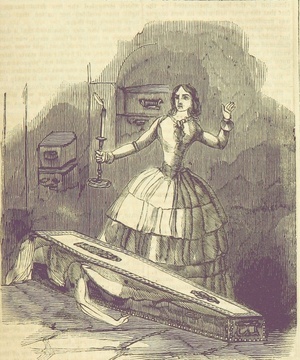
As instructed, Mrs Connell lay very still all day. She must have known there was trickery, for her niece had left her covered in a shroud and surrounded by candles, but she did not realise that the trick was on her.
The penny dropped, however, at 4 pm. that evening, when a little girl, passing down the stairs, told her that Mary was up on nearby High Street in a cab with a coal porter and a Royal Fusilier, having a merry old time.
Mrs Connell might have been 83 years old but was not slow at putting two and two together. She headed promptly to the nearest British Life Assurance office, only to find that she had been declared dead by her niece earlier that day, for the purposes of obtaining payment under the policy.
The revived corpse was still very much alive at the trial of Mary O’Neill in the Southern Police Court, Dublin, which took place later that year. Mrs O’Neill’s defence that her aunt was expected to die any time was not accepted by the court.
Bitter after having been sentenced to two months’ hard labour, she informed the court that she was sure Mrs Connell would be dead and buried before she came out. It is not clear if this happened.
What is clear, however, is that old habits die hard…
….Three years later, Mary O’Neill was again before the Southern Police Court, this time as the ringleader of the famous Dublin Mammies Insurance Scam – a complicated bit of trickery involving four middle aged women, six insurance companies and not-so-dead corpses too numerous to count.
This time, her husband, William O’Neill, whom she had described, when registering his death, ‘as fine a man as you could wish to see, and now he is gone’, who came back from the dead to give evidence against her….
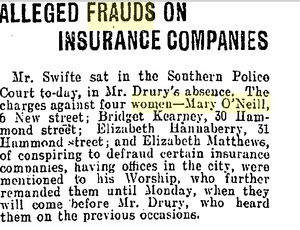
illustration: ‘The Spectre of the Hall’ by JM Rymer
Previously: Forgotten Irish Tricksters 1: Mary Kate Hodges
Forgotten Irish Tricksters 2: Maureen Corrigan and Charlotte Brownlee



Oh.
This morning.
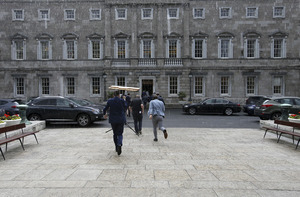
Leinster House, Dublin 2
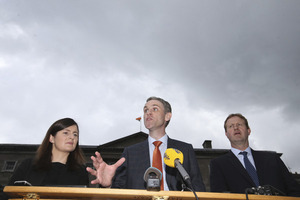
A downpour interrupts the launch of a Fianna Fail billl to re-establish town councils with, top, from left: Group Leader in the Seanad Senator Catherine Ardagh, Fianna Fáil Spokesperson on Local Government Shane Cassells and Spokesperson on Justice and Equality Jim O’Callaghan.
Blummin’ snowflakes.
Rollingnews

Taoiseach Leo Varadkar to have his first phone call with U.S. President Donald Trump today
— 3News (@3NewsIreland) June 27, 2017
Good luck with that…
Just for when leo has to ring Donald later. This from US election day. @olivercallan @newsworthy_ie @broadsheet_ie pic.twitter.com/LuyIZofchg
— Sean C (@CostelloSean) June 27, 2017
Fight!
Rollingnews

Further to yesterday’s exposé of the tax system available for the ‘self-employed…
…another painful diagnosis.
Martin McMahon writes:
Employed or Self-Employed, that is the question for GPs following the Government’ promise to provide free GP care for all at source.
The contract between individual GPs and the State for the provision of medical services labels all such GPs as self-employed.
The Revenue Commissioners have long known that insurability of employment (employed or self-employed) decisions are based on established facts, not assumptions and as such there is no basis for categorisations purely by occupation.
Each case is assessed on it’s own merit in accordance with the general precedents of Irish Law. Operations which seem to be the same, may differ in the actual terms and conditions in any given case. Job title does not define employment status.
The financial implications for the State are substantial.
In the event of a successful application, a ‘Demand Notice’ will issue from the Department of Social Protection to the Health Service Executive to collect the arrears of PRSI contributions due (employee and employer).
If the employer, in this case the HSE, fails to pay up, then the HSE must be pursued by the Department. The Department of Social Protection will credit the contributions to the employee and therefore entitlements to benefits will be secured.
This would mean restoration of contributions to the initial date of employment and immediate entitlement to the relevant benefits in accordance with normal employee conditions.
The Supreme Court has given a definitive judgement on the appropriate test to be applied in determining whether any individual is employed under a contract of services or a contract for services.
The decision concerned is Henry Denny & Sons (Ireland) Limited -v- The Minister for Social Welfare (1988) and indeed the Supreme Court followed that judgement in Tierney -v- An Post (2000).
In the Henry Denny case, Keane J, as he then was, considered firstly how the distinction had formally been drawn up by reference to the degree of control which was exercised by one party over the other in the performance of the work but noted that the fundamental test to be applied is whether the person who was engaged to perform the services is performing them as a person in business on his/her own account.
Keane J said at page 50 of the judgement that, while each case was to be determined in light of its particular facts and circumstances, in general a person will be regarded as providing his or her services under a contract of service and not as an independent contractor where he or she is providing those services for another person and not for himself/herself.The degree of control exercised over how the work is to be performed, although a factor to be taken into account, is not decisive.
It is noteworthy that in the Denny case the contract between the parties was in writing and was drafted with considerable care with a view to ensuring that the punitive employee was regarded in law as an Independent Contractor.
Nevertheless, both the High Court and the Supreme Court confirmed that the person was in fact an employee.
It was not the written contract which determined employment status but instead in the second judgement in the Denny case delivered in the Supreme Court, Murphy J gave implicit approval to the examination of the reality of the relationship to determine it’s true legal import.
Many features of the GMS contract are more in line with a contract of service rather than a contract for service. GPs must render personal service, work set hours and are subject to a great deal of control and direction.
Although convoluted systems are in place for holiday and sick pay, essentially GPs are not free to hire a substitute of their own choosing at a price decided independently between the substitute and the GP, all of which would not normally be the case for self employed persons.
On the substantive issue of being in business on their own account, the contract system restricts competition between GP practices.
The GMS system favours existing GP practices and protects them from competition from newly-qualified GPs. It reduces the number of GP practices available to patients, by creating unnecessary barriers to entry.
Changes in the GMS contract cannot take place without the agreement of the Irish Medical Organisation.
This includes agreement on payments made to GPs under the GMS. Such collective negotiations by “undertakings” on fees are prohibited by Section 4 of the Competition Act 2002 and by Article 101 of the Treaty on the Functioning of the European Union.
The prohibition on collective negotiations is there to protect consumers and the State from concerted practices by independent businesses which could result in them (ie. consumers and/or the State) paying higher prices than necessary for their purchases. In the current instance, its purpose is to protect the State from paying excess prices for GP services purchased by the HSE.
The restrictions on competition arising out of the GMS system affect both private patients and public patients.
Both public and private patients have fewer GP practices to choose from and there is less pressure on GP practices to compete on price for private patients and to be innovative in the service they provide. The impact of the GMS on private patients is often overlooked.
It is assumed that “the market” will take care of them. This ignores the fact that the market for private patients is itself significantly affected by the operation of the GMS.
The GMS system impacts directly on the commercial behaviour of almost every GP practice in the State, affecting decisions on where GPs locate, the number of GP practices established, the nature of such practices and the profitability of individual practices.
This in turn affects the provision of services for private patients and indirectly influences the price GPs charge private patients. The GMS contract severely restricts the ability of a GP to offer his/her services concurrently to others or to profit from sound management or scheduling.
The HSE has placed a self-employed label on all GPs. Misclassification is often the result of cost-cutting measures instituted by employers at the expense of their employees.
Misclassified employees lose workplace protections, including the right to join a union; Maternity leave; face an increased tax burden; receive no overtime pay; and may have no recourse for workplace injury violations and disability-related disputes.
Misclassification also causes government to suffer substantial revenue losses as employers circumvent their tax obligations.
Strange that employment status of GPs doesn’t feature at all in the Oireachtas Committee on the Future of Healthcare report.
Martin blogs at RamshornRepublic
Yesterday: Self Employment is Not Working

Former Tanaiste Joan Burton during the Jobstown protest
Irish Liberal Foresees Own Enduring Relevance
My words are smoother than the essential oils
the Taoiseach last week
had his parliamentary assistant rub
into his badly traumatised buttocks.
My psychotherapist insists
half the people who’ve taken
shotguns to their own heads,
during this recession, would’ve reconsidered,
if only they’d heard me talk for an hour
each week about the dangers of Sinn Féin,
or how I live in the hope of a woman Pope.
I’m all for the good people of middle Ireland
making their point in a dignified manner
with china cups of nothing stronger than tea in their hands.
But when thugs from the far parts start burning vans
and generally acting as if they owned the place;
and gurriers from the depths begin picking up bricks
and tossing words so terrible,
they’re not even in the dictionary,
at the Minister for Poverty’s hair-style.
(How would you like your wife,
sister, great grandmother,
kidnapped in her car
for two and a half hours?)
The world will not be changed by fools
banging on the bonnet of a BMW.
But by the likes of me talking
against social exclusion in TV studios.
And fundraising concerts organised
by former pop-stars.
And the well-meaning priest
with whom I regularly have dinner;
between the two us we’ve enough
concern for the poor to construct a second
Fergal Keane of the BBC,
as a back-up in case
the existing one breaks.
Trust in us. Pay no heed
to the sweary-mouthed crowd,
who if they’re not put back where they belong
will soon be eating pot noodle from scooped out skulls
confiscated from their betters
in defiance of international law.
By the likes of them,
the world must not be changed.
Yesterday: Meanwhile, At Court 13
Lemur Time
at


‘sup?
Dublin Zoo
Siobhan Grogan writes:
Dublin Zoo will mark the birth of two red ruffed lemur pups with a very special event on Saturday 1st and Sunday 2nd of July to celebrate.
Proud parents Pierre and Fifi welcomed the brother and sister pups to Dublin Zoo’s lemur family on April 25th. The latest arrivals join the troop of seven red ruffed lemurs already at Dublin Zoo.
The island of Madagascar has only 10% of its natural vegetation remaining, making lemurs the most threatened group of mammals on Earth.
To see Dublin Zoo’s lemur troop and learn more about why it is so important to protect them and their habitat, visit Dublin Zoo this Saturday and Sunday from 12pm – 4pm for its Long Live Lemurs weekend.
As part of the event there will be special lemur keeper talks, lemur themed arts and crafts, music and more.
Pics Patrick Bolger
Update:
Brian McHale-Boyle writes:
I’m hoping that you might share this short animation, MadagaSCARS, with your wonderful readers with respect to the Long Live Lemurs weekend at Dublin Zoo
MadagaSCARS is a poignant five minute flash animation created by Dublin-based artist Camille Wainer in collaboration with the Lemur Conservation Foundation that captures the urgent environmental and social issues that threaten the future of wildlife and humans on the island of Madagascar.