



Yearly Archives: 2017


MORE to folly.

Broadsheet on the Telly returns tonight at 11.45 streamed live above and on our YouTube channel.
If you want a particular topic tackled please leave suggestions below.
Meanwhile, we are hosting an Ex=Pat Special with contributions from ‘abroad’ next Thursday, March 16. To take part please send a short bio to broadsheet@broadsheet.ie marked ‘Broadsheet on the Telly’.
We hope to see you tonight.
Monday: Did You Stay Up?
Skibb4Repeal
at
‘sup?
Mim Donovan writes;
The best, most defiant #repealthe8th march took place in Skibbereen [County Cork] yesterday. Led by Carmel Winters (right)…
In fairness.
Yesterday: Meanwhile, On O’Connell Street

You may recall how, yesterday, the Minister for Disabilities Finian McGrath withdrew the proposed terms and conditions of a commission of investigation into ‘Grace’ and the alleged abuse she suffered at the home for 20 years.
His decision to remove them came immediately after stinging criticism of the proposed terms and conditions by Fine Gael TD John Deasy, from Waterford, and Fianna Fáil TD John McGuinness.
Mr Deasy alleged that there was a cover-up by the HSE, saying: ‘this was a concerted and organised attempt to hide information and conceal the truth by a clique of HSE managers‘.
Mr McGuinness recounted the experiences of other alleged victims of abuse who lived at the foster home and said if Mr McGrath’s terms and conditions didn’t include the 46 other people who stayed at the home, the State would be “heaping further abuse” on the families affected.
Specifically, Mr McGuinness said, before Grace, a 12-year-old girl was taken out of the home – after the school she attended told the girl’s mother she would attend school bruised, battered and beaten. Mr McGuinness said the girl’s mother made a complaint to the South Eastern Health Board in 1992 but was “… told to shut up. She was told not to repeat those stories. And she was threatened legally”.
This morning, the Dáil unanimously agreed expanded terms of reference which state the 46 other cases will be examined in a second module of the commission of investigation.
But it’s being reported that families of the 46 other cases and the whistleblowers remain unhappy with the revised terms.
RTE reports:
“The whistleblowers added that while the revised terms state that phase two will undertake an investigation of the recommendations in the report of Conor Dignam SC, the terms omit Mr Dignam’s recommendation to look at “allegations of cover up”. This, they say, is of serious concern.”
Further to this…
Independents 4 Change TD Clare Daly TD spoke about the matter in the Dáil this morning.
And she raised concerns about the connection between law firm Arthur Cox, the HSE and Resilience Ireland, which last week published a 2015 report it was commissioned to do, by the HSE, on the Grace case.
Ms Daly said:
“Minister, I have to say, the entire manner in which this has been addressed has been utterly shambolic and wholly unacceptable and I really hope that this does not come back to bite us.
“And the reason why it is particularly important that we get things right in this case is that we know that the backdrop is, at best, I suppose, economical-with-the-truth information being given, but, at worst, deliberate misinformation around these issues in previous attempts to resolve them so forgive us if we’ve trust issues where the HSE are concerned: we think they are legitimate.”
“Now, yesterday, we went into the meeting with yourself. We wanted to raise the issue of the draft order – the statutory instrument upon which the terms of reference were based. The first response we got was, ‘well, sure, God, nobody else raised that’. We want to address the terms of reference. We had to commission legal opinion from Eame’s solicitors to explain why the order had to be changed and that the terms of reference could be ultra vires if you didn’t do that.”
“We then went on to actually submit changes to the terms of reference – none of which were included I might add.”
“Now, no doubt, minister, you will argue that the order and the terms of reference, in the manner in which they have been changed, will allow us to address all of the issues that we have raised and that is possibly the case. And I seriously hope that that is the case.”
“But I found it ironic this morning that one of the amendments that we specifically had posed was the problem that was highlighted by the PAC [public accounts committee] – the fact that earlier attempts by people to get to the truth, including Government ministers and Oireachtas committees were deliberately thwarted by persons or persons unknown in the HSE. It’s an absolute fact.”
“In terms of the information put out, that the gardai were blocking publication of the reports – not even allowing ministers see them – we know it now that that’s not true.”
“We know in the case that I raised with Minister [Leo] Varadkar about a vulnerable person remaining in that facility up to 2015, the minister efficiently asked: are we sending anybody to this? And the answer, very cleverly, he got was: don’t be worrying, Minister. We’re not sending anybody, it might be a private placement but that’s sorted.”
“It wasn’t sorted. So they didn’t actually care about the truth or the person at the centre of it; it was all about covering up for the organisation. And against the backdrop of the Devine Report, which had been hugely discredited, the Resilience Ireland report terms of reference drafted by Arthur Cox who were the legal team that represented the HSE in the Grace case. You couldn’t make this up. Heads have to roll over this.
“I really hope that the changes have got it right and that we be proven wrong on this but there’s a lot hanging on it.”
Anyone?
Previously: ‘Examples Of What Is And Was A Cover-Up’


From top: William Campbell; Terry Prone; Sr Marie Ryan of the Bon Secours order
Here’s How the current affairs podcast presented by journalist William Campbell addresses the media and Tuam.
William writes:
Did the country leader of the Sisters of Bon Secours-Ireland, Sr Marie Ryan organise a campaign of lies and media manipulation in an attempt to distract from the story of the Tuam babies? The latest edition of the Here’s How podcast investigates…
Includes interview with Brendan O’Neill, author of this morning’s criticism of reaction to Tuam.
Listen here

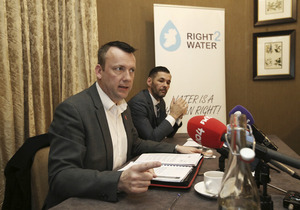
This afternoon.
Buswell’s Hotel, Dublin 2
Right2Water’s Brendan Ogle and Sinn Féin’s Jonathan O Brien TD announce plans to have what they have entitled ‘ the Last Push ‘ demonstration on April 8 in Dublin city.
Mr Ogle said:
“The demonstration on April 8th will allow the public to demonstrate that this issue is not an issue of political opportunism but is, and always has been, about vindication of our human Right2Water by paying for our water and sanitation through the exemplary model of progressive taxation.
I would like to reiterate our view that charges should be abolished in their entirety and that water metering, which is an enabler of charges, should also be abolished and the associated funds invested instead in our antiquated and leaking water infrastructure.“
Fight!
Rollingnews
Suds’ Law
at
Frank O’Dea writes:
Spotted this yesterday around midnight on Dame Street [Dublin] near the fountain. Looks like free bicycle washes for late-night cyclists!
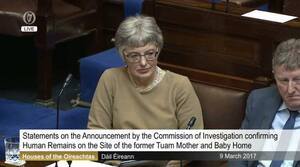
This morning.
In the Dáil.
Before deputies made statements about the confirmation last week that human remains have been found at the site of the former mother and baby home, run by the Bon Secours order, in Tuam, Co Galway.
The Minister for Children Katherine Zappone told the Dáil that, by the end of the months, she will publish an interim report that the Commission of Investigation into Mother and Baby Homes gave her last September.
She also said a scoping exercise will be carried out to examine calls for an expansion of the commission’s terms of reference “to cover all institutions, agencies and individuals that were involved with Ireland’s unmarried mothers and their children.”
From Ms Zappone’s speech:
Experience tells us it can take time to shine a light on dark periods of our history. The truth is hidden. Sometimes hidden in plain sight.
It takes the brave testimony of survivors, long studies by historians and the dogged determination of investigative journalists to bring a spotlight to events which were previously only whispered about – in this case for generations.
It is now almost a week since the Commission of Investigation into Mother and Baby Homes confirmed what we had all feared.
Today I wish to place on the record of this House the Commission’s update that significant number of human remains are buried in the site of the old Mother and Baby Home in Tuam.
For survivors, loved ones and campaigners such as the tireless Catherine Corless it was a moment of vindication. After decades and years of hard work, determination and unwavering commitment the truth has been laid bare for us all to see.
This House, and our entire state, owes a debt of gratitude to Catherine Corless for her work.
Many men and women alive today spent time in that institution, either as children or as young women. Today I offer them my personal solidarity and, as a citizen, my personal apology for the wrongs that were done to them.
Deputies will know that the Commission of Investigation into Mother and Baby Homes continues its work.
You will also know that cases have been made that the terms of reference of this Commission should be reviewed.
I want to acknowledge the calls made since Friday for an expansion of the Terms of Reference to cover all institutions, agencies and individuals that were involved with Ireland’s unmarried mothers and their children.
I can commit to Deputies that a scoping exercise will be carried out to examine this. As Minister I will be announcing the detail of this exercise in the coming weeks. As Minister I will also be publishing the second interim report of the Commission by the end of this month.
I am also mindful that by design the Commission is largely concerned with questions of legality; of legal liability, of compliance with the laws of the day and so on.
These are important questions.
They are however not the only issues which we should consider.
What happened in Tuam is part of a larger picture.
Part of a tapestry of oppression, abuse, and systematic human rights violations that took place all over this country for decades.
As a modern open society we must not treat these as isolated incidents but rather confront what was a dark period in an honest, mature and reflective way. We must acknowledge that what was happening in these institutions was not unknown. We must acknowledge that what was happening in these institutions was not without the support of many pillars in society.
We must acknowledge that this very House debated legislation that allowed for those residing in institutions such as County Homes to work for little or nothing in return for the so-called charity that was shown to them.
Lest we contend that people did not know what was happening, let us remember that some members of this House spoke out against it.
In the Finance Committee debates on the Health Bill 1952, which took place in July 1953, Deputy Kyne condemned putting unmarried mothers in county homes to effectively involuntary labour as “having revenge on her”.
While Deputy Captain Cowan described as “absolute brutality” the fact, as he described it, that “They are not let out even”.
Earlier than that — before our Constitution had been finalised — members of the Oireachtas also raised questions about the ill-treatment of so-called illegitimate children.
Thus, as I said, this history may be dark, but it was not entirely unknown. We must acknowledge that sometimes it was fathers and mothers, brothers and uncles, who condemned their daughters, sisters, nieces and cousins and their children to these institutions.
And that sometimes it was not.
We must accept that between 1940 and 1965 a recorded 474 so-called “unclaimed infant remains” were transferred from Mother and Baby Homes to medical schools in Irish universities.
We must listen to, record, and honour the truth of people’s experiences. We must commit to the best of our ability to recognising, recording and making reparations for the truth.
Making these commitments and honouring them will not be easy. But we must – for those who suffered and also for future generations.
Establishing the truth is important for many reasons – but not least to ensure that the darkness of the past will not return in the future.
Irish women and Irish children must never have to endure such suffering again. As a feminist, as an Independent Minister and as an Irish woman I feel a moral and ethical compulsion to reach beyond the legal questions of what happened in Tuam and elsewhere.
That compulsion is driven to try to arrive at this truth. For it is only from acceptance of the truth that we can move past it; not by drawing a line under it, but by highlighting it.
By recognising it as part of our history and part of our national story.
By commemorating and memorialising it.
By honouring its victims.
By recognising the part that individuals, communities and institutions played in it.
By making sure that, while we still have time, we look to those who are still alive and accept their accounts of what was done to them, and of the wrongness of that. In the coming days, as Minister, I will start a conversation with advocates, with historians and scholars specialising in transitional justice.
The United Nations defines transitional justice as the set of approaches a society uses ‘to try to come to terms with a range of large scale past abuses’. Transitional justice puts survivors and victims at the heart of the process. It commits to pursuing justice through truth.
It aims to achieve not only individual justice, but a wider societal transition from more repressive times, to move from one era to another.
Taking a transitional justice approach means that we will find out and record the truth, ensure accountability, make reparation, undertake institutional reform, and achieve reconciliation.
In doing this I want to acknowledge the many people who have contacted me personally in recent days to tell me directly of their experiences. It is important to also ensure that we learn from international best practice in transitional justice, such as the Museums of Memory in Argentina and Chile, for example.
There may also be lessons to be learned from processes used to establish the truth in other contexts and other countries.
Writing about the Mother and Baby Home in Tuam, as well as other matters, in the London Review of Books last year, our Laureate for Irish Fiction, Anne Enright, said: “The living can be disbelieved, dismissed, but the dead do not lie. We turn in death from witness to evidence, and this evidence is indelible, because it is mute”.
Let us not disbelieve; let us not dismiss.
Let us commit to do justice not solely through law, but through speaking and listening, and through believing what our eyes, our ears what our compatriots tell us.
Transcript via Katherine Zappone
Yesterday: What’s In It That’s So Frightening?


A size comparison of the spaceships of Star Trek by Metaball Studios who qualifies it thus:
Not all the ships of Star Trek. Only the most important.
Photon torpedoes fired.
Related: Star Trek: Just The Spaceships
And the mother of them all: Know Your Spaceships