


 </a/
</a/




MORE to folly




Staying in?
Broadsheet on the Telly returns tonight at 10pm with our 70th episode streaming LIVE above and on our YouTube channel.
Join old friends, surprise guests and domestic pets as we devour the news of the week from home and ‘abroad’.
Matters under discussion will include the MacGill geezer fiasco, Body & Soul, Cannabis Oil, British Royal family love-bombing and The Disclosures Tribunal.
‘Unwholesome’ language inevitable.
Fuck**g sorry.
Previously: Broadsheet on the Telly

‘sup?
Via Clontarf.ie
This lovely fellow managed to get loose from his back garden in Clontarf today after the side entrance was left open. He is missing from the Malahide Road/Howth Road area of Clontarf. Please share and get in touch if you hear from him/see him!
Thanks Alan Bracken


Hazel Larkin
Last week, an item by Hazel Larkin about parents having to resort to crowdfunding to pay for their children’s health needs provoked much discussion with criticism levelled at the motives of its author.
Hazel writes:
Oh Lordy! There have been some weird things said about me in the comments here, and elsewhere. For quite some time now, I have had a policy of not reading the comments on things I write.
Everyone knows the comments section of the Interwebz is where the crackpots and conspiracy theorists hang out. When, however, I got the heads-up that the comments had turned from just nasty to actually defamatory, I reckoned it might be an idea to read the comments and address the nonsense therein.
I did speak with a solicitor, and – while I have a case, there is no point in suing people who have no assets worth suing them for. It’s also mighty expensive and time-consuming. Most people who say ‘just sue them’ have either no idea of the justice system, and how it works, or they are multi-millionaires who can afford to indulge themselves.
The piece that’s managed to get everyone in a flap was a simple enough article written on foot of a few campaigns I’d seen where parents were trying to raise funds for their children’s housing, educational, and medical needs.
I included links to these campaigns to illustrate my point. You know, fuelled on caffeine, and wielding my social justice warrior’s sword.
One of these was a fundraiser for a child whose family is struggling to pay for this child’s exceptional educational needs. It was set up by someone I know because he felt it was in the best interests of the family to protect them from the kind of vitriol that has been directed at other people (like Tara Flynn and Tracy McGinnis).
That is his call, and I completely understand where he’s coming from. Given some of the nastiness unleashed, then it seems he was right. What he didn’t expect was to have keyboard warriors cast aspersions on his excellent character.
Yes, he’s a friend of mine. Yes, I know the family involved, yes they wish to retain their privacy. No, I don’t blame them. Adults are not just cruel to other adults online, they are cruel to children, too.
John has many friends, both on and offline. As have I. He’s so upset by the things that have been said about him, however, that he has closed the fund and returned the money that has already been sent. I can’t say I blame him.
His professional reputation was being questioned and – even though he has done nothing wrong – he doesn’t have time to firefight. Nor should he be expected to. For that matter, neither do, or should, I.
As far as these funding campaigns are concerned, guess what? You get to decide what is, and is not, a worthy cause. You get to decide what to do with your time and money.
Some people think that collecting money to send flowers to a rape victim is a worthy cause, some people think that collecting money to fund the retirement of greyhounds is a worthy cause, some people think that collecting money to send someone on holidays is a worthy cause.
People can decide for themselves what resonates, and what doesn’t. GFM campaigns are set up every day.
Throw a few bob at them, or don’t – that’s entirely your own decision – but stop attacking men, women, and children because they don’t match up to what your idea of a person in need looks like.
Seriously, I thought we had learnt from the recent referendum campaign that one person’s difficulty is not the same as another’s, that we need to be less judgemental; that compassion goes a long way; that we are not entitled to every tiny detail of a person’s life, that some things are private. Clearly, I was wrong.
What strikes me, however, is the gendered element of the comments. By that I mean, the difficulty people have in this country with mothers trying to provide for their children. In Ireland, there is still a notion abroad that mothers raising children alone should be shamed. Including shamed for doing their best – even if that ‘best’ doesn’t look like what other people think it should look like.
If some young fella set up a GFM campaign because he wanted money to go to the World Cup in Russia and get some beers while he’s there, what would the reaction be? I’d be willing to bet that there would be a bit of annoyance, but also a lot of admiration for the sheer brass neckery of it.
People would think he was ‘gas’ and would be keen to know how he got on. That’s okay for a bloke – who would affectionately be called a ‘chancer’. But women, raising children on their own, and doing their best for those children? They get an entirely different shake of the stick. I find that interesting.
That aside, there are a few factual errors referred to in the comments, and they do need to be addressed:
1. There is no provision, in Ireland, for the special educational needs of children who are gifted. There hasn’t been since 2004. So these children can’t get access to the education they need through the state system.
2. Ireland is a signatory of the UNCRC, Article 29 of which states: ‘1. States Parties agree that the education of the child shall be directed to: (a) The development of the child’s personality, talents and mental and physical abilities to their fullest potential;’
3. Clearly, the government is violating the rights of these children by not affording them the opportunity to develop their mental abilities to their fullest potential. Giftedness is hugely mis-understood and seen as some kind of ‘win’ for kids who are this smart. I thought it was worth challenging that misconception. I still think it’s worth challenging, but probably in an article just devoted to that subject.
4. I have had precisely one GFM campaign ever set up for my benefit. It has been referred to several times in the comments, and was set up to pay for my therapy as well as a final installment of my fees. The therapy element – which was the larger portion – has been ignored by every commentator. I had expected that my settlement would cover these expenses, but it hasn’t yet been paid. Sadly, my legal team never informed me of the fees and expenses involved in pursing recovery of the settlement (€10k+) until afterwards (refer to my earlier comment about accessing the law in Ireland).
5. It has been erroneously claimed that the Open University doesn’t admit students under the age of 18. In fact, it does. There is no lower age limit, but those under 18 must go through an additional set of processes for what they refer to as ‘young learners’.
My ‘gap year’ wasn’t nearly as glamourous or as expensive as it would appear people think. I lived in Asia for many years, and still have friends there, so when I returned to pursue my ex for child support (long, difficult, drawn out, involving many jurisdictions, still not resolved), I stayed with people I’d known for nearly 20 years. So, no accommodation costs.
When we flew to Copenhagen we paid the grand total of €1.80 for the three of us. Ryanair. You really can’t beat them (in fairness, it was a one-off to celebrate the launch of the new route: Three thousand tickets, sold over a three-hour period, for €0.30 each). Google it. Or check their Twitter feed. We stayed with friends there and in Sweden, too. Ditto the UK and the Netherlands – we got there as cheaply as possible, and stayed with friends. On occasion, we were treated to our fares, like when we went to the UK, and stayed with an old friend who needed help. Later, another friend saw I was suicidal because of the abuse my ‘family’ was putting me through in advance of my brothers’ trials. She reached out to me – with the keys to her spare house in a village in France. It was a mental health break, because it was either that or a psych unit. And if I took the latter option, where would my kids have gone? Into ‘care’? We all know what that’s like in Ireland. (Abusive family, remember, couldn’t leave the kids with them).
Laid bare like that, it’s not really very glamorous, or exciting, is it? And that’s without detailing the panic attacks, the constant anxiety, etc. etc. Yes, I have a lot of good friends. Probably because I am a good friend.
6. There have been allegations that I am not a PhD candidate in DCU. Well, I am. My supervisors are Dr Mel Duffy and Dr Eileen Courtney.
7. Aspersions have also been cast on the credibility of the course I’m offering for midwives and other birth workers, with the insinuation that there’s something dodgy about it. I don’t know what more would be expected than approval from An Bord Altranais agus Cnáimhsceachais na hÉireann.
8. Then there were suggestions that I’m workshy. Sadly, that line we were all sold about working hard at your education so you’d get a job? It’s a crock. The dynamics are very, very, different. (Hmm, might be another article in it). If, however, you have a job that you’d like to consider me for – I’d be delighted to hear from you. Also, I think it’s important to note that there is a difference between work and a job. I’ve picked up quite a few bits of work since I got back to Ireland, some paid (most unpaid) but securing a job is a different kettle of fish.
8a. It was interesting to note that there were plenty of commentators saying that I was
workshy, and then others actively, deliberately, and maliciously trying to scupper my attempts to earn. So – which is it? Which trope suits your idea of what a lone mother should look like? Can we get a consensus?
9. Then there’s the allegations of child trafficking. They are so bizarre, I don’t know where to start. For the record, I have never trafficked a child. Now, there’s a sentence I never thought I’d have to write.
10. There was also a lot of concern about my bowels. I’d like to categorically state that, as far as I am aware, my bowels are fine.
11. If you’d like more intimate details of my life, feel free to pick up a copy of my book – it’s got a quote from Kate Holmquist on the front, which she is perfectly happy about:
No matter how good a Googler you are, Google doesn’t have all the answers.
I hope that was entertaining for you – I have nothing more to say on the subject – except that I have work to do, kids to raise, a PhD to keep working on, cats to feed, a few social justice campaigns to work on, and lots of coffee to drink.
Hazel Katherine Larkin is a ‘caffeine-fuelled social justice campaigner’. Follow Haxel on Twitter @HazelKLarkin.
Previously: Go Fund Yourself





MORE to folly
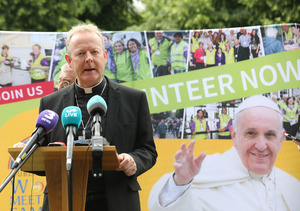


From top: Archbishop of Armagh and Primate of All Ireland Eamon Martin outside the offices of the Irish Catholic Bishops’ Conference in Maynooth, Co Kildare, last month, as the details are published for the the pastoral visit of Pope Francis; Tuam survivor Peter Mulryan and historian Catherine Corless; Ciaran Tierney
The only surprise about the revelation that survivors of institutions and clerical sex abuse are planning to protest during the visit of Pope Francis to Ireland in August is that anybody might be surprised.
There are thousands of people across Ireland, the UK, the USA, and Canada who are waking up to the injustice inflicted upon them and their families. They are determined not to be silenced anymore.
They want the Catholic Church to face up to the abuse inflicted on young mothers and their children in both Magdalene Laundries and Mother and Baby Homes throughout much of the 20th century. As far as many of them are concerned, the religious orders have never faced up to their crimes.
All across Ireland, hundreds of people believe they may have uncles, aunts, brothers, or sisters scattered across the globe.
They believe they have close relatives in cities such as Boston, Chicago, or New York who have no idea of their own true identities, as they were adopted out, illegally and for cash, by nuns whose only concern was that they ended up in good Catholic homes.
The history of Catholic institutions in Ireland in the 20th century is one of physical and emotional abuse, shame, judgement, and even baby trafficking and child abduction, as many “illegitimate” children were forcibly taken from their traumatised mothers after they were transferred to institutions all across the country.
This is not ancient history, as we saw in the emotional but wonderful scenes in Dublin two weeks ago when more than 200 former residents of Magdalene Laundries were honoured in public for the first time.
Many of them flew home from the US and the UK, because the shame of their incarceration – or giving birth outside marriage – ensured they could never return to the towns or villages they came from.
The last Magdalene Laundry only closed down in 1996. Some of the women were so institutionalised after spending three decades in these harsh institutions that they did not wish to leave even when presented with the opportunity to do so. They had given up the will to live independent lives.
The youngest woman to have given birth in a laundry is still only 40 years old. These are real, living, breathing people and now they want the truth – and justice – after so many years of secrets, lies, and shame.
The children born in these horrible places did not all end up living in Ireland. They were trafficked in their hundreds to the USA, their birth records falsified, and to this day many do not even realise that they were adopted or born in Ireland.
When we talk about the 796 ‘Tuam Babies’ we should remember that they are not just skeletons buried in and around a septic tank in a North Galway Mother and Baby Home.
They are the flesh and blood of people like Peter Mulryan, a noble man in his 70s who wants to know what became of the little sister he never knew he had for most of his adult life.
Until he finds proof of her death, for all he knows Peter’s younger sibling could be living out her life somewhere in North America, totally oblivious to her roots or where she came from.
This need to know the truth seems to be of hugely important to the survivors and their children as they reach old age. Who would not want to know what happened to a sibling if he or she was forcibly removed from a tearful mother’s arms?
Even if they knew nothing about them for most of their lives.
Birth records were falsified, an order which ran a notorious Mother and Baby home is now making money from private health care, and religious orders are refusing to hand over records until they receive legal indemnity for crimes committed in the past.
Institutions circumvented the rules to send children out for adoption and priests were moved around from one parish to another when ordinary people raised concerns about clerical sex abuse. For many victims and their families, peace will only come when they hear full apologies and they receive redress for the crimes which destroyed so many lives.
Most of all, people just want to hear the truth.
It’s a theme which recurs again and again in ‘My Name is Bridget’, the new book by journalist Alison O’Reilly which examines the desperately sad case of a woman who had two sons taken from her in the Mother and Baby Home.
Bridget went on to live in Dublin, marry a good man, and have a daughter who never knew about the two older siblings who were seized from her mother in Tuam. It was only after Bridget died that Anna discovered she had two missing brothers, who may or may not be buried in that infamous septic tank in Co Galway.
Right now, Anna, Peter, and other survivors of the Tuam Mother and Baby Home are waiting on tenterhooks to see if Galway County Council are prepared to undertake a full excavation and examination of the Tuam site.
They will be shocked and dismayed if the authorities try in any way to cover up what happened in Tuam after all the pain they endured.
Decades may have passed, but they are still entitled to find out what happened to close family members – were they buried in an unmarked grave or were they trafficked to America?
in a letter to the Minister for Children and Youth Affairs, Katherine Zappone, Anna wrote:
“This is a national scandal, not a popularity contest for who wants the tidiest cover-up. This can’t be the same as in the 1970s. How dare you,”
Anna sent copies of the letter to every member of Galway County Council to make it clear that she and other family members would not accept any kind of ‘cover up’ at the site.
Alison’s book is a very topical addition to the national debate. It shows how important identity is to the adopted and the truth is to survivors of institutions and their families.
In a powerful chapter at the end of her book, entitled Snapshots of Stolen Lives, Alison spoke to a number of survivors about their need to find the truth, justice, and peace.
“Everyone deserves to know who they are and it should not have taken this long and I should never have had to fight so hard,” said Breda Tuite, who was adopted through the St Patrick’s Guild Agency in Dublin in 1959.
It took Breda, from Dublin, years to track down her late mother from Co Kerry. For her, there was a kind of healing in visiting her grave and meeting her friends and family.
Sharon McGuigan was just 16-years old, an innocent child, and had been groomed by an older man when she became pregnant in 1985. She was admitted to the Dunboyne Mother and Baby Home in County Meath and gave birth to a daughter in February 1986.
The daughter was taken from her and adopted. Sharon had no say in the matter. Her daughter is still not ready to meet her but Sharon hopes to build a relationship with her some day.
“We should not have been made to feel so shamed and to be cast aside,” Sharon told Alison O’Reilly. “I just want to tell my story and not to be mistreated because of something that wasn’t my fault. I want an acknowledgement of what happened to women like me.”
Anna Corrigan has described the Tuam grave as a jigsaw which needs to be put back together. The survivors and their families point out that there were many institutions like Tuam all over Ireland and an awful lot of healing still has to take place for those who had no voice for far too long.
They believe that religious orders were engaged in criminal behaviour during the darkest days of 20th century Ireland and it is time the Catholic Church faces up to issues such as the shaming of pregnant women, child abductions, and the trafficking of Irish babies to the USA.
They believe that the visit of Pope Francis to Ireland will be a pivotal moment for the Catholic Church on the island.
If he listens to the people who had their identities stolen or who were separated from their families, a huge amount of healing can occur in August.
Otherwise, Pope Francis can expect very vocal – and hugely embarrassing – protests from victims who are not prepared to be silenced any more.
Ciaran Tierney is a journalist, blogger, and digital storyteller, based in Galway, Ireland.
Victims vow to protest when Pope Francis visits Ireland (Ciaran Tierney)
Rollingnews






MORE to folly

Jason Kearney writes:
I know this is a long shot and I’m sickened even talking about it but my bike got robbed today [from Stoneybatter, Dublin 7] so sharing this in hope someone might spot it or something. I’m ragin as it was a class bike and I was really attached to it.
Matt Black single speed Foffa (logo on front but most likely ripped off by now), black all over except for rims on both wheels, worn to silver by brakes. Handlebar tape worn/bit ripped on outside of right handlebar. Only ever seen one more of these Foffa’s in matt black in Dublin so pretty distinguishable…
Anyone?

Yo, beedu!
The charming Indian actress Deepika Padukone breaks down the Hindi word(s) on the street for Vanity Fair.
Previously: Jackass Down


MORE to folly