
Author Archives: Admin

The breakdown of respondents who said they could speak Irish in the Republic of Ireland and Northern Ireland censuses of 2011

Colm Ó Broin, who last week compiled a rich example of prejudice in the national press about the Irish language, writes:

There are people in every society who are hostile to groups that are different to them. We are all familiar with prejudice against people of a different gender, sexuality, skin colour, nationality, ethnic background or religion.

But what about people who speak a different language? Usually bias against a language is classed as racism – for example, immigrants being verbally abused for speaking their native languages or chauvinists repressing the languages of minorities like Kurdish in Turkey.

We have our own version of this chauvinism here in Ireland – the hostility of British loyalists to the Irish language. One of the earliest examples are the Statutes of Kilkenny, which outlawed the speaking of Irish among the descendants of settlers from Britain.

These laws were enacted in 1366 but given the political nature of this hostility it’s more than likely it goes all the way back to 1169. The fear behind it was the belief that people would be less loyal to the English Crown if they spoke Irish – a fear still heard today in hysterical claims that the United Kingdom will be “undermined” if speakers of Irish Gaelic are given the same rights as speakers of Scottish Gaelic.

Which brings us to Gaeilgephobia – the irrational fear or hatred of the Irish language and those who speak it. You’ve probably never heard the term before and the concept has received little or no recognition in English-speaking Ireland, despite it being one of our oldest recorded prejudices.

While we can see the open hostility of Unionist politicians to the Irish language in Northern Ireland, many would find it hard to believe that there is prejudice against Irish speakers in the Republic of Ireland as well. Any negativity surrounding the language south of the border is supposedly related to government efforts to promote it, and not the language itself.

If you read the articles that the quotes used in my post are taken from you will indeed see legitimate arguments against official policies on the language – but scattered among them you will also see something entirely different – prejudiced attacks on the Irish language and Irish speakers.

One thing that’s striking is the GUBU nature of these statements, which would be worthy material for a Louis Theroux documentary.

In the bizarre corner we have the claim that no Irish word has been created in the past 100 years and the argument that Irish is comical in some way because it has taken words from other languages, something that practically every language on the planet does, none more so than English itself.

Then we have the comparison of Irish speakers with Nazis, skinheads, Communists and Islamic fundamentalists.

Among the worst is the comparison of a school in Dingle with the Finsbury Park Mosque, an establishment frequented by Islamist terrorists linked to Al Qaeda. The great crime committed by this school was to teach through the medium of Irish – in what is officially an Irish-speaking area.

Then there is the association of Irish speakers with IRA terrorism, “mucksavagery” and last but not least, the sexual abuse of children. If linking an entire community to the sexual abuse of children isn’t prejudice then ‘prejudice’ has no meaning.

Like other phobias Gaeligephobia has its own set of mantras that are repeated ad nauseum regardless of evidence, many of which are seen in the quotes.

One of the most common is the false claim that Irish is a “dead language”. The commentators who say this are fully aware that there are Irish-speaking communities in Ireland as well as thousands of fluent speakers in the rest of the country, so this is simply a crude attempt to insult Irish speakers.

After all, if Irish is a “dead language”, and you speak Irish, that means there is something “dead” about you and your community.

The most blatant example of Gaeilgephobia is the ludicrous claim that Irish language schools are “middle class”. The basis for this seems to be that because there are Gaelscoileanna in middle class areas in Dublin then all Gaelscoileanna must be middle class, which is like saying that only middle class people shop in Dunnes Stores because there is a Dunnes Stores in Stillorgan.

Opponents of Irish language education don’t have to send their children to Gaelscoileanna and are not affected in any way if other people make this choice. However, they still go out of their way to attack parents who choose Irish-medium education for their children.

But as they don’t have a rational reason for this opposition they have to resort to bogus pretexts. This is the most revealing attack on Irish as it relies on false claims, which is a sign of pure bias against the language.

Claims that the Irish language is somehow “middle class” are also very amusing for Irish speakers as for centuries we have been told that Irish was a “badge of poverty”.

This Orwellian doublethink will be familiar to other groups subjected to prejudice, like the immigrant who can scrounge on the dole while stealing your job at the same time.

Similarly, if a poor person speaks Irish it becomes a “peasant language”, but if a rich person speaks it it’s an “elitist language”. The object here is not to establish facts but to negatively stereotype the minority group using any means necessary.

Attacks on the Irish language began hundreds of years ago and the quotes highlighted last week show that they continue to this day.

Whatever the reason for this bizarre prejudice it’s time we consign it to the rubbish bin of history, where it belongs.

Colm Ó Broin is an Irish speaker from Clondalkin, Dublin and a member of Conradh na Gaeilge. Follow Colm on Twitter here.

Previously: I’ve Nothing Against Irish Speakers, But…

Pic: Wikipedia

Did you stay up?

And then go to to sleep?

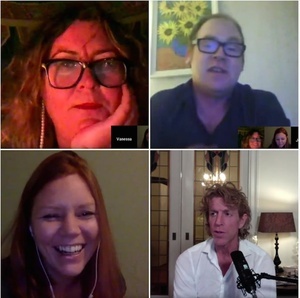
A warm thank you to, clockwise from top left: celebrity accountant Vanessa Foran, Johnny Keenan, ‘Preposterous‘ and Olga Cronin, our reduced panel on last night’s truncated Broadsheet on the Telly.
The show can be viewed in its entirety above

Unforgivably,  ‘Preposterous’ slept through the 10pm start leaving a fuming panel marooned in cyber space. The show managed to begin at 11.30pm, by which time producer Neil Curran had gone to bed.

But an illuminating dispatch from The Disclosures tribunal with Olga and Vanessa and Johnny kindly dropping in helped salvage a screwed-up episode 69.

Less swearing than you would expect.

Previously: Broadsheet on the Telly

Sunday is Father’s Day!

Every year, we give away a 25 euro Golden Discs voucher to ONE paterfamilias on Fathering Sunday.

All we ask from you is a tune your old man (living or tooling about in the great shed in the sky) would like to hear (in his good ear) on the big day.

We already have 33 songs selected from last week (see below).

This is your very last chance to tell your da you love him through the medium of choonage.

To enter, please complete this sentence:

‘Could you please play____________________________for my father on Father’s Day because it reminds him of___________________________________’

Lines MUST close at 6.15pm

Golden Discs

Pic: Shutterstock

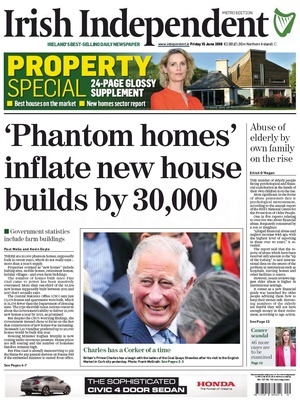
Today’s Irish Independent

Bazza writes:

The Department of Housing has been counting the numbers of houses based on connections to ESB networks.

I’m no electrician but I would expect a lot more than the 30,000 phantom houses that have been reported. This practice has been in place since 1970 so are any of our housing statistics correct?

Anyone?

A third of homes ‘built’ since 2011 don’t exist (irish Examiner)

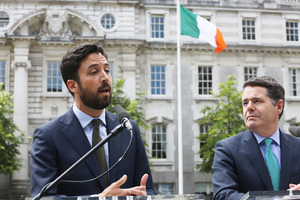
Minister for Housing Eoghan Murphy (left) and Minister for Finance Paschal Donohoe discuss house building initiatives yesterday; Donal O’Shea

In the weeks since the Irish people decided, by an overwhelming majority, to entrust women with control over their own bodies, there has been a tangible sense of optimism about the future for which our country is now heading.

The referendum illustrated that the Irish electorate, despite what we have been told about ourselves, possesses both the compassion and the intellectual wherewithal to engage with issues of great complexity, and come to conclusions not based on fear and manipulation.

It is important that we capitalise on the momentum created by the repeal movement, and continue to work towards change in how our society operates.

What do the repeal, marriage equality, and water charges movements have in common? Each had its roots in citizen-led, grassroots organization; often, years before they became issues of national import.

These campaigns showed that when the Irish people come together in solidarity we can break ties with our regressive past. They should be used as points of reference in the next social and political struggle facing the Irish population; the fight for a right to housing.

It seems clear that if there is to be any change in how we as a people interact with housing, it will need to come from outside the realm of party politics.

A second housing crisis, just 10 years after the first, has seemingly done nothing to dispel the view among our political class of housing as a commodity first and foremost. The needs of the Irish people remain a distant second to the needs of foreign vulture funds, and will continue to do so it seems.

If you were to look briefly at the current government’s oddly passive handling of the housing crisis thus far, you could be forgiven for interpreting their various missteps as just that; missteps.

But after further examination, it becomes apparent that their housing policy fits in with their overall ideological self-image; shepherds for the market, with little or no duty of care to their own electorate.

Their reluctance in regulating a private rental market out of control, for fear that they may disrupt the phantom supply that it has been providing, has seen rents approaching an average of €2000 in Dublin. Indeed, their pursuit of Rent Supplement as a primary solution has only served to create an artificial floor in many areas.

When contrasted with their bullish responses to the EU’s GDPR and the European Commission’s Apple tax ruling, it becomes evident that Irish legislature are only averse to imaginative, decisive policy solutions when the outcomes favour citizens over capital.

One of the most heartening developments of the entire repeal campaign was the success of the Citizens’ Assembly. The Assembly, a collection of citizens drawn from a range of locations, ages, genders, and social backgrounds, came together and heard expert witnesses, held Q&A sessions, and participated in roundtable discussions and debates.

This participatory forum, along with the campaign that followed, showed the way forward for Irish democracy. Citizens were allowed to influence and engage with their own futures in a way that wasn’t limited to a vote every few years.

Although there is no imminent prospect of a similar forum on the issue of housing, there does seem to be an increasing appetite among the public for a change from the traditional paradigm.

People want to live in a society, not a marketplace. Suggestions such as cost rental models and local cooperative housing, with a focus on local investment to suit local needs, are beginning to gain traction in the public consciousness.

The Irish political establishment are still a long way from legislating for the type of change required to make a meaningful impact on our broken housing system, but a groundswell of public protest and support would go a long way in encouraging them.

One needs only to revisit Leo Varadkar’s previous statements regarding marriage equality and the 8th amendment, not to mention Micheál Martin‘s shaky history with water charges, to see that our politicians have a propensity for evolutions in thinking depending on which way the electoral winds are blowing.

 Donal O’Shea is an Irish freelance writer, currently living in Chicago.

Rollingnews

From top: crowdfunding sites like GoFundme and IDonate: Hazel Katherine Larkin

All functional, loving parents strive to provide for their children. We accept – indeed, embrace – our responsibility to them. We know that it is our duty to ensure our offspring have the housing, clothing, education, and medical care that is suitable to, and appropriate for, their needs.

In a country like Ireland, when parents are unable – for whatever reasons – to provide for their children, it is expected that the collective social conscience will step in and help.

The administrative arm of this collective social conscience is largely expected to be the government. People pay up to 52% income tax (including PRSI and USC) on the understanding that it will be used to provide for the less well off; that the children of the nation will be minded; that the parents of children who have additional needs will be assisted.

Sadly, this is not the case. Increasingly, parents are having to put their pride in their pockets, and turn to fundraising sites in order to raise what they need to provide for their children.

It is humiliating for anyone to have to turn to the public to ask for help – especially because not everyone is compassionate, and people who do work up the courage to ask are often lambasted by people who feel that asking for help reeks of a sense of entitlement.

I would counter that everyone is ‘entitled’ to a home, an education, and medical care that is appropriate to their needs.

Instead of being annoyed with parents for asking for help so they can provide for their children, perhaps we should be annoyed with a government that is not honouring its social contract with the people of Ireland.

Perhaps we should be annoyed with a government that reduces citizens and tax-payers to beggars.

Perhaps we should be annoyed with a government that consistently ignores the pleas of the electorate.

Perhaps we should be annoyed with a government that consistently ignores the carefully researched, informed opinions of experts.

Perhaps we should be annoyed with a government that continues to undervalue the work that carers do in our society.

Perhaps we should be annoyed with a government that doesn’t seem to understand that, while individuals make up a society, Society is a collective, where the greater good of all members is considered.

Perhaps we should think, long and hard, about what we can possibly do to create a society where we are committed to providing the basics for all our children, and start to move towards a nation that fulfills the promise of the Proclamation of 1916 and ‘cherish all the children of the nation equally’.

Hazel Katherine Larkin is a ‘caffeine-fuelled social justice campaigner’. Follow Haxel on Twitter @HazelKLarkin.