

Anne writes:
At the till in Dundrum, Co. Down.
Have you been surprised by an unseasonal Yuletide display? Write in confidence (supplying pictorial evidence) to broadsheet@broadsheet.ie, marking your submission ‘Ah here, It’s barely October’.



Anne writes:
At the till in Dundrum, Co. Down.
Have you been surprised by an unseasonal Yuletide display? Write in confidence (supplying pictorial evidence) to broadsheet@broadsheet.ie, marking your submission ‘Ah here, It’s barely October’.


The Staten Island Ferry Disaster memorial – a weathered monument in Manhattan’s Battery Park commemorating the 400 passengers who perished on November 22nd 1963 when the ferry Cornelius G. Kolff was attacked by a giant octopus, their fate overshadowed by the assassination of JFK that same day.
A rather wonderful multimedia hoax created by artist Joe Reginella.
https://www.youtube.com/watch?v=ZjErCdGtJ_A
And so it begins.
FIGHT!
Previously: Face Off
Derek Mooney writes:
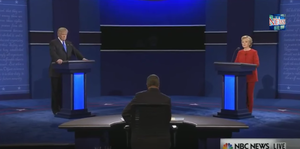
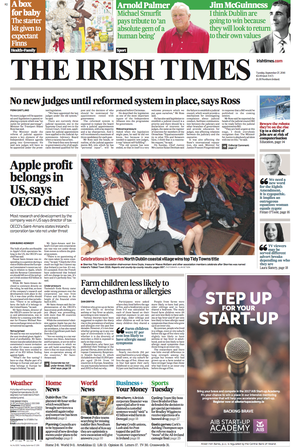
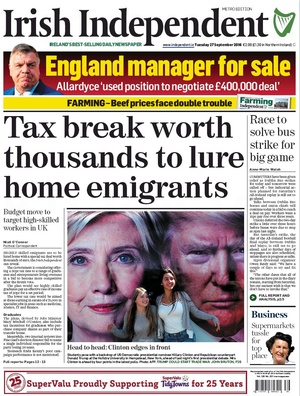
Here are some random, even disconnected, thoughts on tonight’s US Presidential Debate, posting at approx 5:30 am (Irish Time).
The first is just how shockingly poor Trump’s performance really was. While many pundits were predicting that he would do badly, especially as news emerged of how little debate prep he was doing, I hadn’t imagined it would be THAT bad.
Trump is a guy who should be most comfortable in front of the TV cameras. He has spent years as a reality TV star, surely he had learned some understanding of how the medium works. Yet, as we saw from his constant interruptions, his snorting and sniffling and his awful reaction shots in the split screen segments, he seemed the least comfortable of the two in that environment.
To be fair to Trump, he did have a moderately good opening segment. He made it clear from the outset that he was set not only to bring the fight to Hillary Clinton, but to paint her as the ultimate political insider, but he never developed his narrative beyond that opening twenty minutes.He fared best when he offered solutions, the problem is that he spent most of the debate just reciting the problems.
As the debate went on it was soon clear that he had not prepared and that he was just recycling his standard Trump Rally material. His strategy, in so much as he appeared to have one, seemed to be to just play to his own existing voter base and ignore swing voters.
That is not a winning strategy when the race seems to be so close – well, close in terms of national vote, not quite so close in terms of the electoral college – but especially so when the candidate seems so prepared to rise to Clinton’s bait each and every time.
Hillary’s attack lines were so obvious that he and his team must have anticipated them and devised key responses and arguments that would allow him to pivot the debate back to her obvious weaknesses – yet they never came.
The best he could come up with was a crude bait-and-switch, but for most of the time he not only accepted the premise of Hillary’s remarks – on his taxes, his attitude to race issues and his comments on women – he then repeated and expanded on them.
While Hillary helped him implode, most of the credit goes to him. He had too made unforced errors… such as he denial that stop and frisk had been declared unconstitutional – even contradicting the moderator when he stated clearly that it was… or his lethal throwaway “That’s because I’m smart” comment when Hillary wondered if he had paid no federal taxes.
He has made his temperament and his credibility, real election issues, in a way that the Clinton had failed to do before tonight.
While Clinton clearly had a good night and did win the debate, she did not say or do enough to deal with her big unfavourables.
She still lacked passion and never really addressed the accusation that she is a Washington insider, an establishment figure disconnected from the real America which feels disillusioned and ignored – something I explored here on Broadsheet.ie.
The question is whether her winning the debate will move the poll numbers for her. In the past the winner of the first debate has managed to secure a small post debate bounce . In all likelihood she will do so now, which begs the question can she secure that bounce and hold on to it.
I suspect, as the campaign progresses that she will gradually edge more swing voters to her cause, though they will probably go to her more to stop Trump that to push Clinton – but a win is a win, even when it is your opponent who secured it for you.
A win is a win, even when your opponent secures it for you (Derek Mooney)









MORE to follow.
Barry writes:
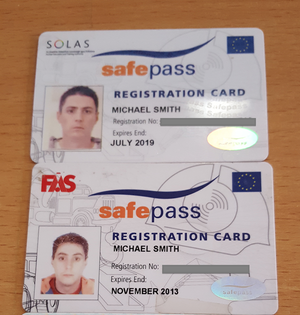
I found three cards belonging to a Michael Smith dumped in a bush outside my office on Grantham Street [Dublin 8]. I’d say he’d be chuffed to get them back as they are all to do with his work.


Jack Reynor tweetz:
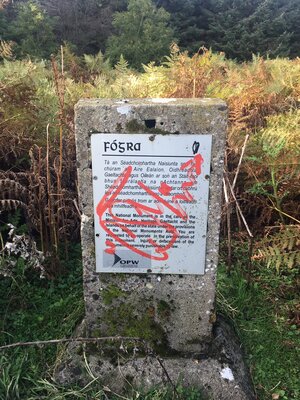
This is at Glen Ding in Blessington [Co. Wicklow]. Can people please not do this kind of sh1t in the few beautiful areas we have left in the county please…
Wow, bummer. MT: Looks like My Sc’tology Movie won’t get an Irish release due to blasphemy laws https://t.co/g7dMDr0ku1 via @entertainmentie
— Louis Theroux (@louistheroux) September 26, 2016
Last week: Going Clear
Meanwhile…
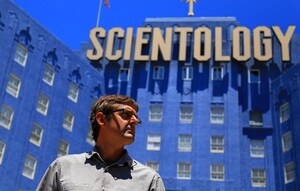
Burn it!
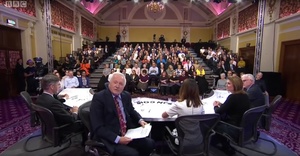
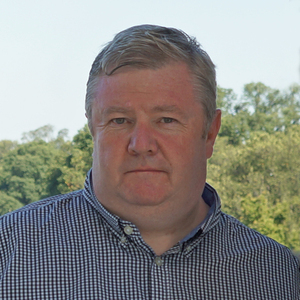
From top last week’s BBC Question time Derek Mooney
There are two chances of a second vote on Brexit
Derek Mooney writes:
I have to confess that my heart sinks a little whenever I hear English Tories or English nationalists, like Nigel Farage, mention Ireland during their rants about the EU.
The reference is usually patronising or condescending or – even worse – is given in the form of advice that would have us join them in their march back to a glorious era that never existed.
This is why my heart sank when Julia Hartley Brewer, a British Talk Radio host, Leave campaigner and former political editor, stated on last Thursday’s BBC Question Time that the EU had forced Ireland, and other countries, to vote again on EU referendums.
Her comments came during the course of a discussion on whether Britain might have another referendum on Brexit – a proposal put forward by the failed Corbyn challenger, Owen Smith MP or that the UK might have a separate vote on the final deal hammered out on the conclusion of the Art 50 negotiations, an idea put forward by Tim Farron’s Liberal Democrats.
Though hearing Hartley-Brewer getting it badly wrong on the notion of the EU ‘forcing’ us to vote again made my heart sink a little,
it sank even further when I realised that she and her fellow panellist that night Jacob Rees-Mogg MP (who looks like he is being portrayed by Joyce Grenfell) may actually have a point, just not the one they think.
Though I and other Remainers may wish it to be otherwise, the hard fact is that Ireland’s voting again on the Nice and Lisbon treaties is not relevant to the UK’s situation for one simple reason: turnout.
In the first referendum on the Nice Treaty (Nice I) in 2001 the turnout was just under 35% – the result then was 54% No: 46% Yes. At second referendum on the Nice Treaty (Nice II) in Oct 2002 the turnout shot up to just under 50% with Yes getting 63% and No dropping to 37%.
It was a broadly similar situation in the case of the two Lisbon Treaty referendums. In Lisbon I in June 2008 the turnout was 53%. No won by 53%:47%. At Lisbon II the turnout had again increased, this time to 59% with Yes now winning by 63%:37%
In both cases the turnout in the first referendum was low to start with, in the case of Nice I it was exceptionally low, just in the mid-30s, so there was a convincing argument to be made for a second vote, particularly when you felt that a second referendum would have a higher turnout.
This was not the case in the UK’s Brexit referendum.
The turnout there was a whopping 72%. This is a substantial turnout. It is much higher that recent UK General Election turnouts, indeed you have to go back to Tony Blair’s 1997 election victory to find a UK general election turnout of over 70%.
The huge political risk you take by having a re-run second Brexit referendum in these circumstances is that you get a lower turnout. It is politically saleable to try to reverse one mandate with a smaller one?
To be clear, turnout alone was not the reason why there were re-runs of the Nice and Lisbon referendums. In both cases post referendum polling and analysis found that the main reason for voting “No” or abstaining was a lack of knowledge of either treaty.
Both “Yes” and “No” voters were highly critical of what they viewed as a dearth of clear, accessible information on the treaty’s merits.
While the Remainers can clearly point to a lot of misinformation from the Leave side, not least the claims that leaving would mean £350 million extra per week for the NHS, they cannot yet point to any substantive research or analysis suggesting any changes in opinion.
Noted UK pollster, Prof John Curtice, reckons that there is little evidence of a “significant rethink” three months on from the result with those who voted Remain still convinced that they were right and likewise for the Leavers.
Very few minds have been changed, though let us see if that remains the case as the details of the Brexit deal on offer emerge during the course of the next year or so.
The problem with all this abstract discussion on a second referendum is that it takes the focus away from the very real and tangible issues with the first result: most crucially that the Hartley Brewer, Farage and others do not want to honour the clear Remain majorities in Northern Ireland and Scotland.
Instead they want to use the votes of English and Welsh people to forcibly drag Northern Ireland and Scotland out of the EU against their declared will.
This is no small issue, yet it is receiving scant attention in the UK and, sadly, here.
Voters in both Northern Ireland and Scotland voted convincingly to stay in the EU, by much bigger margins that the people across the UK voted to leave.
Many of those voters in Northern Ireland hold Irish passports and are thus also EU citizens, even if the UK leaves.
Can that citizenship – and the guarantees and privileges it offers – simply be snatched away from them on the say so of 50%+ of voters in the south of England?
As people like Michéal Martin and Colum Eastwood have repeatedly said over the past few weeks and months; trying to drag the North out of the EU against its will ignores the layered complexities of the Irish political process.
It is a refutation of the basic principles of the accommodation achieved in the Good Friday Agreement and that is something that concerns all of us on this island.
We should be debating and discussing this now. We should be looking at the significant consequences of Brexit for our economy, for our trade – both North/South and East/West, our education system, out health service.
We should not allow the foot dragging by the British Government on outlining its terms of exit to stop us from forcefully setting out our concerns and our alternatives.
We need the speedy establishment of the all-island political/civic forum I called for here at the end of June. I know the Taoiseach and his team messed up their first attempt to get the idea up and running, but they need to go again and get it right this time
Derek Mooney is a communications and public affairs consultant. He previously served as a Ministerial Adviser to the Fianna Fáil-led government 2004 – 2010. His column appears here every Monday mid-afternoon. Follow Derek on Twitter: @dsmooney
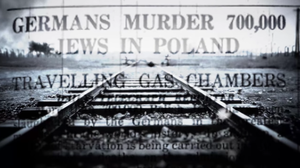
The latest video from Youth Defence.
Calling for the 8th amendment to be “saved”.
Includes, segregation, the Holocaust and “discrimination against those who are deemed imperfect”.
Previously: Unbowed


Polymer clay sculptures by Angela Schwer, monocolour representations of the form of sea urchins, flowers, fungi and more, clustered into (buyable) hangable tiles.