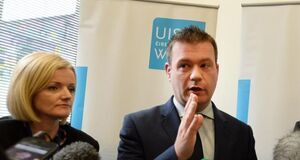
From, top: Maurice McCabe And Lorraine McCabe; From left: Former Garda Commissioner Noirin O’Sullivan; Supreme Court judge Peter Charleton and former Minister for Justice Frances Fitzgerald
Today.
At the Disclosures Tribunal in Dublin Castle.
Head of HR at An Garda Siochana John Barrett will continue to give evidence.
Yesterday, he told the tribunal that former Chief Administration Officer of An Garda Siochana Cyril Dunne told him “we are going after him in the Commission”.
He has said he believes this occurred on May 13, 2015 – the day before the O’Higgins Commission of Investigation began.
He was to bring documentation supporting this claim to the tribunal this morning.
Meanwhile, Supt Noel Cunnigham and retired Chief Superintendent Colm Rooney are scheduled to give evidence once Mr Barrett is finished answering questions.
Separately…
Yesterday, at the end of the former Minister for Justice Frances Fitzgerald’s evidence, she had this exchange with Supreme Court judge Peter Charleton who is overseeing the tribunal.
Judge Peter Charleton: The last matter I wanted to ask you about I think was this whole thing of, forgive a kind of a male sporting term, a game changer, this question was asked of Ken O’Leary, and he said, look, I knew there was an allegation against Maurice McCabe, or at least this is what I said to him, I knew that there was a ruling by the Director of Public Prosecutions that this does not amount to a sexual assault, it doesn’t amount to an assault at all, even if there were no issues as to credibility. Now, did you actually know the text of the DPP’s letter of, I think, the 5th May 2007? Had you ever actually read that letter in the context of this?
Frances Fitzgerald: I don’t believe that the — I’m not absolutely sure, but I don’t think the DPP’s original letter was available in the Department. It might have been made available to the IRM.
Charleton: Yes.
Fitzgerald: And maybe in that context. But I may have seen it in that context.
Charleton: “Yes. And did you sit down and read the file? ”
Fitzgerald: Yes, I would have. The IRM file? Yes.
Charleton: No, no, I mean the original investigation file?
Fitzgerald: No, no, no.
Charleton: You didn’t?
Fitzgerald: Never. That was very much within the IRM.
Charleton: Yes. Because in doing that, I suppose, you get a good sense of the whole thing, and that’s the only way, in effect, to make sense of it?
Fitzgerald: Yes.
Charleton: And again it’s not a criticism.
Fitzgerald: I don’t believe I did, yes.
Charleton: Mr. O’Leary said the following; he said, look, in the event that it had come to my attention that counsel for the Garda Commissioner had been instructed by the Garda Commissioner to actually accuse Maurice McCabe of sexually assaulting a child, that would have put an entirely different complexion on it, it would have brought it to a completely different level and he would have gone in to you straightaway. Now, obviously that never happened. But were you to have — were that to have been the information that was put before you, would you have reacted differently or thought about matters differently or —
Fitzgerald: Well, if that situation had arisen, effectively what you would have a Garda Commissioner doing is bringing up an issue that had been dealt with by the DPP, that had been dealt with by the Independent Review Mechanism and GSOC, which she would have been aware of, I think, at that point, if the dates are right, and that would be a very extraordinary situation. If an allegation that had been disproved by — you know, was not taken as — that there was any basis to it, and the Garda Commissioner was doing that, that would be a totally different situation, and I imagine if that happened at the Commission of Investigation, that I believe that there would be a different note going from the CSSO to the Attorney and there would be different issues being raised, and at that point then there would be a different discussion.
Charleton: And which arising out of that is, I wouldn’t, I suppose, be any kind of a lawyer if I didn’t know about Cabinet confidentiality, and I’m not asking you to breach that, but it’s become increasingly stark every time I read paragraph (e) that I have been required to investigate whether false allegations, plural, of sexual abuse were inappropriately relied on by Commissioner O’Sullivan to discredit Maurice McCabe. Now we know that didn’t happen. But where did the notion that anybody had made false allegations of sexual abuse and put them to Sergeant McCabe at the O’Higgins Commission ever come from? If you can’t answer that, don’t answer it. But I’m just tending to wonder why is it there?
Fitzgerald: Yes. Well, it’s very hard to say exactly where it arose from. But it seemed to be — it seemed to be an innuendo that, you know, was around, and that — in terms of, I think there may have been, there may have been some media coverage in relation to it, and I suppose there perhaps was confusion between the investigation into the Ms. D complaint, which was about the investigation as opposed to the original allegation. But certainly we felt that it needed to be in the terms of reference —
Charleton: Yes.
Fitzgerald:— because it had arisen from all of this.
Charleton:Sure. Even if that were so, why is there a plural on it?
Fitzgerald: The plural is?
Charleton: “False allegations of sexual assault”. I’d just better get the exact words.
Fitzgerald: Yes.
Charleton: I’m sorry, just give me a second to look back at it. “False allegations of sexual abuse”. Allegations.
Fitzgerald: Yes. Well, it was allegation. That may be — that may be referring to a sense of it being out there with other people, the allegation. But you’re right, it is only about, clearly only about the allegation.
Charleton: Yes. But I’m required to investigate into a number of, it could be from anything to two to God knows, the awful cases that have been seen in the courts —
Fitzgerald: Yes.
Charleton: — where there is — you know, and the swimming — or the swimming case or the gymnastic case in America recently. It’s rarely one. Why the plural, do you know? And if you don’t know, you don’t know.
Fitzgerald: I mean, I would have taken advice on the terms of reference at the time. And I can’t — I can’t say on that.
Charleton:: Thank you very much.
Fitzgerald: Thank you.
The tribunal continues today. Follow Olga Cronin’s coverage here.
Previously: Unconscionable
Questions For Frances