
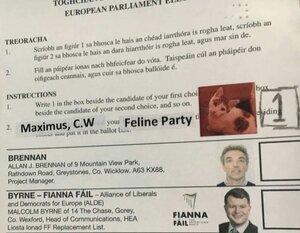
Alan Kinsella tweetz:
#IrelandSouth For all those wishing to vote for your cat… A voter made stickers to vote for their own cat!



Alan Kinsella tweetz:
#IrelandSouth For all those wishing to vote for your cat… A voter made stickers to vote for their own cat!


Minister for Housing Eoghan Murphy; latest homelessness figures from the Department of Housing
This morning.
The Department of Housing released it’s homeless figures for April.
It found that a new record of 10,378 people (6,584 adults and 3,794 children) were living in emergency accommodation in the final week of April.
Some 1,729 families were also recorded as living in emergency accommodation in April.
In March there were 10,305 people accessing emergency accommodation – 6,484 adults and 3,821 children. There were also 1,733 homeless families accessing emergency accommodation.
Therefore, this morning’s figures show there has been an increase of 100 adults, a decrease of 27 children, and four families living in emergency accommodation since March.
Asked about the figures this morning, Housing Minister Eoghan Murphy said:
“It’s hugely disappointing to see the numbers up again but we have seen a decrease in the number of families and children in emergency accommodation month-on-month. It’s a small decrease but it’s still a decrease.”
Depaul CEO Kerry Anthony said:
“The increase in those experiencing homelessness, the fourth in as many months shows that something is still very wrong with the way we are dealing with homelessness. We know house building is the real solution but in the interim we need to take measures that stop people entering homelessness.
“Depaul recently launched our awareness campaign ‘Real Doors of Dublin’ highlighting the on-going homelessness and rough sleeper crisis. We are urging people to stay sympathetic to those experiencing homelessness.
“There is a danger with such high numbers that the public may see homelessness as an issue that cannot be solved. That homelessness is simply a part of everyday life. This cannot happen.”
Read the department’s report in full here
UPDATE:
Eoin, in comments, writes:
Disappointing”, where have you heard that word or minimal variations thereof before?
Looking back at the comments accompanying previous month’s homeless figures, all [bar the first which is Leo’s] from Eoghan Murphy since he’s been the housing minister (June 2017):
March 2019
“The situation is “disappointing and very depressing”. [Leo Varadkar]
February 2019
“The increase in homelessness in February is hugely disappointing.”
January 2019
“It is very disappointing and we remain in a very difficult situation where homelessness is heavily impacting on the lives of families and individuals.”
November 2018
“It is very disappointing to see more children in emergency accommodation as we enter into Christmas week.”
September 2018
“We are still very much in the midst of a crisis in homelessness in this country.”
August 2018
“Earlier this year a number of categorisation errors were identified and corrected in the March and April reports.”
July 2018
“Any increase in the number of people accessing emergency accommodation is unacceptable.”
June 2018
“Obviously any increase in people accessing emergency accommodation is unwelcome but it is good to see a decrease in the number of children and we are seeing a continued stabilisation of the numbers of people in emergency accommodation.”
May 2018
“Any increase in people in emergency accommodation is very disappointing.”
March 2018
“A number of local authorities have erroneously categorised individuals and families living in local authority owned or leased housing stock, including in some instances people renting in the private sector but in receipt of social housing supports, as being in emergency accommodation.”
January 2018
“The increase in homelessness in January was anticipated to a degree.”
November 2017
“Obviously the increase in November is disappointing.”
August 2017
“While the number of family presentations nationally in August has increased by 13 overall, the figure for Dublin has fallen by 32.”


Spotted on Morehampton Road, Donnybrook, Dublin 4, at the weekend.
It follows reports that up to 130 trees may be cut in Ballsbridge and Donnybrook areas to allow for roads to be widened for the BusConnects programme.
Related: BusConnects: 130 at-risk D4 trees festooned with red ribbons (Olivia Kelly, The Irish Times)
Previously: Someone Shout Stop
Thanks Edmund McCann

Lois Kapila, in the Dublin Inquirer, reports:
The biggest difference between the mammoth shared-living blocks being put forward by developers such as Bartra, and cohousing models, boils down, in a sense, to who gets listened to.
Shared living is mainly speculative, said Padraig Flynn, of Self-Organised Architecture (SOA), on Friday, in a meeting room at the Fumbally Exchange in Blackpitts.
“People who live there have no agency or input of the design or the long-term management of the building,” Flynn says.
Cohousing is the opposite: it’s resident-led, from design to management.
“It gives people an opportunity to decide where they cut costs, what’s important to them, and what they don’t actually need,” he says.
“They’re two completely different concepts. But the wording is almost identical so it becomes very confusing for people,” said Flynn.
The CoHousing Here! event [in Dublin] in mid-June, organised by Flynn and others at SOA, should help get that message out – and further open up debates around future affordable housing in the city.
Previously: Co-Living Dangerously

‘Never Drink & Swing’
A topical new game by Simon Darcy.
Play NOW
Thanks Bibi Baskin
Meanwhile…

From left: Maria Bailey, Kate O’Connell and her sister Mary Newman-Julian
Fine Gael TD Kate O’Connell changed her Facebook photo mere moments after her friend and colleague Maria Bailey’s interview with Sean O’Rourke.
The Dublin Bay South TD’s ‘cover photo’ was a picture of her with her sister Mary Newman-Julian, a Fine Gael election candidate for Tipperary, and her close friend Maria Bailey.
It had been her Facebook ‘cover photo’ since March 24.
But at 10:32am on Monday morning she switched it for a group photo without the now-controversial figure.

Former chief executive of Rehab Angela Kerins
RTE reports:
The Supreme Court has declared the actions of the Dáil’s Public Accounts Committee as unlawful in its treatment of the former chief executive of the Rehab Group, Angela Kerins.
The court said by conducting a public hearing in a manner significantly outside of its terms of reference and which also departed significantly from the terms of the invitation issued to Ms Kerins, the committee had acted unlawfully.
The Supreme Court also noted that issues raised in these proceedings about the conduct of Dáil committees were capable of being remedied by the Oireachtas.
Supreme Court rules PAC acted unlawfully in dealings with Kerins (RTÉ)
UDPATE:

From 2014.
Thanks Bebe


From top: Frenzy and Betrayal (top) by Alan Shatter, above right with Leo Varadkar in 2010
Alan Shatter launching his book this evening. Here’s a short extract in which he 🔥s the current Taoiseach pic.twitter.com/qMWG4WzvYs
— Hugh O’Connell (@oconnellhugh) May 29, 2019
The ex-Dublin Rathdown TD writes at length about a now infamous speech given by Mr Varadkar at a road safety conference in March 2014.
Mr Varadkar called on then Garda Commissioner Martin Callinan to withdraw controversial remarks he made about the two Garda whistleblowers, Maurice McCabe and John Wilson.
The commissioner used the word “disgusting” in relation to the leaking of details of the scrapping of penalty points by the two men.
By contrast, Mr Varadkar described them as “distinguished” and suggested the Department of Justice was not properly investigating the allegations.
Mr Shatter was in Mexico on government business at the time and felt “ambushed” by the comments.
In his book, he claims Mr Varadkar chose to “entirely ignore” briefings from the Department of Justice on the actions being taken and the fact the issue had been referred to the Garda Inspectorate.
Mr Shatter says the RSA event was used “as a platform for a publicity-seeking piece of self promotion”.
“The speech also clearly promoted the false narrative that both Callinan and I had ‘turned a blind eye to McCabe’s complaints…”
“I believe that Varadkar was opportunistically reigniting a controversy, despite knowing the background to be more complex than the public could have understood or as presented by Opposition politicians and media commentators.”
He continued: “Varadkar was depicted as the handsome hero, Luke Skywalker, and Martin Callinan and I joined at the hip as Darth Vader, with the shadow of Maurice McCabe cast across the whole stage.”
Leo Varadkar betrayed me to win power, Shatter claims (Independent.ie)
Previously: Revenge Is A Cold Canapé
Thanks Bebe

The Meet Your Maker podcast.
On ‘Devil worshipers, Yeats and Ireland’s first coinage’.
Host Liam Geraghty writes:
In 1928 the Irish Free State caused a commotion when they decided to put animals on their coins instead of political heads. Historian Maeve Casserly, coin designer Mary Gregoriy and former keeper of the National Museum of Ireland Michael Kenny tell the story.


This morning.
In Committee Room 2 in Leinster House.
Members of the Irish Refugee Council and Movement of Asylum Seekers in Ireland (MASI) – including Lucky Khambule and Bulelani Mfaco – are appearing before the Oireachtas justice committee.
They are discussing direct provision and the international protection process.
Just yesterday, the Ombudsman Peter Tyndall said direct provision centres are unsuitable for longer-term occupation and called for a formal resettlement programme to be put in place.
At the end of his opening contribution, Mr Mfaco said:
“We are human beings, like everyone, like all of you. All we ask is that we be treated as such. The very fact that people have to ask the Government to treat them humanely should shame all of you.”
UPDATE:


Donnah Vumah, of MASI, told the committee that there is a dearth of mental health services available to people living in direct provision.
She said the “only thing there at the moment” are posters in the centres telling people they can contact The Samaritans or Spirasi (an organisation which helps survivors of torture who are asylum seekers, refugees, or other disadvantaged migrant groups).
However, Donnah said securing an appointment with Spirasi requires asylum seekers to get that appointment through a referral from a solicitor or from a GP and that usually takes a “very long time”.
She added:
“This is why we find that a lot of people tend to turn to things like sleeping tablets or alcohol, they develop a lot of addictions such as gambling addictions because they are trying to find a way to cope with living in that situation.”
Lucky Khambule told the committee that the number of suicide attempts in direct provision centres has increased in the past 18 months.
He said last year alone there were five deaths in direct provision.
He said some of these deaths concerned individuals with mental health issues while some were using sleeping tablets.
“We feel this is not qualified obviously, that the provision of the tablets, in terms of addressing the mental health issue, is the wrong one. The psychological traumas that people do face in direct provision are the things that need to be addressed in a very, very serious way.
“Otherwise we will see more deaths happening in direct provision because we ignore the signs that are there on mental health issues.”

MASI member Tinda Ndlovu told the committee that she and her three children live in Direct Provision.
She said that her eldest child, aged nine, has previously said to her:
“Sometimes when I feel sad, I feel like kiling myself.”
Mr Mfaco, who is gay and living in Knockalisheen Direct Provision Centre in Clare, spoke about homophobic slurs that he has received at the centre.
He said he doesn’t trust anyone in the centre and when he goes to eat in its canteen, he will sit somewhere with his back against the wall as he doesn’t feel comfortable.
He added:
“You have staff members in direct provision who also undermine privacy for individuals.
“I was sitting in my room one day and they knocked once and they opened the door. It’s a lady who worked in Knockalisheen. She knocked once, she opened the door and I was sitting in my room getting ready to go and have a shower.
“So obviously I had my underwear on.
“The next time it happened it was a manager in Knockalisheen direct provision centre who walked into the men’s showers, in the men’s block…She opened the door in the men’s showers, she looked, and then she closed the doors and said ‘sorry’ as she walked away.
“It’s a man’s shower. What are you expecting to see there? Like privacy means nothing to them.”
“We’ve had similar incidences in Hatch Hall Direct Provision Centre and in Balseskin Direct Provision Centre [both in Dublin] where either a staff person walks into a room where a person is naked or another resident walks into a room and the person is naked.”
“We’ve had experiences from children who feel unsafe in the way that men look at them, creepily, it’s been reported in the news.
“…women who feel unsafe sharing those intimate living spaces with other people because a lot of the women, some of them would have suffered torture or sexual violence and to be placed then in a position where you feel you’re unsafe again becomes very cruel.”
Mr Mfaco also spoke about the sexual exploitation of some people living in direct provision.
He said:
“When people aren’t allowed to work legally, it creates then the openness for whoever wants to exploit them to actually do… and we’ve had people who come to MASI who work from 7am in the morning until 5pm and they are only paid €25 to €27.
“It becomes very difficult then for a person to live a normal life because they don’t have a sense of what their rights are once they are actually given permission to leave – they might just continue with that exploitation.
“We’ve also had people being offered money for sex in direct provision.
“Because people know that there are people who are getting paid €21.60 per week, it’s now €38.80, and you have to live.
“I’ve been offered money for sex, there are children who’ve been offered money for sex, there are women who’ve been offered money for sex.
“So it becomes very, the exploitation, we don’t know to what extent that it is happening but we have reports from our work and other people.”

Christopher Sibanda, who has lived in a direct provision centre in Waterford for the past three years and travels to Dublin for college every day – therefore spends six hours on the road – told the committee that he shares a room with three other men.
He said the room is four metres long by four metres wide.
He said he would invite any politician to join him and a spend a night in his centre to see what life is like in direct provision.
He said:
“In that same environment, in that same centre, Viking House, there is no area where if you come today and visit me, where you can sit and talk to me, just greet me. There is none.
“That is not human living.
“The jailer-prisoner attitude that pervades there is not for human beings.
“…the treatment by the centre managements, I don’t know what is in place by RIA [Reception Integration Agency] that has been put in place for training of the people that work there because they do have the feeling that they are jailers there and that we are prisoners.
“And that they are doing favours for us.
“From the kitchen staff – you get people being thrown with plates of food. Some times those plates will fall and people will laugh.
“That happens to human beings [inaudible] who will be in a queue by the way and you will then beg for food.
“If you happen to miss a meal, you miss a meal, you know you’ve missed a meal, you can come back, the same food that has not been served because I missed meal obviously, there will be leftovers, cannot be served to me because I’m out of meal time.
“That is not human.”
Mr Sibanda also said he cannot take a lunch from the centre with him when he leaves for college.
Mr Mfaco also spoke about how many children and adults “warehoused” in direct provision centres are prevented from integrating in Irish society and, in fact, “segregated” from Irish people.
He said:
“Like when you go, get off the bus in Limerick city centre. You see all these brown people, you actually see Irish people staring at us and going ‘where did this bus come from?’
“It has brown people. They don’t look like, they look different, it only has them.
“Everybody knows it’s from a direct provision centre.
“When the bus shows up at the school. Some of the school kids are ashamed, of their friends to know, but everybody knows that that school bus is going to take them to a direct provision centre.”
Mr Mfaco said it’s a similar situation for adult asylum seekers when they go to their local Post Office to collect their weekly allowance.
“Everybody in the queue, everybody in the Post Office staff, know that that person lives in a direct provision centre.
“…you’re constantly reminded of how bad your life is, and you’re constantly reminded that you are not considered part of Irish society. You’re divorced from social life, you can’t really socialise on €38.80 while you’re living in Mount Trenchard [Limerick], there is no public transport.
“There is no public transport in Knockalisheen and other direct provision centres as well.”
He later added:
“We get called ‘welfare scroungers, fee loaders. We’ve had, in the election campaign, we’ve been called freeloaders, we never asked.
“When an asylum seeker came to Ireland, they never asked the Irish Government for a plate of food. Nobody arrives at Dublin Airport and says ‘I’d like to have food please’.
“So when you tell me that you’re providing me with food, I never asked for any of that, I asked for protection.
“So it becomes very difficult to even begin to talk about integration for us when we have people being warehoused in direct provision centres without access to very basic everyday things.”
The meeting can be watched in the video link above and here.
Previously: In Direct Provision For 14 Years
