

The Desert Rain Frog or Boulenger’s short-headed frog (Breviceps macrops) – under threat from habitat loss in its native Namibia and South Africa.
Understandably pissed off about that.



The Desert Rain Frog or Boulenger’s short-headed frog (Breviceps macrops) – under threat from habitat loss in its native Namibia and South Africa.
Understandably pissed off about that.

The Irish History Show tweets:
Crumlin this morning. Are a lot of kids asking for knockoff Lego Hitler this Christmas?


The fragile celestial love triangle of the Earth, Moon and Sun depicted in a rather gorgeous short by Eusong Lee.
Full screen recommended for maximum cosmic feels.


Winged blur, more like.
Behold: the tiny silhouette of the planet Mercury against the vast backdrop of Sol during this week’s transit. To wit:
In the high resolution telescopic image, a colorized stack of 61 sharp video frames, a turbulent array of photospheric convection cells tile the bright solar surface. Mercury’s more regular silhouette still stands out though. Of course, only inner planets Mercury and Venus can transit the Sun to appear in silhouette when viewed from planet Earth. For this November 11, 2019 transit of Mercury, the innermost planet’s silhouette was a mere 1/200th the solar diameter. So even under clear daytime skies it was difficult to see without the aid of a safe solar telescope. Following its transit in 2016, this was Mercury’s 4th of 14 transits across the solar disk in the 21st century. The next transit of Mercury will be on November 13, 2032
(Image: Martin Wise)


Large scale photographs installed in line with their surroundings – the trompe l’oeil, mise en abîme illusions of Olivier Lovey.

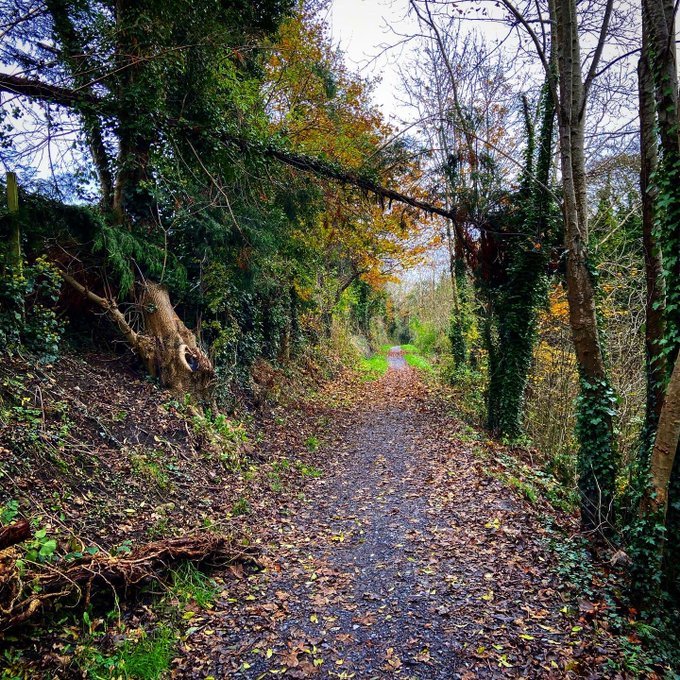

Colum Cronin tweets:
Some photos from Sunday’s walk along the @royalgreenway. The variety and vibrancy of autumn colours was stunning. Ireland is gorgeous.
In fairness.

Behold: Langrenus and Petavius – two of the more distinctive of the moon’s many craters, as seen from earth. They’ll be there long after we’re gone. To wit:
The craters formed in separate impacts. Langrenus spans about 130 km, has a terraced rim, and sports a central peak rising about 3 km. Petavius is slightly larger with a 180 km diameter and has a distinctive fracture that runs out from its center. Although it is known that Petravius crater is about 3.9 billion years old, the origin of its large fracture is unknown. The craters are best visible a few days after a new Moon, when shadows most greatly accentuate vertical walls and hills. The featured image is a composite of the best of thousands of high-resolution, infrared, video images taken through a small telescope. Although mountains on Earth will likely erode into soil over a billion years, lunar craters Langrenus and Petavius will likely survive many billions more years, possibly until the Sun expands and engulfs both the Earth and Moon.
(Image: Eduardo Schaberger Poupeau)


Behold: the MV Augusta Rush 1000, an aggressively styled, track-only, carbon fibre 185kg superbike with a frankly terrifying 212bhp, 998cc, liquid cooled, inline four engine kept in check with a host of electronic rider aids, custom suspension, four pot callipers and huge brake discs.
Yours, sometime next year for between €30,000 and €40,000 when it goes into full production.
Related: Ballistic Trident