Author Archives: Chompsky

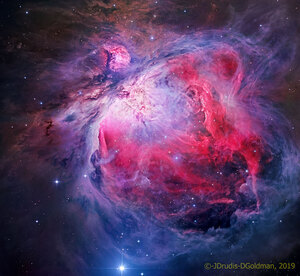
Behold: M42, the great stellar nurseries of the Orion Nebula – the most famous of all astronomical nebulae. To wit:

Here, glowing gas surrounds hot young stars at the edge of an immense interstellar molecular cloud only 1500 light-years away. In the featured deep image in assigned colours highlighted by emission in oxygen and hydrogen, wisps and sheets of dust and gas are particularly evident. The Great Nebula in Orion can be found with the unaided eye near the easily identifiable belt of three stars in the popular constellation Orion. In addition to housing a bright open cluster of stars known as the Trapezium, the Orion Nebula contains many stellar nurseries. These nurseries contain much hydrogen gas, hot young stars, proplyds, and stellar jets spewing material at high speeds. Also known as M42, the Orion Nebula spans about 40 light years and is located in the same spiral arm of our Galaxy as the Sun.

(Image: Josep M. Drudis & Don Goldman)

apod

Behold: the Norfolk Southern–Gregson Street Overpass in Durham, North Carolina — aka the 11 Foot 8 Bridge, aka ‘The Can Opener’.

For eleven years, this low span has been tearing the tops off trucks despite light sensors and clear signage warning the drivers of tall vehicles. The carnage has been such that the bridge has long since been fitted with a camera, generating an endless stream of impact videos

Due to an unground sewage line, the road can’t be lowered but the local authority has now finally agreed to raise the bridge height by eight inches, thereby ending an era.

Spoilsports.

kottke

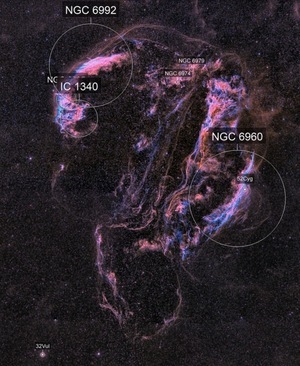
Behold: the glowing spectral remains of shocked gas in the Veil Nebula – the Halloweeniest apparition in the night sky. To wit:

 The nebula itself is a large supernova remnant, an expanding cloud born of the death explosion of a massive star. Light from the original supernova explosion likely reached Earth over 5,000 years ago. Also known as the Cygnus Loop, the Veil Nebula now spans nearly 3 degrees or about 6 times the diameter of the full Moon. That translates to over 70 light-years at its estimated distance of 1,500 light-years. In fact, the Veil is so large its brighter parts are recognized as separate nebulae, including The Witch’s Broom (NGC 6960) below and right of center. At the top left you can find the Spectre of IC 1340.

(Image: Anis Abdul)

apod

Behold: the 1985 Lamborghini Countach QV Downdraft Coupe – a 5 litre V12 455bhp sportscar named for its six Weber downdraft carbs and something of a ‘Holy Grail’ among Lambos.

Only 544 of these were ever built and this was the showcar – the subject of the brochure handed out at the 1985 Geneva Salon. A €270,000 restoration includes all log books and documentation along with period-correct Pirelli P7 tires and Ansa Sports exhaust.

All this, and only 14,500km on the clock.

uncrate

Behold: the Cheshire Cat galaxy group in the constellation of Ursa Major – apparently grinning happily at us from 4.6 billion light years away. To wit:

Albert Einstein’s general theory of relativity, published over 100 years ago, predicted the phenomenon of gravitational lensing. And that’s what gives these distant galaxies such a whimsical appearance, seen through the looking glass of X-ray and optical image data from the Chandra and Hubble space telescopes. Nicknamed the Cheshire Cat galaxy group, the group’s two large elliptical galaxies are suggestively framed by arcs. The arcs are optical images of distant background galaxies lensed by the foreground group’s total distribution of gravitational mass. Of course, that gravitational mass is dominated by dark matter. The two large elliptical “eye” galaxies represent the brightest members of their own galaxy groups which are merging. Their relative collisional speed of nearly 1,350 kilometers/second heats gas to millions of degrees producing the X-ray glow shown in purple hues

apod