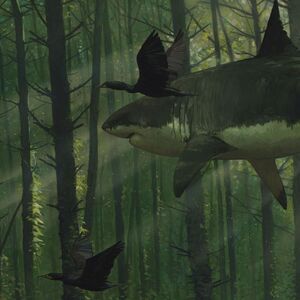

That is the Q.
Patrick Stewart demonstrates his redoubtable Shakepearian chops on Sesame Street in 1996.



That is the Q.
Patrick Stewart demonstrates his redoubtable Shakepearian chops on Sesame Street in 1996.
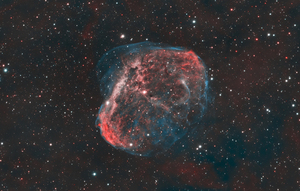
Behold: NGC 6888, aka Sharpless 105, aka the Crescent Nebula – 25 light-years wide and blown by winds from its central, bright, massive star. To wit:
A triumvirate of astro-imagers ( Joe, Glenn, Russell) created this sharp portrait of the cosmic bubble. Their telescopic collaboration collected over 30 hours of narrow band image data isolating light from hydrogen and oxygen atoms. The oxygen atoms produce the blue-green hue that seems to enshroud the detailed folds and filaments. Visible within the nebula, NGC 6888’s central star is classified as a Wolf-Rayet star (WR 136). The star is shedding its outer envelope in a strong stellar wind, ejecting the equivalent of the Sun’s mass every 10,000 years. The nebula’s complex structures are likely the result of this strong wind interacting with material ejected in an earlier phase. Burning fuel at a prodigious rate and near the end of its stellar life this star should ultimately go out with a bang in a spectacular supernova explosion. Found in the nebula rich constellation Cygnus, NGC 6888 is about 5,000 light-years away.
(Image: Joe Navara, Glenn Clouder, Russell Discombe)


Behold: the southern constellation of Scorpius, but not as normally seen by the unaided human eye. To wit:
Scorpius more typically appears as a few bright stars in a well-known but rarely pointed out zodiacal constellation. To get a spectacular image like this, though, one needs a good camera, a dark sky, and some sophisticated image processing. The resulting digitally-enhanced image shows many breathtaking features. Diagonal across the image right is part of the plane of our Milky Way Galaxy. Visible there are vast clouds of bright stars and long filaments of dark and intricate dust. Rising vertically on the image left are dark dust bands known as the Dark River. Several of the bright stars on the left are part of Scorpius’ head and claws, and include the bright star Antares. Numerous red emission nebulas, blue reflection nebulas, and dark filaments became visible as the deep 17-hour expo image developed. Scorpius appears prominently in southern skies after sunset during the middle of the year.
(Image: Stefan Lenz)
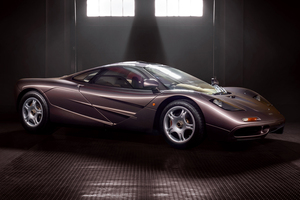
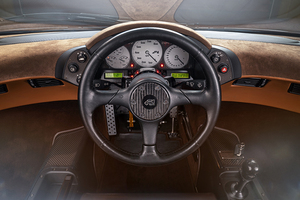

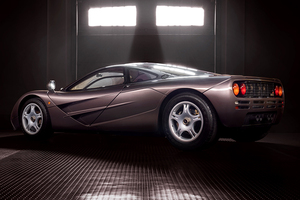
Behold: the 1995 McLaren F1: with its central driver position, carbon fibre monocoque chassis, naturally-aspirated 6.0L BMW V12 and downforce enhancing lines, it’s perhaps the most performance-oriented road car ever made.
Only 106 were built and this is something of a unicorn, being (a) the only one finished in (looks better than it sounds) ‘Creighton Brown’ and (b) the lowest mileage F1 ever offered at auction with a mere a mere 242 miles (390km) on the clock.
It goes under the hammer (in mint condition) this August at Pebble Beach Concours d’Elegance.


A minute-by-minute account of the last great extinction event on Earth by German education design studio Kurzgesagt.
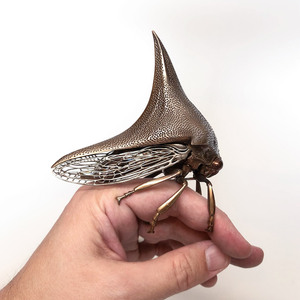
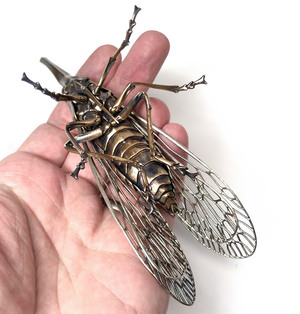

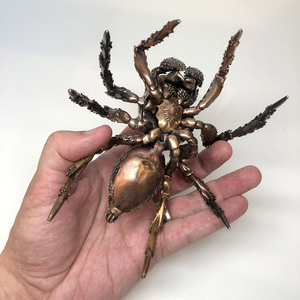


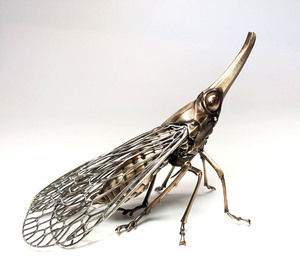


The metal insects and prehistoric organisms of Dr Allan Drummond – an associate professor of biochemistry at the University of Chicago.
Each biologically realistic ’specimen’ starts life as a 3D Blender rendering, later cast in bronze of silver with the help of jewellery designers, then assembled into meticulous, enlarged representations of the actual creatures.
You can follow his process here.


An artificial skin cover for smartphones developed by Marc Teyssier and his colleagues at Telecom Paris. To wit:
Currently limited to smartphones, smartwatches, and touchpads, the prototype is responsive to a variety of gestures, including pinching, tickling, and poking, responding to different emotions: sudden, hard pressure is associated with anger, while gentle and sustained stroking is associated with providing comfort.
Oh dear.

Colum Cronin tweets:
“She wanted the blue sky, but I was just mere water. And so I did my best … I reflected”. Wild Whispers
Fermoy, County Cork. River Blackwater. Ireland is magic!