
Author Archives: Chompsky

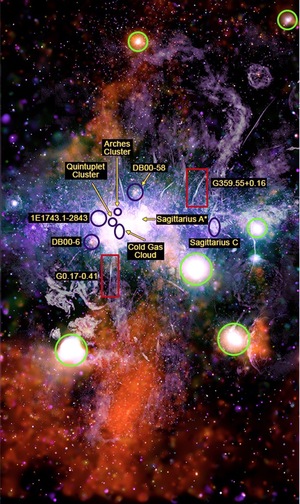
Behold: a newly detailed panorama that explores regions just above and below the galactic plane near the centre of our beloved Milky Way in radio and X-ray light. But what’s going on in there? To wit:

 X-ray light taken by the orbiting Chandra Observatory is shown in orange (hot), green (hotter), and purple (hottest) and superposed with a highly detailed image in radio waves, shown in gray, acquired by the MeerKAT array. Interactions are numerous and complex. Galactic beasts such as expanding supernova remnants, hot winds from newly formed stars, unusually strong and colliding magnetic fields, and a central supermassive black hole are all battling in a space only 1000 light years across. Thin bright stripes appear to result from twisting and newly connecting magnetic fields in colliding regions, creating an energetic type of inner galactic space weather with similarities to that created by our Sun. Continued observations and study hold promise to not only shed more light on the history and evolution of our own galaxy — but all galaxies.

(Image: X-ray: NASA/CXC/UMass/Q.D. Wang; Radio: NRF/SARAO/MeerKAT)

apod

Behold: the Rimac Nivera – an all electric hypercard from Croatian manufacturer Rimac that debuted at the 2018 Geneva motor show – finally ready for full production.

An ‘ultra-aero system’ and carbon fibre monocoque chassis maximise downforce and minimise drag with four electric motors pushing 0-100km’h in a staggering 1.85 seconds with a top speed of 415km/h. Off the track, there’s room for two, plus luggage.

Only 150 will be made. Yours will cost €2,050,000.

uncrate

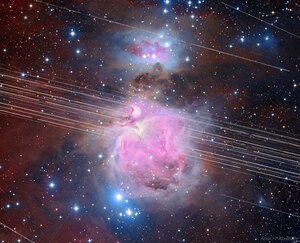
Behold: Orion. But what are those streaks of light crossing through it? To wit:

They are reflections of sunlight from numerous Earth-orbiting satellites. Appearing by eye as a series of successive points floating across a twilight sky, the increasing number of communications satellites, including SpaceX Starlink satellites, are causing concern among many astronomers. On the positive side, Starlink and similar constellations make the post-sunset sky more dynamic, satellite-based global communications faster, and help provide digital services to currently underserved rural areas. On the negative side, though, these low Earth-orbit satellites make some deep astronomical imaging programs more difficult, in particular observing programs that need images taken just after sunset and just before dawn. Planned future satellite arrays that function in higher orbits may impact investigations of the deep universe planned for large ground-based telescopes at any time during the night. The streaks across Orion are not from Starlink but rather satellites in high geosynchronous orbit. The featured picture, taken in 2019 December, is a digital combination of over 65 3-minute exposures, with some images taken to highlight the background Orion Nebula, while others to feature the passing satellites.

(Image: Amir H. Abolfath)

apod