
Author Archives: Chompsky

It is.

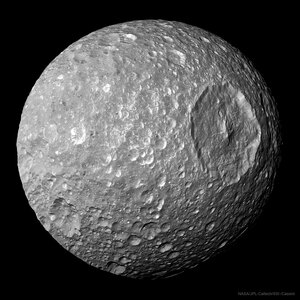
Behold: Mimas – the Death Starriest of all Saturn’s moons.  See that big dent though? That’s no super laser emitter. To wit:

Whatever hit Mimas nearly destroyed it. What remains is one of the largest impact craters on one of Saturn‘s smallest round moons. Analysis indicates that a slightly larger impact would have destroyed Mimas entirely. The huge crater, named Herschel after the 1789 discoverer of Mimas, Sir William Herschel, spans about 130 kilometers and is featured here. Mimas‘ low mass produces a surface gravity just strong enough to create a spherical body but weak enough to allow such relatively large surface features. Mimas is made of mostly water ice with a smattering of rock – so it is accurately described as a big dirty snowball. The featured image was taken during the closest-ever flyby of the robot spacecraft Cassini past Mimas in 2010 while in orbit around Saturn.

(Image: NASA, JPL-Caltech, Space Science Institute, Cassini)
apod

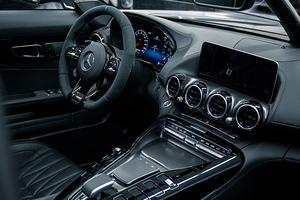
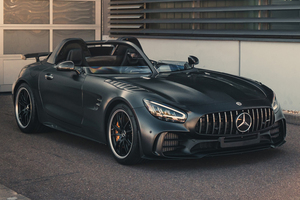
Behold: the Bussink GT R SpeedLegend – a customised Mercedes-AMG GT R Roadster inspired by the Mercedes-McLaren SLR Stirling Moss.

Designed by Roland A. Bussink, the car – with its  4.0l twin turbo tweaked to deliver 850bhp – loses its soft top and windscreen in favour of a Formula 1 Halo-style ‘speedbow’ that extends over and behind the passengers’ heads with custom rollover hoops. 

A helmet would seem in order.

hiconsumption

No she doesn’t.

She’s just Humouring you.

But this is what it might be like if she did.

NOWNESS writes:

Inspired by ancient Greek philosopher Galen, video installation artist #MarcoBrambilla explores the human condition in his latest film, The Four Temperaments. Starring Academy-Award winner #CateBlanchett, Brambilla uses colour to evoke the Four Humours. In this beguiling quadriptych, the artist tests whether it is possible to create drama using two lines of dialogue spoken by the same actor. This project is part of #UnrealCity—the biggest augmented reality exhibition to come to London. 

kottke

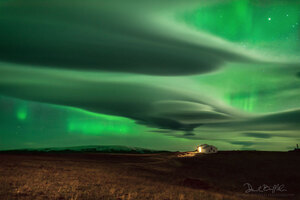
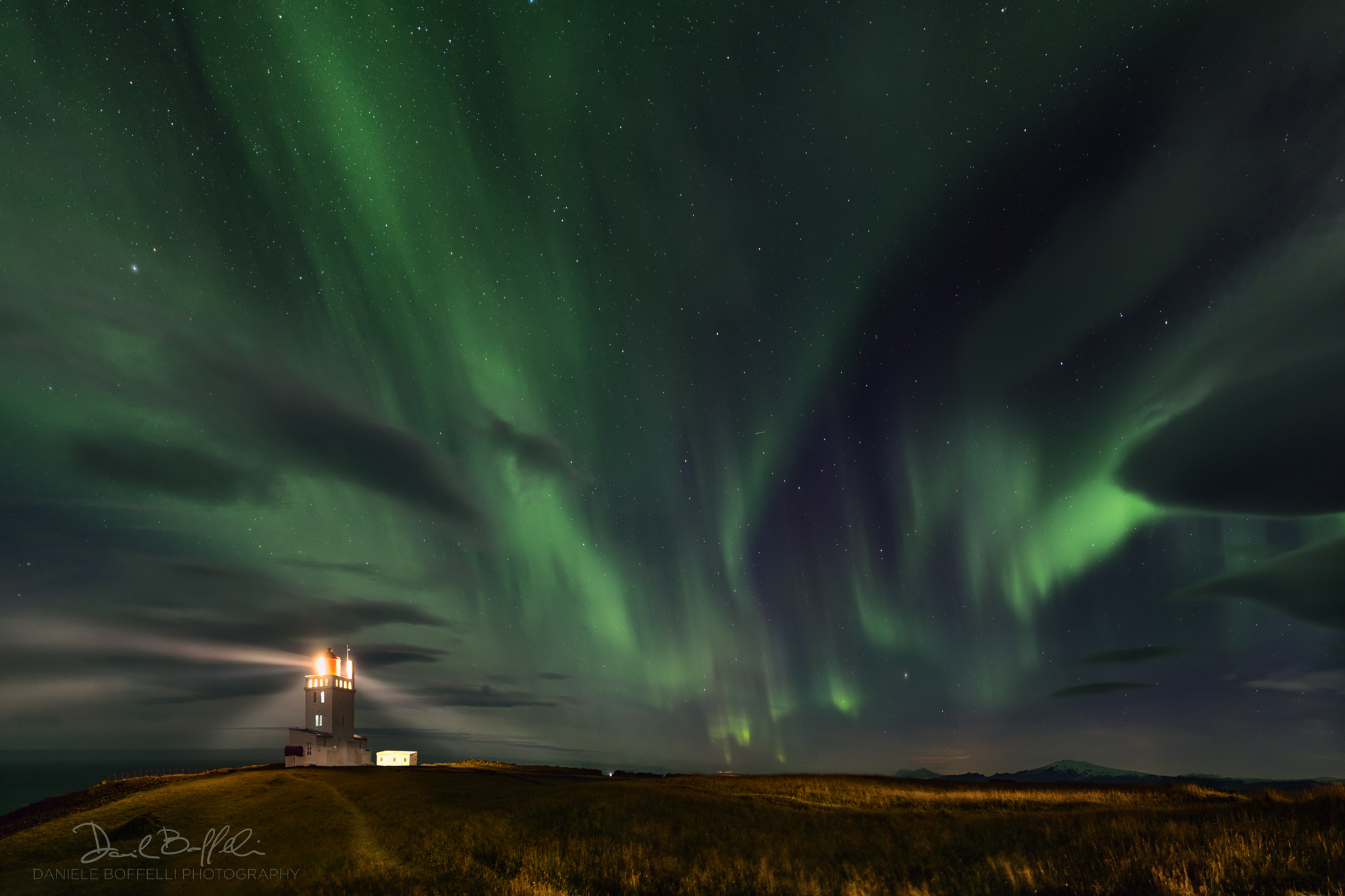
Behold: an Icelandic lighthouse being assimilated by the Borg. Not really. To wit:

Auroras usually occur high above the clouds. The auroral glow is created when fast-moving particles ejected from the Sun impact the Earth’s magnetosphere, from which charged particles spiral along the Earth’s magnetic field to strike atoms and molecules high in the Earth’s atmosphere. An oxygen atom, for example, will glow in the green light commonly emitted by an aurora after being energised by such a collision. The lowest part of an aurora will typically occur about 100 kilometres up, while most clouds exist only below about 10 kilometres. The relative heights of clouds and auroras are shown clearly in the featured picture in 2015 from Dyrholaey, Iceland. There, a determined astrophotographer withstood high winds and initially overcast skies in an attempt to capture aurora over a picturesque lighthouse, only to take, by chance, the featured picture including elongated lenticular clouds, along the way.

(Image: Daniele Boffelli)

apod

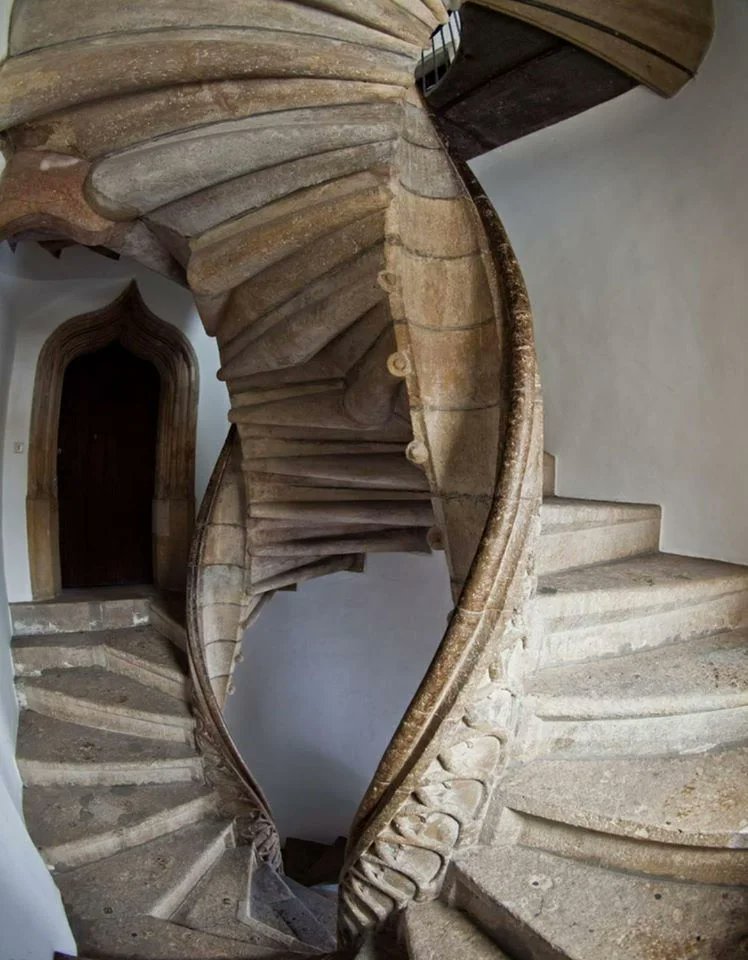
The late 15th century double spiral staircase at the Burg – regional government headquarters of Graz in southern Austria – so called because two people ascending in opposite directions will separate and rejoin several times before ultimately reuniting.

Yeah. Never gonna happen.

(Pics by Irène DB)

tih