Yesterday.
Sunrise in Swords, county Dublin.
(Thanks Colum Cronin)




The ‘afrofuturistic Lego’ of Toronto based artist Ekow Nimako – hundreds of thousands of sleek black Lego blocks in structures which explore ‘the intersection of technology and race to visualize a powerful future for the African diaspora”.
Nimako’s ongoing project ‘Building Black’ envisages West African mythology and folklore in the form of masks and a huge 1.85m² urban landscape called ‘Kumbi Saleh 3020 CE’ representing the ancient capital of the Ghana empire.


An award winning 2019 short by Merlin Flügel in which a community of occasionally masked individuals play a series of weirder and weirder games together prior to one final intense head-infiltrating contest.
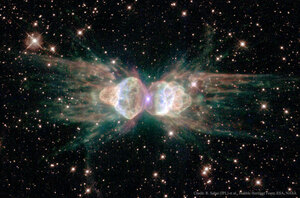
Behold Mz 3, aka the Ant Nebula. Quite unlike other planetary nebulae of its kind. To wit:
Mz3 is being cast off by a star similar to our Sun that is, surely, round. Why then would the gas that is streaming away create an ant-shaped nebula that is distinctly not round? Clues might include the high 1000-kilometer per second speed of the expelled gas, the light-year long length of the structure, and the magnetism of the star featured here at the nebula’s center. One possible answer is that Mz3 is hiding a second, dimmer star that orbits close in to the bright star. A competing hypothesis holds that the central star’s own spin and magnetic field are channeling the gas. Since the central star appears to be so similar to our own Sun, astronomers hope that increased understanding of the history of this giant space ant can provide useful insight into the likely future of our own Sun and Earth.
(Image: R. Sahai (JPL) et al., Hubble Heritage Team, ESA, NASA)


Friday last.
Colum Cronin tweets:
Beautiful morning in Stephen’s Green, and look closely and you can see the heron hanging out in the tree! Although Google tells me it’s not uncommon, it’s not something I had seen before.
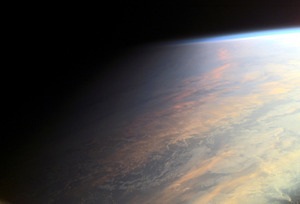
Behold: the passage of day into night as seen from the International Space Station in 2001. To wit:
…in this gorgeous view of ocean and clouds over our fair planet Earth, the shadow line or terminator is diffuse and shows the gradual transition to darkness we experience as twilight. With the Sun illuminating the scene from the right, the cloud tops reflect gently reddened sunlight filtered through the dusty troposphere, the lowest layer of the planet’s nurturing atmosphere. A clear high altitude layer, visible along the dayside’s upper edge, scatters blue sunlight and fades into the blackness of space. This picture was taken in June of 2001 from the International Space Station orbiting at an altitude of 211 nautical miles. But you can check out the vital signs of Planet Earth Now.
(Image: ISS Expedition 2 Crew, Gateway to Astronaut Photography of Earth, NASA)
Boris was watching the Playboy Channel again wasn't he @broadsheet_ie #BUNNYHUGGING https://t.co/vxzLn19l2M
— Marcus Rashford stan account #FPL (@eachwaypunter21) April 22, 2021