

Paul Condron tweetz:
Last days of summer on a scorched Bray Head.







MORE to folly.

Seán writes`;
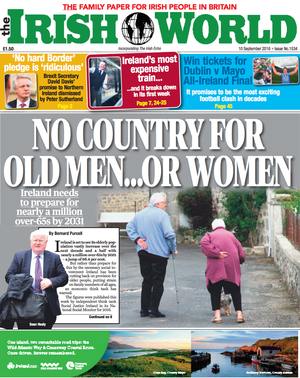
I just wanted to send this picture to you to show that there are some extremely kind and generous individuals who work for Dublin Bus. I witnessed this moment of kindness on Sunday afternoon on George’s Street [Dublin 2] when a driver for Dublin Bus was tying an elderly person’s shoelace who was unable to do so himself. Really great to see.
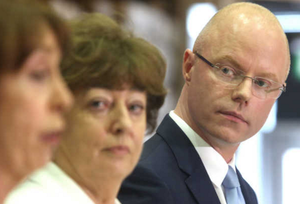
Roisin Shortall, Catherine Murphy and Stephen Donnelly at the launch of the Social Democrats in July 2015
Further to Stephen Donnelly’s announcement earlier today that he is leaving the Social Democrats.
The Wicklow/east Carlow TD spoke to Mary Wilson on RTÉ’s Drivetime this evening.
From the interview…
Mary Wilson: “Were you overwhelmed by the dedication it takes?”
Stephen Donnelly: “No, not at all, Mary. But can I start, I’ll come directly back to that, can I just say today’s decision is, is a very sad one for me personally. It’s one that I’ve thought about long and hard. Catherine [Murphy], Roisin [Shortall] and myself have been working on this for nearly two years. I consider it a great privilege to have worked with Catherine and Roisin. They’re two formidable parliamentarians. I feel, I consider it a great privilege to have worked with our candidates in the election and everyone who’s been involved in the Social Democrats. So, first and foremost, for me, I just want to say that this, this is a sad day – we’ve all invested a lot in it. To your question: look, I think it’s an unfortunate line that Catherine and Roisin are taking. Nobody can start a new political party work-shy. I’ve certainly been accused of all manner of things in my time. But nobody has ever accused me of being work-shy. Look, the reality is we all worked very, very hard on this and I have concluded, sadly, after nearly two years at it, the team, it’s not that it wasn’t working, I think we got some great things done together. It wasn’t working well enough and it just wasn’t working well enough for me. And Mary, anybody who’s listening to the show will understand. Will have been involved in a sports team or a business or whatever it may be. They come together with a good group of people, everybody tries to make it work and, after a reasonable period of time, in this case, for me, nearly two years, somebody on that team, or more people on the team say, ‘do you know what? Look, we’ve all been trying, it just isn’t working for me, this is no longer the right thing for me to be doing’. And so I’m stepping back. That’s what’s going on.”
Wilson: “Or, you could conclude, from the tone of the contributions from Roisin and Catherine, and now from yourself and your statement today, you’re not a team player.”
Donnelly: [Laughs] “Yeah, I don’t think anyone is kind of, who works with me in politics or outside of politics, would conclude that. You can suggest it, but I mean…”
Wilson: “Well I’m reading the line in your own statement, where you say, ‘despite the many obstacles new parties face, one critical component is that the leadership team must function very well together as a team, in spite of everyone’s best efforts, I have concluded our partnership didn’t have that’. You didn’t have that.”
Donnelly: “Maybe, maybe. Am I partly to blame for it? Absolutely I am. In any relationship, in this case, where I was in a relationship where I was in a three-way partnership, of course, there are things I could point to and say, you know, did I always preform at my best – of course not. None of us ever do. It’s a team effort. We all tried, we all did things right, we all made mistakes and, sadly, I have concluded, after a considerable period of time, and after a lot of conversation, and talking to Catherine and Roisin about this, for some time, it isn’t right for me, and it isn’t right for the party either, and that’s the decision I’ve taken.”
Wilson: “So will you continue on now, as an Independent? Or would you, at some stage, in the future, consider joining another party? Or founding another party?”
Donnelly: “Well, look, my head, for the last two years, has been in Social Democrats and my head, over the last few weeks, has been only in whether or not to stay and continue to make a try. I can concluded some time ago that it probably wasn’t right but I, you know, kept going, gave every chance and, by the way, as did Catherine and Roisin. We all tried.”
Wilson: “It must have been an awful blow to you, Stephen Donnelly, I mean you came close in a couple of constituencies in the election, but that you didn’t add value to the party. You’re still there with the three TDs that you entered the last election with.”
Donnelly: “Yeah, yeah, it is a blow, there’s no question about it. It’s been a tough week. I’ve been speaking during the week with people involved in the party, who I care a great deal for and, you know, any of us, with our work colleagues, we feel a sense of obligation, we feel a loyalty, we feel a debt of gratitude, so yes, it does come as a blow. However, if we move from the personal to the professional, I’m elected to do the best job I can do, to serve my constituents here in Wicklow, west Carlow and to serve the country as best I can. And I concluded that I was no longer doing that in the Social Democrats.”
Wilson: “I know but you concluded two years ago that your best way of serving your constituents was to be part of a political party, to move forward the changes that you wanted to bring forward. Now you’re concluding you’re better off as an Independent, or are you?”
Donnelly: “Well, no, all I’m doing today, Mary, is concluding, or announcing the decision I concluded a few days ago, is to say, I can’t serve my constituents and my country as best as I want to within the situation I was in. Like, Catherine, Roisin and myself, everyone who got involved in the Social Democrats, and by the way, I wish the party the very best, we tried to do something very, very difficult to do and if you try these things, you have to be prepared to fail. Now, let me be absolutely clear, I am not suggesting, in any way, that the party has failed, it hasn’t. But for me, my involvement has, had got to the point where I said, ‘no, look, this just isn’t the right place for you to be anymore’. But you have to take those risks. I mean politics needs to be shaken up, we need people in there who are willing to stick the head above the parapet and say ‘look, here’s a set of values we all believe in, let’s try and make this work, let’s try and work together and affect good, positive change in the country’. There is so much opportunity and, you know, other parliamentarians and myself, we’ve got to be able to take risks and that’s what this was.”
Wilson: “Would you take the risk again? Would you join an existing political party?”
Donnelly: “Oh look, for two years, or nearly two years, I’ve been involved in the Social Democrats, the last few weeks, I’ve just been thinking about whether or not to do that, today, I’m just announcing, ‘look, I’m stepping back, it’s a hard decision’. I will be consulting with supporters in Wicklow, I started doing it today. There will be people coming into the office this evening and I’m going to be around the county over the next few days. So, that is a conversation that will have to be had. It will be had quickly and it will be had with my supporters.”
Wilson: :You must look though, at some of the Independent colleagues you had in the past, you see them in Government now: Shane Ross, Katherine Zappone, you see the opportunity they have, perhaps, to implement some of the policies that they want to implement. You’d like a slice of that.”
Donnelly: “I think anyone who has the great honour of being elected to the Dail, or the Seanad, or in this case, I guess, the Dail, should aspire to office, but like let’s not forget the vulture fund decision, let’s take that as an example. I think, Minister Ross, Minister Zappone, and I imagine other Independents involved there, would appear to have forced that over the line. But myself and Pearse Doherty and Michael McGrath and others, from outside of Government, have been raising these issues in the last few months and there’s been fantastic work done by RTE, by Prime Time, by journalists like Mark Paul, in the Irish Times, and others, so, it’s not that if you’re in Government, you have all the power and all the influence and, if you’re not, you don’t. You can influence the direction of the country from anywhere. From you, your colleagues in the media, me, my colleagues in the opposition benches, or indeed within Government. This vulture fund decision which was taken today, is an example of that. I wrote to the charity regulator before the [Dail] break and said, ‘Look, are you aware that this is going on with charities in the country? Would you take a look?’ and they got back to me, just about two days ago, and said, ‘you know what? we are going to take a look. So you can affect positive change from anywhere but, if you’re asking me straight, would I love to be in Government one day? Of course I would. I’d be astounded to hear any TD say that they wouldn’t.”
Wilson: “Say differently. Would you be open to an approach from another political party? Would you open to an approach from Fianna Fáil? Or would you immediately say, ‘no, ideologically, I could never join that party’?”
Donnelly: “No, I’m just not there, Mary. That’s exactly the kind of conversation I’m going to have with my supporters here in Wicklow over the next few days and next few weeks.”
Wilson: “But that in itself is interesting, that that is the conversation you’re having about where you go from here. Whether it’s into another political party or whether you’re not definite back to the road of the Independent.”
Donnelly: “No, look the objective, if you’re lucky enough to be elected to serve, in my case, to represent the people of Wicklow and east Carlow, you always want to do that to the best of your ability. I’ve done it as an Independent, I’ve done it as the founder of a party, so I’ll be going into conversations here in Wicklow with a very open mind, you know, I want to serve, I want to do the best job that I can. There’s a huge opportunity out there for the country, there’s a lot of people who were left behind in the recession, there’s a lot of important work to be done. And I want to be involved in doing it.”
Wilson: “Will you stay in politics long-term Stephen Donnelly? You never struck me as a lifer?”
Donnelly: “I’m certainly an accidental politician. There’ no question about that. Before 2011, I don’t know if I’d ever met a politician to be honest, I’d certainly never been in a political party and I’d been out of the country for ten years. I got involved, Mary, I think actually your show was one of the first ones I went on, I remember my hand shaking…”
Wilson: “I remember that too.”
Donnelly: “…for the first time, I was so nervous. And I read out a statement and tried to sound confident. I got in, in response to the crisis, I just wanted to help. My mum spent a long career in public service as a teacher and in a girls’ reformatory, as with the hundreds of thousands of public servants around the country. I like working for my country. I’d no idea how I’d find politics, it’s been bizarre and rewarding and difficult and an incredible honour. I really had no idea…”
Wilson: “Will you stay in politics?”
Donnelly: “That’s a question for the people of Wicklow and east Carlow. My answer is I would very much like to continue to represent them but it is their seat and they get to decide that, not me.”
Listen back in full here
Earlier: Stephen Gonnelly
Sam Boal/Rollingnews
Tonight.
On RTÉ One, at 9.35pm.
The second instalment of five-part series Keeping Ireland Alive: The health service in a day.
Gareth Naughton writes:
In the first clip (top), we visit Beaumont Hospital, where Maria Montgomery, 36, and her younger brother David O’Sullivan, 35, from Tipperary, are preparing to go into surgery. Today, under the team of Ms Dilly Little and Mr Gordon Smyth, Maria will be donating her kidney to her brother.
In the second clip (above), at the National Burns Unit in St James’s Hospital, we find Mr Odhran Shelley, consultant plastic and reconstructive surgeon on his morning rounds. Today, Mr Shelley will operate on Joanne McMahon, who suffered heavy burns to her face and body in an accident during a barbecue two years ago.
Previously: Staying In Tonight?
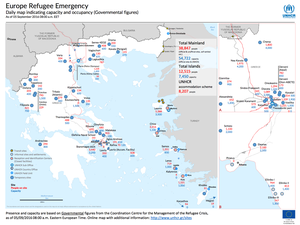
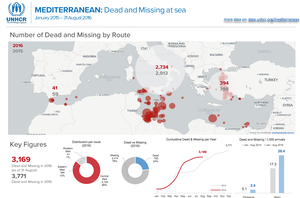
Graphics from the UNHCR showing the capacity and occupancy rates at sites for refugees across Greece (top) and the number of people known to have died or gone missing this year, as of August 31, in comparison to 2015
According to the latest figures from the UNHCR, there are now 59,569 refugees and migrants on Greek territory.
The figures also show the following numbers of people on the islands versus the capacity of the facilities available.
Lesbos: 5,388 people versus facilities with a capacity for 3,500.
Chios: 3,316 people versus facilities with a capacity for 1,100.
Samos: 1,351 people versus facilities with a capacity for 850.
Ekathimerini, a daily Greek newspaper which is sold with the International Herald Tribune, in Greece reports:
A year after the European Union launched its refugee sharing plan so member countries could help overwhelmed Greece and Italy less than five percent of the migrants have been relocated.
European Commission figures show that only 4,473 asylum seekers were relocated as of September 1.
The plan is a cornerstone of the EU’s strategy to deal with more than one million people who entered Europe last year in search of sanctuary or jobs. It commits countries to relocate 160,000 refugees from Greece, Italy or any other member state deemed unable to cope by September 2017.
EU Commission spokeswoman Natasha Bertaud said Monday that, despite the slow pace, “what we are doing is not insignificant.”
Small percentage of Europe’s migrants relocated (Ekathimerini)



Elaine Edwards tweetz:
Stand down. It’s over. I’ve won all the herb scrabble.
#HerbScrabble
In fairness.
Hic!
WHERE IT ALL BEGAN: Mmm. Boobs
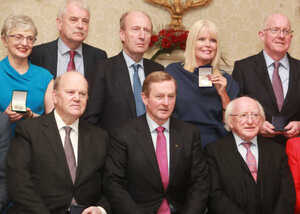
From top: Independents – back row from left: Katherine Zappone, Finian McGrath and Shane Ross – and Fine Gael TDs assemble at the Aras after the 2016 election; Derek Mooney
Spinning against your own junior partners may play well with dispirited Fine Gael members,
But collapsing the government will dishearten them even more.
Derek Mooney writes;
“To provide spurious intellectual justifications for the Secretary of State’s prejudices”
This is how the late Maurice Peston (father of ITV’s political editor Robert Peston) responded in the early 1970s when a senior UK civil servant asked him to explain how he saw his role as Roy Hattersley’s newly appointed Special Adviser (Spad).
It was more than just a casual witty remark from the Professor of Economics: it specifically referenced the fears the Department of Prices and Consumer Protection had about having an acknowledged policy expert in their midst and gainsaying their more generalist advice.
For a serious and nuanced consideration of the role of the Special Adviser in the Irish context the research work of the University of Limerick’s Dr Bernadette Connaughton is a good starting point, especially her August 2010 Irish Political Studies article.
In that article Connaughton argues that while the main role of most Irish Ministerial Spad is that of a ‘minder’ or gofer – working vertically within Departments to help their Ministers’ obtain results – Spads can, as a collective – also have the potential to contribute effectively to the political coordination of policy-making by working horizontally across Government.
As someone who spent almost six years in partnership governments, and someone who contributed to Dr Connaughton’s research, I can attest to the truth of the latter part of her argument.
From my experience the most effective Spads were those whose commitment is as much to the whole of government as it is to their individual minister.
I suspect the troubles and turmoil which has beset the current Government are due in no small measure to the absence of this.
When Fianna Fáil cut the number of ministerial advisers in 1997, before that each Minister had a separate Special Adviser and Programme Manager,
it did so by effectively merging the two roles so that each Special Adviser was also fulfilling the role of departmental programme manager, being responsible of assisting the Minister get that Department’s portion of the Programme for Government (PfG) implemented.
Each party in Government still retained a single Programme Manager – each responsible for co-ordinating the delivery of their party’s elements of the PfG. This co-ordination was done both between the two programme managers, and also through the individual Spads, making the weekly meeting of advisers particularly important.
At these meetings, which took place of the afternoon before Cabinet meetings, the individual Spads would advise the group on memos their Ministers were brining to Cabinet the following morning and gauge the reaction from others.
While Cabinet memos are circulated to other Department before cabinet for reaction, some Departments are less forthcoming in expressing their views in advance than others.
Often times the first real signal that another Department (by which I mean the Department at “official” level, rather than “political”) might have an issue with what your Minister was proposing came at these meetings.
Another key component in this process were the group of Spads working for the Taoiseach. Each of them usually co-ordinated with 3 or 4 Departmental Spads to also work as an early warning system for issues and problems.
As with all information channels, these systems worked best when they worked both ways – not that I think they worked both ways all the time during the time of the FF/Green government, but that’s an article for another day.
They also worked best when the larger party recognised that partnership in communications should not just be pro-rata and that the smaller party in Government has to be given a bit more space and room than their size or strength of numbers dictates.
The major party sometimes needs to roll with the punches when the junior partner attempts to assert its identity and influence. It doesn’t have to respond to every snide comment, particularly those from the “reliable sources close to the Minister”, indeed the senior partner’s responsibility is to take the heat out of situations, not inflame it.
This is something that the spin conscious Fine Gael appeared not to learn in the last FG/Labour government.
I know this may seem heretical for many in Fine Gael, particularly those who saw the headlines in the Irish Times or listened to Marian Finucane every weekend and convinced themselves that the Labour tail was wagging the FG dog, but when you look at the Government’s policy output, the evidence is clear – Fine Gael got its way most of the time.
Fast forward to this week and you realise that publicly accusing one of your independent Ministerial colleagues of “showboating” doesn’t achieve anything, apart from having one of that Minister’s allies responding in kind saying: “Fine Gael’s problem is they don’t like any dialogue and just want it all their own way” as Philip Ryan reported in yesterday’s Sunday Independent.
I can understand Fine Gael’s frustration in not having a single junior partner – with a single identity and a single voice – sitting at the table with it, but that is the reality and it is long past the time for it to develop the internal systems to address that.
Just continuing to do what it did when it was in government with Labour, isn’t going to work… indeed, as we have seen over the past few months it is not working.
If Fine Gael wants the independents to work cohesively as a group within a wider partnership, then it has to equip those independent ministers with the supports and internal early warning systems they need to allow the Spad system to work horizontally as it should.
The office of the Taoiseach has a vital role to play in that, especially when there is no single and identifiable programme manager to speak on behalf of the group of independents.
It needs to recognise that those non Fine Gael faces around the table are not just interlopers, they are their partners in Government and while occasionally spinning against them may play well with its own dispirited back-benchers, collapsing your own government might even dishearten them more.
Derek Mooney is a communications and public affairs consultant. He previously served as a Ministerial Adviser to the Fianna Fáil led government 2004 – 2010. His column appears here every Monday mid afternoon. Follow Derek on Twitter: @dsmooney

A new video by young animation company Ecluna Productions in Donaghmeade, Co Dublin, for Valley Where the Rivers Run by Delorentos.
Delorentos’ new album Night Becomes Light is released today.
Thanks Buzz

Spotted at the weekend (location unspecified).
Audrey Twyford writes:
Ireland in the sky.
The Broadsheet Buke of Unspecified Things That Look Like Ireland (edited by Aidan Coughlan, New Island €5) Some still in stock!