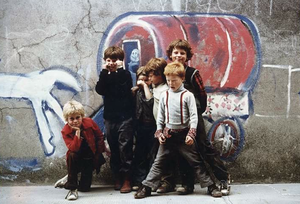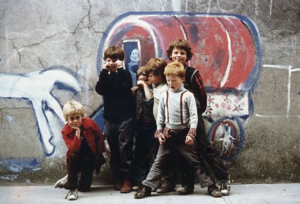
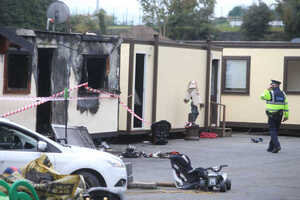

From top: Traveller boys in Dublin, 1980 by Brian Palm; The aftermath of the Carrickmines halting site fire, September 10, 2015; Frankie Gaffney
Frankie Gaffney writes:
Primitive, unruly, unkempt, nomadic, prone to thievery and feuding — they ride horses without saddles or stirrups — they’re clannish, ignorant, dirty, lawless and violent.
This is how the English described the Irish people for almost a millenium.
In this the centenary year of 1916, the Irish nation and State wallowed in self-pity over this treatment — and enthusiastically celebrated our violent rejection of it.
It is beyond irony that right to the present day we visit prejudice and racism on our own citizens from the Travelling community in precisely the same terms once used against us.
A barbarous people
“Their want of civilization, shown both in their dress and mental culture, makes them a barbarous people… Exceedingly averse to civil institutions, they lead the same life their fathers did in the woods and open pastures, neither willing to abandon their old habits or learn anything new… In riding, they neither use saddles, nor boots, nor spurs… Abandoning themselves to idleness, and immersed in sloth, their greatest delight is to be exempt from toil…”
Sounds familiar doesn’t it?
But this is not from one of the many sensational newspaper articles denigrating Travellers in the Ireland of today, this is from a 12th-century manuscript, Topographia Hiberniae, that was written by a courtier and scholar, Giraldus Cambrensis.
Like all such dehumanising narratives, it was composed with the distinct aim of dominating and dispossessing the people it described.
Indeed, Cambrensis followed the work shortly after with Expugnatio Hibernica — a celebratory account of King Henry II’s invasion of Ireland.
Echoes of these events resound.
It is more than symbolic that at the “Reclaim 1916” event (a commemoration “for the people, by the people”) a traditional Traveller wagon was shamefully prevented by Gardaí on the day from joining the parade as planned.
The current focus on 1916 might lead us into thinking rejection of English tyranny is a modern phenomenon, but this is not so. There has always been resistance to these injustices — militarily, but also diplomatically.
In 1317, the Irish Chieftains penned their “Remonstrance” to the Pope, bemoaning (among other things) the fact that Irish lives were not valued as much as English lives.
While such a state of affairs might belong in the 14th century, it sadly persists.
In June of 2015, six Irish students were killed when a balcony they were partying on collapsed in the university town of Berkeley California.
It is suspected that poor construction or maintenance were at least partly to blame.
Just a few months later that year, ten Irish Travellers perished in a fire.
Overcrowding, due to lack of space and inadequate provision of housing, has been cited as a cause of the death toll.
Five of those who died were children under the age of ten. There were glaring discrepancies in reactions to these two tragedies.
A New York Times piece about the Berkeley tragedy made reference to bad behaviour and drunkenness among Irish J-1 students.
It was slammed for insensitivity, and provoked a massive outcry from a variety of public figures. Officialdom was not silent either — the Irish Ambassador to the USA wrote to the paper and registered a complaint.
The article even prompted a vitriolic condemnation from former President Mary McAleese.
The language McAleese used in her open letter is telling:
“Today in Ireland we are hanging our heads in shock and sorrow at the needless deaths of six of our brightest and best young adults . . . the vast majority [of J-1 students] have been a credit to Ireland and only the very tiniest minority have not.”
Nobody was so enthusiastic in eulogising the victims of the Carrickmines fire.
McAleese and the other high-powered public figures who condemned coverage of the Berkeley tragedy (in the strongest possible terms) weren’t to be heard so robustly defending the Travelling community when they were grossly slandered in a variety of media following Carrickmines.
While it is likewise a small minority of Travellers who engage in bad behaviour, this defense was not offered by our establishment for them — nor, predictably but sadly, were the young children who died in the fire to be declared among “our best”.
This is not paranoid “victim-complex” thinking, or impressionistic “what-aboutery”. There is emerging empirical evidence to confirm this.
A pioneering study by Dr Fergal Quinn and Dr Elaine Vaughan is currently underway at University of Limerick, and looks set to demonstrate conclusively that there was stark media bias in this coverage.
Using linguistic techniques, they analysed articles in our national daily newspapers.
One striking aspect of the data they collected was unusually high incidences of the words “but” and “however” after the word “tragedy” in articles covering Carrickmines.
The study continues, but the fact such a high number of journalists felt the need to qualify the fact that a fire which killed ten human beings was “a tragedy” speaks volumes.
Predictably, worse was to be found in the comments sections.
The Journal.ie actually had to shut theirs down, but even that didn’t prevent people from venting their hate.
Journalist Gene Kerrigan has written powerfully about his shock, as comments such as “So sad” (posted before the thread was closed), were given a thumbs down by 268 people.
It is shocking that anyone could be so callous as to reject an expression of condolence in the wake of such a tragedy — but for hundreds to do so on all such comments is terrifying.
“Shame on you,” McAleese scolded the New York Times in outrage, but their article was mild and respectful in comparison to how the distraught Travelling coommunity were slandered and degraded in our press.
Incredibly, even worse treatment than this media denigration was to face the grieving Carrickmines families and survivors.
The Travelling community not only had to contend with vicious slurs, but in a disgusting and despicable development there were actual protests to prevent the survivors being temporarily accommodated nearby.
Let this sink in for a second: these are not hurtful words, or inappropriately timed references to misbehaviour.
This is people taking to the street and breaking the law to blockade a road, with the sole aim of preventing a devastated group of people from seeking shelter after an unconscionably horrific tragedy — the most lethal fire in this country since the Stardust disaster.
Is this 21st Century Ireland?
It feels more like Alabama in the 1950s.
Continue reading →