

Hello you.
He’s lost a few Euros pounds.
Apple Ordered to Pay Up to $14.5 Billion in EU Tax Crackdown (Bloomberg)
Earlier: The €13billion Apple Bill
Previously: A Long Way from £2 Apple
Thanks Graeme Kelly



Hello you.
He’s lost a few Euros pounds.
Apple Ordered to Pay Up to $14.5 Billion in EU Tax Crackdown (Bloomberg)
Earlier: The €13billion Apple Bill
Previously: A Long Way from £2 Apple
Thanks Graeme Kelly


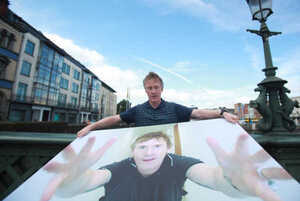
This morning.
The launch of TG4’s Autumn Schedule 2016.
Smock Alley Theatre, Dublin.
From top: TG4 weather persons, Caitlin Nic Aoidh( black dress), Mairead Ni Chuaig (pink dress) and Irish television presenter and columnist, Paidi O Lionaird; Patrick Bergin and Hector O hEochagain.
Any excuse.
Leah Farrell/Rollingnews

Annalise Murphy and sports minister Shane Ross at Aras an Uachtarain
A new season of the Late Late Show.
No wait, come back.
Gareth Naughton writes:
As the Olympic ticket scandal rumbles on in Rio, Minister for Transport, Tourism and Sport Shane Ross joins Ryan Tubridy on this Friday’s The Late Late Show…We’ll also be hearing from the man at the centre of one of the biggest upsets in Ireland’s Olympic history, Michael Conlan. We will be celebrating the achievements of our Olympic heroes with silver medallists Annalise Murphy and Gary and Paul O’Donovan, the latter fresh from his gold medal win at the world championships, in studio to chat about achieving glory in Rio….
Fight!
Late Late Show Friday on RTÉ One at 9.35pm
Rollingnews

Gulp.
Darragh Ó Tuathail writes:
Just taken in Northwood, Santry. Storm’s a comin‘!
RUUUUUUUN!


From top: Fine Gael MEP Brian Hayes, Apple logo and Richard Murphy, of the City University London
Further to the Apple tax ruling…
Richard Murphy, a tax expert based at the City University London, along with Fine Gael’s Brian Hayes spoke to Seán O’Rourke this morning.
Mr Murphy, from the outset, explained that he wasn’t in the least bit surprised by the European Commission’s ruling, as Ireland had let Apple have “unfair advantage” over its competitors and, therefore, under EU competition law, the ruling is logical.
He said the decision isn’t one about tax so much as it is about competition, adding:
“It is the right decision, yes it is because if we believe in fair markets, if we believe that that’s the way we should organise the world, then everybody has to compete on a level playing field. And, as any economist will tell you, we need transparency. Well, this was a secret deal, it was done without people knowing. The consequences were unclear for a long time and it did give Apple an unfair advantage over everyone else. It was bad for economics, it was bad for Ireland, let’s be clear here. It’s very obviously bad for Ireland now and it was bad for everybody else in the marketplace – for you and me as consumers.”
From the rest of the discussion:
Brian Hayes: “Well, this is a very serious decision, Sean. And I have no doubt that this will cause significant reputational damage to the country and that’s why I presume the Government will immediately have to appeal this decision. I think some of the logic that is behind this decision, I haven’t got the full document which is now being produced but some of the logic, in my view, is quite faulty.”
“The essential argument is that we’re being asked to collect tax that was generated from profits in other countries, ostensibly in the United States of America. Now there is absolutely no doubt that the change of tax structures brought about by [Finance Minister] Michael Noonan in terms of the ‘stateless’ branches of the companies that were there have come to an end, as a consequence of his decision. There’e been a fundamental change to the law in the last number of years and I think the argument that’s being made in the United States, and by the Irish Government is, and we are being asked to retrospectively apply a new tax code on a whole range of…”
Talk over each other
Seán O’Rourke: “But is it a new tax code, Brian Hayes? I mean if you don’t pay your taxes, or I don’t pay mine, I mean we’ll be very quick to tell us we have to pay retrospectively and with interest.”
Hayes: “You pay tax on what you generate in Ireland, Sean. You don’t pay tax for what you generate in the United States of America or elsewhere. And that’s the fundamental problem here. This is, in my initial reading of this, fundamentally altering the international standard about where you apply. You pay tax in Ireland on the value that you, on the profits that you create in Ireland. We cannot be responsible for taking the tax from other countries. And that’s why all of these issues can only be resolved at an OCED level.”
O’Rourke: “Right. Well, let’s ask Richard Murphy about that. Do you take that argument, Richard Murphy?”
Murphy: “No, I don’t buy that argument at all. There are a number of reasons why not. Firstly, this arrangement was designed to make sure that the tax was not paid in any other country, as well. So you can’t pretend that the tax should have been due in the UK and therefore Ireland shouldn’t be penalised because the arrangement made sure that no tax was paid in the UK. So you can’t use that argument. If you had been sure it was paid in the UK, you could use that argument. But you have not, you know it was not. And, secondly, the deal was designed to make sure the tax was actually paid nowhere. If it had been paid in full and properly in Ireland, I think there would have been some defence but, in practice, the structure was designed to make sure that, in effect, tax was not paid at all. And therefore, the ruling it is, well it must be due somewhere. And that must be Ireland. And, because it has not been taxed anywhere else, because that was what the ruling intended, Ireland should be responsible for collecting the tax…”
Later
Hayes: “And Seán, the only other argument the Irish government have always said and it has been mentioned by every other member state of the European Union, this is ostensibly a matter for the United States of America…In the case of Apple, this could be resolved entirely by the US Congress changing the way in which they allow repatriation and allow…”
Murphy: “No, Brian, that’s no reasonable…”
Talk over each other
Hayes: “In the Irish case, just let me have my point, in the Irish case, there was an issue around stateless companies – that was remedied and the argument that has been made since then is how can you retrospectively apply this bill over a period of time? You’d have no surprise in my view Sean, that most of the cases on this top-level are being taken against small members states of the European Union – Belgium, the Netherlands, Luxembourg and Ireland. Countries that have, traditionally, certainly in the case of Ireland, have no industrial revolution, have since the 1960s got to open its doors towards inward investment and now we’re being asked, in terms of the entire corporate tax structure in Europe, to take these cases on. I have no doubt that the Government will want to appeal this decision. Firstly, to ensure, that the integrity of our revenue system for all to see. You cannot have a retrospective effect in corporate tax law and that has been applied. And the other argument I would make which I think is important from the Irish Revenue’s perspective is they are, we tax all monies generated in Ireland, profits generated in Ireland, where all of the changes that Michael Noonan has brought about: abolishing the double Irish, making sure that stateless companies registration was changed, changing the residency rules, that happened in the last number of years and that’s right that that should happen. We’re ahead of the OECD in this regard and it’s entirely right that those are in place now in Irish law.”
O’Rourke: “Richard?”
Murphy: “I’m sorry, Brian, but I’m going to have to accuse you of using weasel words there. One of your key arguments was that this is a problem for the USA. What you were effectively saying, in your first intervention, was ‘Ireland couldn’t tax profits arising elsewhere’ and then you say, ‘the US should have profits, tax profits arising elsewhere’. You can’t have it both ways. This was not a US tax problem. It was a problem of tax not being paid in Europe and Ireland facilitating that by making sure that the tax was paid nowhere. There is no credibility in the Irish tax system. If you think there is, you are deceiving yourself. Around the world, people know…
Talk over each other
Hayes: “With respect…
Talk over each other
Murphy: “No, no, no, I’m allowed to say what I think here…”
Hayes: “And I’m allowed also to say what I think…”
Murphy: “There is no credibility because Ireland did go out of its way to help, the same, by the way, as Luxembourg did, as Belgium did and as The Netherlands have. All are tax havens. You are sitting in a tax haven, Brian, and that tax haven has made a fundamental error…
Talk over each other
Murphy: ..equality in the world and it decided to undermine fair competition in the world and it’s time Ireland stopped doing this and actually put in a place a fair competition policy that the people of Ireland could be proud of.”
Talk over each other
Hayes: “I’d like to counter that ideological rant.”
Murphy: “It’s not an ideological rant, Brian.”
Hayes: “I have my say now, I have my say now. I fully accept that there were issues in the past that had to be resolved but under the last government and under commitments made by this current government, those issues are being resolved and you need to respect that…”
Listen back in full here
Pics: Rollingnews

Mary Caulfield tweetz:
How dirty is your linen? €5,000.00 per litre dirty? Tesco now. Well, it is Dublin 4 I suppose…

Apple’s European headquarters in Cork
Further to report yesterday saying one unnamed minister suggested the Apple tax bill would amount to just €100million – as opposed to the €19billion previously estimated…
In the last few minutes.
Tony Connolly, of RTÉ, reported on the Today with Seán O’Rourke Show:
“We can establish that the amount of money that Ireland and Apple, or the amount of tax, rather, that the [EU] Commission believes Apple should have paid amounts to the sum of €13billion over a ten-year period.”
“That is a staggering figure – €13billion – that the Commission believes that Apple should have paid to Ireland and they said the fact that they didn’t, that this amounts to illegal state aid. Another line that I can tell you is that the Commission believes that between that, in that period, Apple paid an effective tax rate of 1%, then falling to an effective tax rate of 0.005% in 2013.”
“…So that’s what the Commission are saying. They’re going to give more details in that news conference [at 11am] in the next 15 minutes…”
Commission says Ireland granted undue tax benefits of up to €13bn to Apple (RTE)
Previously: Far From The Tree
Low Rates And Not Too Many Questions
UPDATE:
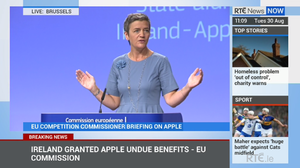
European Competition Commissioner Margrethe Vestager at a news conference this afternoon in light of the Apple tax finding
“…the profit between each Irish branch and the company’s head office or I should say so-called head office because this so-called head office only existed on paper. It has no employees, it has no premises and it has no real activities.”
“The Irish branch was subject to normal Irish corporation tax. However, the head office was subject to no tax in Ireland or elsewhere. This was possible under Irish law which, until 2013, allowed for so-called stateless companies.”
“As a result of the allocation method, in the tax rulings, only a fraction of the profits from the Apple Sales International were attributed to the Irish branch. The remainder, the vast majority of profits was attributed to the so-called head office.”
“This means that Apple Sales International, as a whole, paid very little tax on its profits.”
“Let me illustrate for one tax year: In 2011, Apple Sales International made a profit of €16billion – less than €50million were allocated to the Irish branch, the rest, the huge majority, was allocated to the so-called head office where they remained untaxed.”
“This means that Apple’s effective tax rate, in 2011, was 0.05%. TO put that in perspective, it means that for every €1million in profits, it paid just €500 in taxes. This effective tax rate dropped further to as little as 0.005% in 2014, which means that even less was paid in taxes, it was €50 per €1million in profit.”
Morto.

Liam O’Brien writes:
A short documentary I shot and produced for the ‘repeal’ movement featuring Waterford-based artist Sam Doyle.
Previously: Meanwhile, In Waterford


From top: Loughton House, Dr James Reilly
For those of us who wondered how did Dr James Reilly sleep at night when he was minister for health at a time when our health service was so woefully and devastatingly inept, the question was answered in your newspaper.
He slept exceptionally well on a deep feather mattress in a “royal, carved-oak, sleigh bed made for King George IV’s visit to Ireland” in a 13-bedroom, 1,393sq m (15,000sq ft) Georgian mansion. And how did he relieve the stresses of his day? Chopping logs on his 82-acre estate.
Eimear Morhan,
Drumcondra,
Dublin 9.
James Reilly’s big estate (Irish Times letters page)
Pics: MyHome.ie/Rollingnews
